浙江舟山卷(拔高)--备战2026年中考英语新课标(核心素养)一轮复习之仿真模拟卷
2026-03-07
|
6份
|
48页
|
305人阅读
|
7人下载
内容正文:
听力考试正式开始。Tom, is this red back yours? No, Linda, mine is yellow. Look, there is a name Sally on IT. IT must be hers. Listen to the next question, David. why didn't you turn up for the match yesterday? I'm sorry, but I wasn't leave my fault. T you know. it's all very well saying IT wasn't your fault, but IT is because of you that we lost. Listen to the next question. Are you going to move from new york to chicago? Jack. yes, my dad finds a new job there. I feel sad about this, and I will miss you very much. Listen to the next question. honey, could you help me claim the bathroom? Oh, mom, i'm just about to walk the dog, but I promise I will do IT as soon as I come back. Listen to the next question. Oh no. What happened then? I cut myself . by accident when I was making dinner. Listen to the next question. Hi Young lady, how can I help you? Well, yeah, i'm looking for the father's day gift. Okay. how about a new wallet? We have different colors. How much is that black wallet? Oh, it's only forty dollars. Ah, that's too expensive for me. Do you have a cheaper one? How about this Brown one is twenty five dollars. That's really pretty, but I don't have enough money. Well, how about this blue tie is on sale? It's only five dollars. That's great. I'll take IT. Hi Young lady, how can I help you? Well, yeah, i'm looking for a father's day gift. Okay, how about a new wallet? We have different colors. Um how much is that black wallet? Oh, it's only forty dollars. huh? That's too expensive for me. Do you have a cheap a one? How about this Brown one is twenty five dollars. That's really pretty, but I don't have . enough money. Well, how about this blue tie is on sale? It's only five dollars. That's great. I'll take IT. Listen to the next question. The doctor just told me, I have to be careful about things I eat. Like what? Well, for example, he told me to eat fish, no more hamburgers or fried chicken yet. I hardly is this. I don't like IT at all. I don't either. You want me to evil. A lot of vegetables too, especially Green ones, but that's okay. I like them. Oh, vegetables. I often have cards, metals. They are my favorite. He also told me not to drink any coffee that's difficult. I love my coffee in the morning. I know what you mean, so do I, but I dream too much. Four or five cups a day. Cake with cake or pie after a good meal . is k or pie. The doctor said to them too. I almost always happening in my house. You know, I don't think I thought you a daughter very much. The doctor just told me I have to be careful about . things I eat. Like what? Well, for example, he told me to eat fish. No more hamburgers or fried chicken. yet I hardly eat fish. I don't like IT at all. I don't either. He wants me to eat a lot of vegetables too, especially Green ones, but that's okay. I like them. Oh, vegetables. I often have Carol and tomatoes. They are my favorite. He also told me not to drink any coffee that's difficult. I love my coffee in the morning. I know what you mean, so do you like, but I mean too much four or five cups a day coffee with cake or pie of a . good news, cake or pie. The doctor said them too. I almost always happening in my house. You know, I don't think i'd like you a doctor very much. Listen to the next question. Good morning, everyone. I like blast saturday. I learned that life is full of the unexpected, especially when we meet nature face to face. My dad and I wanted to fish, so we wrote our bikes to the small river outside town. The sky was blue and the water was calm. We felt lucky, but after only twenty minutes, dark clouds came from the west and the wind turned cold. Dad said, we should go yet before we could move. Heavy rain started. The quiet river became fast, Brown and noisy. We quickly put our things into the bag and ran to a farmer small house nearby. The kind farmer open the door, gave us hot tea and even shared this fresh bread. When the rain stopped, the river was clean again. Birds returned to singh, and a bright hung over the water. We didn't catch any fish, but I learned that nature can change quickly. We must respect IT, stay alert and keep safe. Good morning, everyone. I, mike, last . saturday, I . learned IT that life is full of the unexpected, especially when we meet nature face to face. My dad and I wanted to fish, so we wrote our bikes to the small river outside town. The sky was blue and the . water was calm. We felt lucky, but after only twenty minutes, dark clouds came from the west and the wind turned cold. Dad said, we should go yet. Before we could move. Heavy rain started, the quiet river became fast, Brown and noisy. We quickly put our things into the bag and ran to a farmer small house nearby. The kind farmer opened the door, gave us hot tea and even shared his fresh bread. When the rain stopped, the river was clean again. Birds return to singing and a bright rainbow hang over the water. We didn't catch any fish, but I learned that that nature can change quickly. We must respect IT, stay alert and keep safe. 听力部分到此结束。
浙江舟山卷
备战2026年中考英语新课标(核心素养)一轮复习之仿真
模拟卷
姓
名:
条码粘贴处
意事项
答题前,考生先将自己的姓名、准考证号码填写清楚
请将准考证条码粘贴在右侧的[条码粘贴处]的方框内。
选择题必须使用2B铅笔填涂:非选择题必须用0.5mm黑色字迹的签字笔填写,字体工整。
请按题号顺序在各题的答题区内作答,超出范围的答案无效,在草纸、试卷上作答无效。
保持卡面清洁,不要折叠、不要弄破、弄皱,不准使用涂改液、刮纸刀。
6.
填涂样例正确▣错误【-[)
选择题(请用2B铅笔填涂)
1.1AlIBIIC
6.[A]IBIICI
11AI[BIIC
16.LA1[B1[C1[D
2.1AlIBIIC
7.JAlIBIIC
12.IAIIBIIC
17.1AIIBIICI[DI
3.[AJIB]IC
8.A1IB11C1
13.[A][B]IC
18.[AIIBIICI[DI
4.AIBIIC
9.AIIBIIC
14.[AJ[B]ICI
19.IAIIBIICIID
5.AlIBIICI
10.[AIIBIICI
15.[AIIBIICI
20.[AlIBIICIIDI
Dnn
21.JAIIBIICIID
26.AIBIICIIDI
31.JAlIBIICIID
36.[Al[BIICIIDI
22.JAlIBIICID
27.JAlBICIID
32.[AI[BIICIID
37.1AI[BICID
23.[AIIBIICIIDI
28.[AIBIICIID
33.[AI[BIICIID
38.[AlIBIICI[D
24.1AlIBIICIID
29.ABCID
34.1AJIBIICIID
39.A1IB1「C1ID1
25.1A]IBIICIID]
30.[AI[BI[CIID]
35.[AI[BI[CIID]
40.1A[BIICIID
41.[[D
46.[AJIBIICIIDIIE
42.1AJIBIIC]ID
47.[AIIBIICIIDI[E
43.1A]IBIIC]ID
48.AIIB]ICIIDIIE
44.1A]IBIICIID
49.ABIICIIDIE
45.1AIIBIICIID]
英语第1页(共2页)
请在各题目的答题区域内作答,超出黑色矩形边框限定区域的答案无效!
卷Ⅱ」
请在各题目的答题区域内作答,
超出黑色矩形边框限定区域的答案无效!
四、任务型阅读(共5小题,每小题2分,满分10分)
阅读以下文章,根据短文内容选择合适的问题填入对应位置(第46-49题)并回答第50小题。
50.
五、词汇运用(共15小题;每小题1分,满分15分)
A.根据下列句子及所给首字母或汉语注释,写出空缺处各单词的正确形式,每空只写一词。
51.
52.
53.
54.
55.
56.
57.
58.
59
60
B.选词填空
用方框中所给单词的适当形式填空,使短文通顺、正确。每词仅用一次(每空一词)。
61
62.
63.
64.
65.
六、语法填空(共10小题;每小题1分,满分10分)
阅读短文,在文中空白处填入1个适当的单词,或用括号内所给单词的正确形式填空。
66
67.
68.
69
70.
71.
72.
73.
74.
75.
七、书面表达(共1小题,满分20分)
Things I want to do for
英语第2页(共2页)
请在各题日的答题区域内作答,超出黑色矩形边框限定区域的答案无效!
■
■
(迎乙并)迎【患单
■
浙江舟山卷
备战2026年中考英语新课标(核心素养)一轮复习之仿真模拟卷
(考试时间:100分钟 试卷满分:120分)
注意事项:
1.本试卷分第Ⅰ卷(选择题)和第Ⅱ卷(非选择题)两部分。答卷前,考生务必将自己的姓名、准考证号填写在答题卡上。
2.回答第Ⅰ卷时,选出每小题答案后,用2B铅笔把答题卡上对应题目的答案标号涂黑。如需改动,用橡皮擦干净后,再选涂其他答案标号。写在本试卷上无效。
3.回答第Ⅱ卷时,将答案写在答题卡上。写在本试卷上无效。
4.考试结束后,将本试卷和答题卡一并交回。
第一部分 听力部分
(本题有15小题,第一、二节每小题1分,第三节每小题2分;满分20分)
第一节 听小对话,从A、B、C三个选项中选出最佳选项,回答问题。
1.Whose red bag is this?
A.Tom’s. B.Sally’s. C.Linda’s.
【答案】B
【难度】0.4
【知识点】介绍
【原文】W: Tom, is this red bag yours?
M: No, Linda. Mine is yellow. Look, there is a name Sally on it. It must be hers.
2.How does the woman feel about the man?
A.Unhappy. B.Worried. C.Sorry.
【答案】A
【难度】0.4
【知识点】介绍
【原文】W: David, why didn’t you turn up for the match yesterday?
M: I’m sorry, but it wasn’t really my fault, you know.
W: It’s all very well saying it wasn’t your fault, but it is because of you that we lost.
3.Where is Jack’s father going to work?
A.In New York. B.In Chicago. C.In Houston.
【答案】B
【难度】0.4
【知识点】位置
【原文】W: Are you going to move from New York to Chicago, Jack?
M: Yes, my dad finds a new job there. I feel sad about this and I will miss you very much.
4.What’s the boy going to do probably?
A.Clean the bathroom. B.Cook the dinner. C.Walk the dog.
【答案】C
【难度】0.4
【知识点】意愿和打算
【原文】W: Honey, could you help me clean the bathroom?
M: Oh, Mom, I’m just about to walk the dog. But I promise I would do it as soon as I come back.
5.What was the matter with Ben?
A.He had a fever. B.He had a cold. C.He cut himself.
【答案】C
【难度】0.4
【知识点】介绍
【原文】W: Oh no, what happened, Ben?
M: I cut myself by accident when I was making dinner.
第二节 听长对话,从A、B、C三个选项中选出最佳选项,回答问题。
听下面一段长对话,回答以下两个小题。
6.Why does the girl want to buy her father a gift?
A.For Father’s Day. B.For his birthday. C.For the New Year.
7.What does the girl buy for his father at last?
A.A black wallet. B.A brown wallet. C.A blue tie.
【答案】6.A 7.C
【难度】0.4
【知识点】原因、购物、商品
【原文】A: Hi, young lady, how can I help you?
B: Well, yeah. I’m looking for the Father’s Day gift.
A: Ok, how about a new wallet? We have different colors.
B: Hmm, how much is that black wallet?
A: Oh, it’s only 40 dollars.
B: Huh? That’s too expensive for me. Do you have a cheaper one?
A: Hmm. How about this brown one? It’s 25 dollars.
B: That’s really pretty. But I don’t have enough money.
A: Well, how about this blue tie? It’s on sale. It’s only five dollars.
B: That’s great. I’ll take it.
听下面一段较长的对话,回答下列三个小题。
8.What does the woman dislike?
A.Fish. B.Vegetables. C.Fried chicken.
9.What does the man find it hard to do?
A.Make cakes and pies. B.Stop drinking coffee. C.Eat a lot of tomatoes.
10.What are the speakers talking about?
A.Doctor’s advice to the man.
B.What to eat for a good meal.
C.The man’s favorite dishes.
【答案】8.A 9.B 10.A
【难度】0.4
【知识点】意见/建议、判断与评价、介绍、食物
【原文】M: The doctor just told me I have to be careful about things I eat.
W: Like what?
M: Well, for example, he told me to eat fish, no more hamburgers or fried chicken.
W: Yuck, I hardly eat fish. I don’t like it at all.
M: I don’t, either. He wants me to eat a lot of vegetables too, especially green ones. But that’s okay. I like them.
W: Oh vegetables. I often have carrots and tomatoes. They are my favorite.
M: He also told me not to drink any coffee. That’s difficult. I love my coffee in the morning.
W: I know what you mean. So do I. But I drink too much, four or five cups a day. Coffee with cake or pie after a good meal is ...
M: Cake or pie ... The doctor said to them, too.
W: I almost always have them in my house. You know I don’t think I’d like your doctor very much.
第三节 听下面一段独白,回答第11至第15四个小题。短文听两遍。
11.Where did Mike and his dad plan to fish?
A.At a river. B.At the sea. C.At a lake.
12.What was the weather like when Mike and his dad got to the river?
A.Cloudy. B.Rainy. C.Sunny.
13.What happened first after Mike and his father arrived?
A.The wind turned cold. B.They saw a rainbow. C.They caught a big fish.
14.How did the farmer help Mike and his dad?
A.He lent them raincoats.
B.He gave them hot tea and bread.
C.He showed them a new fishing spot.
15.What does Mike want to tell us through his story?
A.Respect nature and stay safe.
B.Rain brings good luck.
C.Always fish with a farmer.
【答案】11.A 12.C 13.A 14.B 15.A
【难度】0.4
【知识点】周末活动、家庭生活
【原文】
Good morning, everyone. I’m Mike. Last saturday, I learned that life is full of the unexpected. Especially when we meet nature face to face. My dad and I wanted to fish, so we rode our bikes to the small river outside town. The sky was blue and the water was calm. We felt lucky. But after only 20 minutes, dark clouds came from the west and the wind turned cold. Dad said we should go. Yet before we could move, heavy rain started. The quiet river became fast, brown and noisy. We quickly put our things into the bag and ran to a farmer’s small house near by. The kind farmer opened the door, gave us hot tea and even shared his fresh bread. When the rain stopped, the river was clean again. Birds returned to sing and a bright rainbow hung over the water. We didn’t catch any fish, but I learned that nature can change quickly. We must respect it, stay alert and keep safe.
第二部分 阅读理解(共两节,满分40分)
第一节 阅读理解(共15小题,每小题2分,满分30分)
阅读下面短文,从每题所给的A、B、C、D四个选项中选出最佳选项。
A
Do you believe in green living? Read the following blog (博客) and replies about a fun, easy and creative way to make your lifestyle greener.
Posted by Gina at 8:32 a.m. on 11th February, 2021New uses for old clothing
What do you think of the “new” hat I made for my sister? It used to be my mom’s sweater.
Nowadays, we’re more wasteful than ever—buying, using and throwing things away without thinking about the costs. We need to start living more responsibly (负责任地) but how? One answer is to upcycle (再生利用).
I started upcycling clothing. Making new things out of old clothes is the best way to mix my talent and my interest.
Do you upcycle? If so, what new things have you made? If not, why not give it a try?
Reply Terry B
Posted at 9:08 a. m. on 11th February, 2021
Why don’t you give your old clothes to people in need? I even gave away the most expensive things I don’t wear anymore. So I can help the environment while giving something useful to people in need.
Reply Gina
Posted at 9:28 a. m. on 11th February, 2021
Good point! I’m talking about only the oldest clothing in your room—the clothes that are too old to be owned by others. The same idea goes for food waste at restaurants and supermarkets before upcycling food that can still be eaten, for example, using it to make soil. We should give it to those in need.
Reply Betty 99
Posted at 10:28 a. m. on 11th February, 2021
I’ve made the shopping bags out of T-shirts and the dog toys out of socks. Upcycling clothing is a fun hobby, but the most important thing is that it makes me feel like I’m leaving less wastefully.
16.What is special about the hat?
A.It came from an old sweater. B.It was given by a clever mom.
C.It was new and expensive. D.It was a gift from a clever sister.
17.Why did Gina give a reply to Terry B?
A.To catch Terry B’s attention. B.To further explain her idea.
C.To introduce a new way. D.To express her deep sorry.
18.What did Betty 99 upcycle to make dog toys?
A.Paper boxes. B.Shopping bags. C.T-shirts. D.Socks.
【答案】16.A 17.B 18.D
【难度】0.4
【知识点】应用文、环境保护
【分析】文章主要介绍了Gina对绿色生活的看法——再生利用旧衣物,以及Terry B和 Betty 99对Gina这篇博客的回复。
16.细节理解题。根据“ It used to be my mom’s sweater.”可知这个帽子的特殊之处在于它是用Gina母亲的旧毛衣做的,故选A。
17.推理判断题。根据文章第二部分Gina有关再利用旧物以及不要的食物的回复内容“Good point! I’m talking about only the oldest clothing in your room—the clothes that are too old to be owned by others. The same idea goes for food waste at restaurants and supermarkets before upcycling food that can still be eaten, for example, using it to make soil. We should give it to those in need. ”可知,这是为了进一步说明解释“再生利用”的观点,故选B。
18.细节理解题。根据“I’ve made the shopping bags out of T-shirts and dog toys out of socks.”可知Betty 99用T恤衫做成了购物袋,用袜子做成了小狗玩具,故选D。
B
No one wants to work at a messy desk and look lazy or sloppy (草率的). But does a messy desktop actually make you either of those things? Not all disorders mean you’re out of control. Even Steve Jobs thought his personal charm (个人魅力) came from his messy desktop.
People who prefer a messy desk have their own ideas. Some think it makes them comfortable. A too-tidy room can sometimes make them uncomfortable. Some believe it helps them concentrate more easily. Messy tables can make it easier to focus on the tasks, just like some novelists can write patiently in a noisy cafe. Others may be perfectionists (完美主义者). For those who strive for perfection, tasks are either 100% or 0% performed. Therefore, they usually put away the less important things and perform the most important ones perfectly.
Many people are labeled as (被标记为) “sloppy” and “inefficient” because of messy tabletops. However, when we see the desks of Albert Einstein, Mark Twain and Mark Zuckerberg, things might change. Obviously, the world welcomes uniformity (整齐划一) and order. It also never refuses regular disorder, which seems like a mess but runs in an organized way.
In an experiment done by psychologist Kathleen Vohs, participants (参与者) were asked to come up with new uses for ping-pong balls. Both participants in the messy and clean offices created the same number of ideas. However, those in the messy room came up with more interesting and creative ideas. People who don’t keep a neat and tidy desktop can actually develop organizational skills and manage work and thoughts successfully.
In spite of great disorder, a messy desktop presents information clearly, which can sometimes inspire us unconsciously (无意识地). Research has found people working with a messy desktop are more likely to be creative and willing to take risks, while people with a tidy one tend to follow the rules and are less likely to try new things.
But a messy desk might not be ideal all the time. When you need new ideas, a messy desk might be a good choice; but when you want to be efficient (高效的) and perform a task successfully, it seems better to make a desk clean and tidy.
No matter what kind of desk you prefer, we hope you feel comfortable and enjoy it!
19.The underlined phrase “strive for” in Paragraph 2 probably means “________”.
A.fight for B.is interested in C.is afraid of D.keep away from
20.The writer talks about the experiment in the 4th paragraph to ________.
A.encourage people to have messy desks as they like
B.explain the reasons why people like the messy desks
C.introduce a new way of being creative and interesting
D.show the influence of messy desks on people’s minds
21.The writer probably agrees that people with messy desks might ________.
A.be intelligent and successful B.have good behaviors and habits
C.become creative men and risk takers D.finish the task quickly and perfectly
22.Which of the following would be the best title for the passage?
A.Messy Desk: Do We Need to Change It?
B.Messy Desk: Do We Find Excuses for It?
C.Messy Desk: Does It Make Us Comfortable?
D.Messy Desk: Does it Help Us Work Efficiently?
【答案】19.A 20.D 21.C 22.A
【难度】0.4
【知识点】议论文、哲理感悟
【导语】本文围绕凌乱的桌面展开讨论,探讨了人们对凌乱桌面的看法、凌乱桌面可能带来的影响,以及不同情境下凌乱桌面和整洁桌面的选择。
19.词句猜测题。根据“tasks are either 100 % or 0 % performed”可知,这些人追求完美,会努力去达成目标。fight for“为……而奋斗、力求”;is interested in“对……感兴趣”;is afraid of“害怕……”;keep away from“远离……”。只有选项A符合语境。故选A。
20.细节理解题。第四段实验内容为“在凌乱和整洁办公室的参与者想出乒乓球新用法的数量相同,但凌乱房间的参与者想法更有趣、更有创造力”,选项D“展示凌乱桌子对人们思维的影响”,实验中“凌乱环境让人产生更有创造力的想法”,正好体现了对思维的影响,符合实验的作用。故选D。
21.推理判断题。根据“Research has found people working with a messy desktop are more likely to be creative and willing to take risks…”可知,作者认为有凌乱桌面的人更可能具有创造力和冒险精神,选项C“成为有创造力和愿意冒险的人”符合。故选C。
22.最佳标题题。文章先讨论了人们对凌乱桌面的不同看法,接着通过实验说明凌乱桌面对人们思维的影响,最后指出不同情境下对凌乱桌面和整洁桌面的选择,整体是在探讨凌乱桌面是否有必要改变。选项A“凌乱的桌子:我们需要改变它吗?”符合主旨。故选A。
C
①Are you a sci-fi (科幻) story fan? Can you play a game with me? Imagine wearing a magic cap that allows you to write words down just by thinking of them. This is not a sci-fi story, but a real study done by students at Tianjin University.
②They used brain-computer interface (BCI 脑机接口) technology (技术) to write the character “fu”. “It is written by a robotic arm controlled by our researchers’ minds,” said Xu Minpeng, a professor at the university.
③In the laboratory, two researchers wear caps with sensors (传感器) while their eyes focus on a computer screen to “mind write” the character. After a computer reads signals from their brainwaves (脑电波), a robot writes the character on red paper. It takes 3 minutes for the researchers to write “fu”.
④In fact, BCI technology has already been used in several different areas. In 2016, Chinese astronauts Jing Haipeng and Chen Dong used it in the Tiangong-2 space laboratory. They tested a BCI system in space for the first time. It is hoped that in the future, astronauts can use these systems to do difficult tasks, since it’s not easy for them to move around in space.
⑤ ▲ For example, people who lost their hands or arms can use BCIs to write messages and surf the Internet. BCIs could also be used in smart homes in the future. Simply thinking “turn on the light” could turn on the lights in your home.
23.The writer starts the passage by ________.
A.giving examples B.listing numbers
C.expressing ideas D.asking questions
24.With BCI technology, the researchers can write “fu” by ________.
A.a robot B.a professor C.sensors D.a computer
25.Which of the following sentences can be put in the ▲ ?
A.BCI technology has had some disadvantages.
B.BCI technology is hard for people to use.
C.BCI technology can also help disabled people.
D.BCI technology has been widely used now.
26.The structure of the passage may be ________.
(①=Paragraph 1 ②=Paragraph 2 ③=Paragraph 3 ④=Paragraph 4 ⑤=Paragraph 5)
A.
B.
C.
D.
【答案】23.D 24.A 25.C 26.B
【难度】0.4
【知识点】说明文、科学技术、发明与创造
【导语】本文以互动提问和 “魔法帽子” 的想象开篇,介绍了天津大学研究者利用脑机接口技术控制机械臂写 “福” 字的研究,并阐述该技术已在航天领域应用及未来可帮助残疾人、应用于智能家居的潜力。
23.推理判断题。根据“Are you a sci-fi (科幻) story fan? Can you play a game with me?”可知,作者第一段提出了两个问题;因此,作者采用了提问的方式开头。故选D。
24.细节理解题。根据“It is written by a robotic arm controlled by our researchers’minds.” 可知,“福” 字由受研究者大脑控制的机械臂写出。故选A。
25.推理判断题。根据空后内容“For example, people who have lost their hands or arms can use BCIs to write messages and surf the Internet.” 可知, 此处内容应与残疾人有关, 选项C“BCI技术同样可以帮助残疾人。”符合语境。故选C。
26.篇章结构题。通读全文可知,第①段(引入话题):通过 “科幻帽子” 的想象和提问,引出天津大学关于 BCI 技术的真实研究,吸引读者兴趣。第②-③段(具体案例):详细描述天津大学的研究细节 —— 研究者戴传感器帽子、电脑读脑电波、机器人写 “福” 字,解释 BCI 技术的具体应用过程。第④-⑤段(拓展应用):从具体案例延伸到更广泛的场景。因此,文章的整体结构与选项B呈现一致。故选B。
D
①Since the birth of AI robots, many people have been hoping these smart machines would help us with boring chores. Robots on show at the 2024 World Robot Conference showed that tech companies want to make this happen.
②“People are looking for smarter and more humanized robots,” said Meng Yuan, the boss of DEEP Robotics, who joined in the conference. “We don’t want to spend much time giving orders or controlling them. They can do this by themselves.” Meng said.
③Take the company’s robot dog X30, for example. The robot dog can understand its environment and move around without hitting things. The X30 uses built-in cameras and laser radars (激光雷达) to collect information. It then processes (处理) this information, breaking it down into smaller tasks. After deciding on the skills involved in the mission, the robot chooses skills from its skill set to perform these tasks. Developers at DEEP Robotics explained that the robot’s autonomous behaviors (自主行为) and improvement come about through real-life learning and training, not just from remembering “the rules”.
④The X30 has recently become a household name at Zhejiang University, where it is busy helping students carry their heavy bags across the university. Robot dogs like this one are becoming real helpers in our daily lives.
⑤Atribot S1, another humanoid robot, showed its humanization during the conference through its amazing “hands”. Many were shocked to see it skillfully perform Chinese calligraphy (书法) and dulcimer (扬琴). Atribot S1 also learned how to clean the bottom of a teapot with a cloth.
⑥“The fast growth of generative (生成的) AI, such as ChatGPT, will give humanoid robots a real ‘soul’, improving their decision-making abilities,” Ren C. Luo, a professor from Taiwan, said.
⑦However, as Luo pointed out, “the percentage of real application (应用) of generative AI on robots is now less than 5 percent. There is still a lot of room for improvement.”
27.What is the advantage of the smarter robots according to Meng Yuan?
A.Smaller size. B.Less human control.
C.Lower cost. D.More real applications.
28.In what order does the robot dog X30 work?
a. The robot chooses skills from its skill set. b. The robot processes the information.
c. The robot collects information. d. The robot performs the task.
A.abcd. B.cbad C.acdb D.cdba
29.What can be inferred about the X30 robot from the passage?
A.It will completely replace human jobs in a short time.
B.It learns through real-life learning and training as well as the rules.
C.It can perform all difficult tasks without human control.
D.It will come up with a better way to carry the bags after doing this more times.
30.Which of the following shows the structure of this passage?
A. B.
C. D.
【答案】27.B 28.B 29.D 30.D
【难度】0.4
【知识点】说明文、科学技术、发明与创造
【导语】本文是一篇说明文。本文主要讲述了人工智能的发展,以及在机器人方面的运用。
27.细节理解题。根据“We don’t want to spend much time giving orders or controlling them. They can do this by themselves.”可知,更智能的机器人优势在于“人类不需投入大量控制”而让它们自主完成任务。故选B。
28.细节理解题。根据“The X30 uses built-in cameras and laser radars (激光雷达) to collect information. It then processes (处理) this information, breaking it down into smaller tasks. After deciding on the skills involved in the mission, the robot chooses skills from its skill set to perform these tasks.”可知,X30的工作顺序是:先用内置摄像头和激光雷达“收集信息”(c),然后“处理信息”(b),再“选择所需技能”(a),最后“执行任务”(d),故选B。
29.推理判断题。根据第③段“Developers at DEEP Robotics explained that the robot’s autonomous behaviors (自主行为) and improvement come about through real-life learning and training, not just from remembering ‘the rules’”可知,X30的自主行为及其改进是通过现实生活中的学习和训练实现的,而不仅仅是靠记住“规则”。由此可以推断出X30能通过实践不断改进。故选D。
30.篇章结构题。通读全文可知,①②段引出话题,提出人性化机器人的需求;③至⑤段介绍具体机器人实例(目前的现实应用);⑥⑦段关于对未来的展望与尚待解决的问题。与选项D所示结构最吻合。故选D。
第二节 任务型阅读(共5题,每小题2分,满分10分)
阅读下面材料,从所给的A-E五个选项中选择正确的选项(其中一项是多余选项),将序号填入31-34题,并回答35题。
Ready for Tomorrow?
Host: Good evening, everyone! Today we are honoured to have Dr Pete Roberts, author of the best-selling book Ready for Tomorrow, with us. Welcome to the show, Dr Roberts!
Dr Roberts: Good evening. Thank you. It’s a pleasure to be here.
Host: As a futurist, can you tell us how life will be different in 50 years?
Dr Roberts: 31 Service robots will do nearly all our housework and help save lives when disasters (灾难) happen.
Host: 32
Dr Roberts: Some present jobs will disappear, but there will be more challenging roles, like space pilots and AI experts.
Host: Will robots replace humans one day?
Dr Roberts: No. Our creativity and emotional intelligence (情绪智力) are key for relationships, which AI can never take over. 33 For example, smart fridges will order food by themselves when the food runs low.
Host: Wow, that’s amazing! Last question: How can we prepare for the future?
Dr Roberts: Simple----accept change, keep learning and work hard. 34
Host: Thank you for your inspiring sharing, Dr Roberts. That’s all for today’s programme. Thanks for watching!
A.Also, AI will change our lives a lot.
B.Today’s choices shape your future.
C.What jobs will humans still do then?
D.Well, robots will work everywhere.
E.People will have many robots at home.
35.Do you like robots? Why or why not?(不超过15词)
【答案】31.D 32.C 33.A 34.B
35.开放性回答。Yes, because they can help us do many things.(答案不唯一,合理即可)
【难度】0.4
【知识点】应用文、畅想未来
【导语】本文是一段访谈节目,未来学家罗伯茨博士展望了50年后的生活,包括机器人、人工智能、未来职业以及如何为未来做准备。
31.根据“Service robots will do nearly all our housework…”可知,这里先总述机器人会到处工作。故选D。
32.根据“Some present jobs will disappear, but there will be more challenging roles, like space pilots and AI experts”可知,主持人在问未来人类还能做什么工作。故选C。
33.根据“smart fridges will order food…”可知,这里在说AI也会改变生活。故选A。
34.根据“How can we prepare for the future?”以及“accept change, keep learning and work hard”可知,最后总结今天的选择塑造未来。故选B。
35.开放性回答。参考答案为:Yes, because they can help us do many things.(答案不唯一,合理即可)
第三部分 语言运用(共三节,满分40分)
第一节 完形填空(共15小题,每小题1分,满分15分)
阅读下列短文,从每题所给的四个选项(A、B、C和D)中选出最佳选项。
It was a summer. After a 33-kilometre cycling, my cousin Gabriel and I were 36 . We planned to get lunch and then 37 back to Valence, where I was spending my holiday with Gabriel’s family.
We bought a baguette. As we ate, I noticed a girl in a queue smiling to us.
I met her again when she sat on a bench, enjoying her bread in front of a riverboat named Voyageur. Soon she boarded the boat. Then I noticed a colourful handbag on the 38 . The girl had left it!
She was on the upper deck (甲板)! I held up the bag and 39 it to get her attention. When she noticed the bag, she opened her mouth 40 . But her face fell—the boat started to pull away from the dock (码头).
“We can 41 it! The boat’s next stop is Valence!” Gabriel came up.
“Great! But do you think we can 42 ?” I asked.
Gabriel laughed. “We’re going to find out!”
We set off. It was a race now: 43 against the boat. If the boat beat us to Valence, we might 44 have the chance to give back the bag.
Pedaling hard, we quickly caught up to the Voyageur. When the boat disappeared 45 us, we felt confident enough to relax our pace.
Then it happened: pffft! Flat tire (轮胎漏气)! My heart sank.
We had to stop and took out tools when the Voyageur was coming near. I saw the girl again. She noticed our 46 and shook her head sadly.
After a quick 47 , we were back on our way. The boat pulled ahead. We watched 48 as the boat disappeared around a bend.
Finally we arrived, 49 the Voyageur had docked. We failed!
Gabriel suddenly shouted, “I see her!”
The girl was strolling towards us! “You followed my boat!” she smiled.
“No, your boat followed us,” I 50 . “Until I got a flat tire, that is.” I handed her the bag.
36.A.hungry B.lazy C.relaxed D.bored
37.A.walk B.drive C.ride D.fly
38.A.bench B.boat C.bike D.bread
39.A.threw B.opened C.dropped D.waved
40.A.in fear B.in surprise C.in silence D.in sadness
41.A.return B.borrow C.sell D.use
42.A.break down B.catch up C.go out D.get away
43.A.her B.it C.them D.us
44.A.usually B.sometimes C.never D.always
45.A.behind B.before C.beside D.opposite
46.A.effort B.trouble C.risk D.success
47.A.sleeping B.riding C.fixing D.swimming
48.A.happily B.angrily C.helplessly D.excitedly
49.A.and B.so C.or D.but
50.A.refused B.joked C.complained D.nodded
【答案】
36.A 37.C 38.A 39.D 40.B 41.A 42.B 43.D 44.C 45.A 46.B 47.C 48.C 49.D 50.B
【难度】0.4
【知识点】志愿服务、个人经历
【导语】本文主要讲述了作者和表弟骑行33公里后,偶遇一位女孩遗落手提包,两人为归还手提包与轮船展开竞速的暖心故事。
36.句意:骑了33公里后,我和表弟Gabriel很饿。
hungry饥饿的;lazy懒惰的;relaxed放松的;bored无聊的。根据“We planned to get lunch”可知,我们很饿。故选A。
37.句意:我们打算吃午饭,然后骑车返回瓦朗斯,我正在那里和Gabriel的家人一起度假。
walk步行;drive驾驶;ride骑行;fly飞行。根据“33-kilometre cycling”可知,此处指骑车返回。故选C。
38.句意:然后我注意到长椅上有一个色彩鲜艳的手提包。
bench长椅;boat船;bike自行车;bread面包。根据“she sat on a bench”可知,女孩坐在长椅上,离开后包落在长椅上了。故选A。
39.句意:我举起包并挥舞着以引起她的注意。
threw扔;opened打开;dropped掉落;waved挥舞。根据“She was on the upper deck (甲板)! I held up the bag and...it to get her attention”可知,为让甲板上的女孩发现包,应是挥舞包。故选D。
40.句意:当她注意到包时,惊讶地张开了嘴。
in fear恐惧地;in surprise惊讶地;in silence沉默地;in sadness悲伤地。根据“When she noticed the bag, she opened her mouth”可知,发现自己落下的包时,应是感到惊讶。故选B。
41.句意:我们可以归还它!
return归还;borrow借;sell卖;use使用。根据“give back the bag”可知,此处表示可以归还包。故选A。
42.句意:“太好了!但你认为我们能追上吗?” 我问道。
break down故障;catch up追上;go out出去;get away逃离。根据“caught up to the Voyageur”可知,此处询问能否追上船。故选B。
43.句意:现在这是一场比赛:我们与船的竞速。
her她;it它;them他们;us我们。“a race”指代“与船赛跑”的行为,用代词us代指代我和表弟。故选D。
44.句意:如果船比我们先到瓦朗斯,我们可能再也没有机会归还包了。
usually通常;sometimes有时;never从未;always总是。根据“If the boat beat us to Valence”可知,如果船比我们先到,我们应是再也没有机会归还包。故选C。
45.句意:当船从我们身后消失时,我们自信地放慢了速度。
behind在……后面;before在……前;beside在旁边;opposite在对面。根据“we felt confident enough to relax our pace.”可知,船应是从我们身后消失,说明此时我们领先于船。故选A。
46.句意:她注意到我们的麻烦,悲伤地摇了摇头。
effort努力;trouble麻烦;risk风险;success成功。根据“Then it happened: pffft! Flat tire (轮胎漏气)!”和“and shook her head sadly”可知,轮胎漏气是麻烦,女孩看到我们的困境后悲伤地摇头。故选B。
47.句意:快速修理后,我们重新上路了。
sleeping睡觉;riding骑行;fixing修理;swimming游泳。根据“Then it happened: pffft! Flat tire (轮胎漏气)!”和“we were back on our way”可知,轮胎漏气后,需要修理,才能重新上路。故选C。
48.句意:我们无助地看着船消失在弯道处。
happily开心地;angrily愤怒地;helplessly无助地;excitedly兴奋地。根据“The boat pulled ahead...as the boat disappeared around a bend”可知,船开走时我们未能追上,应是感到无助。故选C。
49.句意:最后我们到了,但Voyageur号已经靠岸了。
and并且;so所以;or或者;but但是。空格前后句为转折关系,故应用but连接。故选D。
50.句意:“不,是你的船跟着我们,” 我开玩笑说。
refused拒绝;joked开玩笑;complained抱怨;nodded点头。根据“Until I got a flat tire, that is.”可知,此处在开玩笑。故选B。
第二节 词汇运用(共15小题,每小题1分,满分15分)
A. 用方框中所给单词的适当形式填空,每词仅用一次
pride leaf discover everyday seldom no matter
On a tall tree lived many green 51 . One of them always took 52 in being special. It told the others, “I will never fall, 53 what happens. I am stronger than you.”
Seasons changed. Rain and sun came in their 54 way. The proud leaf laughed, but it had 55 noticed how its color was turning yellow.
One morning, a child walked in the forest and 56 the leaf lying on the ground. The tree whispered, “Every leaf has its time to shine and its time to rest.”
【答案】51.leaves 52.pride 53.no matter 54.everyday 55.seldom 56.discovered
【难度】0.4
【知识点】记叙文、寓言童话
【导语】本文讲述了一片骄傲的树叶从自信到凋落的过程,寓意万物皆有兴衰规律。
51.句意:一棵高大的树上长着许多绿色的叶子。根据“On a tall tree”及备选词可知,树上应是有很多叶子,leaf“叶子”,many后跟名词复数形式leaves。故填leaves。
52.句意:其中一片叶子总是以与众不同为傲。根据“being special”及备选词可知,是指以与众不同为傲,take pride in“以……为傲”。故填pride。
53.句意:无论发生什么,我都不会掉落。根据“what happens”及备选词可知,此处是指无论发生什么,no matter“无论”符合语境。故填no matter。
54.句意:雨水和阳光以它们日常的方式降临。根据“in their ... way”及备选词可知,是指以它们日常的方式,everyday“日常的”符合语境。故填everyday。
55.句意:那片骄傲的叶子笑了,但它很少注意到自己的颜色正逐渐变黄。根据“but it had ... noticed how its color was turning yellow.”及备选词可知,是指那片骄傲的叶子很少注意到自己的颜色在变黄,用副词seldom“很少”,修饰动词。故填seldom。
56.句意:一个早晨,一个孩子走进森林,发现了树叶正躺在地上。根据“the leaf lying on the ground”及备选词可知,是指孩子走进森林发现了树叶躺在地上,discover“发现”,结合“walked”可知,时态是一般过去时。故填discovered。
B. 阅读下面短文,根据括号内所给的汉语注释写出单词的正确形式,每空一词。
Diana and Peter decided to spend the afternoon at the park. The weather was perfect. They started by sitting on the grass and having a conversation about their favorite subjects at school. Diana loved English, while Peter was interested in 57 (化学).
After a while, Diana decided to 58 (复习) her notes for an English test. She memorized a few important grammar rules and practiced pronouncing some difficult words 59 (大声地). Peter asked her, “Can you say the final word again?” Diana smiled and 60 (重复) the word until Peter could say it correctly.
They walked around the park and noticed the beautiful trees and flowers. Diana pointed to some special 61 (叶子). “Look at these! They are so beautiful and they are 62 (确切地) the things I want to see,” she said. They both 63 (欣赏) the beauty of the plants.
When it was time to leave, they felt happy. They had learned something new that would be 64 (有帮助的) in their daily life. Diana realized that even a simple day like this could make her have a better understanding of the world, and she took 65 (自豪) in the ability to see things in new ways.
【答案】57.chemistry 58.review 59.aloud/loudly 60.repeated 61.leaves 62.exactly 63.admired 64.helpful 65.pride
【难度】0.4
【知识点】记叙文、学习策略、其他人
【导语】本文介绍了戴安娜和彼得在公园度过愉快下午,讨论学科、复习英语、欣赏自然,感悟生活,收获新知识。
57.句意:戴安娜喜欢英语,而彼得对化学感兴趣。根据括号内提示“化学”及上下文学科名称可知,此处应填chemistry“化学”。故填chemistry。
58.句意:过了一会儿,戴安娜决定为一场英语考试复习她的笔记。“复习”对应单词review;句中存在固定结构decide to do sth.(决定做某事),不定式符号to后接动词原形。故填review。
59.句意:她记住了几条重要的语法规则,并且大声练习了一些难词的发音。括号内提示词为“大声地”,该词用于修饰句中的动词 practiced(练习),需填副词。aloud和loudly均表示“大声地”,且均可修饰动词,二者均符合要求。故填aloud/loudly。
60.句意:戴安娜笑了笑,把这个单词重复了一遍又一遍,直到彼得能正确念出来为止。“重复”对应单词repeat;句中and连接两个并列的谓语动词,其前的smiled(微笑)为过去式,因此repeat需用过去式repeated。故填repeated。
61.句意:戴安娜指着一些特别的叶子。“叶子”对应单数名词leaf;其前有限定词 some(一些)修饰,可数名词需用复数形式,leaf的复数为leaves。故填leaves。
62.句意:“看这些!它们太漂亮了,正是我想看的东西。” 她说。exactly为副词,意为“确切地、正好”,符合语境及语法要求。故填exactly。
63.句意:他们俩都欣赏着这些植物的美。“欣赏”对应单词admire;全文以一般过去时为主,描述过去发生的事件,因此admire需用过去式admired。故填admired。
64.句意:他们学到了一些能对日常生活有帮助的新东西。helpful“有帮助的”,形容词作表语。故填helpful。
65.句意:她为自己能够用新视角看待事物的能力感到自豪。根据括号内“自豪”及take pride in固定搭配可知,应填pride。故填pride。
第三节 语法填空(共10小题,每小题1分,满分10分)
阅读下面短文,在空格处填入一个适当的词或填入括号中单词的正确形式。
A new sport is becoming popular around the world. This sport does not need a ball or a net-instead, 66 (play) wear gloves, use tongs(钳子), and carry trash bags. The sport is called spogomi. It turns cleaning up into a fast and exciting game.
Spogomi 67 (work) in Japan since 2008. Its name comes from “sports” and “gomi.” Gomi means “trash” in Japanese. 68 goal of it is to clean public spaces in a fun way. Now people play it in 69 (park), schools and neighbourhoods around the world.
Following the success of the first Spogomi World Cup in 2023, the second Spogomi World Cup Finals 70 (hold) in Tokyo, Japan last October. It’s reported more than 30 countries took part 71 the competition
72 do they play? Teams try to collect as much trash as they can. They have one hour to pick up trash 73 they get 20 more minutes to sort the trash. Different types of trash can get different points. To win, teams must work fast and think 74 (careful)!
A team of three girls from Chengdu, China finished in 7th place in the finals. “This activity is not just fun. It also helps teach people 75 (protect) the environment and change our future for the better,” said Wu Xinyi from the Chinese team.
【答案】
66.players 67.has worked 68.The 69.parks 70.was held 71.in 72.How 73.and 74.carefully 75.to protect
【难度】0.4
【知识点】说明文、国际赛事
【导语】本文介绍了一项名为Spogomi的新型运动,它将垃圾清理变成了一项有趣的竞技比赛,自2008年在日本兴起后已在全球推广,并举办了世界杯赛事,旨在以趣味方式清洁公共空间、提升人们的环保意识。
66.句意:这项运动不需要球或网——相反,运动员戴手套、用钳子并携带垃圾袋。此处需要表示“运动员”的复数名词作主语,play的名词形式是player,根据后文的“wear gloves, use tongs...”可知是多人参与,故填players。
67.句意:自2008年以来,Spogomi就在日本开展。since 2008是现在完成时的标志,结构为“have/has + 过去分词”,主语Spogomi是单数,故填has worked。
68.句意:它的目标是以有趣的方式清洁公共场所。此处特指“这项运动的目标”,用定冠词The,句首首字母大写。故填The。
69.句意:现在世界各地的人们在公园、学校和社区里进行这项运动。根据后文的schools和neighbourhoods可知,此处用复数名词parks表示泛指的多个公园。故填parks。
70.句意:继2023年首届Spogomi世界杯成功举办后,第二届Spogomi世界杯决赛于去年10月在日本东京举行。last October是一般过去时的标志,且“决赛”是被举办,用被动语态,主语是单数,故填was held。
71.句意:据报道,超过30个国家参加了比赛。 解析:take part in是固定搭配,意为“参加”。故填in。
72.句意:他们怎么玩呢?后文介绍了比赛的玩法,此处用疑问词How表示“如何、怎样”,句首首字母大写。故填How。
73.句意:他们有一个小时捡垃圾,然后还有20分钟分类垃圾。前后两个动作是顺承关系,用and连接。故填and。
74.句意:要赢,团队必须行动迅速,仔细思考! 解析:此处需要副词修饰动词think,careful的副词形式是carefully。故填carefully。
75.句意:它也有助于教导人们保护环境,让我们的未来变得更好。teach sb. to do sth.是固定搭配,意为“教导某人做某事”,故填to protect。
第四部分 书面表达(共1小题,满分20分)
76.每个人心里都藏着一些想做的事,比如为家人分担家务,为同学解决困难,为社会……,为……。你校英文报社以“Things I want to do for ”为题开展征文活动,请你补全题目并按提示写一篇短文投稿。
注意:
1.请按思维导图合理发挥;
2.词数80词左右,请你补全题目;
3.不得透露学校、真实姓名及任何个人信息,否则不予评分。
Things I want to do for
_________________________________________________________________________________________________________________________________________________________________________________________________________________________________________________________________________________________________________________________________________________________________________________________________________________________________________________________________________________________________________________________________________________________________________
【答案】
Things I want to do for My Family
My family means the world to me, so I want to do more for them in daily life. First, I’ll share more housework like washing dishes and tidying my room to let my parents rest more after work. Second, I’ll listen to their stories carefully and talk with them often, because communication makes our family warmer. Besides, I’ll study harder to make them proud of me. Small things can show my love, and I’ll keep doing these to make my family full of happiness.
【难度】0.4
【知识点】计划、应用文、家庭关系
【详解】[总体分析]
①题材:本文是一篇材料作文;
②时态:时态为“一般现在时”和“一般将来时”;
③提示:写作要点已给出,不得遗漏,可适当增加细节,以使行文连贯。
[写作步骤]
第一步:开门见山,表明家人的重要性;
第二步:详细描述为家人做的事以及原因和将会怎样做;
第三步:书写结尾,升华主题。
[亮点词汇]
①daily life日常生活
②carefully认真地
③communication沟通
④full of happiness充满喜悦
[高分句型]
①First, I’ll share more housework like washing dishes and tidying my room to let my parents rest more after work. (动词不定式作目的状语)
②Second, I’ll listen to their stories carefully and talk with them often, because communication makes our family warmer. (原因状语从句)
学科网(北京)股份有限公司
$
浙江舟山卷
备战2026年中考英语新课标(核心素养)一轮复习之仿真模拟卷
(考试时间:100分钟 试卷满分:120分)
注意事项:
1.本试卷分第Ⅰ卷(选择题)和第Ⅱ卷(非选择题)两部分。答卷前,考生务必将自己的姓名、准考证号填写在答题卡上。
2.回答第Ⅰ卷时,选出每小题答案后,用2B铅笔把答题卡上对应题目的答案标号涂黑。如需改动,用橡皮擦干净后,再选涂其他答案标号。写在本试卷上无效。
3.回答第Ⅱ卷时,将答案写在答题卡上。写在本试卷上无效。
4.考试结束后,将本试卷和答题卡一并交回。
第一部分 听力部分
(本题有15小题,第一、二节每小题1分,第三节每小题2分;满分20分)
第一节 听小对话,从A、B、C三个选项中选出最佳选项,回答问题。
1.Whose red bag is this?
A.Tom’s. B.Sally’s. C.Linda’s.
2.How does the woman feel about the man?
A.Unhappy. B.Worried. C.Sorry.
3.Where is Jack’s father going to work?
A.In New York. B.In Chicago. C.In Houston.
4.What’s the boy going to do probably?
A.Clean the bathroom. B.Cook the dinner. C.Walk the dog.
5.What was the matter with Ben?
A.He had a fever. B.He had a cold. C.He cut himself.
第二节 听长对话,从A、B、C三个选项中选出最佳选项,回答问题。
听下面一段长对话,回答以下两个小题。
6.Why does the girl want to buy her father a gift?
A.For Father’s Day. B.For his birthday. C.For the New Year.
7.What does the girl buy for his father at last?
A.A black wallet. B.A brown wallet. C.A blue tie.
听下面一段较长的对话,回答下列三个小题。
8.What does the woman dislike?
A.Fish. B.Vegetables. C.Fried chicken.
9.What does the man find it hard to do?
A.Make cakes and pies. B.Stop drinking coffee. C.Eat a lot of tomatoes.
10.What are the speakers talking about?
A.Doctor’s advice to the man.
B.What to eat for a good meal.
C.The man’s favorite dishes.
第三节 听下面一段独白,回答第11至第15四个小题。短文听两遍。
11.Where did Mike and his dad plan to fish?
A.At a river. B.At the sea. C.At a lake.
12.What was the weather like when Mike and his dad got to the river?
A.Cloudy. B.Rainy. C.Sunny.
13.What happened first after Mike and his father arrived?
A.The wind turned cold. B.They saw a rainbow. C.They caught a big fish.
14.How did the farmer help Mike and his dad?
A.He lent them raincoats.
B.He gave them hot tea and bread.
C.He showed them a new fishing spot.
15.What does Mike want to tell us through his story?
A.Respect nature and stay safe.
B.Rain brings good luck.
C.Always fish with a farmer.
第二部分 阅读理解(共两节,满分40分)
第一节 阅读理解(共15小题,每小题2分,满分30分)
阅读下面短文,从每题所给的A、B、C、D四个选项中选出最佳选项。
A
Do you believe in green living? Read the following blog (博客) and replies about a fun, easy and creative way to make your lifestyle greener.
Posted by Gina at 8:32 a.m. on 11th February, 2021New uses for old clothing
What do you think of the “new” hat I made for my sister? It used to be my mom’s sweater.
Nowadays, we’re more wasteful than ever—buying, using and throwing things away without thinking about the costs. We need to start living more responsibly (负责任地) but how? One answer is to upcycle (再生利用).
I started upcycling clothing. Making new things out of old clothes is the best way to mix my talent and my interest.
Do you upcycle? If so, what new things have you made? If not, why not give it a try?
Reply Terry B
Posted at 9:08 a. m. on 11th February, 2021
Why don’t you give your old clothes to people in need? I even gave away the most expensive things I don’t wear anymore. So I can help the environment while giving something useful to people in need.
Reply Gina
Posted at 9:28 a. m. on 11th February, 2021
Good point! I’m talking about only the oldest clothing in your room—the clothes that are too old to be owned by others. The same idea goes for food waste at restaurants and supermarkets before upcycling food that can still be eaten, for example, using it to make soil. We should give it to those in need.
Reply Betty 99
Posted at 10:28 a. m. on 11th February, 2021
I’ve made the shopping bags out of T-shirts and the dog toys out of socks. Upcycling clothing is a fun hobby, but the most important thing is that it makes me feel like I’m leaving less wastefully.
16.What is special about the hat?
A.It came from an old sweater. B.It was given by a clever mom.
C.It was new and expensive. D.It was a gift from a clever sister.
17.Why did Gina give a reply to Terry B?
A.To catch Terry B’s attention. B.To further explain her idea.
C.To introduce a new way. D.To express her deep sorry.
18.What did Betty 99 upcycle to make dog toys?
A.Paper boxes. B.Shopping bags. C.T-shirts. D.Socks.
B
No one wants to work at a messy desk and look lazy or sloppy (草率的). But does a messy desktop actually make you either of those things? Not all disorders mean you’re out of control. Even Steve Jobs thought his personal charm (个人魅力) came from his messy desktop.
People who prefer a messy desk have their own ideas. Some think it makes them comfortable. A too-tidy room can sometimes make them uncomfortable. Some believe it helps them concentrate more easily. Messy tables can make it easier to focus on the tasks, just like some novelists can write patiently in a noisy cafe. Others may be perfectionists (完美主义者). For those who strive for perfection, tasks are either 100% or 0% performed. Therefore, they usually put away the less important things and perform the most important ones perfectly.
Many people are labeled as (被标记为) “sloppy” and “inefficient” because of messy tabletops. However, when we see the desks of Albert Einstein, Mark Twain and Mark Zuckerberg, things might change. Obviously, the world welcomes uniformity (整齐划一) and order. It also never refuses regular disorder, which seems like a mess but runs in an organized way.
In an experiment done by psychologist Kathleen Vohs, participants (参与者) were asked to come up with new uses for ping-pong balls. Both participants in the messy and clean offices created the same number of ideas. However, those in the messy room came up with more interesting and creative ideas. People who don’t keep a neat and tidy desktop can actually develop organizational skills and manage work and thoughts successfully.
In spite of great disorder, a messy desktop presents information clearly, which can sometimes inspire us unconsciously (无意识地). Research has found people working with a messy desktop are more likely to be creative and willing to take risks, while people with a tidy one tend to follow the rules and are less likely to try new things.
But a messy desk might not be ideal all the time. When you need new ideas, a messy desk might be a good choice; but when you want to be efficient (高效的) and perform a task successfully, it seems better to make a desk clean and tidy.
No matter what kind of desk you prefer, we hope you feel comfortable and enjoy it!
19.The underlined phrase “strive for” in Paragraph 2 probably means “________”.
A.fight for B.is interested in C.is afraid of D.keep away from
20.The writer talks about the experiment in the 4th paragraph to ________.
A.encourage people to have messy desks as they like
B.explain the reasons why people like the messy desks
C.introduce a new way of being creative and interesting
D.show the influence of messy desks on people’s minds
21.The writer probably agrees that people with messy desks might ________.
A.be intelligent and successful B.have good behaviors and habits
C.become creative men and risk takers D.finish the task quickly and perfectly
22.Which of the following would be the best title for the passage?
A.Messy Desk: Do We Need to Change It?
B.Messy Desk: Do We Find Excuses for It?
C.Messy Desk: Does It Make Us Comfortable?
D.Messy Desk: Does it Help Us Work Efficiently?
C
①Are you a sci-fi (科幻) story fan? Can you play a game with me? Imagine wearing a magic cap that allows you to write words down just by thinking of them. This is not a sci-fi story, but a real study done by students at Tianjin University.
②They used brain-computer interface (BCI 脑机接口) technology (技术) to write the character “fu”. “It is written by a robotic arm controlled by our researchers’ minds,” said Xu Minpeng, a professor at the university.
③In the laboratory, two researchers wear caps with sensors (传感器) while their eyes focus on a computer screen to “mind write” the character. After a computer reads signals from their brainwaves (脑电波), a robot writes the character on red paper. It takes 3 minutes for the researchers to write “fu”.
④In fact, BCI technology has already been used in several different areas. In 2016, Chinese astronauts Jing Haipeng and Chen Dong used it in the Tiangong-2 space laboratory. They tested a BCI system in space for the first time. It is hoped that in the future, astronauts can use these systems to do difficult tasks, since it’s not easy for them to move around in space.
⑤ ▲ For example, people who lost their hands or arms can use BCIs to write messages and surf the Internet. BCIs could also be used in smart homes in the future. Simply thinking “turn on the light” could turn on the lights in your home.
23.The writer starts the passage by ________.
A.giving examples B.listing numbers
C.expressing ideas D.asking questions
24.With BCI technology, the researchers can write “fu” by ________.
A.a robot B.a professor C.sensors D.a computer
25.Which of the following sentences can be put in the ▲ ?
A.BCI technology has had some disadvantages.
B.BCI technology is hard for people to use.
C.BCI technology can also help disabled people.
D.BCI technology has been widely used now.
26.The structure of the passage may be ________.
(①=Paragraph 1 ②=Paragraph 2 ③=Paragraph 3 ④=Paragraph 4 ⑤=Paragraph 5)
A.
B.
C.
D.
D
①Since the birth of AI robots, many people have been hoping these smart machines would help us with boring chores. Robots on show at the 2024 World Robot Conference showed that tech companies want to make this happen.
②“People are looking for smarter and more humanized robots,” said Meng Yuan, the boss of DEEP Robotics, who joined in the conference. “We don’t want to spend much time giving orders or controlling them. They can do this by themselves.” Meng said.
③Take the company’s robot dog X30, for example. The robot dog can understand its environment and move around without hitting things. The X30 uses built-in cameras and laser radars (激光雷达) to collect information. It then processes (处理) this information, breaking it down into smaller tasks. After deciding on the skills involved in the mission, the robot chooses skills from its skill set to perform these tasks. Developers at DEEP Robotics explained that the robot’s autonomous behaviors (自主行为) and improvement come about through real-life learning and training, not just from remembering “the rules”.
④The X30 has recently become a household name at Zhejiang University, where it is busy helping students carry their heavy bags across the university. Robot dogs like this one are becoming real helpers in our daily lives.
⑤Atribot S1, another humanoid robot, showed its humanization during the conference through its amazing “hands”. Many were shocked to see it skillfully perform Chinese calligraphy (书法) and dulcimer (扬琴). Atribot S1 also learned how to clean the bottom of a teapot with a cloth.
⑥“The fast growth of generative (生成的) AI, such as ChatGPT, will give humanoid robots a real ‘soul’, improving their decision-making abilities,” Ren C. Luo, a professor from Taiwan, said.
⑦However, as Luo pointed out, “the percentage of real application (应用) of generative AI on robots is now less than 5 percent. There is still a lot of room for improvement.”
27.What is the advantage of the smarter robots according to Meng Yuan?
A.Smaller size. B.Less human control.
C.Lower cost. D.More real applications.
28.In what order does the robot dog X30 work?
a. The robot chooses skills from its skill set. b. The robot processes the information.
c. The robot collects information. d. The robot performs the task.
A.abcd. B.cbad C.acdb D.cdba
29.What can be inferred about the X30 robot from the passage?
A.It will completely replace human jobs in a short time.
B.It learns through real-life learning and training as well as the rules.
C.It can perform all difficult tasks without human control.
D.It will come up with a better way to carry the bags after doing this more times.
30.Which of the following shows the structure of this passage?
A. B.
C. D.
第二节 任务型阅读(共5题,每小题2分,满分10分)
阅读下面材料,从所给的A-E五个选项中选择正确的选项(其中一项是多余选项),将序号填入31-34题,并回答35题。
Ready for Tomorrow?
Host: Good evening, everyone! Today we are honoured to have Dr Pete Roberts, author of the best-selling book Ready for Tomorrow, with us. Welcome to the show, Dr Roberts!
Dr Roberts: Good evening. Thank you. It’s a pleasure to be here.
Host: As a futurist, can you tell us how life will be different in 50 years?
Dr Roberts: 31 Service robots will do nearly all our housework and help save lives when disasters (灾难) happen.
Host: 32
Dr Roberts: Some present jobs will disappear, but there will be more challenging roles, like space pilots and AI experts.
Host: Will robots replace humans one day?
Dr Roberts: No. Our creativity and emotional intelligence (情绪智力) are key for relationships, which AI can never take over. 33 For example, smart fridges will order food by themselves when the food runs low.
Host: Wow, that’s amazing! Last question: How can we prepare for the future?
Dr Roberts: Simple----accept change, keep learning and work hard. 34
Host: Thank you for your inspiring sharing, Dr Roberts. That’s all for today’s programme. Thanks for watching!
A.Also, AI will change our lives a lot.
B.Today’s choices shape your future.
C.What jobs will humans still do then?
D.Well, robots will work everywhere.
E.People will have many robots at home.
35.Do you like robots? Why or why not?(不超过15词)
第三部分 语言运用(共三节,满分40分)
第一节 完形填空(共15小题,每小题1分,满分15分)
阅读下列短文,从每题所给的四个选项(A、B、C和D)中选出最佳选项。
It was a summer. After a 33-kilometre cycling, my cousin Gabriel and I were 36 . We planned to get lunch and then 37 back to Valence, where I was spending my holiday with Gabriel’s family.
We bought a baguette. As we ate, I noticed a girl in a queue smiling to us.
I met her again when she sat on a bench, enjoying her bread in front of a riverboat named Voyageur. Soon she boarded the boat. Then I noticed a colourful handbag on the 38 . The girl had left it!
She was on the upper deck (甲板)! I held up the bag and 39 it to get her attention. When she noticed the bag, she opened her mouth 40 . But her face fell—the boat started to pull away from the dock (码头).
“We can 41 it! The boat’s next stop is Valence!” Gabriel came up.
“Great! But do you think we can 42 ?” I asked.
Gabriel laughed. “We’re going to find out!”
We set off. It was a race now: 43 against the boat. If the boat beat us to Valence, we might 44 have the chance to give back the bag.
Pedaling hard, we quickly caught up to the Voyageur. When the boat disappeared 45 us, we felt confident enough to relax our pace.
Then it happened: pffft! Flat tire (轮胎漏气)! My heart sank.
We had to stop and took out tools when the Voyageur was coming near. I saw the girl again. She noticed our 46 and shook her head sadly.
After a quick 47 , we were back on our way. The boat pulled ahead. We watched 48 as the boat disappeared around a bend.
Finally we arrived, 49 the Voyageur had docked. We failed!
Gabriel suddenly shouted, “I see her!”
The girl was strolling towards us! “You followed my boat!” she smiled.
“No, your boat followed us,” I 50 . “Until I got a flat tire, that is.” I handed her the bag.
36.A.hungry B.lazy C.relaxed D.bored
37.A.walk B.drive C.ride D.fly
38.A.bench B.boat C.bike D.bread
39.A.threw B.opened C.dropped D.waved
40.A.in fear B.in surprise C.in silence D.in sadness
41.A.return B.borrow C.sell D.use
42.A.break down B.catch up C.go out D.get away
43.A.her B.it C.them D.us
44.A.usually B.sometimes C.never D.always
45.A.behind B.before C.beside D.opposite
46.A.effort B.trouble C.risk D.success
47.A.sleeping B.riding C.fixing D.swimming
48.A.happily B.angrily C.helplessly D.excitedly
49.A.and B.so C.or D.but
50.A.refused B.joked C.complained D.nodded
B. 阅读下面短文,根据括号内所给的汉语注释写出单词的正确形式,每空一词。
Diana and Peter decided to spend the afternoon at the park. The weather was perfect. They started by sitting on the grass and having a conversation about their favorite subjects at school. Diana loved English, while Peter was interested in 57 (化学).
After a while, Diana decided to 58 (复习) her notes for an English test. She memorized a few important grammar rules and practiced pronouncing some difficult words 59 (大声地). Peter asked her, “Can you say the final word again?” Diana smiled and 60 (重复) the word until Peter could say it correctly.
They walked around the park and noticed the beautiful trees and flowers. Diana pointed to some special 61 (叶子). “Look at these! They are so beautiful and they are 62 (确切地) the things I want to see,” she said. They both 63 (欣赏) the beauty of the plants.
When it was time to leave, they felt happy. They had learned something new that would be 64 (有帮助的) in their daily life. Diana realized that even a simple day like this could make her have a better understanding of the world, and she took 65 (自豪) in the ability to see things in new ways.
第三节 语法填空(共10小题,每小题1分,满分10分)
阅读下面短文,在空格处填入一个适当的词或填入括号中单词的正确形式。
A new sport is becoming popular around the world. This sport does not need a ball or a net-instead, 66 (play) wear gloves, use tongs(钳子), and carry trash bags. The sport is called spogomi. It turns cleaning up into a fast and exciting game.
Spogomi 67 (work) in Japan since 2008. Its name comes from “sports” and “gomi.” Gomi means “trash” in Japanese. 68 goal of it is to clean public spaces in a fun way. Now people play it in 69 (park), schools and neighbourhoods around the world.
Following the success of the first Spogomi World Cup in 2023, the second Spogomi World Cup Finals 70 (hold) in Tokyo, Japan last October. It’s reported more than 30 countries took part 71 the competition
72 do they play? Teams try to collect as much trash as they can. They have one hour to pick up trash 73 they get 20 more minutes to sort the trash. Different types of trash can get different points. To win, teams must work fast and think 74 (careful)!
A team of three girls from Chengdu, China finished in 7th place in the finals. “This activity is not just fun. It also helps teach people 75 (protect) the environment and change our future for the better,” said Wu Xinyi from the Chinese team.
第四部分 书面表达(共1小题,满分20分)
76.每个人心里都藏着一些想做的事,比如为家人分担家务,为同学解决困难,为社会……,为……。你校英文报社以“Things I want to do for ”为题开展征文活动,请你补全题目并按提示写一篇短文投稿。
注意:
1.请按思维导图合理发挥;
2.词数80词左右,请你补全题目;
3.不得透露学校、真实姓名及任何个人信息,否则不予评分。
Things I want to do for ___________
_________________________________________________________________________________________________________________________________________________________________________________________________________________________________________________________________________________________________________________________________________________________________________________________________________________________________________________________________________________________________________________________________________________________________________
学科网(北京)股份有限公司
$ (
………………○………………
外
………………○………………
装
………………○………………
订
………………○………………
线
………………○………………
) (
………………○………………
内
………………○………………
装
………………○………………
订
………………○………………
线
………………○………………
) (
此卷只装订
不密封
)
(
………………○………………
内
………………○………………
装
………………○………………
订
………………○………………
线
………………○………………
………………○………………
外
………………○………………
装
………………○………………
订
………………○………………
线
………………○………………
… 学校:
______________
姓名:
_____________
班级:
_______________
考号:
______________________
)
浙江舟山卷
备战2026年中考英语新课标(核心素养)一轮复习之仿真模拟卷
(考试时间:100分钟 试卷满分:120分)
注意事项:
1.本试卷分第Ⅰ卷(选择题)和第Ⅱ卷(非选择题)两部分。答卷前,考生务必将自己的姓名、准考证号填写在答题卡上。
2.回答第Ⅰ卷时,选出每小题答案后,用2B铅笔把答题卡上对应题目的答案标号涂黑。如需改动,用橡皮擦干净后,再选涂其他答案标号。写在本试卷上无效。
3.回答第Ⅱ卷时,将答案写在答题卡上。写在本试卷上无效。
4.考试结束后,将本试卷和答题卡一并交回。
第一部分 听力部分
(本题有15小题,第一、二节每小题1分,第三节每小题2分;满分20分)
第一节 听小对话,从A、B、C三个选项中选出最佳选项,回答问题。
1.Whose red bag is this?
A.Tom’s. B.Sally’s. C.Linda’s.
2.How does the woman feel about the man?
A.Unhappy. B.Worried. C.Sorry.
3.Where is Jack’s father going to work?
A.In New York. B.In Chicago. C.In Houston.
4.What’s the boy going to do probably?
A.Clean the bathroom. B.Cook the dinner. C.Walk the dog.
5.What was the matter with Ben?
A.He had a fever. B.He had a cold. C.He cut himself.
第二节 听长对话,从A、B、C三个选项中选出最佳选项,回答问题。
听下面一段长对话,回答以下两个小题。
6.Why does the girl want to buy her father a gift?
A.For Father’s Day. B.For his birthday. C.For the New Year.
7.What does the girl buy for his father at last?
A.A black wallet. B.A brown wallet. C.A blue tie.
听下面一段较长的对话,回答下列三个小题。
8.What does the woman dislike?
A.Fish. B.Vegetables. C.Fried chicken.
9.What does the man find it hard to do?
A.Make cakes and pies. B.Stop drinking coffee. C.Eat a lot of tomatoes.
10.What are the speakers talking about?
A.Doctor’s advice to the man.
B.What to eat for a good meal.
C.The man’s favorite dishes.
第三节 听下面一段独白,回答第11至第15四个小题。短文听两遍。
11.Where did Mike and his dad plan to fish?
A.At a river. B.At the sea. C.At a lake.
12.What was the weather like when Mike and his dad got to the river?
A.Cloudy. B.Rainy. C.Sunny.
13.What happened first after Mike and his father arrived?
A.The wind turned cold. B.They saw a rainbow. C.They caught a big fish.
14.How did the farmer help Mike and his dad?
A.He lent them raincoats.
B.He gave them hot tea and bread.
C.He showed them a new fishing spot.
15.What does Mike want to tell us through his story?
A.Respect nature and stay safe.
B.Rain brings good luck.
C.Always fish with a farmer.
第二部分 阅读理解(共两节,满分40分)
第一节 阅读理解(共15小题,每小题2分,满分30分)
阅读下面短文,从每题所给的A、B、C、D四个选项中选出最佳选项。
A
Do you believe in green living? Read the following blog (博客) and replies about a fun, easy and creative way to make your lifestyle greener.
Posted by Gina at 8:32 a.m. on 11th February, 2021New uses for old clothing
What do you think of the “new” hat I made for my sister? It used to be my mom’s sweater.
Nowadays, we’re more wasteful than ever—buying, using and throwing things away without thinking about the costs. We need to start living more responsibly (负责任地) but how? One answer is to upcycle (再生利用).
I started upcycling clothing. Making new things out of old clothes is the best way to mix my talent and my interest.
Do you upcycle? If so, what new things have you made? If not, why not give it a try?
Reply Terry B
Posted at 9:08 a. m. on 11th February, 2021
Why don’t you give your old clothes to people in need? I even gave away the most expensive things I don’t wear anymore. So I can help the environment while giving something useful to people in need.
Reply Gina
Posted at 9:28 a. m. on 11th February, 2021
Good point! I’m talking about only the oldest clothing in your room—the clothes that are too old to be owned by others. The same idea goes for food waste at restaurants and supermarkets before upcycling food that can still be eaten, for example, using it to make soil. We should give it to those in need.
Reply Betty 99
Posted at 10:28 a. m. on 11th February, 2021
I’ve made the shopping bags out of T-shirts and the dog toys out of socks. Upcycling clothing is a fun hobby, but the most important thing is that it makes me feel like I’m leaving less wastefully.
16.What is special about the hat?
A.It came from an old sweater. B.It was given by a clever mom.
C.It was new and expensive. D.It was a gift from a clever sister.
17.Why did Gina give a reply to Terry B?
A.To catch Terry B’s attention. B.To further explain her idea.
C.To introduce a new way. D.To express her deep sorry.
18.What did Betty 99 upcycle to make dog toys?
A.Paper boxes. B.Shopping bags. C.T-shirts. D.Socks.
B
No one wants to work at a messy desk and look lazy or sloppy (草率的). But does a messy desktop actually make you either of those things? Not all disorders mean you’re out of control. Even Steve Jobs thought his personal charm (个人魅力) came from his messy desktop.
People who prefer a messy desk have their own ideas. Some think it makes them comfortable. A too-tidy room can sometimes make them uncomfortable. Some believe it helps them concentrate more easily. Messy tables can make it easier to focus on the tasks, just like some novelists can write patiently in a noisy cafe. Others may be perfectionists (完美主义者). For those who strive for perfection, tasks are either 100% or 0% performed. Therefore, they usually put away the less important things and perform the most important ones perfectly.
Many people are labeled as (被标记为) “sloppy” and “inefficient” because of messy tabletops. However, when we see the desks of Albert Einstein, Mark Twain and Mark Zuckerberg, things might change. Obviously, the world welcomes uniformity (整齐划一) and order. It also never refuses regular disorder, which seems like a mess but runs in an organized way.
In an experiment done by psychologist Kathleen Vohs, participants (参与者) were asked to come up with new uses for ping-pong balls. Both participants in the messy and clean offices created the same number of ideas. However, those in the messy room came up with more interesting and creative ideas. People who don’t keep a neat and tidy desktop can actually develop organizational skills and manage work and thoughts successfully.
In spite of great disorder, a messy desktop presents information clearly, which can sometimes inspire us unconsciously (无意识地). Research has found people working with a messy desktop are more likely to be creative and willing to take risks, while people with a tidy one tend to follow the rules and are less likely to try new things.
But a messy desk might not be ideal all the time. When you need new ideas, a messy desk might be a good choice; but when you want to be efficient (高效的) and perform a task successfully, it seems better to make a desk clean and tidy.
No matter what kind of desk you prefer, we hope you feel comfortable and enjoy it!
19.The underlined phrase “strive for” in Paragraph 2 probably means “________”.
A.fight for B.is interested in C.is afraid of D.keep away from
20.The writer talks about the experiment in the 4th paragraph to ________.
A.encourage people to have messy desks as they like
B.explain the reasons why people like the messy desks
C.introduce a new way of being creative and interesting
D.show the influence of messy desks on people’s minds
21.The writer probably agrees that people with messy desks might ________.
A.be intelligent and successful B.have good behaviors and habits
C.become creative men and risk takers D.finish the task quickly and perfectly
22.Which of the following would be the best title for the passage?
A.Messy Desk: Do We Need to Change It?
B.Messy Desk: Do We Find Excuses for It?
C.Messy Desk: Does It Make Us Comfortable?
D.Messy Desk: Does it Help Us Work Efficiently?
C
①Are you a sci-fi (科幻) story fan? Can you play a game with me? Imagine wearing a magic cap that allows you to write words down just by thinking of them. This is not a sci-fi story, but a real study done by students at Tianjin University.
②They used brain-computer interface (BCI 脑机接口) technology (技术) to write the character “fu”. “It is written by a robotic arm controlled by our researchers’ minds,” said Xu Minpeng, a professor at the university.
③In the laboratory, two researchers wear caps with sensors (传感器) while their eyes focus on a computer screen to “mind write” the character. After a computer reads signals from their brainwaves (脑电波), a robot writes the character on red paper. It takes 3 minutes for the researchers to write “fu”.
④In fact, BCI technology has already been used in several different areas. In 2016, Chinese astronauts Jing Haipeng and Chen Dong used it in the Tiangong-2 space laboratory. They tested a BCI system in space for the first time. It is hoped that in the future, astronauts can use these systems to do difficult tasks, since it’s not easy for them to move around in space.
⑤ ▲ For example, people who lost their hands or arms can use BCIs to write messages and surf the Internet. BCIs could also be used in smart homes in the future. Simply thinking “turn on the light” could turn on the lights in your home.
23.The writer starts the passage by ________.
A.giving examples B.listing numbers
C.expressing ideas D.asking questions
24.With BCI technology, the researchers can write “fu” by ________.
A.a robot B.a professor C.sensors D.a computer
25.Which of the following sentences can be put in the ▲ ?
A.BCI technology has had some disadvantages.
B.BCI technology is hard for people to use.
C.BCI technology can also help disabled people.
D.BCI technology has been widely used now.
26.The structure of the passage may be ________.
(①=Paragraph 1 ②=Paragraph 2 ③=Paragraph 3 ④=Paragraph 4 ⑤=Paragraph 5)
A.
B.
C.
D.
D
①Since the birth of AI robots, many people have been hoping these smart machines would help us with boring chores. Robots on show at the 2024 World Robot Conference showed that tech companies want to make this happen.
②“People are looking for smarter and more humanized robots,” said Meng Yuan, the boss of DEEP Robotics, who joined in the conference. “We don’t want to spend much time giving orders or controlling them. They can do this by themselves.” Meng said.
③Take the company’s robot dog X30, for example. The robot dog can understand its environment and move around without hitting things. The X30 uses built-in cameras and laser radars (激光雷达) to collect information. It then processes (处理) this information, breaking it down into smaller tasks. After deciding on the skills involved in the mission, the robot chooses skills from its skill set to perform these tasks. Developers at DEEP Robotics explained that the robot’s autonomous behaviors (自主行为) and improvement come about through real-life learning and training, not just from remembering “the rules”.
④The X30 has recently become a household name at Zhejiang University, where it is busy helping students carry their heavy bags across the university. Robot dogs like this one are becoming real helpers in our daily lives.
⑤Atribot S1, another humanoid robot, showed its humanization during the conference through its amazing “hands”. Many were shocked to see it skillfully perform Chinese calligraphy (书法) and dulcimer (扬琴). Atribot S1 also learned how to clean the bottom of a teapot with a cloth.
⑥“The fast growth of generative (生成的) AI, such as ChatGPT, will give humanoid robots a real ‘soul’, improving their decision-making abilities,” Ren C. Luo, a professor from Taiwan, said.
⑦However, as Luo pointed out, “the percentage of real application (应用) of generative AI on robots is now less than 5 percent. There is still a lot of room for improvement.”
27.What is the advantage of the smarter robots according to Meng Yuan?
A.Smaller size. B.Less human control.
C.Lower cost. D.More real applications.
28.In what order does the robot dog X30 work?
a. The robot chooses skills from its skill set. b. The robot processes the information.
c. The robot collects information. d. The robot performs the task.
A.abcd. B.cbad C.acdb D.cdba
29.What can be inferred about the X30 robot from the passage?
A.It will completely replace human jobs in a short time.
B.It learns through real-life learning and training as well as the rules.
C.It can perform all difficult tasks without human control.
D.It will come up with a better way to carry the bags after doing this more times.
30.Which of the following shows the structure of this passage?
A. B.
C. D.
第二节 任务型阅读(共5题,每小题2分,满分10分)
阅读下面材料,从所给的A-E五个选项中选择正确的选项(其中一项是多余选项),将序号填入31-34题,并回答35题。
Ready for Tomorrow?
Host: Good evening, everyone! Today we are honoured to have Dr Pete Roberts, author of the best-selling book Ready for Tomorrow, with us. Welcome to the show, Dr Roberts!
Dr Roberts: Good evening. Thank you. It’s a pleasure to be here.
Host: As a futurist, can you tell us how life will be different in 50 years?
Dr Roberts: 31 Service robots will do nearly all our housework and help save lives when disasters (灾难) happen.
Host: 32
Dr Roberts: Some present jobs will disappear, but there will be more challenging roles, like space pilots and AI experts.
Host: Will robots replace humans one day?
Dr Roberts: No. Our creativity and emotional intelligence (情绪智力) are key for relationships, which AI can never take over. 33 For example, smart fridges will order food by themselves when the food runs low.
Host: Wow, that’s amazing! Last question: How can we prepare for the future?
Dr Roberts: Simple----accept change, keep learning and work hard. 34
Host: Thank you for your inspiring sharing, Dr Roberts. That’s all for today’s programme. Thanks for watching!
A.Also, AI will change our lives a lot.
B.Today’s choices shape your future.
C.What jobs will humans still do then?
D.Well, robots will work everywhere.
E.People will have many robots at home.
35.Do you like robots? Why or why not?(不超过15词)
第三部分 语言运用(共三节,满分40分)
第一节 完形填空(共15小题,每小题1分,满分15分)
阅读下列短文,从每题所给的四个选项(A、B、C和D)中选出最佳选项。
It was a summer. After a 33-kilometre cycling, my cousin Gabriel and I were 36 . We planned to get lunch and then 37 back to Valence, where I was spending my holiday with Gabriel’s family.
We bought a baguette. As we ate, I noticed a girl in a queue smiling to us.
I met her again when she sat on a bench, enjoying her bread in front of a riverboat named Voyageur. Soon she boarded the boat. Then I noticed a colourful handbag on the 38 . The girl had left it!
She was on the upper deck (甲板)! I held up the bag and 39 it to get her attention. When she noticed the bag, she opened her mouth 40 . But her face fell—the boat started to pull away from the dock (码头).
“We can 41 it! The boat’s next stop is Valence!” Gabriel came up.
“Great! But do you think we can 42 ?” I asked.
Gabriel laughed. “We’re going to find out!”
We set off. It was a race now: 43 against the boat. If the boat beat us to Valence, we might 44 have the chance to give back the bag.
Pedaling hard, we quickly caught up to the Voyageur. When the boat disappeared 45 us, we felt confident enough to relax our pace.
Then it happened: pffft! Flat tire (轮胎漏气)! My heart sank.
We had to stop and took out tools when the Voyageur was coming near. I saw the girl again. She noticed our 46 and shook her head sadly.
After a quick 47 , we were back on our way. The boat pulled ahead. We watched 48 as the boat disappeared around a bend.
Finally we arrived, 49 the Voyageur had docked. We failed!
Gabriel suddenly shouted, “I see her!”
The girl was strolling towards us! “You followed my boat!” she smiled.
“No, your boat followed us,” I 50 . “Until I got a flat tire, that is.” I handed her the bag.
36.A.hungry B.lazy C.relaxed D.bored
37.A.walk B.drive C.ride D.fly
38.A.bench B.boat C.bike D.bread
39.A.threw B.opened C.dropped D.waved
40.A.in fear B.in surprise C.in silence D.in sadness
41.A.return B.borrow C.sell D.use
42.A.break down B.catch up C.go out D.get away
43.A.her B.it C.them D.us
44.A.usually B.sometimes C.never D.always
45.A.behind B.before C.beside D.opposite
46.A.effort B.trouble C.risk D.success
47.A.sleeping B.riding C.fixing D.swimming
48.A.happily B.angrily C.helplessly D.excitedly
49.A.and B.so C.or D.but
50.A.refused B.joked C.complained D.nodded
B. 阅读下面短文,根据括号内所给的汉语注释写出单词的正确形式,每空一词。
Diana and Peter decided to spend the afternoon at the park. The weather was perfect. They started by sitting on the grass and having a conversation about their favorite subjects at school. Diana loved English, while Peter was interested in 57 (化学).
After a while, Diana decided to 58 (复习) her notes for an English test. She memorized a few important grammar rules and practiced pronouncing some difficult words 59 (大声地). Peter asked her, “Can you say the final word again?” Diana smiled and 60 (重复) the word until Peter could say it correctly.
They walked around the park and noticed the beautiful trees and flowers. Diana pointed to some special 61 (叶子). “Look at these! They are so beautiful and they are 62 (确切地) the things I want to see,” she said. They both 63 (欣赏) the beauty of the plants.
When it was time to leave, they felt happy. They had learned something new that would be 64 (有帮助的) in their daily life. Diana realized that even a simple day like this could make her have a better understanding of the world, and she took 65 (自豪) in the ability to see things in new ways.
第三节 语法填空(共10小题,每小题1分,满分10分)
阅读下面短文,在空格处填入一个适当的词或填入括号中单词的正确形式。
A new sport is becoming popular around the world. This sport does not need a ball or a net-instead, 66 (play) wear gloves, use tongs(钳子), and carry trash bags. The sport is called spogomi. It turns cleaning up into a fast and exciting game.
Spogomi 67 (work) in Japan since 2008. Its name comes from “sports” and “gomi.” Gomi means “trash” in Japanese. 68 goal of it is to clean public spaces in a fun way. Now people play it in 69 (park), schools and neighbourhoods around the world.
Following the success of the first Spogomi World Cup in 2023, the second Spogomi World Cup Finals 70 (hold) in Tokyo, Japan last October. It’s reported more than 30 countries took part 71 the competition
72 do they play? Teams try to collect as much trash as they can. They have one hour to pick up trash 73 they get 20 more minutes to sort the trash. Different types of trash can get different points. To win, teams must work fast and think 74 (careful)!
A team of three girls from Chengdu, China finished in 7th place in the finals. “This activity is not just fun. It also helps teach people 75 (protect) the environment and change our future for the better,” said Wu Xinyi from the Chinese team.
第四部分 书面表达(共1小题,满分20分)
76.每个人心里都藏着一些想做的事,比如为家人分担家务,为同学解决困难,为社会……,为……。你校英文报社以“Things I want to do for ”为题开展征文活动,请你补全题目并按提示写一篇短文投稿。
注意:
1.请按思维导图合理发挥;
2.词数80词左右,请你补全题目;
3.不得透露学校、真实姓名及任何个人信息,否则不予评分。
Things I want to do for___________
____________________________________________________________________________________________________________________________________________________________________________________________________________________________________________________________________________________________________________________________________________________________________________________________________________________________________________________________________________________________________________________________________________________________________________________________________________________________________________________________________
第3页(共8页) 第4页(共8页)
第1页(共8页) 第2页(共8页)
学科网(北京)股份有限公司
$浙江舟山卷
备战2026年中考英语新课标(核心素养)一轮复习之仿真
模拟卷
姓
名:
条
码粘贴处
准考证号:
缺考标记☐
注意禀项
违纪标记☐
1.答题前,考生先将自己的姓名、准考证号码填写清楚
以上标记由监考
2.
请将准考证条码粘贴在右侧的条码粘贴处]的方框内。
3.选择题必须使用2B铅笔填涂;非选择题必须用0.5mm黑色字迹的签字笔填写,字体工整。
人员用2B铅笔
4.
请按题号顺序在各题的答题区内作答,超出范围的答案无效,在草纸、试卷上作答无效。
填涂!
5.保持卡面清洁,不要折叠、不要弄破、弄皱,不准使用涂改液、刮纸刀。
填涂样例正确[■错误[-][√][X]
选择题(请用2B铅笔填涂)
1.[A][B][C]
6.[A][B][C]
11.A][B1[CJ
16.[A][B][C][D]
2.[A1[B1[CJ
7.A][B1[C]
12.AJ[B1[C]
17.[A][B][C][D]
3.A1[B1[Cj
8.A[B][C]
13.[A)[B1[C]
18.[A][B][C][D]
4.[A1[B1[C
9.A][B][C]
14.A][B1[C]
19.[A][B][C1[D]
5.[A][B][C]
10.AJ[B][C]
15.A][B][C]
20.[A][B1[C1[D]
21.A1[B][C][D]
26.[A1[B1[CJ[D1
31.[A][B][C][D]
36.[A1[B1[C][D1
22.(A][B][CJ[D]
27.IA][B][C1[DJ
32.A][BJ[C][D1
37.[A][B][C][D]
23.[A][B][C][D]
28.[A][B][C][D]
33.A][BJ[C1[D1
38.[A1[B1[CI[DJ
24.[A1IB][C][D]
29.AJ[B][C][D]
34.A][BJ[C][D]
39.[A1[B][CI[D]
25.[A][B][C][D]
30.[A1[B][C][D1
35.[A][B][C][D]
40.[A][B][CJ[D]
41.A1[B][C1[D]
46.A[B][cJ[D1[E]
42.[A1[B][C][D1
47.[A][B][C][D][E]
43.[AJ[B][C][D
48.[A][B][C][D][E]
44.[A][B][C][D]
49.AJ[B][C][D1[E1
45.[AJ[B][C][D]
请在各题目的答题区域内作答,超出黑色矩形边框限定区域的答案无效!
英语第1页(共2页)
请在各题目的答题区域内作答,超出黑色矩形边框限定区域的答案无效!
卷Ⅱ
四、任务型阅读(共5小题,每小题2分,满分10分)
阅读以下文章,根据短文内容选择合适的问题填入对应位置(第46-49题)并回答第50小题。
50.
五、词汇运用(共15小题;每小题1分,满分15分)
A.根据下列句子及所给首字母或汉语注释,写出空缺处各单词的正确形式,每空只写一词。
51.
52
53.
54
55.
56.
57.
58.
59.
60.
B.选词填空
用方框中所给单词的适当形式填空,使短文通顺、正确。每词仅用一次(每空一词)。
61.
62.
63
64.
65
六、语法填空(共10小题:每小题1分,满分10分)
阅读短文,在文中空白处填入1个适当的单词,或用括号内所给单词的正确形式填空。
66.
67.
68.
69.
70.
71.
72
73.
74.
75.
七、书面表达(共1小题:满分20分)
Things I want to do for
请在各题目的答题区域内作答,超出黑色矩形边框限定区域的答案无效!
英语第2页(共2页)
■
英语第1页(共2页)
■
■
资源预览图

1

2
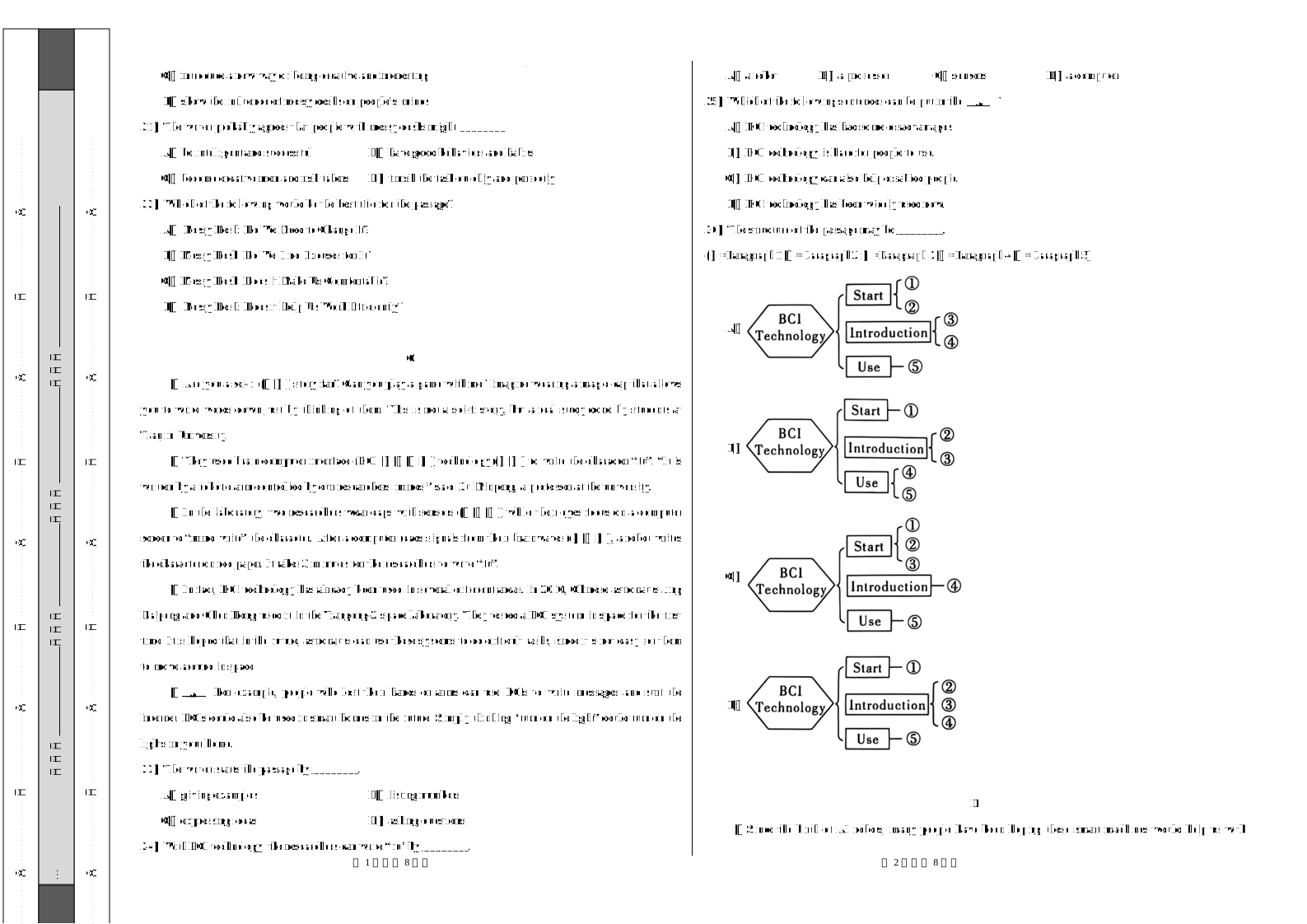
3

相关资源
示范课
由于学科网是一个信息分享及获取的平台,不确保部分用户上传资料的 来源及知识产权归属。如您发现相关资料侵犯您的合法权益,请联系学科网,我们核实后将及时进行处理。