Unit 3 Festivals and Holidays 一般现在时现和一般过去时过辨析运用-2025-2026学年八年级英语下册语法知识点全解(北师大版)
2026-02-09
|
8页
|
33人阅读
|
1人下载
教辅

资源信息
| 学段 | 初中 |
|---|---|
| 学科 | 英语 |
| 教材版本 | 初中英语北师大版八年级下册 |
| 年级 | 八年级 |
| 章节 | - |
| 类型 | 学案 |
| 知识点 | - |
| 使用场景 | 同步教学-新授课 |
| 学年 | 2026-2027 |
| 地区(省份) | 全国 |
| 地区(市) | - |
| 地区(区县) | - |
| 文件格式 | |
| 文件大小 | 140 KB |
| 发布时间 | 2026-02-09 |
| 更新时间 | 2026-02-09 |
| 作者 | 北京菁榕教育咨询有限公司 |
| 品牌系列 | - |
| 审核时间 | 2026-02-09 |
| 下载链接 | https://m.zxxk.com/soft/56407260.html |
| 价格 | 3.00储值(1储值=1元) |
| 来源 | 学科网 |
内容正文:
8下北师大版
Unit 3 Festivals and Holidays
语法专项
一般现在时与一般过去时辨析运用
北师大版八年级下册Unit3
考频分析
8下北师大版中,一般现在时和一般过去时的辨析运用是重点语法模块,考频占语法总量的15%左
右,贯穿试卷核心题型:单项选择(2-3题)、完形填空(2-3题)、语法填空(1-2题)、书面表达
(核心考察,直接影响句子时态准确性与语境合理性)。在语境理解类题目中,时态标志词识别和上
下文时间逻辑判断往往是解题关键。
考查内容
·动词分类应用:系动词、实义动词、情态动词、助动词的辨析与功能
。时态与语态:一般现在时、一般过去时、一般将来时、现在完成时的基本结构与语境匹配,主动语
态与被动语态的转换
。非谓语动词:todo、doing、do的固定搭配与句法功能(作宾语、宾语补足语、定语等)
知识点一:一般现在时与一般过去时的辨析及运用
1.一般现在时(表示经常性、习惯性动作或客观事实)
1.时间标志词:often(经常)、usually(通常)、always(总是)、every day(每天)、sometimes(有时)
on Sundays(在周日)
2.动词形式:主语为第三人称单数时,动词加-s-es(如:1ikes,goes,watches):其他人称用原形
3.例句:
。She usually gets up at6:30a.m.(经常性动作,主语第三人称单数,动词用gets)
。The Earth goes around the Sun.(客观事实,动词用goes)
2.一般过去时(表示过去某个时间发生的动作或存在的状态)
1.时间标志词:yesterday(昨天)、last week(上周)、two days ago(两天前)、in2020(在2020年)、
just now(刚才)
8下北师大版
Unit 3 Festivals and Holidays
2.动词形式:动词用过去式(规则变化加-ed,如:played,visited;不规则变化需记忆,如:went,saw,
ate)
3.例句:
。They visited the Great Wall last month.(过去时间last month,动词用过去式visited)
·I was ten years old in20l5.(过去状态,be动词用was)
3.两者辨析对比
1.时间区别:一般现在时强调”现在习惯或客观规律”,一般过去时强调”过去某特定时间的动作
2.例句对比:
·He plays basketball every afternoon.(一般现在时,表经常性动作)
·He played basketball yesterday afternoon.(一般过去时,表过去特定时间动作)
知识点二:一般现在时和一般过去时辨析及运用
1.一般现在时(表示经常性、习惯性的动作或状态,或客观真理)
1.核心用法标志:
·时间特征:常与always、usually、ofte、every day/week等时间状语连用,或描述客观事实、普
遍规律(无特定时间限制)
。语境场景:用于表达反复发生的日常行为、不变的状态或科学真理
2.结构与例句:
·主动语态:主语+动词原形(非三单)/动词三单形式(三单主语)
例l:We usually have breakfast at7o'clock.(非三单主语,原形have)
例2:The sun rises in the east..(客观真理,三单主语rises)
。否定式:主语+don't/doesn't+动词原形
例:She doesn't like spicy food.(三单主语用doesn't)
2.一般过去时(表示过去某一特定时间发生的动作或存在的状态,与现在无
关联)
1.核心用法标志:
。时间特征:明确指向过去的时间状语,如yesterday、last month、in2023、three days ago等
·语境场景:用于叙述过去的具体事件、经历或已结束的状态
2.结构与例句:
2
8下北师大版
Unit 3 Festivals and Holidays
。主动语态:主语+动词过去式(无人称和数的变化)
例l:They visited the museum last Sunday.(visit的过去式visited)
例2:I was late for school yesterday morning..(be动词过去式was)
●否定式:主语+didn't+动词原形
例:He didn't finish his homework last night..(didn't+原形finish)
3.易混点对比与辨析
1.时间状语区分:
一般现在时:every week(每周,重复发生)vs一般过去时:last week(上周,一次性过去)
例:He plays football every Saturday..(常态)一→He played football last Saturday.(过去某次)
2.语境逻辑区分:
描述客观事实用一般现在时:Water boils at 100C.
描述过去特定经历用一般过去时:I boiled water five minutes ago.
3.状态持续性区分:
一般现在时表持续状态:My father works in a hospital..(目前仍在)
般过去时表已结束状态:My father worked in a hospital in20l0.(2010年时,现在可能已换工作)
知识点三:一般过去时与一般现在时辨析运用
1.一般过去时(表示过去发生的动作或状态)
1.基础时间标志(中考必背):
·yesterday(昨天)→例句:She went to the park yesterday.
。last week/month/year(上周/月/年)→例句:They visited Beijing last year
。two days ago(两天前)→例句:I finished my homework two days ago.
·in2020(在2020年)→例句:He was born in2020.
·just now(刚才)一例句:The teacher called your name just now.
。this morning(今天早上,已过)→例句:I had breakfast at7 this morning.
。when引导的过去时间状语从句→例句:When I was young,I lived in a small village,
2.一般现在时(表示经常性、习惯性动作或客观真理)
1.基础时间标志(中考必背):
。usually(通常)→例句:She usually gets up at6:30a.m.
·often(经常)→例句:They often play football after school..
。always(总是)→例句:My mother always cooks dinner for us.
。sometimes(有时)→例句:I sometimes go shopping on weekends,
3
8下北师大版
Unit 3 Festivals and Holidays
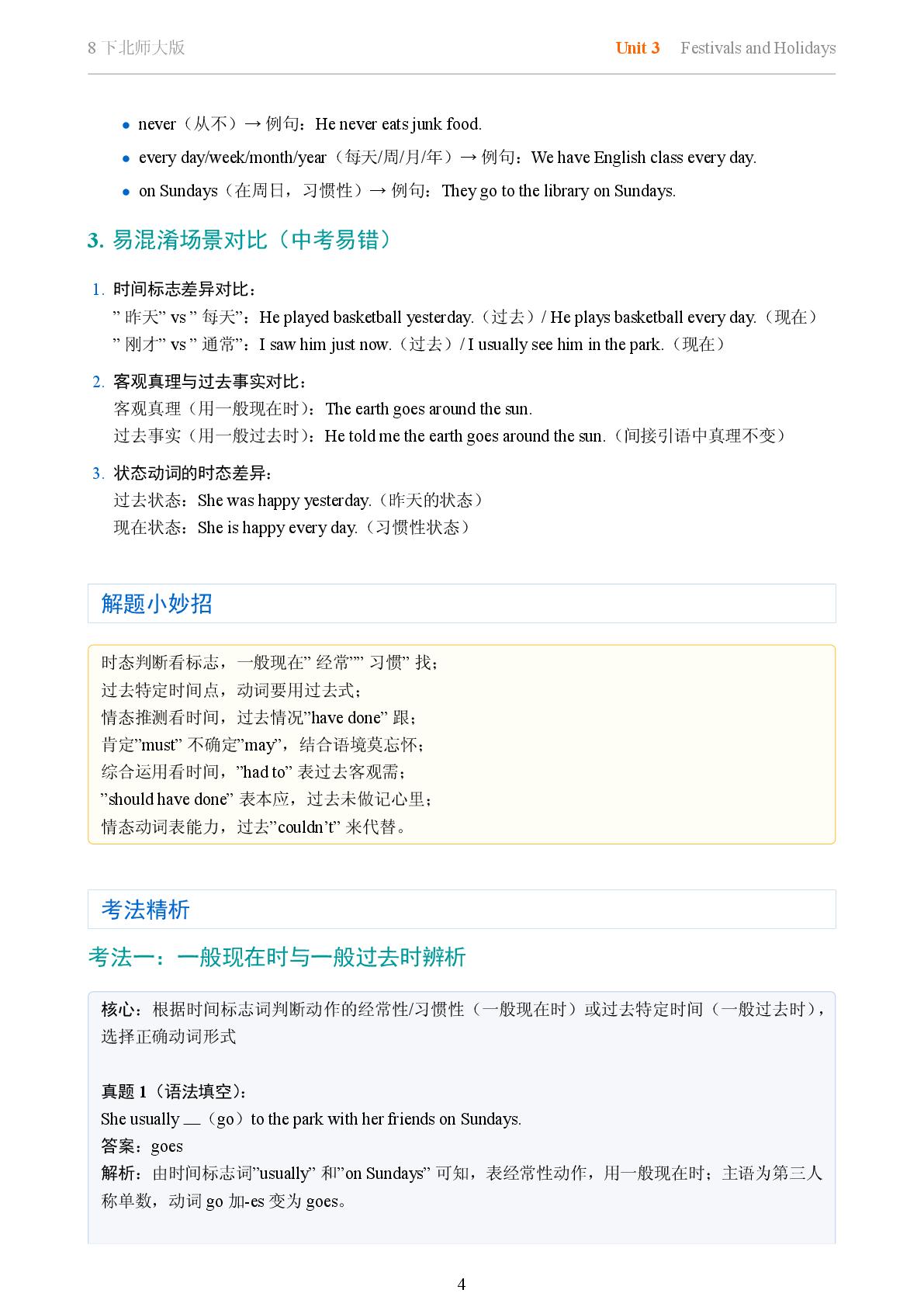
。never(从不)→例句:He never eats junk food.
·every day/week/month/year(每天/周/月/年)一例句:We have English class every day.
·on Sundays(在周日,习惯性)→例句:They go to the library on Sundays.
3.易混淆场景对比(中考易错)
1.时间标志差异对比:
”昨天”vs”每天”:He played basketball yesterday.(过去)/He plays basketball every day.(现在)
”刚才”vs”通常”:I saw him just now.(过去)/I usually see him in the park.(现在)
2.客观真理与过去事实对比:
客观真理(用一般现在时):The earth goes around the sun.
过去事实(用一般过去时):He told me the earth goes around the sun.(间接引语中真理不变)
3.状态动词的时态差异:
过去状态:she was happy yesterday..(昨天的状态)
现在状态:She is happy every day.(习惯性状态)
解题小妙招
时态判断看标志,一般现在”经常”习惯找:
过去特定时间点,动词要用过去式:
情态推测看时间,过去情况have done'跟:
肯定must'不确定may”,结合语境莫忘怀:
综合运用看时间,had to'”表过去客观需:
”should have done”表本应,过去未做记心里;
情态动词表能力,过去”couldn't”来代替。
考法精析
考法一:一般现在时与一般过去时辨析
核心:根据时间标志词判断动作的经常性/习惯性(一般现在时)或过去特定时间(一般过去时),
选择正确动词形式
真题1(语法填空):
She usually(go)to the park with her friends on Sundays.
答案:goes
解析:由时间标志词usually'和'on Sundays”可知,表经常性动作,用一般现在时:主语为第三人
称单数,动词go加-es变为goes。
4
8下北师大版
Unit 3 Festivals and Holidays
真题2(单项选择):
My family_to Beijing last summer vacation.
A.travel B.travels C.traveled D.will travel
答案:C
解析:由时间标志词”last summer vacation'”可知,动作发生在过去,用一般过去时,travel的过去式
为traveled。
考法二:一般过去时与情态动词表推测结合
核心:根据过去时间标志词判断动作发生背景,结合上下文语境选择恰当情态动词表对过去情况
的推测
真题1(语法填空):
The light in his room was off last night,so he(go)to bed early
答案:must have gone
解析:由时间标志词'last night',可知动作发生在过去,结合”灯关了”的语境,用'must have gone'”
表对过去情况的肯定推测,意为”一定早就睡觉了”。
真题2(单项选择):
-Why didn't Tom come to the party yesterday?
-He ill,but I'm not sure.
A.may be B.must be C.may have been D.must have been
答案:C
解析:由时间标志词'yesterday”可知谈论过去情况,I'm not sure'”提示不确定推测,用'may have
been”表对过去情况的可能性推测,意为”可能生病了”。
考法三:一般现在时/一般过去时与情态动词结合的语境运用
核心:根据时间标志词和语境逻辑判断时态(一般现在时/一般过去时),结合情态动词(can/may/must
等)的基本用法及推测功能进行综合运用
真题1(单项选择):
-you_to the Great Wall with your parents last summer?
-No,I_not.I was busy with my homework then.
A.Did;go;could B.Do;go;can C.Did;went;must D.Do;went;may
答案:A
解析:由时间标志词'last summer”可知问句需用一般过去时,助动词用Did,后接动词原形go;答
句根据I was busy”(过去状态)可知表过去不能”,用could not。
真题2(语法填空):
The earth_(go)around the sun.We_(must)remember this scientific fact.My teacher_(tell)us
8下北师大版
Unit 3 Festivals and Holidays
about it in class yesterday.
答案:goes,must;told
解析:第一句描述客观事实,用一般现在时,主语the earth为三单,动词go加-es;第二句表”必
须”,用情态动词must加动词原形;第三句由时间标志词'yesterday”可知用一般过去时,tel的过
去式为told.
真题演练
演练一:单项选择试题(共10题)
1.My mother often_cakes for us on weekends.
A.make B.makes C.made D.will make
2.They-to the museum last Sunday afternoon.
A.go B.goes C.went D.will go
3.-What did you do?
-I visited my grandparents with my parents.
A.tomorrow B.last week C.every day D.next month
4.The sun_in the east and sets in the west.
A.rise B.rises C.rose D.will rise
5.You_wear a helmet when riding a bike.It's the traffic rule
A.can B.may C.must D.could
6.He_finish the work yesterday because he was too tired.
A.can't B.couldn't C.mustn't D.needn't
7.-Why didn't Lucy come to school this morning?
-She-have missed the bus,but I'm not sure.
A.may B.must C.should D.can
8.We_walk on the grass in the park.It's not allowed.
A.mustn't B.needn't C.couldn't D.may not
9.My father-to work by car every day,but he_by bike yesterday.
A.go;go B.goes;went C.went;goes D.will go;went
10.There was a heavy rain last night,so the ground_wet this morning
A.must be B.must have been C.may be D.may have been
演练二:填空试题(共10题)
1.He usually(get)up at 7:00 a.m.,but he(get)up at 8:00 a.m.yesterday.
2.My sister_(visit)her friend last month.They_(play)games together.
6
8下北师大版
Unit 3 Festivals and Holidays
3.The Earth (go)around the sun.This is an objective fact.
4.You _(should)study harder for the exam.You got a low score last time.
5.They-(not go)to the cinema last night because they had too much homework
6.-(can)you swim when you were five?
-No,I_(can not).But now I_(can)swim very well.
7.It_(rain)heavily yesterday,so we_(stay)at home.
8.You(must not)park your car here.Look at the sign"No Parking".
9.She(may)be late for school today.The bus is usually on time,but this morning it didn't come.
10.We_(have)a picnic next Sunday.Would you like to join us?
演练三:语法填空试题(共10空)
Last Saturday,my family and I decided to visit the City Museum.We 1._(meet)at the bus stop at 9:00
a.m.My little brother 2._(be)very excited because he 3._(never visit)a museum before.
When we arrived,the guide told us,"You 4.-(not touch)the exhibits.They are very old and precious."
We listened carefully and 5.(follow)her instructions.In the science hall,we saw a model of the solar
system.My brother asked,"Why 6.-(the Earth go)around the sun?"I told him it's a natural law-the
Earth always 7.(orbit)the sun.
At noon,we 8.-(have)lunch in the museum cafe.The food was delicious,but my sister said,"We 9.
(order)more dishes.I'm still hungry!"In the afternoon,we visited the art gallery.I saw a painting of a
famous artist and thought,"This 10.(be)painted in the 19th century.It looks so beautiful!"
We left the museum at 4:00 p.m.and felt very happy.It was a great day!
参考答案
演练-:1B2.C3B4.B5.C6B7.A8.A9B10B
演练二:
1.gets;got
2.visited;played
3.goes
4.should
5.didn't go
6.Could;couldn't;can
7.rained;stayed
8.mustn't
7
8下北师大版
Unit 3 Festivals and Holidays
9.may
10.will have are going to have
演练三:
1.met
2.was
3.had never visited
4.mustn't
5.followed
6.does the Earth go
7.orbits
8.had
9.should have ordered
10.must have been
P
资源预览图

1

2

3
4

相关资源
由于学科网是一个信息分享及获取的平台,不确保部分用户上传资料的 来源及知识产权归属。如您发现相关资料侵犯您的合法权益,请联系学科网,我们核实后将及时进行处理。