Unit 2 Language and Culture A部分-2025-2026学年高中英语必修第一册期末词汇复习(沪外版)
2025-12-29
|
9页
|
34人阅读
|
1人下载

资源信息
| 学段 | 高中 |
|---|---|
| 学科 | 英语 |
| 教材版本 | 高中英语沪外版必修第一册 |
| 年级 | 高一 |
| 章节 | Unit 2 Language and Culture |
| 类型 | 题集-专项训练 |
| 知识点 | - |
| 使用场景 | 同步教学-期末 |
| 学年 | 2025-2026 |
| 地区(省份) | 全国 |
| 地区(市) | - |
| 地区(区县) | - |
| 文件格式 | |
| 文件大小 | 135 KB |
| 发布时间 | 2025-12-29 |
| 更新时间 | 2025-12-29 |
| 作者 | 北京菁榕教育咨询有限公司 |
| 品牌系列 | - |
| 审核时间 | 2025-12-29 |
| 下载链接 | https://m.zxxk.com/soft/55695743.html |
| 价格 | 2.00储值(1储值=1元) |
| 来源 | 学科网 |
内容正文:
期末词汇复习
必修第一册·沪外版·Unit2 LanguageandCultureA部分
一、】
重点单词详解
1:confusing
一、核心考点
词性:形容词(adj.)
核心义:adj.难以理解的;令人困惑的
二、构词法(词性转换)
词根:fse(v.融合;混合,来自拉丁语fundere'”倾倒)
动词:confuse/kan'fu:z/(v.使困惑;混淆)
形容词:confusing(confuse+-ing,表示”令人…的);confused(confuse+-ed,表
示”感到…的)
名词:confusion/ken'fju:3n/(confuse的名词形式,意为”困惑;混乱)
三、
用法与常见搭配
形容词:
sth.be confusing(某事令人困惑),如:The instructions are confusing.(说明书令人费
解。)
sb.feel confused(某人感到困惑),如:I was confused by his mixed signals.(他矛盾的信
号让我困惑。)
动词:
confuse A with B(将A与B混淆),如:Don't confuse”affect''with”effect''.(不要混淆
affect和effect。)
confuse sb.about sth.(使某人对某事困惑),如:Her explanation confused me about the
process.(她的解释让我对流程更困惑了。)
四、重点辨析
confusing vs.confused:
-confusing:修饰事物,强调”事物本身令人困惑”,如:a confusing question(一道令人
因惑的题)
-confused:修饰人或人的表情、声音等,强调”人感到困惑的状态”,如:a confused look
(困惑的表情)
2:immediate
一、核心考点
词性:形容词(adj.)
核心义:adj.立即的;直接的;最接近的
二、构词法(词性转换)
词根:mediate(adj.间接的;v.调解,来自拉丁语medius'”中间的”)
前缀:im-(否定前缀,意为”不”)+mediate→immediate(”非间接的?→直接的:立
即的)
副词:immediately/'mi:dietli/(adv.立即;直接地)
名词:immediacy'mi:diesi/(n.直接性;迫切性,高中选考)
三、用法与常见搭配
形容词:
immediate action/response(立即行动/▣应)
immediate fami山y(直系亲属,如父母、子女)
in the immediate future(在不久的将来)
副词:
act immediately(立即行动)
immediately after/before(刚,之后/之前),如:She left immediately after the meeting.
(会议一结束她就走了。)
四、重点辨析
immediate vs.instant:
-immediate:强调'时间上无延迟或”逻辑上直接关联”,如:immediate cause(直接原
因)
-instant:强调”瞬间发生,无需等待”,多修饰具体事物,如:instant coffee(速溶咖啡)
3:signal
核心考点
词性:动词(v.)/名词(n.)
核心义:v.发信号;示意;n.信号;标志;信号
二、构词法(词性转换)
词根:sign(n.符号;迹象;V.签名)
后缀:-al(名词/形容词后缀)→signal(”用作标志的事物”→信号)
词性转换:
signal(n.信号)→signal(v.发信号)→signaled/signalled(过去式/过去分词);signal-
ing/signalling(现在分词))
形容词:signal/'sIgn/(adj.显著的;重大的,如:a signal achievement重大成就,高中
选考)
三、用法与常见搭配
名词:
traffic signals(交通信号灯)
a signal for sth.(…的信号),如:a signal for departure(出发的信号)
动词:
signal(to)sb.to do sth.(示意某人做某事),如:He signaled(to)me to stop.(他示意我停
下。)
signal that..(示意…),如:She signaled that she was ready..(她示意她准备好了。)
常见搭配:
send/give a signal(发出信号);receive/pick up a signal(接收信号)
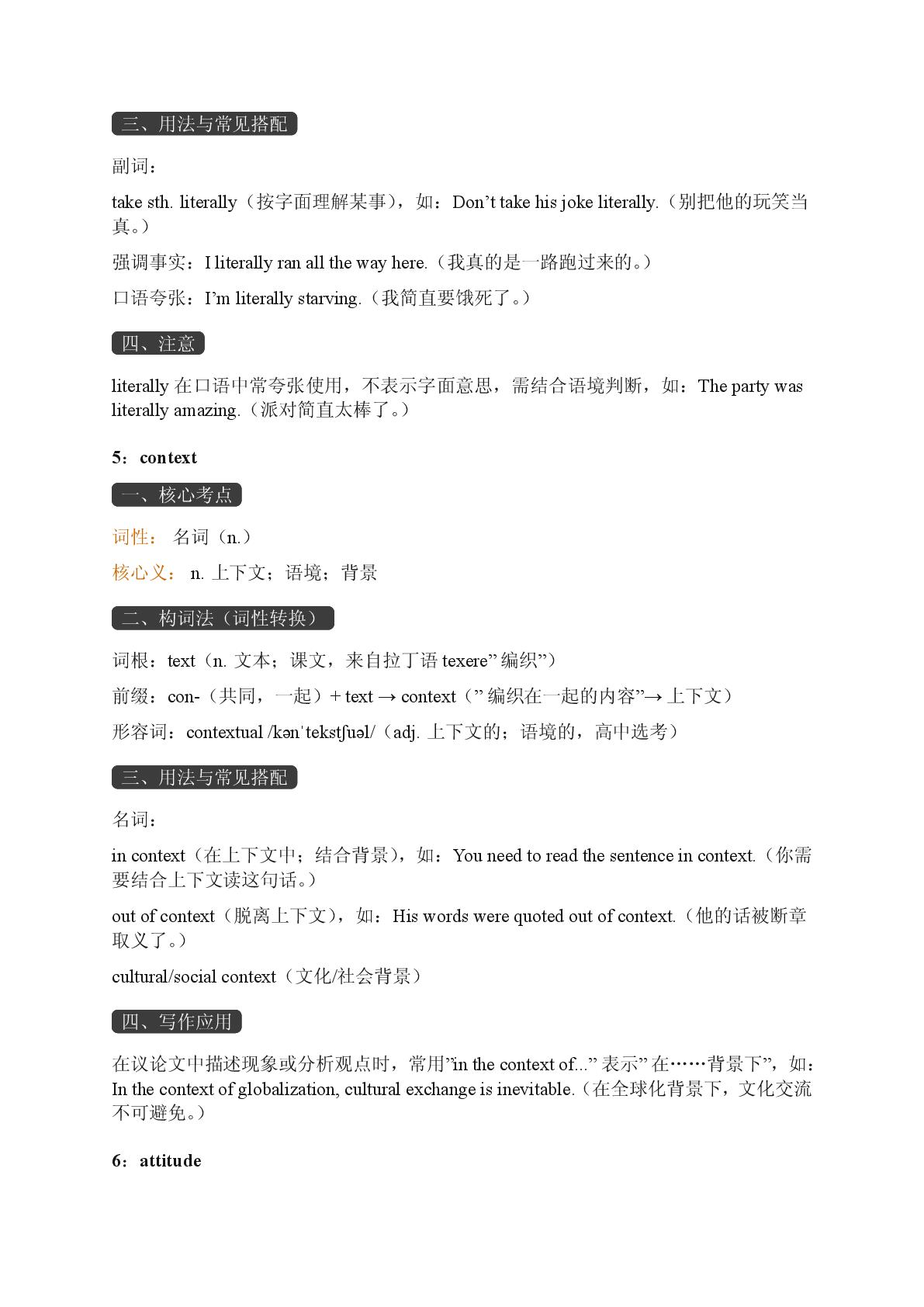
4:literally
核心考点
词性:副词(adv.)
核心义:adv.字面上:确实地:简直(口语中表强调)
二、构词法(词性转换)
词根:literal/1 tarel/(adj.字面的;逐字的,来自拉丁语literalis'字母的”)
后缀:-y(副词后缀)→literally(按字面;确实地)
名词:literalness/lrterelnes/(n.字面意思;刻板,高中选考)
、
用法与常见搭配
副词:
take sth.literally(按字面理解某事),如:Don't take his joke literally.(别把他的玩笑当
真。)
强调事实:I literally ran all the way here..(我真的是一路跑过来的。)
口语夸张:I'm literally starving.(我简直要饿死了。)
四、注意
literally在口语中常夸张使用,不表示字面意思,需结合语境判断,如:The party was
literally amazing.(派对简直太棒了。)
5:context
核心考点
词性:名词(n.)
核心义:n.上下文;语境:背景
二、
构词法(词性转换)
词根:text(n.文本;课文,来自拉丁语texere'”编织)
前缀:con(共同,一起)+text→context(”编织在一起的内容”→上下文)
形容词:contextual/kan'tekstfual/(adj山.上下文的;语境的,高中选考)
三、用法与常见搭配
名词:
in context(在上下文中;结合背景),如:You need to read the sentence in context.(你需
要结合上下文读这句话。)
out of context(脱离上下文),如:His words were quoted out of context.(他的话被断章
取义了。)
cultural/social context(文化/社会背景)
四、写作应用
在议论文中描述现象或分析观点时,常用in the context of..”表示”在…背景下”,如:
In the context of globalization,.cultural exchange is inevitable.(在全球化背景下,文化交流
不可避免。)
6:attitude
核心考点
词性:名词(n.)
核心义:n.态度;看法;姿势
二、构词法(词性转换)
词源:来自意大利语attitudine'”姿势”,后引申为”态度
动词:attitudinize/,eetr'tju:dinaiz/(v.装腔作势,高中不常见)
三、
用法与常见搭配
名词:
attitude to/towards..(对…的态度),如:her attitude towards learning(她对学习的态
度)
a positive/negative attitude(积极/消极态度)
take a/an…attitude(采取…态度),如:take a responsible at:tude(采取负责任的态度)
四、写作应用
在观点类作文中常用:”A positive attitude towards challenges is crucial for success.”(对挑
战的积极态度是成功的关键。)
7:dramatically
、
核心考点
词性:副词(adv.)
核心义:adv.显著地;剧烈地;戏剧性地
二、构词法(词性转换)
词根:drama/dra:ma/(n.戏剧)
形容词:dramatic/dra'metk/(adj.戏剧性的;显著的)
副词:dramatically(dramatic+-ally)
、
用法与常见搭配
副词:
change dramatically(显著变化),如:Technology has changed our lives dramatically.(科
技极大地改变了我们的生活。)
increase/decrease dramatically(急剧增加/减少),如:The number of students has increased
dramatically.(学生人数显著增加。)
四、辨析
dramatically vs.greatly:
-dramatically:强调变化?'突然、显著且有冲击力,如:The sky changed dramatically
from blue to black.(天空从蓝色骤变为黑色。)
-greatly:强调程度”很大,但语气较平和,如:I greatly appreciate your help.(我非常
感谢你的帮助。)
8:panic
核心考点
词性:动词(v.)/名词(n.)
核心义:v.(使)惊慌:n.恐慌:惊慌
二、构词法(词性转换)
名词:paic(n.恐慌,来自希腊神话中牧神Pam,其突然出现会引发恐慌)
动词:paic(v.惊慌)→panicked(过去式/过去分词);panicking(现在分词)
形容词:panicky/paeniki/(adj.恐慌的;易恐慌的)
三、
用法与常见搭配
名词:
in a panic(惊慌地),如:She left the room in a panic.(她惊慌地离开了房间。)
cause/create panic(引起恐慌)
动词:
panic about/over sth.(对…感到恐慌),如:Don't panic about the exam.(别对考试感到
恐慌。)
panic sb.into doing sth.(使某人仓促做某事),如:The news panicked him into making a
hasty decision.(这个消息让他仓促做出了决定。)
四、写作应用
在描述紧急情况时常用:The sudden earthquake caused widespread panic among the
esidents.”(突然的地震在居民中引起了广泛的恐慌。)
二、词汇巩固练习
(一)单项选择(10题)
1.The instructions on the machine are so_that few people can understand them.
A)confused
B)confusing
C)confuse
D)confusion
2.All passengers must show their ticketsafter boarding the train
A)immediate
B)immediacy
C)immediately
D)mediated
3.The traffic light turned red,drivers to stop their cars.
A)signaling
B)signaled
C)signal
D)signals
4.In his speech,the professor said that we should not take his words_
A)literal
B)literally
C)literate
D)literacy
5.To understand the poem better,you need to read it the historical context.
A)out of
B)beyond
C)in
D)without
6.Her positive towards life has inspired many young people around her.
A)altitude
B)attitude
C)aptitude
D)gratitude
7.With the development of technology,people's lifestyles have changed_over the past
decade
A)dramatically
B)greatly
C)slightly
D)hardly
8.When the fire alarm rang,there was a sudden_and everyone rushed out of the building.
A)panic
B)panicking
C)panicked
D)panics
9.He sent a message to his parents,asking for their_support during the exam period.
A)directly
B)immediate
C)instant
D)lately
10.The teacher's explanation only_the students more about the grammar rule
A)confused
B)confusing
C)confusion
D)confuses
(二)根据提示补全句子(8题)
1.The government called for(immediate)action to solve the environmental problem.
2.She felt(confuse)when facing so many choices at the same time.
3.The company's profits have increased_(dramatic)since the new policy was introduced.
4.We need to consider the issue in its social and cultural(contextual)
5.His_(signal)of approval made everyone in the team feel relieved.
6.The_(panic)crowd rushed towards the exit when they heard the explosion.
7.A positive (attitude)is essential for overcoming difficulties in life
8.The word"literal"has an adverb form_(literally).
(三)首字母填空(10题)
1.In the i future,we plan to expand our business to other cities.
2.The teacher asked us to read the paragraph in c to understand the main idea.
3.Her sudden resignation sa big change in the company's management.
4.Don't take his jokes 1;he was just teasing you.
5.The number of online shoppers has increased d in recent years.
6.A positive a towards failure can help us learn and grow.
7.The confusing instructions led to a lot of camong the participants.
8.The doctor advised him to seek i medical attention for his injury.
9.When the earthquake happened,there was a lot of p in the streets.
10.The new policy will have a s impact on the local economy.
(四)答案与解析
1.单项选择答案:BCCBCBABAA
2.补全句子答案:
immediate confused dramatically context signal panicked attitude literally
3.首字母填空答案:
immediate context signaled literally dramatically attitude confusion immediate panic signal
英语词汇复习手册·必修第一册·Unit2 Language and Culture A部分
资源预览图

1

2

3
4

相关资源
由于学科网是一个信息分享及获取的平台,不确保部分用户上传资料的 来源及知识产权归属。如您发现相关资料侵犯您的合法权益,请联系学科网,我们核实后将及时进行处理。