第6讲 谓语动词(一) 动词的时态、语态和主谓一致-【红对勾讲与练·讲义】2026年高考英语大一轮复习全新方案通用版(人教版)
2025-12-24
|
2份
|
11页
|
120人阅读
|
5人下载
教辅

资源信息
| 学段 | 高中 |
|---|---|
| 学科 | 英语 |
| 教材版本 | - |
| 年级 | 高三 |
| 章节 | - |
| 类型 | 教案-讲义 |
| 知识点 | 语法 |
| 使用场景 | 高考复习-一轮复习 |
| 学年 | 2026-2027 |
| 地区(省份) | 全国 |
| 地区(市) | - |
| 地区(区县) | - |
| 文件格式 | ZIP |
| 文件大小 | 2.83 MB |
| 发布时间 | 2025-12-24 |
| 更新时间 | 2025-12-24 |
| 作者 | 河北红对勾文化传播有限公司 |
| 品牌系列 | 红对勾·高考大一轮复习讲与练全新方案 |
| 审核时间 | 2025-12-24 |
| 下载链接 | https://m.zxxk.com/soft/55594180.html |
| 价格 | 3.00储值(1储值=1元) |
| 来源 | 学科网 |
内容正文:
专题二
第六讲
谓语动词(一)
高考体验
单句语法填空
1.(2024·全国甲卷)They
(be)part of
a 15-member exploring party that had spent
almost five awesome weeks in witness of the
natural beauties there.
2.(2024·新课标I卷)Further,the Silk Route
Garden around the greenhouse
(walk)
visitors through a journey influenced by the
ancient Silk Road,by which silk as well as many
plant species came to Britain for the first time.
3.(2024·浙江1月卷)Over the last two years,
some supermarkets
(start)selling
chicken or salad in packs designed with two
halves containing separate portions ()
4.(2024·新课标Ⅱ卷)Two years later,asix-
meter-tall pavilion,inspired by The Peony Pavilion,
(build)at the Firs Garden,just ten
minutes'walk from Shakespeare's birthplace.
5.(2023·全国乙卷)Having visited several times
over the last 10 years,I
amaze)by
the co-existence of old and new,and how a city
was able to keep such a rich heritage(遗产)
while constantly growing.
6.(2023·新课标Ⅱ卷)As a little girl,I
(wish)to be a zookeeper when I grew up.
7.(2022·新高考Ⅱ卷)Heny
(fix)his
car when he heard the screams.He looked up and
saw Eric hanging from the balcony.
8.(2022·新高考Ⅱ卷)He quickly
throw)his tools aside,and started running,
arms out.
9.(2022·全国乙卷)The chairman of the China
Culture Promotion Society
address)
the opening ceremony.
词法篇
动词的时态、语态和主谓一致
10.(2022·浙江1月卷)On a website called No
Fly Climate Sci,for example,roughly 200
academics-many of them climate scientists-
promise)to fly as little as possible
since the effort started two years ago.
语法精讲]
考点一动词的时态
(一)一般时态
1.一般现在时
(1)表示经常性或习惯性的动作或存在的状态。
常用的时间状语有always,usually,often,
315
sometimes,every day等。
I usually do my homework in the evening.
我通常晚上做作业。
(2)按时间表、时刻表、日程表等安排将要发生
的动作,用一般现在时。只限于go,arrive,
leave,start,stay,return,begin,come,take off
等动词(短语)。
My flight takes off at 5:00 am.
我的航班早上五点起飞。
(3)在时间、条件等状语从句中常用一般现在时
代替一般将来时。
They'll stand by you even if you don't succeed.
即使你不成功,他们也会支持你。
(4)表示客观真理、科学事实。
The geography teacher told us the earth travels
around the sun
地理老师告诉我们地球绕着太阳转。
2.一般过去时
(1)表示过去某个时间发生的动作或存在的状
态。常用的时间状语有yesterday,last year,just
now,the other day,two weeks ago等。
He arrived at school at 9:00 am yesterday.
他昨天上午九点到的学校。
2题勾·讲与练·高三英语RJ
(2)根据上下文或主从句提示判断用一般过
去时。
We often played together when we were children.
我们小时候经常在一起玩。
即学即练①—一单句语法填空
1.Nowadays,many people across the world
(be)eager to learn about China through stories
about Chinese civilisation and contemporary
China.
2.He and the other workers let people vote for their
favourite fat bear on Facebook.The one-day
event
attract)just 1,700 votes
in2014.
3.The Taizhou outlet of Dayin Bookmall,a famous
bookstore chain from Shanghai,
(open)last year on the street in a traditional
Chinese-style building with cutting-edge designs.
(二)进行时态
1.现在进行时
(1)表示说话时正在进行或发生的动作,也可表
316
示现阶段正在进行的动作或存在的状态。常用
的时间状语有now,right now,at present,at
this moment,.these days等。
I don't really work here;I am just helping out
until the new secretary arrives.
我并不是真的在这里工作。我只是在新秘书来
之前在这里帮忙。
(2)表示按计划或安排即将发生的动作,常用的
动词有go,come,leave,arrive,start,move等。
He is leaving tomorrow to play his first match.
他明天要去打他的第一场比赛。
(3)always,often,forever,constantly,continually
等连用时,表示赞赏或厌恶等感情色彩,而非强
调动作正在进行。
He is always helping others.
他总是帮助其他人。
2.过去进行时
(1)表示过去某一时刻或某一段时间内正在进
行的动作(这一过去时间需用时间状语表示)。
常用的时间状语有then,yesterday,at that time,
at this time等。
Susan had quit her well-paid job and was
working as a volunteer in the neighbourhood
when I visited her last year.
去年我去拜访苏珊时,她已经辞去了收入丰厚
的工作,在社区做志愿者。
(2)表示过去计划或安排在将来会发生的动作。
常用的动词有plan,come,go,leave,arrive,
start,move,sail,fly,travel,stay等。
He said that)she was arriving the next day.
他说她第二天会到达。
(3)always,constantly,continually,forever
等副词连用表示赞美或讨厌的感情色彩。
She was always thinking of others.
她总是为别人考虑。
3.将来进行时
表示将来某一时刻或某一段时间内正在进
行的动作。常用的时间状语有at six tomorrow,
in the next two months等。
I'll be doing some housework tomorrow afternoon.
明天下午我将要干些家务活。
即学即练2—完成句子
1.听!玛丽正在教室里唱一首英文歌。
Listen!Mary
2.昨天下午从3点到5点他一直在家看电视。
He
from 3:00 to 5:00 yesterday afternoon.
3.当你到达时,她将正在车站等你。
She
for you at the
station when you arrive.
(三)将来时态
1.一般将来时
(1)“wil/shall-+动词原形”表示将来要发生的
动作或存在的状态。“wl+动词原形”还可以
表示说话人临时做出的决定。
It is said that he will retire next month.
据说他将于下个月退休。
(2)“be going to+-动词原形”表示打算、计划、决
定要做的事或肯定要发生的事;表示说话人根
据已有的事实或迹象,推测某事即将发生。
Look at the cloud.It looks as if it is going to
rain.
瞧那乌云,看起来好像要下雨了。
(3)“be about to+动词原形”表示打算或根据安
排即将发生的动作。它不与表示具体时间的状
语连用,但可以与when连用。
The English evening is about to start.
英语晚会即将开始。
(4)“beto+动词原形”表示约定的、计划中的或
按职责、义务将要发生的动作,这种动作通常是
人的意志所能控制的,或用于征求意见。
You are to hand in your papers by 10 o'clock
你要在10点前上交论文。
2.过去将来时
表示从过去的某一时间来看将来要发生的
动作或存在的状态。过去将来时常用于宾语从
句和间接引语中。
She was sure she would succeed.
她确信她会成功。
1即学即练3
—完成句子
1.你如果努力,就会成功。(祈使句+and+陈述句)
Work hard
2.除非下雨,否则我们是要参加聚会的。(unless)
3.这条公路将在五月份通车。(be to do)》
The highway
4.今年冬天我打算买一件新大衣。(be going to do)
this winter.
5.他说他第二天要来看我。(would do)
He said he
the next day.
(四)完成时态
1.现在完成时
(1)表示一个动作开始于过去,一直持续到现在
(甚至到将来)。常与之连用的时间状语有:
lately,recently,in the last/past few days/years
since then,up to now,so far等。
In the past few years,great changes have taken
place in my hometown.
在过去的几年里,我的家乡发生了巨大变化。
(2)表示过去发生的事情对现在产生的影响或
结果。常用的状语有:already,ever,just(刚
刚),yet等:
He has already turned off the light.(=The light
is off now.
他已经关掉灯了。
(3)在“最高级+名词”或“It/This is+he+序数
词+time”之后的从句中谓语动词常用现在完
成时。
This is the first time (that)I have come here.
这是我第一次来这里。
专题二词法篇
2.过去完成时
(1)一件事情发生在过去,而另外一件事情先于
它发生(即表示“过去的过去”),那么发生在前
的动作要用过去完成时。
When Jack arrived,Mary had been away for
almost an hour.
当杰克到达时,玛丽已经离开快一个小时了。
(2)hope,expect,mean,intend,want,suppose
的过去完成时表示过去未曾实现的愿望或
意图。
I had hoped to send Peter a gift to congratulate
him on his marriage,but I couldn't manage it.
我本希望送彼得一件礼物来祝贺他结婚,但我
没做到。
(3)在Hardly/Scarcely/Barely.when.和No
sooner.than.句型中,when和han引导的从
句用一般过去时,主句用过去完成时,且常用倒
装,表示“刚…就…”。
Hardly/No sooner had I got home when/than the
rain poured down.
我刚到家,大雨就倾盆而下。
317
(4)在“It/This was the first(second,etc.)
ime+hat从句”句型中,从句谓语动词用过去完
成时。
It was the second time that he had won the
election.
那是他第二次在大选中获胜。
3.现在完成进行时
表示动作从过去某时开始,一直延续到现
在并且还要继续下去的动作。常和all this
time,this week,this month,all night,all the
morning,recently等状语以及since和for引导
的状语从句连用。
I have been reading Hemingway's A Farewell to
Arms recently.
我最近一直在读海明威的《永别了,武器》。
即学即练④一单句语法填空/完成句子
1.For the past few decades,many of us
(rey)on“Doctor Google”to self-diagnose(自
我诊断)aches,pains and complaints.
2.It doesn't impress like George Washington's
plantation on the Potomac,but Lincoln's home
in downtown Springfield,Illinois,
prove)irresistible to visitors since it opened to
2勾·讲与练·高三英语RJ
the public
3.自任教以来,她一直在努力工作。
She
since she became a
teacher.
4.我到达电影院时,电影票已经卖完了。
When I got to the cinema,
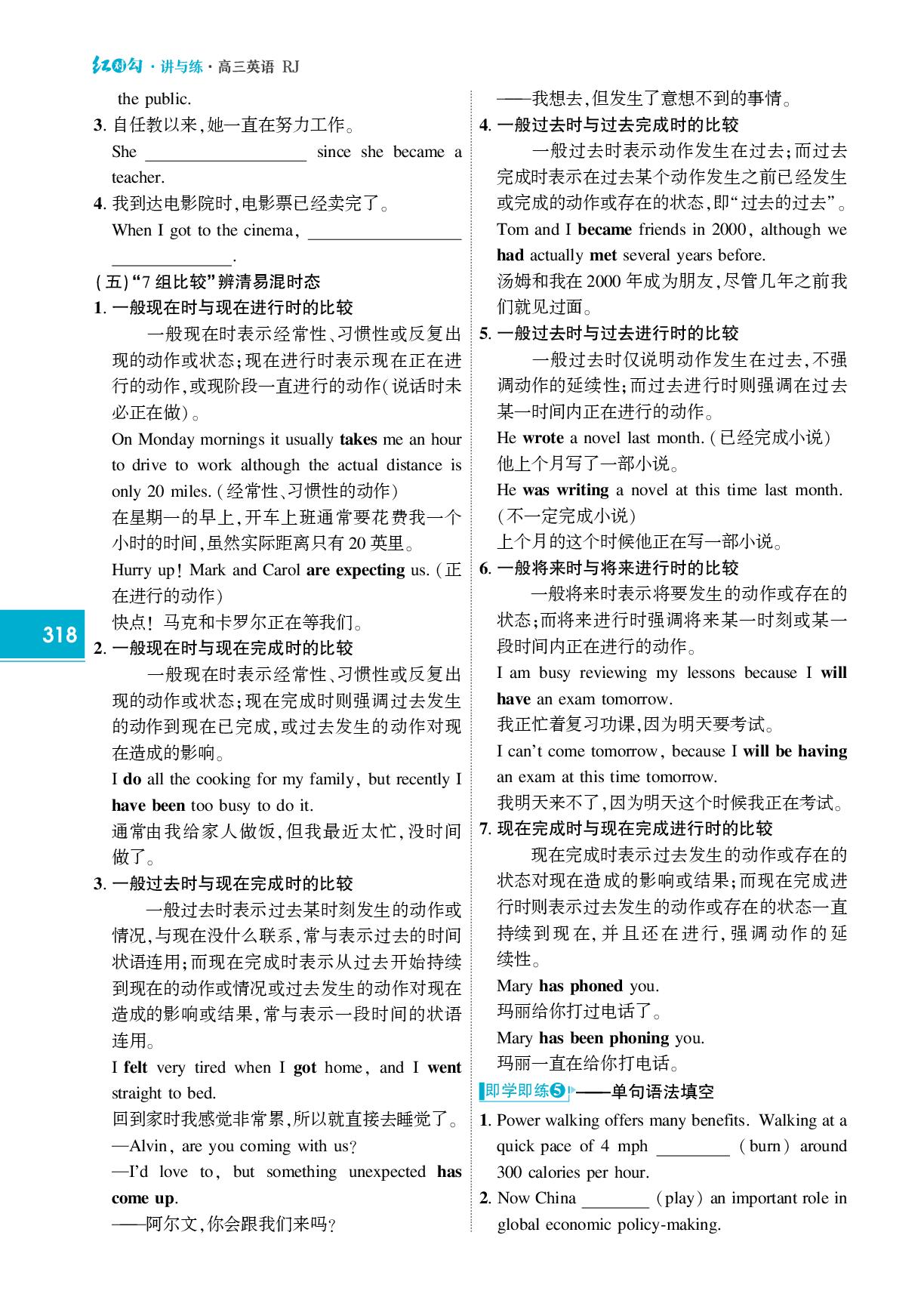
(五)“7组比较”辨清易混时态
1.一般现在时与现在进行时的比较
一般现在时表示经常性、习惯性或反复出
现的动作或状态;现在进行时表示现在正在进
行的动作,或现阶段一直进行的动作(说话时未
必正在做)。
On Monday mornings it usually takes me an hour
to drive to work although the actual distance is
only20 miles..(经常性、习惯性的动作)
在星期一的早上,开车上班通常要花费我一个
小时的时间,虽然实际距离只有20英里。
Hurry up!Mark and Carol are expecting us.(正
在进行的动作)
快点!马克和卡罗尔正在等我们。
318
2.一般现在时与现在完成时的比较
一般现在时表示经常性、习惯性或反复出
现的动作或状态:现在完成时则强调过去发生
的动作到现在已完成,或过去发生的动作对现
在造成的影响。
I do all the cooking for my family,but recently I
have been too busy to do it.
通常由我给家人做饭,但我最近太忙,没时间
做了。
3.一般过去时与现在完成时的比较
一般过去时表示过去某时刻发生的动作或
情况,与现在没什么联系,常与表示过去的时间
状语连用:而现在完成时表示从过去开始持续
到现在的动作或情况或过去发生的动作对现在
造成的影响或结果,常与表示一段时间的状语
连用。
I felt very tired when I got home,and I went
straight to bed.
回到家时我感觉非常累,所以就直接去睡觉了。
-Alvin,are you coming with us?
-I'd love to,but something unexpected has
come up.
——阿尔文,你会跟我们来吗?
一我想去,但发生了意想不到的事情。
4.一般过去时与过去完成时的比较
一般过去时表示动作发生在过去;而过去
完成时表示在过去某个动作发生之前已经发生
或完成的动作或存在的状态,即“过去的过去”。
Tom and I became friends in 2000,although we
had actually met several years before.
汤姆和我在2000年成为朋友,尽管几年之前我
们就见过面。
5.一般过去时与过去进行时的比较
一般过去时仅说明动作发生在过去,不强
调动作的延续性:而过去进行时则强调在过去
某一时间内正在进行的动作。
He wrote a novel last month.(已经完成小说)
他上个月写了一部小说。
He was writing a novel at this time last month.
(不一定完成小说)
上个月的这个时候他正在写一部小说。
6.一般将来时与将来进行时的比较
一般将来时表示将要发生的动作或存在的
状态:而将来进行时强调将来某一时刻或某一
段时间内正在进行的动作。
I am busy reviewing my lessons because I will
have an exam tomorrow
我正忙着复习功课,因为明天要考试。
I can't come tomorrow,because I will be having
an exam at this time tomorrow.
我明天来不了,因为明天这个时候我正在考试。
7.现在完成时与现在完成进行时的比较
现在完成时表示过去发生的动作或存在的
状态对现在造成的影响或结果:而现在完成进
行时则表示过去发生的动作或存在的状态一直
持续到现在,并且还在进行,强调动作的延
续性。
Mary has phoned you.
玛丽给你打过电话了。
Mary has been phoning you.
玛丽一直在给你打电话。
即学即练⑤—单句语法填空
1.Power walking offers many benefits.Walking at a
quick pace of 4 mph
burn)around
300 calories per hour.
2.Now China
(play)an important role in
global economic policy-making.
3.1
(use)this pen only three times.It is
still good.
4.Translated fiction sales in the United Kingdom
(rise)by 5.5 percent last year,with
growing demand for Chinese titles,said Nielsen
on Wednesday.
(六)确定动词时态的4个依据
依据1:时间状语
动词的时态,顾名思义就是指动作或状态在
不同时间条件下的动词形式,因此时间状语是确
定动词时态的最直接的决定因素。
【例1】It is said that silk
become)one
of the primary goods traded along the Silk Road
by about 100 BCE.
分析:had become题千中by about 100BCE
是表示过去的时间状语,当时间状语是“介词
by(不迟于,不晚于)+过去的某一时间”时,表
示动作发生在“过去的过去”,谓语动词应用
过去完成时。
【例2】In the last few years,China
make )great achievements in environmental
protection.
分析:has made句意:在最近的几年里,中国
在环境保护方面取得了巨大的成就。题干中
的时间状语是In the last few years,表示动作
“从过去某一时间一直持续到现在”,所填谓
语动词应用现在完成时;主语China为第三人
称单数形式,助动词应用has。故填has made。
依据2:参照动词
当题干中没有时间状语,或时间状语不能完
全决定所填动词的动作发生的具体时间时,动词
的时态由其参照动词来决定。
【例3】The real reason why prices
(be),and still are,too high is complex,and no
short discussion can satisfactorily explain this
problem.
分析:were分析句子结构可知,题千中没有
时间状语,由参照动词are和is以及stil可以
推断出所填动词陈述的是过去的事实,表示
“过去是”,应用一般过去时;主语prices为复
数形式,故填were。
依据3:句意或语境
当题干中无时间状语及参照动词,或时间状
语和参照动词都不能确定所填动词的时态时,所
专题二词法篇
进
填动词的时态由题干的具体意思或动作所发生的
语境来决定。
【例4】一s Peter coming?
-No,he
(change)his mind after a
phone call at the last minute.
分析:changed根据语境可知,所填词的动作
发生在过去,陈述的是过去的事实,应用一般
过去时。题千中虽有时间状语at the last
minute和参照动词is coming,但它们都不能准
确定位所填动词的动作发生的时间,因此所填
词的时态由句意或语境来决定。
【例5】When walking down the street,.I came
across David,whom I
not see)for
years.
分析:hadn't seen根据语境可知,“多年没
见”这一动作发生在“偶然遇到(came
across)”之前,即“过去的过去”,故用过去完
成时。
【例6】He said that one of the phone boxes
generate)around 13,500 in revenue a
month and cost only about 400 to rent.
319
分析:generated句意:他说一个电话亭每月
能产生约1.35万美元的收入,租金仅为400
美元左右。根据主句中的said可知,that引导
的宾语从句时态也应用过去的某种时态,从句
陈述过去的一般情况,应用一般过去时。
依据4:固定句式
英语中有一些句式的时态常常是固定的,如
果题干中出现这类句式,应注意根据规则选用适
当的时态。常见的固定句式如下:
DIt is the first/second/...time that sb.have/has
done...
2It was the first/second/...time that sb.had done...
3Sb.was doing sth.when...did...
4Hardly/Scarcely had sb.done sth.when...did...
5Sb.was about to do sth.when...did...
6It's (high)time that sb.did/should do...
【例7】It is the first time that I
(be)to
Beijing.
分析:have been句意:这是我第一次去北京。
提示词为be动词,设空处在句中作谓语,再根
据固定句式It is the first time that sb.have/has
done..确定使用现在完成时。
2题勾·讲与练·高三英语RJ
技法图解
时间状语
根据句中出现的时间状语并
判断法
结合语境确定对应时态
固定句式判断法一根据固定搭配对号入座
语动
宏观
根据语境考虑设
过去
语
空处说的是什么
定时
现在
时候的事情
将来
态
综合判
微观
进一步确认谓语动词使用
判断方法
法
定谓
过去、现在或将来的特定
时态
主句是一般将来时,时间、条件、让步状
语从句的谓语动词常用一般现在时表
时
将来
一般过去时
判
主句谓语动
词为一般过
过去进行时
法
去时,宾语从
过去将来时
句可用过去
过去完成时
的某种时态
过去完成进行时
320
过去将来进行时
考点二被动语态
(一)各种时态中被动语态的构成
时态
一般式
进行式
完成式
am/is/are+
am/is/are+
have/has+been
现在时
过去分词
being+过去分词
过去分词
Wwas/were+过
was/were+
had+been+过去
过去时
去分词
being+过去分词
分词
shall/will
shall/will have
将来时
be+过去分词
been+过去分词
should/
should/would
过去
would be
将来时
have been+过去
过去分词
分词
(二)被动语态的用法
1.不知道或没有必要指明动作的执行者
Attention,please!A meeting will be held in the
office at 8:00 am tomorrow.Everyone is expected
to attend on time
请注意!明天上午八点在办公室召开会议。望
大家准时参加。
2.强调或突出动作的承受者
The woman was taken to hospital.
那位女士被送进了医院。
3.动作执行者被较长的修饰语修饰
The idea was supported by those who wished to
make much money
想挣许多钱的人们支持那个主意。
[名师指津]不能使用被动语态的几种情况:
①不及物动词(短语)不用于被动语态,如
happen,occur,fail,remain,spread,take place,
break out,.come true等。
The disease spreads easily.
这种疾病容易传播。
②某些动词(短语)不用于被动语态,如benefit,
fit,lack,contain,join,last,arrive at/in,agree
with,look like,consist of,suffer from.succeed
in等。
This drink doesn't contain any alcohol.
这种饮料不含任何酒精。
③表示归属的动词(短语)不用于被动语态,如
have,own,belong to等。
The red pen belongs to me.
这支红色的钢笔是我的。
④宾语是反身代词或相互代词时,谓语动词用
主动语态,不用被动语态。
We often help each other.
我们经常互相帮助。
(三)主动形式表示被动意义的4种情况
系动词,如smell,taste,feel,This kind of wool shirt
look,sound,prove等后接形容feels soft.
词作表语,用主动形式表示被动这种羊毛衫摸起来
意义
很软。
表示主语的某种属性特征或功能Have you bought the
的动词,如read,write,sel,book that sells well
wash,clean等,常与well,badly,these days?
easily,smoothly等副词连用,用你买了最近很畅销的
主动形式表示被动意义
那本书了吗?
某些与can't,won't等连用的不
The door won't shut.
及物动词,如open,shut,move
等,用主动形式表示被动意义
这扇门关不上。
少数不及物动词用于进行时,如
The meat is cooking.
print,cook,sell等,其主动形式
肉正在炖着。
表示被动意义
即学即练⑥—单句语法填空
1.Luzhou Wood Carving
(list)into the
Provincial Intangible Cultural Heritage project
in2013.
2.Now,in Beijing,it
forbid)to keep
adult dogs that are taller than 35 centimeters in the
restricted areas.
3.By the end of November,2022,videos recording
or introducing this activity,Weilu Zhucha,
(play)1.14 billion times.
4.Traditional Chinese medicine is an important part
of Chinese culture and
practice)in
China for over 2,000 years till now
技法图解
如果主语为动作发出者,谓
主语动
语动词则多为主动语态
词关系
判断法
如果主语为动作承受者,谓
语动词则多为被动语态
被动语态
判断谓语动词是否用主动
动词特点
形式表示被动意义
鹤
判断法
不能用于被动语态的动词
或动词短语使用主动语态
法
含有情态动词
情态动词+be done
的被动语态
考点三主谓一致
1.语法一致原则
(1)动名词(短语)、不定式(短语)、从句、不定
代词作主语时,谓语动词常用单数。
Listening to music makes me relaxed after a
busy day
忙碌一天之后,听音乐使我感到很放松。
[名师指津]what引导的从句作主语时,谓语
动词一般用单数形式,但如果从句表示复数意
义,则谓语动词用复数形式。
What he says and does does not concern me.
他的言行与我无关。
What he says and does do not agree.
他的言行不一致。
(2)主语后跟with,together with,as well as,like,
but,except,along with,rather than等连接的短语
时,谓语动词的数要与连接词前面的主语保持
一致。
The teacher as well as his students was very
excited.
这位老师和他的学生们都非常激动。
(3)and,both.…and…连接两个不同的主语时,谓
语动词用复数形式;但是如果由and连接的两
个名词表示同一个人或物时,谓语动词用单数
专题二词法篇
形式。
The singer and dancer is to attend our evening
party.
那位歌舞表演者将参加我们的晚会。
(4)定语从句中关系代词作主语时,从句中的谓
语动词要与先行词保持一致。
My friend showed me around the town,which
was very attractive.
我的朋友带我参观了这个小镇,它非常迷人。
(5)“many a/more than one+单数名词”作主语
时,谓语动词用单数。each,every,no所修饰的
名词作主语时,即使由and连接,谓语动词仍用
单数。
Many a parent has had to go through this same
painful process.
很多家长不得不经历同样的痛苦过程。
Every boy and every girl wishes to attend the
party to be held on Sunday.
每个男孩和女孩都希望参加周日举行的聚会。
(6)“the+形容词”表示一类人,在句中作主语
时,谓语动词用复数形式。
The sick have been cured and the missing have
321
been found.
患病的人被治愈,同时失踪的人也被找到了。
(7)表示时间、距离、重量、金额等的复数名词或
短语通常看作一个整体,谓语动词通常用单数
形式。
Two thousand miles is a long distance.
两千英里是一段很长的距离。
2.意义一致原则
(1)集体名词作主语时,若被看作一个整体,谓
语动词用单数形式;若被看作构成集体的一个
个成员,谓语动词用复数形式。常见的集体名
词有:family,class,team,group,public,committee,
government,audience等。
The whole class were told to stay behind after
school.
全班学生被告知放学后留下。
(2)“分数/百分数/the majority+of+名词”作主
语时,谓语动词的单复数取决于of后名词的数
以及其表示的意义;all,some,half,most,the rest
等作主语时,谓语动词的单复数取决于主语实
际表达的意义。
About one third of the books were written
by him.
这些书中大约有三分之一是他写的。
2题勾·讲与练·高三英语RJ
3.就近一致原则
(1)or,either...or...,neither...nor...,not only...
but also..,not.but.等连接的名词(短语)或代
词作主语时,谓语动词的数常与最邻近的主语
保持一致。
Neither you nor I am fit for the work.
你和我都不适合做这个工作。
(2)在there,/here be结构中,谓语动词的数通常
和最邻近的主语保持一致。
There are three chairs,a desk and a computer in
the room.
房间里有三把椅子、一张桌子和一台电脑。
即学即练⑦一单句语法填空
1.Either the principal or his assistants
(be)to attend the meeting.
2.Sharing food and drink
be)one of
everyday habits that should be changed forever
after the epidemic.
3.Of the nineteen recognized polar bear subpopula-
tions,three are declining,six
(be)
stable,one is increasing,and nine lack enough
data.
322
4.Amy,as well as her brothers,
(give)
a warm welcome when returning to the village last
week.
5.The palace caught fire three times in the last
century,and little of the original building
remain)now.
技法图解☐
看主语是第一、第二还是第三人称,确定谓语
动词形式
“四
看”
看到主语为动名词、动词不定式或从句,要想
到谓语动词应为第三人称单数形式
看到“分数/百分数+of+名词”作主语,要想
到谓语动词的数取决于名词
数
看到there be等结构,要想到就近一致原则
素养提能]川
I.单句语法填空
1.Impressed by the beauty of a desert beside the
Yellow River,Wang Wei stopped off and
write)a timeless classic poem:"In the vast
desert rises straight,lonely smoke:the grand,
long river
reflect the round
setting sun.”
2.Over the past decade,a global push to reduce
hunger and extreme poverty
mark)
some significant success.
3.It was time for me to try my hand,so I took up
the brush,
dip)it in the ink,and
carefully wrote“one”in Chinese.
4.When we read a poem,we often imagine what
the poets
(think)when they wrote or
what they were doing at the time.
5.For the past four days I
(take)part in
a disability arts festival as a member of a choir
(合唱团)set up specially to perform at this
festival.Looking forward to the day of
performance!
6.By the time he was fourteen years old,Einstein
learn advanced mathematics all by
himself.
7.If we keep on doing this practice,gradually,we
(learn)how to express ourselves in
English better.
8.This kind of cloth has been sold out in no time at
the trade fair because it
wash)very
easily.
9.More efforts,as reported,
make)in
the years ahead to accelerate the supply-side
structural reform.
10.The Mid-Autumn Festival is a very important
traditional festival in China,which takes its
name from the fact that it
(celebrate)
in the middle of autumn.
11.The tower which
(restore)will be
open to tourists soon.As we can see,the work
is almost finished.
12.By the time he was 30,he
regard)
as one of the outstanding sculptors.
Ⅱ.语篇专练(动词的时态、语态和主谓一致)
My best friend Kaiya is like me.She 1.
(remind)me of myself.In the past,I 2.
(be)never confident because of my appearance.
People always laughed at my weight,my height,my
hairstyle,etc.At that time,I was the shortest
student in my class.I started getting depressed.
However,someone told me something that I will
always remember.
It was in March.Surrounded by a group of girls
who 3.
(point)at me and laughed at me,
专题二词法篇
进
I couldn't help crying.The tears rolled down my2.(2024·新课标I卷读后续写)我向他要了电话
face like a rushing river.To my surprise,someone
号码,并真诚地向他保证,我一回来就给他钱。
lifted my head up and wiped the tears from my face.
I asked him for his telephone number and
I then knew it was our English teacher,Miss
promised sincerely to him that I
as
Li.She said,"You 4.(be)perfect the
soon as I returned.
way you are.You should never change or hate
3.(2024·全国甲卷书面表达)首先,共享单车给
yourself.People 5.
(accept)you for who
我们的短途出行带来了极大的便利,使其更加
you 6.(be).But if you cannot accept
灵活和环保。
yourself,then how will other people accept you?"I
First of all,shared bicycles
7.
(inspire)by her words.Over the past
to our short-distance travel,making
few months,I 8.
(learn)that no one is
it more flexible and environmentally friendly.
perfect and that we all have flaws.Now I have
4.(2023·新课标I卷应用文写作)得知将为我们
wonderful friends who 9.
(love)me for
安排英语口语课的消息,我们兴奋不已。
who I am.
We're overwhelmed with excitement at the news
Now,seeing Kaiya cry,I decide to tell her the
that an oral English class
for us.
same thing Miss Li 10.
(tell)me.
5.(2023·新课标I卷读后续写)我还记得那是一
Ⅲ.写作迁移(正确运用动词的时态和语态完成
个春天的星期一的早晨,老师把我叫到他的办
句子)
公室,告诉我,我在写作比赛中得了第一名。
1.(2024·新课标I卷应用文写作)我写信是想和
I still remember it was a Monday morning in
你分享上周五我在公园上的一堂美术课。
spring,when my teacher
with you an art class
telling me that I
in the writing contest.
323
第七讲
谓语动词(二)
情态动词和虚拟语气
高考体验
the ages can still
employ)today to
draw attention to important truths.
单句语法填空
4.(2021·天津3月卷)It used to be that you
1.(2024·全国甲卷)What should
(do)
drive for miles here without seeing another
with such a beautiful place?
person,but now there are houses and people
2.(2024·浙江1月卷)However,though it's nice
everywhere.
to get a few cents off a pack of sausages,it would
5.(2020·天津7月卷)Jim says we
stay
help even more if they could sometimes
in his house as long as we leave it clean and tidy.
offer)in smaller packs.
6.(江苏卷)What a pity!You missed the sightseeing,
3.(2023·全国甲卷)Carson proves that a simple
or we
(have)a good time together.
literary form that has been passed down through
语法精讲
考点一情态动词
1.情态动词的类型
只作情态动词的有:must,can/could,may/might,ought to
可作情态动词与实义动词的有:need,dare
情态
动词
可作情态动词与助动词的有:shall/should,wil/would
具有情态动词的某些特征的有:have/has/had to,used totime and mistakes are a positive way to devel-
op and grow.”可知,大多数人从错误中学
习,错误是我们得以发展和成长的良好途
径。G项中的“it isn't a fixed aspect of your
personality”与空后的“We're all changing and
learning all the time”对应。故G项承上启
下,符合语境
(三)析文本一发掘真题价值
Ⅱ.句子解读
1.定语时间状语
2.宾语定语
3.时间状语定语
(四)拓思维
一重视以读促写
[参考范文]
Hello everyone.It's a great honor for me to
deliver a speech about forgiveness here.Learning
to forgive plays an important role in our daily
lives.First,tolerance is a virtue which helps us
lighten our mood.Besides,to forgive means to
stop blaming others or ourselves,which can ben
efit us a lot,because we might lose our well-be
ing if we always focus on some mistakes.
The key to learning to forgive is to care
more about positive aspects.Only in this way
can we establish a harmonious relationship with
others and learn to reconcile with ourselves.If we
develop a forgiving virtue,we'll also receive for-
giveness from the world.Why not try it now?
That'sall.Thank you!
[语法专题
专题一
语法奠基篇
第一讲
十大词类
…素养提能
写出下列句子中画线词的词性和汉语
意思
1.y.把…装箱
2.v.把…装进袋子
3.注明日期
4.y.给…提供住处
5.n.(在比赛、竞赛等中的)胜利
第二讲三种构词方法
素养提能
I,单句语法填空
1.removal
collection
2.suffering additional
3.variety concentration entertainment
tendency
4.imperfect 5.unpleasant boredom
Ⅱ.写出下列句子中加黑词的含义
1.自我修复2.启动3.类似温室的
4.后续的5.幸福
Ⅲ.写出下列句子中加黑词的词性及含义
1.(1)t.尊敬,尊重(2)n.荣幸
(3)vt.纪念
2.(1)n.公寓.套房(2)ad.平坦的
(3)ad.撒了气的
第三讲八大句子成分
素养提能
--
I.单句语法填空(从句子成分角度分析)
1.their
解析:空后的use为名词,应该用形容
词性物主代词来修饰,作定语
2.steadily
解析:grow在此句中为实义动词,故应
用副词形式修饰。
3.honesty
解析:that从句中的主语是“the key”
空处在系动词后对主语进行解释说
明,所以此处应用名词作表语。
4.taking
解析:between.…and.是固定结构,and
前后连接的是并列成分,因此and后应
用动名词作宾语,和staying并列。
5.feel
解析:make后常用不带to的不定式作
宾语补足语。
Ⅱ.写出下列加黑词的句子成分
1.定语2.表语3.定语4.主语
5.状语6.宾语7.补语8.同位语
第四讲八大基本句型
…素养提能
写出下列句子的类型
1.主语+系动词+表语
2.主语+谓语+宾语+宾语补足语
3.主语+谓语+宾语
4.主语+谓语+宾语+宾语补足语
5.主语+谓语+间宾+直宾
6.there be句型
7.主语+谓语+状语
8.主语+谓语+宾语+状语
第五讲科学分析长难句
素养提能
分析长难句并翻译
l.后置定语非限制性定语social media
根据这一理论,人们接触数字文本时
的心态与社交媒体相适应,社交媒体
通常不那么严肃,并且与阅读印刷品
时相比,他们付出的精力更少
2.定语something目的状语
Trost说:“我们想要向湾区的艺术家们
发起呼吁,让他们提交故事参与比赛。”
3.定语endings宾语
他建议我思考我想要的角色结局和适
合角色的结局之间的区别:适合角色
的结局即满足故事需要的结局,即使
这些结局不是传统意义上的美满结局
4.表语宾语非限制性定语
这就是为什么大多数宠物猫能够立即
判断它们的主人是否曾接触过其他
猫,而它们通常不喜欢主人这样做。
5.状语定语时间状语
在第一部分中,我论述了数字极简主
义的哲学基础,首先探讨了到底是什
么样的力量使得许多人的数字生活越
来越难以忍受,然后对数字极简主义
哲学进行了详细讨论。
6.宾语定语raps
你将了解到这些参与者的故事,知悉
哪些策略对他们有效,以及他们遇到
了哪些你应当避免的陷阱。
7.表语时间状语定语
-535-
smaller groups the averages
这项研究的重要发现是,当大的群体
被进一步分成更小的群体并被允许讨
论时,这些群体(估算)的平均值比同
样数量的独立个体的平均值更准确。
8.原因状语伴随状语
最近,由于书籍变得廉价甚至被随意
丢弃,艺术家们已经将书籍用作艺术
品的原材料,将书籍的封面、内页甚至
整本书变成绘画和雕塑作品。
专题二词法篇
第六讲谓语动词(一)
动词的时态、语态和主谓一致
…
高考体验…
单句语法填空
1.were 2.walks 3.have started
4.was built 5.was amazed 6.wished
7.was fixing 8.threw 9.addressed
10.have promised
……语法精讲
即学即练1
1.are 2.attracted 3.opened
即学即练2
1.is singing an English song in the classroom
2.was watching TV at home
3.will be waiting
即学即练3
1.and you will succeed
2.We shall attend the party unless it rains
3.is to be open to traffic in May
4.I'm going to buy a new coat
5.would come to visit me
即学即练4
1.have relied
2.has proved/has proven
3.has been working hard
4.the tickets had been sold out
即学即练5
1.burns 2.is playing 3.have used
4.rose
即学即练6
1.was listed 2.is forbidden
3.had been played 4.has been practiced
即学即练7
1.are 2.is 3.are
4.was given 5.remains
…素养提能
1.单句语法填空
1.wrote reflects 2.has marked 3.dipped
4.were thinking 5.have been taking
6.had learned/had learnt 7.will learn
8.washes 9.will be made
10.is celebrated 11.is being restored
12.had been regarded
Ⅱ.语篇专练(动词的时态、语态和主谓一致)
1.reminds 2.was 3.pointed 4.are
5.will accept 6.are 7.was inspired
8.have learned/learnt 9.love 10.told
Ⅲ.写作迁移(正确运用动词的时态和语态完
成句子)
1.I'm writing to share I had in a park last
Friday
2.would pay him
参考答案‘☑。
3.have brought great convenience
4.will be arranged
5.called me to his office
had taken first place
第七讲谓语动词(二)
情态动词和虚拟语气
高考体验
单句语法填空
1.be done 2.be offered 3.be employed
4.could
5.can
6.would have had
语法精讲
即学即练1
1.shall 2.can 3.may 4
4.must
5.needn't 6.have arrived
7.have practised 8.have left
即学即练2
1.would have gone 2.had told
3.had completed 4.had explored
5.should)be formed
6.applied/should apply
素养提能
I.单句语法填空
1.can 2.should 3.should)be taken
4.would 5.may 6.be shared
7.be made 8.may/might 9.would
10.would not manage
Ⅱ.语篇专练(情态动词和虚拟语气)
1.must 2.can't 3.lived 4.need
5.would have arrived 6.(should)
arrive
7.would punish 8.must
9.went/should go 10.can
Ⅲ.写作迁移(正确运用情态动词和虚拟语
完成句子)】
1.should get
2.Should it be possible/If it should be possible
3.couldn't be better could be grouped we ca
help each other
4.couldn't help missing
5.I wouldn't have made it
第八讲非谓语动词
高考体验
单句语法填空
1.to give 2.to find 3.Recalling
4.to catch 5.borrowing
intended
6.built 7.Having visited
8.recording
9.to bite 10.recognized
11.to be lifted 12.wanting
13.visiting
14.held
15.planning
语法精讲
即学即练1
1.meaning
2.to tell 3.Known
4.doing 5.serving
即学即练2
1.collected 2.to deal
3.shaped
4.weighing 5.to conserve
即学即练3
1.mixing
2.to sell
3.thinning
4.finding 5.to give
即学即练4
1.to overcome
2.smoking
3.surrounded 4.settled 5.performing
即学即练5
1.to update
2.to be learned/learnt
3.qualified 4.receiving 5.scheduled
2刈勾·讲与练·高三英语RJ
素养提能
【.单句语法填空
1.to sign 2.to produce 3.recognizing
4.visiting 5.Known 6.containing
7.promoting 8.to practice
9.boiled to kill 10.Convinced
Ⅱ.语篇专练(非谓语动词)
1.to judge 2.learning 3.being corrected
4.corrected 5.to make 6.skilled
7.needed 8.to find 9.to notice 10.made
Ⅲ.写作迁移(正确运用非谓语动词完成句子)
1.Inspired by the fantastic scenery to create a
watercolor painting of the pond
2.telling him to miss
3.learning that we'll be randomly paired to do
the oral practice
to express my different
voice hoping that this wouldn't offend you
4.The most difficult task to do
5.to carry out a series of reforms to make his
country prosperous
第九讲
名词和数词
高考体验
单句语法填空
1.favourites 2.richness
3.themes
4.visibility 5.treasures 6.completion
7.criticism 8.arrival 9.interviews
10.wonders 11.sixth 12.events
13.populations 14.invitation
15.responsibility
语法精讲
即学即练1
1.delivery 2.safety 3.meaning
4.country's 5.growth
即学即练2
1.second 2.has been polluted 3.fifth
素养提能
1.单句语法填空
1.knives 2.persistence 3.visits
4.poverty 5.distance 6.Curiosity
7.description 8.customers
9.championships 10.passers-by
Ⅱ.语篇专练(名词)】
1.celebration 2.beginning
3.significance 4.life 5.symbol
6.wealth 7.times
8.health 9.presents
10.renewal
Ⅲ.写作迁移(正确运用名词和数词完成句子)】
1.sense of accomplishment
2.improved our living standards
3.held by the Students'Union
4.the first to worry about
5.an increasing number of students
in various ways
第十讲
形容词和副词
高考体验…
单句语法填空
1.functional 2.largest 3.tasty
4.rarely
5.confident 6.Basically 7.remarkable
8.Different 9.originally
10.spacious
11.simpler 12.highest
语法精讲…
即学即练1
1.rarely 2.various 3.accessible 4.globally
-536-
即学即练2
1.best 2.better 3.stronger 4.than 5.faster
…素养提能
I.单句语法填空
1.easily 2.harmful 3.beneficial
4.valuable 5.less frequent 6.easier
7.frequently 8.traditional hugely
9.basically 10.largest
Ⅱ.语篇专练(形容词和副词)
1.well 2.great 3.quickly 4.suddenly
5.closely 6.disappointed 7.exactly 8.tired
9.later 10.nearly
Ⅲ.写作迁移(正确运用形容词和副词完成句子)】
1.thought highly of
2.not until the moment she got closer
3.Undoubtedly numerous knowledge became
interested in this meaningful activity
4.becoming more and more serious
5.The more the better
第十一讲冠词和介词
…高考体验
单句语法填空
1.the 2.as 3.to 4.for 5.a 6.by
7.to/with 8.the 9.to 10.for 11.as
12.the
…
语法精讲
即学即练1
1.an 2.a 3.the 4.the
即学即练2
1.on 2.in 3.for 4.to 5.in
…素养提能…
I.单句语法填空
1.the 2.a 3.a 4.an 5.the a 6.as
7.on 8.in 9.for 10.from
Ⅱ.语篇专练(冠词和介词)
1.between 2.a 3.for 4.with 5.The
6.to 7.in 8.in 9.by 10.from
Ⅲ.写作迁移(正确运用冠词和介词完成句子)
1.I won first prize in the writing contest in two
days
2.the importance of moral values,respect for
elders and social harmony
3.take up a piano lesson
4.At the award ceremony
a certificate of
achievement
5.with a mixture of gratitude and excitement
第十二讲代词和并列连词
…高考体验…
单句语法填空
1.its 2.ones 3.and 4.or 5.or
6.their 7.and 8.but/yet 9.and 10.its
…语法精讲
即学即练1
1.them 2.It 3.his 4.yourself
即学即练2
1.and 2.or 3.but 4.and
…素养提能
I,单句语法填空
1.it 2.its 3.him 4.themselves 5.ours
6.or 7.so 8.while 9.but/yet 10.when
Ⅱ.语篇专练(代词和并列连词)
1.It 2.and 3.but 4.them 5.its
资源预览图

1

2

3
4
相关资源
由于学科网是一个信息分享及获取的平台,不确保部分用户上传资料的 来源及知识产权归属。如您发现相关资料侵犯您的合法权益,请联系学科网,我们核实后将及时进行处理。