Unit 3 The world of Science Developing ideas 课件-2024-2025学年高一下学期英语外研版必修第三册
2025-11-15
|
16页
|
1071人阅读
|
3人下载
特供
资源信息
| 学段 | 高中 |
|---|---|
| 学科 | 英语 |
| 教材版本 | 高中英语外研版必修第三册 |
| 年级 | 高一 |
| 章节 | Developing ideas |
| 类型 | 课件 |
| 知识点 | - |
| 使用场景 | 同步教学-新授课 |
| 学年 | 2025-2026 |
| 地区(省份) | 全国 |
| 地区(市) | - |
| 地区(区县) | - |
| 文件格式 | PPTX |
| 文件大小 | 35.84 MB |
| 发布时间 | 2025-11-15 |
| 更新时间 | 2025-11-15 |
| 作者 | 匿名 |
| 品牌系列 | - |
| 审核时间 | 2025-11-15 |
| 下载链接 | https://m.zxxk.com/soft/54919029.html |
| 价格 | 1.00储值(1储值=1元) |
| 来源 | 学科网 |
内容正文:
外研社高中英语教材(2019)
必修三
Unit 3: The world of science
Developing ideas
How much do you know about him?
He was one of the founding fathers of the US.
He helped draft the Declaration of Independence.
He was a successful statesman and a leading author, printer, publisher, diplomat, creative scientist and inventor.
Benjamin Franklin
Franklin’s kite experiment
Prediction
Read the title and predict what the author talks about.
Read for general ideas
Read the passage and find out
1. the author’s view on the story of the experiment.
The story may be fiction instead of fact.
2. the genre of the passage.
It is an argumentative essay.
Question: how does the author support his view?
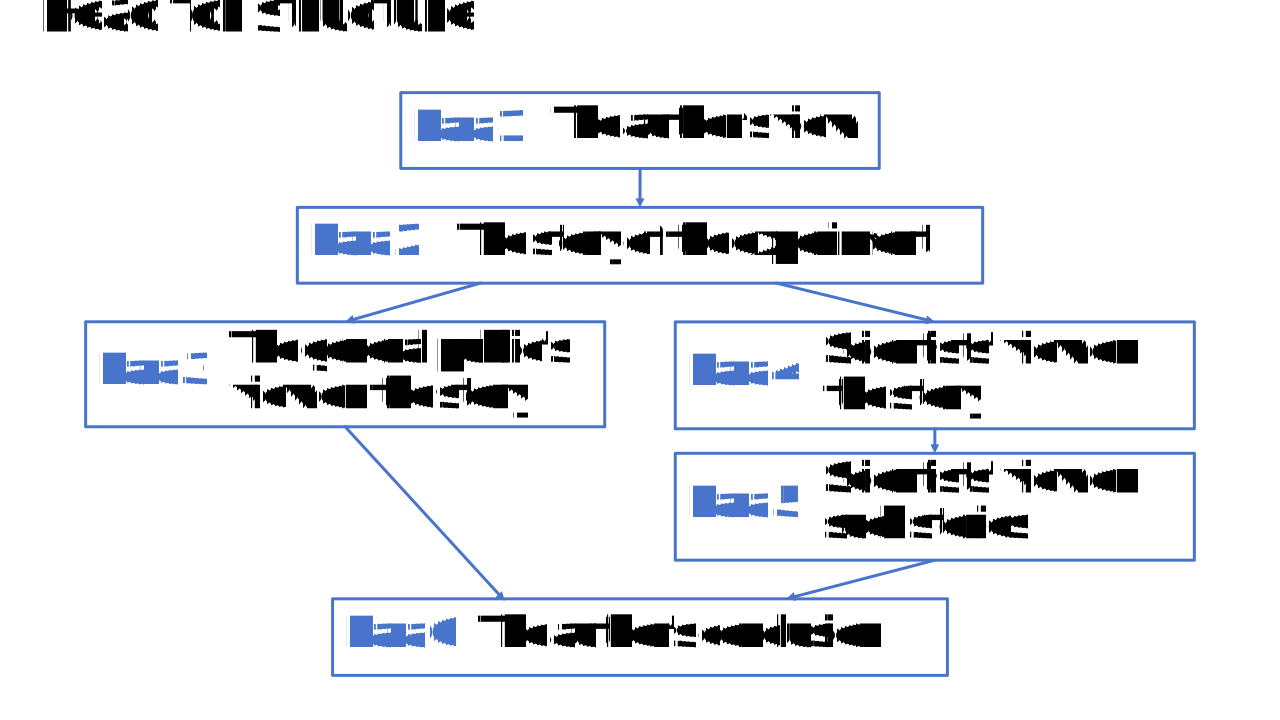
Read for structure
Para 2
Para 3
Para 4
Para 6
Para 1
Para 5
The author’s view
The story of the experiment
The general public’s view on the story
Scientists’ view on the story
Scientists’ view on such stories
The author’s conclusion
The title contains a question being answered in the essay.
Introduction
What is the experiment?
Different people hold different attitudes towards the experiment.
Conclusion
Read for details
Para. 2 The story of Franklin’s experiment
The lightning is _________________
Aim
Materials
Procedure
Result
Conclusion
To find out __________________________________
a kite, a string, a metal key
1. ___ a string __ a kite and ______ a metal key __ the string;
2. ___ the kite during ________;
3. _____ the key with _________.
A flash of lightning ____ the kite and electricity is __________ through the string to the key. He gets an _______ ______.
a form of electricity.
if lightning is produced by electricity
Tie
to
attach
to
Fly
a storm
Touch
the finger
hits
conducted
electric shock
Para. 3 The general public’s view on the story
How popular?
Why?
Read for details
Schools have taught the story of Franklin’s lightning experiment for many years.
Schoolchildren have been amazed at and inspired by the story and they have realised the importance of scientific experiment through the experiment.
Para. 4-5 Scientists’ view on the story and such stories
What is true?
What is false?
Why do scientists think so?
Why do scientists question accepted ideas?
It took place.
The detail about the string and the key is true.
Franklin touched the key.
He would certainly have died from the electric shock if he had touched the key.
They want to establish the facts.
Read for details
Para. 6 The author’s conclusion
What is the author’s attitude towards such fictional stories? Why?
A. Negative B. Positive C. Neutral D. Indifferent
Admittedly, fiction is more interesting than the truth.
But in science, facts should be proved by experiments and research.
What is the author’s conclusion from the story?
We should not always believe everything we read or hear - even if it is a great story.
What really happened?
Read for details
In the speaker’s opinion, what is the real experiment?
Loose threads on the kite string started to stand on end (竖起来).
He then touched his knuckle to the key and received the electric shock.
The kite was conducting
electricity.
Do you think it matters that Franklin’s experiment might not be true? Why?
Yes. I think it matters because…
No. I think it does not matter because…
Yes, It matters because science, at its core, is not about heroic individuals performing singular, dramatic acts. It is a collaborative evidence-based and accumulative process.
No. I think it does not matter because even though the story is fiction instead of fact, it still has immense cultural power and value.
A Powerful Symbol: The image of a man harnessing the power of the heavens with a simple kite and a key is a perfect symbol of the Enlightenment: human reason and curiosity triumphing over superstitious fear.
Inspirational Value: The story has inspired countless young people to become interested in science. It's a captivating narrative that communicates a complex idea in a simple, memorable way.
$
资源预览图

1

2

3

4

5
6
相关资源
由于学科网是一个信息分享及获取的平台,不确保部分用户上传资料的 来源及知识产权归属。如您发现相关资料侵犯您的合法权益,请联系学科网,我们核实后将及时进行处理。