Unit5 Working the Land 衡水体书写字帖-2025-2026学年高中英语人教版(2019)选择性必修第一册
2025-10-16
|
8页
|
539人阅读
|
2人下载
普通
资源信息
| 学段 | 高中 |
|---|---|
| 学科 | 英语 |
| 教材版本 | 高中英语人教版选择性必修第一册 |
| 年级 | 高二 |
| 章节 | Unit 5 Working the Land |
| 类型 | 学案-学习任务单 |
| 知识点 | - |
| 使用场景 | 同步教学-新授课 |
| 学年 | 2025-2026 |
| 地区(省份) | 河北省 |
| 地区(市) | 衡水市 |
| 地区(区县) | - |
| 文件格式 | |
| 文件大小 | 25.01 MB |
| 发布时间 | 2025-10-16 |
| 更新时间 | 2025-10-16 |
| 作者 | 好fine不怕晚 |
| 品牌系列 | - |
| 审核时间 | 2025-10-16 |
| 下载链接 | https://m.zxxk.com/soft/54391636.html |
| 价格 | 0.50储值(1储值=1元) |
| 来源 | 学科网 |
内容正文:
A PIONEER FOR ALL PEOPLE
Yuan tongping,known as the "father of hybrid rice",was one of China's
most famous scientists.Yet,he considered himself a farmer because he
continuatty worked the tand in his research.Indeed,his stim but strong
body was just like that of millions of Chinese farmers,to whom he had
devoted his tife
Yuan tongping was born in 1930 in Beijing.His parents wanted him to
pursue a career in science or medicine.However,what concerned him
most was that farmers often had poor harvests and sometimes even had
a serious shortage of food to eat.To tackle this crisis,he chose to study
agricutture and received an education at Southwest Agricultural College
in Chongqing.
After graduating in 1953,he worked as a researcher.Yuan Longping
reatised that larger fietds were not the solution.Instead,farmers needed
to boost uields in the fields they had.How this could be done was a
chaltenging question at the time.Yuan was convinced that the answer
could be found in the creation of hybrid rice.A hybrid is a cross between
two or more varieties of a species.One characteristic of hubrids is that
they usually attain a higher yield than conventionat crops.However,
whether it was possible to devetop a hubrid of self-poltinating plants such
as rice was a matter of great debate.The common assumption then was
that it coutd not be done.Through intense effort,Yuan overcame
enormous technicat difficulties to develop the first hubrid rice that could
2
be used for farming in 1974.This hubrid enabted farmers to expand their
output greatly
Today,it is estimated that about 60 percent of domestic rice consumption
in China is comprised of crops generated from Yuan's hybrid strains,and
his strains have allowed China's farmers to produce around 200 miltion
tons of rice per year.Yuan's innovation has helped feed not just China,
but many other countries that depend on rice as well,such as India and
Vietnam.Because of his invaluabte contributions,Yuan tongping received
numerous awards both in China and abroad.
Given that Yuan's hybrids made him quite wealthy,one might think he
would have retired to a tife of teisure.However,this is far from the case.
Deep down,Yuan was stilt very much a farmer at heart.As a man of the
3
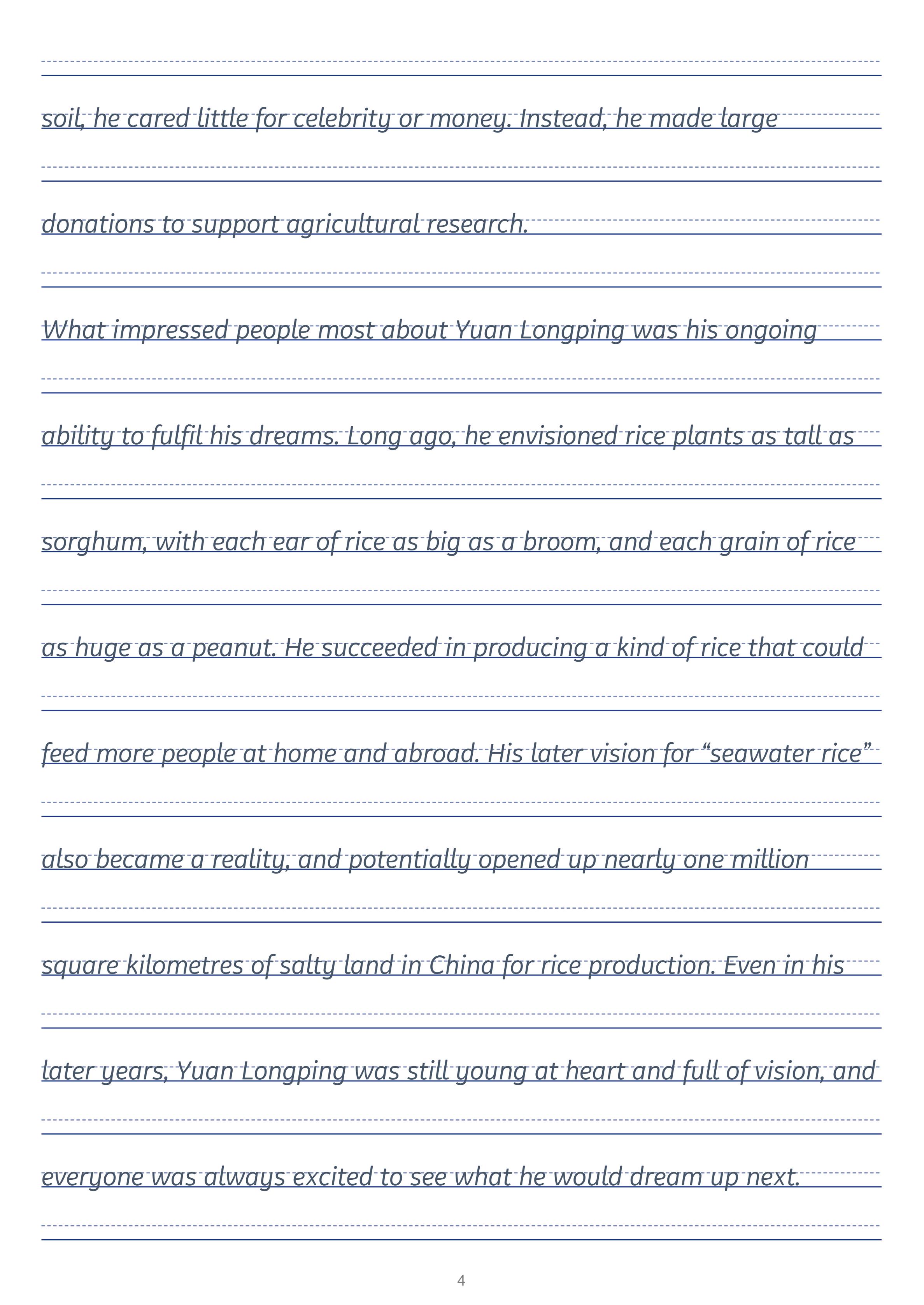
soil,he cared littte for cetebrity or money.Instead,he made targe
donations to support agricuttural research.
What impressed people most about Yuan tongping was his ongoing
abitity to fulfit his dreams.Long ago,he envisioned rice plants as tatl as
sorghum,with each ear of rice as big as a broom,and each grain of rice
as huge as a peanut.He succeeded in producing a kind of rice that coutd
feed more peopte at home and abroad.His later vision for "seawater rice".
also became a reality,and potentialty opened up nearty one mittion
square kilometres of salty land in China for rice production:Even in his
later years,Yuan Longping was still young at heart and full of vision,and
everyone was always excited to see what he would dream up next.
4
CHEMICAL VERSUS ORGANIC FARMING
Chemicat pesticides and artificiat fertilisers have been in widespread use
in farming since the middte of the 20th century.When they were first
introduced,many farmers welcomed them as a great way to fight crop
disease and increase production.Over time,however,what some
scientists have found is that their tong-term use can sometimes harm
both the land and people's heatth.
For example,pesticides can damage the tand by killing not only harmfut
bacteria and insects,but also hetpfut ones.In addition,these chemicals
can stay in the soil and underground water sources for a long time.This
5
affects the crops grown on the tand and,in turn,the animals and humans
who digest them.Many people worry that these chemicals may make
them ill and even cause cancer.In fact,some pesticides tike DDT have
been prohibited in most countries because of the damage they cause to
people and the environment.As for chemicat fertilisers,crops grown with
them usually grow too fast to be rich in nutrition.They may took
beautifut on the outside,but inside there is usually more water than
essentiat minerats,and they often have less flavour as wetl
As an alternative,some farmers have switched to organic farming,and
many customers have turned to organic food when they shop at the local
grocery.Organic farming is simpty farming without using any chemicals.
6
Organic farmers focus on keeping their soil rich and free of disease
through naturat means.For exampte,many organic farmers use naturat
waste from animals as fertiliser.This makes the soil in their fields richer
in minerals.It atso keeps the air,soil,water,and crops free of chemicats.
Organic farmers also use many other methods to produce rich soit.They
often change the kind of crop grown in each field every year.For instance,
they may grow corn or wheat in a field one year,and then grow beans
there the next.Why different crops are grown is that they put important
minerals back into the ground,making it ready for the next batch of
crops.Organic farmers atso plant diverse crops that use different depths
of soil to help keep it rich.For example,peanuts grow on the ground's
surface,but many other vegetabtes put down deep roots.The goal of
7
using different organic farming methods is to grow good food while
avoiding damage to the environment or to people's health.
Some people would prefer to stop the use of man-made chemicats in
agricutture entirely.What keeps them from doing so is the fact that
chemicat farming serves the high demand for food around the wortd.
Organic farming is nowhere near able to meet that need.Therefore,there
is still a tong way to find a suitabte sotution that puts sufficient food on
the dinner table white keeping people and the environment as healthy as
possible
8
资源预览图

1

2

3
4

相关资源
由于学科网是一个信息分享及获取的平台,不确保部分用户上传资料的 来源及知识产权归属。如您发现相关资料侵犯您的合法权益,请联系学科网,我们核实后将及时进行处理。