Unit4 Body Language 衡水体书写字帖-2025-2026学年高中英语人教版(2019)选择性必修第一册
2025-10-16
|
8页
|
260人阅读
|
0人下载
普通
资源信息
| 学段 | 高中 |
|---|---|
| 学科 | 英语 |
| 教材版本 | 高中英语人教版选择性必修第一册 |
| 年级 | 高二 |
| 章节 | Unit 4 Body Language |
| 类型 | 学案-学习任务单 |
| 知识点 | - |
| 使用场景 | 同步教学-新授课 |
| 学年 | 2025-2026 |
| 地区(省份) | 河北省 |
| 地区(市) | 衡水市 |
| 地区(区县) | - |
| 文件格式 | |
| 文件大小 | 24.36 MB |
| 发布时间 | 2025-10-16 |
| 更新时间 | 2025-10-16 |
| 作者 | 好fine不怕晚 |
| 品牌系列 | - |
| 审核时间 | 2025-10-16 |
| 下载链接 | https://m.zxxk.com/soft/54391635.html |
| 价格 | 0.50储值(1储值=1元) |
| 来源 | 学科网 |
内容正文:
LISTENING TO HOW BODIES TALK
We use both words and body language to express our thoughts and
opinions in our interactions with other peopte.We can learn a tot about
what people are thinking by watching their body language:Words are
important,but the way peopte stand,hold their arms,and move their
hands can also give us information about their feelings.
Just tike spoken tanguage,body language varies from culture to culture.
The cruciat thing is using body tanguage in a way that is appropriate to
the culture you are in.For example,making eye contact-tooking into
someone's eyes-in some countries is a way to display interest.In other
countries,by contrast,eye contact is not always approved of.For
exampte,in many Middle Eastern countries,men and women are not
sociatty permitted to make eye contact.In Japan,it may demonstrate
respect to took down when talking to an older person.
The gesture for "OK"has different meanings in different cultures.In
Japan,someone who witnesses another person employing the gesture
might think it means money.In France,a person encountering an
identical gesture may interpret it as meaning zero.However,you should
avoid making this gesture in Brazil and Germanu,as it is not considered
polite.
Even the gestures we use for“yes”and“no”differ around the world.In-
many countries,shaking one's head means "no",and nodding means
"yes".By comparison,in Butgaria and southern Albania,the gestures
2
have the opposite meaning.There are also differences in how we touch
each other,how close we stand to someone we are talking to,and how
we act when we meet or part.In countries like France and Russia,peopte
may kiss their friends on the cheek when they meet.Elsewhere,people
favour shaking hands,bowing from the waist,or nodding the head when
they meet someone else.
Some gestures seem to have the same meaning everywhere.Placing your
hands together and resting them on the side of your head while closing
your eyes means“steep”.A good way of saying“1 am futl"is moving your
hand in circles over your stomach after a meal.
Some body tanguage has many different uses.Perhaps the best example
is smiling.A smile can hetp us get through difficult situations and find
3
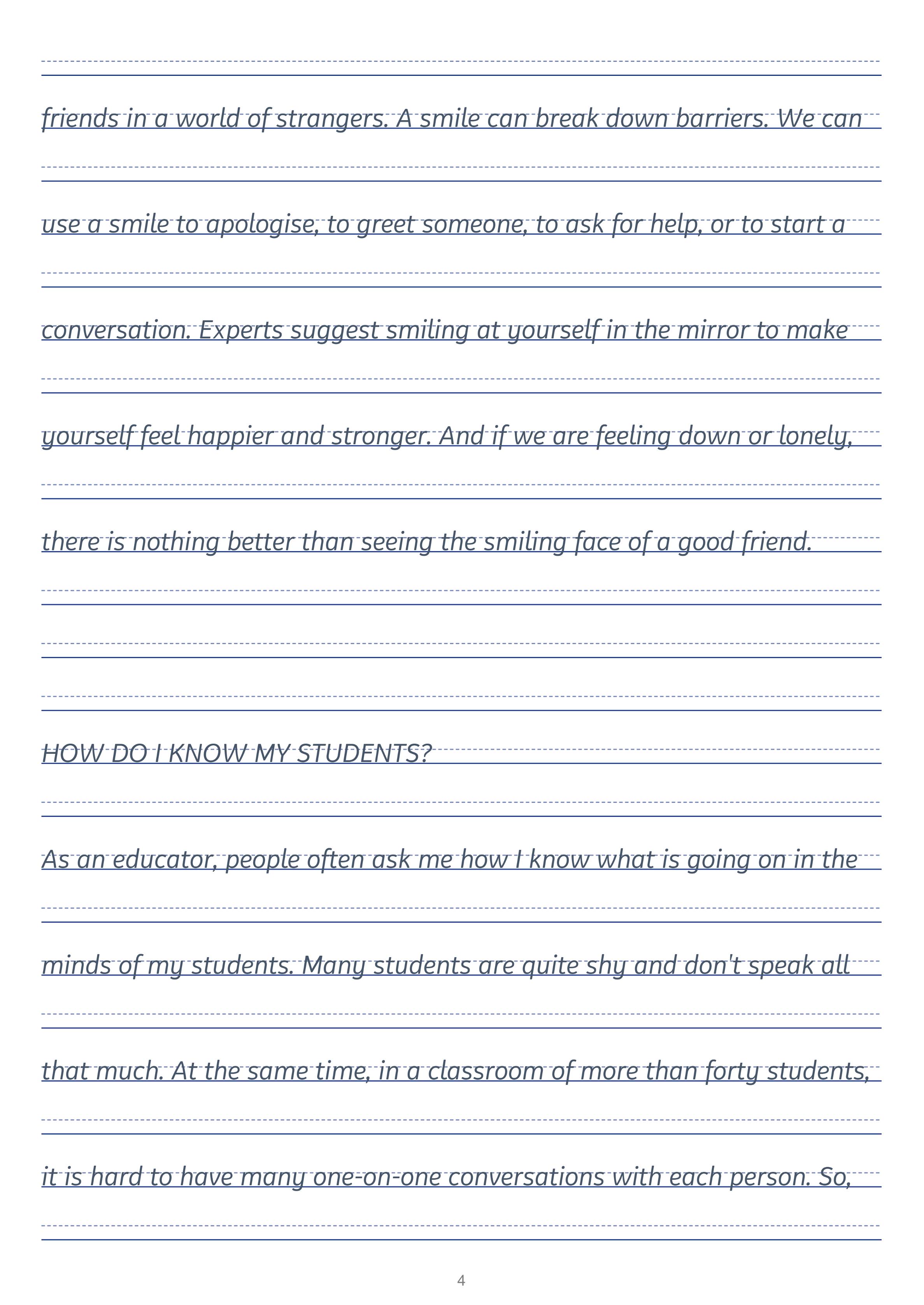
friends in a world of strangers.A smile can break down barriers.We can
use a smile to apologise,to greet someone,to ask for help,or to start a
conversation:Experts suggest smiting at yourself in the mirror to make
yourself feel happier and stronger.And if we are feeling down or tonely,
there is nothing better than seeing the smiling face of a good friend.
HOW DOIKNOW MY STUDENTS?
As an educator,peopte often ask me how t know what is going on in the
minds of my students.Many students are quite shy and don't speak att
that much.At the same time,in a classroom of more than forty students,
it is hard to have many one-on-one conversations with each person.So,
4
how can I reatly know what makes each student tick?
My answer?I took at their body language.
It is easy to recognise when students are interested in a lesson.Most tend
to took up and make eye contact.When I make a joke,they smite.When I
tatk about something difficult,they look confused.I know when students
are really interested,however,because they lean forward and took at me:
People have a tendency to tean towards whatever they are interested in.
So if a student has his head towered to look at his watch,it implies he is
bored and just counting the minutes for the class to end.If two friends
are leaning their heads together,they are probably writing notes to each
other.Of course,not everyone who looks up is paying attention in ctass.
Some students took up,but there is an absence of eye contact.Their eyes
5
barely move,and they atways have the same distant expression on their
faces.It is as though they are asteep with their eyes open.
Some students are amused by something etse.They spend all their time
looking anywhere but at me.Then again,some students'favourite
activity is daydreaming.With their chins on their hands,they occupy
themselves by staring out of the window or up at the ceiling.They are
certainly interested in something,but who knows what.The main thing is
reminding distracted students that they need to pay attention in class.
White it is easy to perceive when students are interested,bored,or
distracted,it is sometimes much harder to distinguish when students are
troubled.Students who are angry,afraid,or experiencing anxiety may
6
have their arms crossed in front of their chests and their legs closed or
crossed,like they are guarding their bodies.Students who are sad or
worried will nearly atways wear a frown.They may atso hide their faces
in their hands tike they are embarrassed or ashamed.Some students act
this way merely because they are afraid of being catled on by the
teacher.However,if a student does not bother to brush her hair and her
eyes are red from weeping,then can infer that there are deeper issues at
work.It could be that she is having serious conflicts with other students
or at home.Whatever it is,I know I need to inquire and assess what is
going on.
Ultimately,my duty is helping every student to tearn.Their body
lanquage tets me know when to adjust class activities,when to intervene,
and when to talk to students individuatly,so they can all get the most
out of school.Reacting to body tanguage is an important component of
being a teacher.
8
资源预览图

1

2

3
4

相关资源
由于学科网是一个信息分享及获取的平台,不确保部分用户上传资料的 来源及知识产权归属。如您发现相关资料侵犯您的合法权益,请联系学科网,我们核实后将及时进行处理。