Unit 4 Period 2 Grammar & Usage (课件)英语译林版2020必修第二册
2025-10-10
|
16页
|
2430人阅读
|
13人下载
精品
摘要:
该高中英语课件系统讲解情态动词用法,涵盖ought to、have to、must等词的基础功能(如必要性、可能性)及拓展用法(如完成式表责备),通过对比辨析(如must与have to的主客观区别)和例句分析,构建“基础用法—拓展功能—语境应用”的学习支架,帮助学生逐步掌握其在不同语境中的运用。
其亮点在于融合语言能力与思维品质培养,通过阅读日记补全情态动词、小组制定图书馆规则等任务让学生在真实语境中运用知识,结合总结表格梳理功能分类提升学习能力。学生能深化语言理解,教师可借助系统资源和任务设计提高教学效率。
内容正文:
Unit 4 Exploring literature
Grammar & Usage
1
目标
1. identify and categorize the usage of modal verbs;
2. summarize general rules of modal verbs;
3. distinguish and use the right modal verbs to finish tasks of offering suggestions and making rules.
2
Exploring the rules
Below is a website article about how to choose books. Read the article and get some ideas about the answers to the question.
Suggestion What shall I read?
… you can get ideas from different sources …
You could also read book reviews in newspapers, in magazines or online.
Ability Teachers in particular can provide suggestions for interesting reading materials that can be found in the library or bookshop easily.
A book review can often tell you whether a book is worth reading or not.
Necessity … what books you ought to read.
However, you must also decide for yourself what kind of books to read.
You do not have to read a book just because everyone recommends it.
Possibility You might have asked yourself this question more than once.
These ideas should point you in the right direction.
… you may find yourself better able to seek out books to your taste …
Read the passage again and find the other sentences that use modal verbs, identifying their functions respectively. And then fill in thetable on Page 48.
Working out the rules
Model verbs can express ability or necessity. They can also make suggestions or describe the probability of an event. The same modal verb can have different functions.
Modal verbs can be followed by _____________.
You can choose more than one answer for the blank.
a do(the base form) d be done(the passive voice)
b doing(the verb-ing form) e be doing(the continuous form)
c did (the past form) f have done (the perfect form)
a, d, e, f
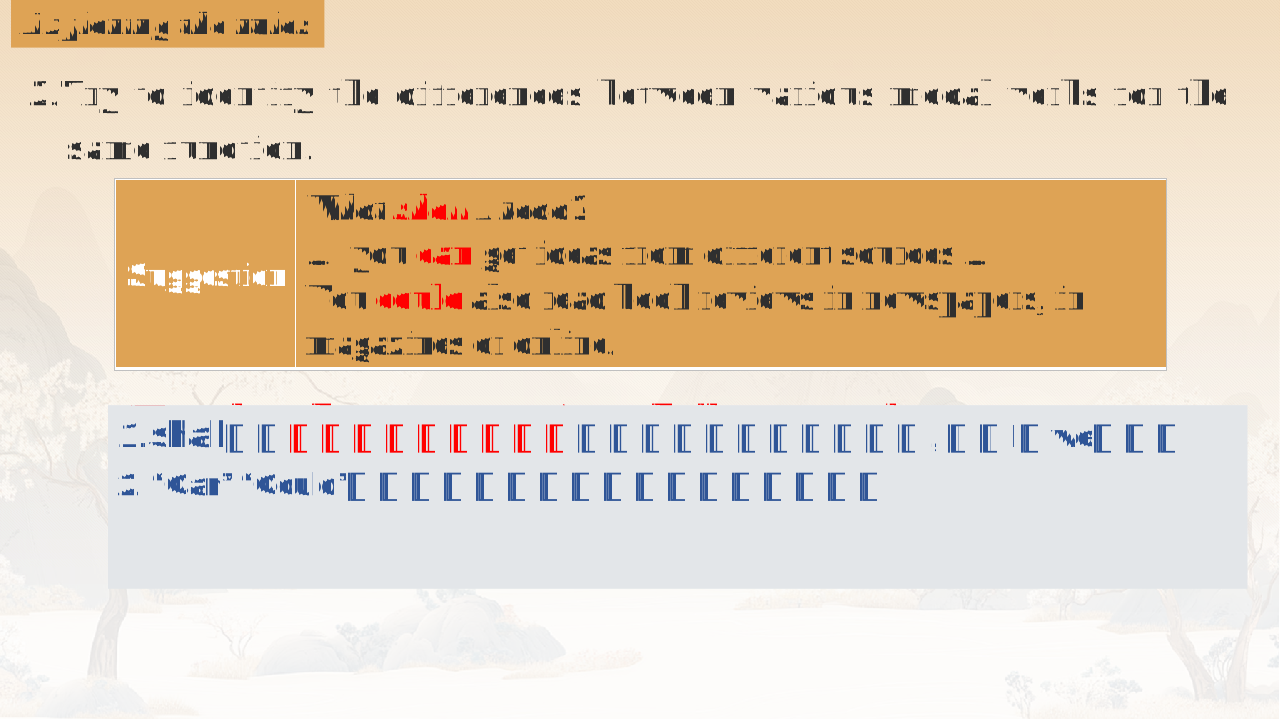
Suggestion What shall I read?
… you can get ideas from different sources …
You could also read book reviews in newspapers, in magazines or online.
Exploring the rules
1.What we do this weekend?
2. Which one should I choose? You choose the red one。
Modal verbs for suggestion: shall, can, could
shall
can
1.shall用于一、三人称的疑问句,表征求建议或请求允许, 多与I或we连用。
2. “Can” “Could”能用来给出建议或提出问题的解决办法
2.Try to identify the differences between various modal verbs for the same function.
Ability Teachers in particular can provide suggestions for interesting reading materials that can be found in the library or bookshop easily.
A book review can often tell you whether a book is worth reading or not.
_____you speak any foreign language?
By the time she was eight, she _______ read Greek and Latin.
He fell into the river, but he swim to the bank.
Modal verbs for ability: can, could, be able to
could
was able to
Can
can表能够做某事(具备某种能力);could主要指过去能够.
Be able to 则可以用于其他时态。
表示“经过努力才得以做成功某事”时应用be able to,相当于succeeding in doing=managed to do.不能用can/could。
Exploring the rules
Necessity … what books you ought to read.
However, you must also decide for yourself what kind of books to read.
You do not have to read a book just because everyone recommends it.
As a League member, you set a good example to your classmates.
You_______obey the rules, otherwise I would punish you.
It’s five o’clock. I _____________ leave now.
Modal verbs for necessity: should, ought to, must, have to
ought to (should)
must
have to
1. must表示“必须, 一定要”。肯定句中表说话人的主观看法。must 只有一般现在时。
2. have to 表示“不得不”,强调客观需要,有更多的时态形式。
3.should表义务, 意为“应该”(某件事宜做),用于各种人称;
4. Ought to→should→have to→must语气由弱到强
Exploring the rules
Possibility You might have asked yourself this question more than once.
These ideas should point you in the right direction.
… you may find yourself better able to seek out books to your taste …
—Where’s Rose?
—I’m not sure. She be at home.
You haven’t eaten all day. You _________ be hungry.
I don’t believe it. It _________ (not) be true.
Wild dogs be dangerous.
Mary took dancing classes for years; she _________ be an excellent dancer.
Modal verbs for probability: may, might, could, can, should must
may/might/could
must
can’t
can
should
may/might/could:也许;大概;表示把握不大的推测
can表可能性或推断,用于肯定句中表常有的行为和情形,意为“有时会/可能”
can’t:不可能;推测的语气相当有把握
couldn’t:不可能;语气较委婉
should:很可能;应该…, 指按常理推测
must:肯定;准是;想必是
Exploring the rules
1.For the following groups of three sentences, tick the sentence which uses the modal verb differently from the other two.
P49B1
ability
permission
possibility
permission
necessity
possibility
possibility
suggestion
Applying the rules
10
B2 Below is an entry in a student’s reading journal. Complete the entry with the correct model verbs in brackets.
When my English teacher suggested that I read Charles Dickens’s A Christmas Carol, I thought, “I (1) (can’t/shouldn’t) read this! It (2) (has to/must) be very boring.” Surprisingly, it turned out the exact opposite. I (3)
(could/might) not stop turning the pages!
The book’s main character is Scrooge, a rich but mean old man. He hates all kinds of celebrations. On Christmas eve, he is transported to different points in his life by three spirits. In the end, he reflects on these moments and realizes his mistakes. Then he decides that he (4) (might/must) change himself. On Christmas morning, he sends a large turkey to a poor man for Christmas dinner. He also tries to make his family and friends happy by spending time with them.
There is something that (5) (can/must) be learnt from A Christmas Carol: we (6) ——(should/may) treat others with kindness, generosity and love. I think everyone (7) (would/ought to) read this book.
can’t
must
could
must
can
should
ought to
Applying the rules
I. 选择填空。
1. Robert is good at languages and_______ (can/must)
speak four languages.
2. The meeting is very important and you ___________
(would/should) attend it on schedule.
3. I managed to find the street, but I____________
(couldn't/mustn't) find her house.
4. When the girl was five years old, she _________
(might/could) skate very well.
5. Every Sunday afternoon, the boy______(will/may) sit
there hour after hour looking at the traffic go by.
can
should
couldn't
could
will
6. In his childhood, Jack__________(would/could) be
nervous when he met strangers.
7. If you earn more than 5,000 yuan per month, you ______(have to/can) pay tax (税).
8. According to the doctor's advice, the medicine
__________(might/must) be taken three times a day.
9. Rose _______(can't/needn't) be in the classroom
now, because I saw her leave school several
minutes ago.
10. You_________(ought to/will) give up smoking. It
does no good to your health.
would
have to
must
can't
ought to
功能 情态动词
表能力
表可能性
表必要性
表职责
表许可
表请求,建议
can (现在), could(过去)
can, could, may, might, must, should,
ought to
must, mustn’t, need, needn’t, have to
should, ought to
can, could, may, might, shall
will, would, should, shall (疑问句),ought to, may, might
Summary
14
1. Summarize the different functions of the following modal verbs: can, must, should, may, might and shall.
2. Write a paragraph on the book you would like to recommend most with at least five sentences, using proper modal verbs.
Homework
15
Thanks~
16
$
资源预览图

1

2

3

4

5
6

相关资源
示范课
由于学科网是一个信息分享及获取的平台,不确保部分用户上传资料的 来源及知识产权归属。如您发现相关资料侵犯您的合法权益,请联系学科网,我们核实后将及时进行处理。