U1L1 Talking with Others-Where are you from?(教学设计)-《新模式英语1》(劳保版第三版)《上好课》
2025-09-10
|
6页
|
525人阅读
|
5人下载
精品
内容正文:
版 本
《新模式英语1》(劳保版第三版)
课 题
Unit 1 Talking with Others
( Lesson 1 Where are you from? )
课 型
新授课
课 时
授课班级
授课时间
授课教师
教材分析
本课是《新模式英语1》(劳保版第三版)第一单元 “Talking with Others”的第一课“Where are you from?”,是单元主题“与人交流”的开篇内容,核心目标为“提供个人信息(Give personal information)”,在整个单元中起到基础铺垫作用。教材围绕“个人信息”设计了多样化的教学活动:从阅读 Ryan 的个人介绍文本(Exercise A),到提取关键信息完成表格(Exercise B),再到结合图片听录音补全人物信息(Exercise D)、匹配问答句式(Exercise E),最后通过图表学习 “be动词一般现在时”语法(Exercise F)并进行句子创作(Exercise G)与小组访谈实践(Exercise H)。这些内容由易到难、层层递进,既符合中职学生“从输入到输出”的语言学习规律,又紧密贴合中职教育实用性导向——学生掌握个人信息表达,不仅能满足日常校园交流需求,还能为未来职场中的自我介绍、同事沟通等场景打下基础,是连接基础英语学习与职业应用的重要起点。
学情分析
本课授课对象为中职学校一年级学生。学生在初中阶段已接触过简单的个人信息表达(如姓名、年龄)和基础be动词用法,但存在知识遗忘率高、词汇量有限(如“major(专业)”“welding(焊接)”“floristry(花艺)”等职业相关词汇陌生)、语法应用不熟练的问题,难以完整、连贯地用英语介绍自己。中职学生对与自身生活、专业相关的话题兴趣更高——本课涉及“专业(major)”“国家(country)”等与学生身份紧密关联的内容,容易引发共鸣;同时,学生乐于参与互动性强的活动(如角色扮演、小组访谈),动手实践意愿高于单纯的文本学习。需要注意的是,学生英语水平差异较大,部分基础薄弱学生恐惧开口表达,害怕发音错误或表达不流畅;此外,学生对语法规则的学习兴趣较低,单纯讲解be动词用法易导致注意力分散,需要通过情境化、任务化的活动降低学习难度。
学习目标
Knowledge objectives:
To master some words and expressions about personal information:
name/age/country/major/welding/floristry/restaurant service
To be able to learn the sentence patterns for asking and answering about personal information:
Question patterns: Where are you from?/What's your name?/How old are you?/What's your major?
Response patterns: I'm from.../My name is.../I'm... years old./My major is...
To understand and master the use of the verb "be" (am/is/are) in the simple present tense, and be able to correctly match "be" with subjects (I/he/she/we/you/they)
Ability objectives:
To be able to independently read simple personal introduction texts and extract key information such as name, age, country and major.
To be able to understand short conversations about personal information and complete the missing information.
To be able to have one-on-one Q&A about personal information with peers, with basically accurate pronunciation and coherent expression; to be able to participate in group interview activities, record others' information and give a brief report.
Emotional objectives:
To enhance students' confidence in communicating in English and help them overcome the "fear of speaking" by sharing personal information.
To cultivate students' cross-cultural awareness (e.g., understanding different national backgrounds) and sense of class belonging, as well as stimulate their sense of identity with their own majors, by learning about peers' majors and countries (or hometowns).
教学重难点
1.Master core occupation-related vocabulary (e.g., welding, floristry) and use them accurately in practical contexts.
2.Proficiently apply key Q&A sentence patterns (such as "Where are you from?") in real-life dialogues with correct basic usage of the verb "be" (am/is/are).
教学方法
情境教学法、任务教学法、直观演示法、小组讨论法
课前准备
PPT课件,语音素材
教学媒体
PPT课件、多媒体设备、语音素材、拓展资源包等
教学过程
教学环节
教师活动设计
学生活动设计
设计意图
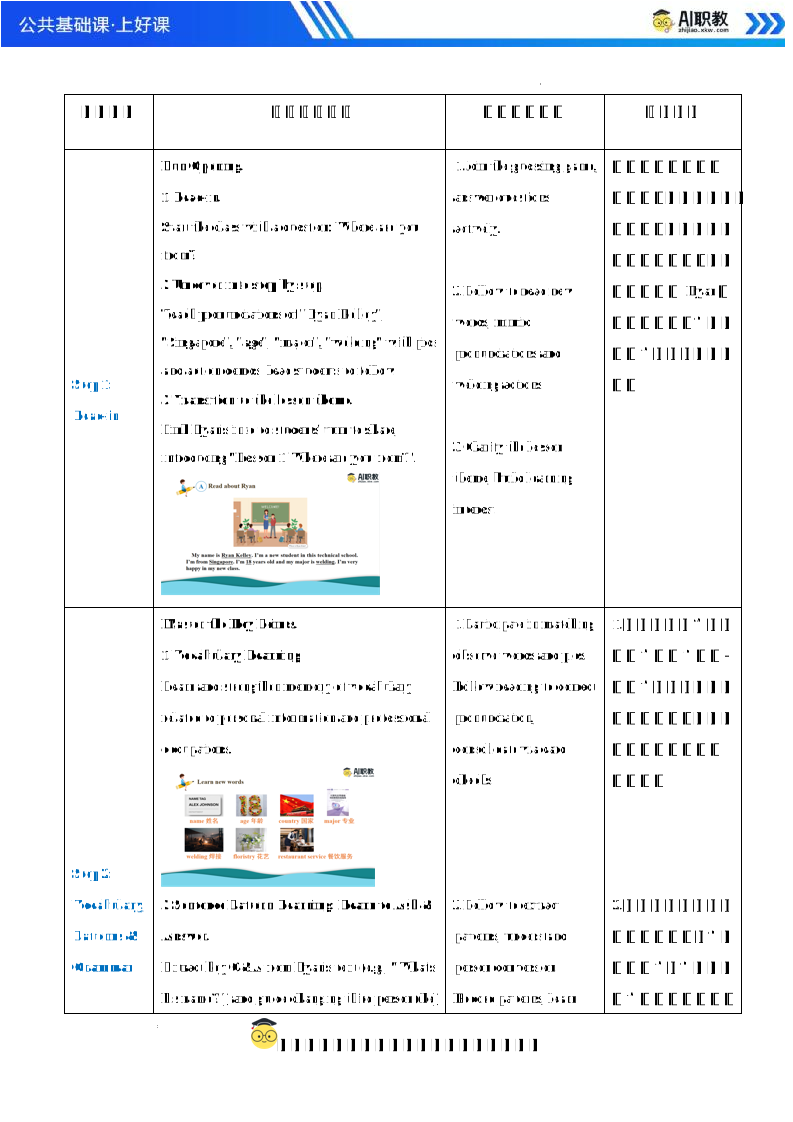
Step 1:
Lead-in
Fun Opening.
1.Lead-in.
Start the class with a question: Where are you from?
2.Uncover info step by step.
Teach pronunciations of "Ryan Kelley", "Singapore", "age", "major", "welding" with pics and action demos; lead students to follow.
3.Transition to the lesson theme.
Link Ryan's info to students' turn to share, introducing "Lesson 1 Where are you from?".
1.Join the guessing game, answer questions actively.
2.Follow to read new words, mimic pronunciations and welding actions.
3.Clarify the lesson theme, build learning interest.
用问答引入将学习趣味化,吸引注意力;借图片、动作帮学生理解陌生词汇,为新授铺垫;以Ryan的例子自然引入“个人信息”主题,过渡流畅。
Step 2:
Vocabulary, Patterns & Grammar
Master the Key Points.
1.Vocabulary Learning.
Learn and strengthen memory of vocabulary related to personal information and professional occupations.
2.Sentence Pattern Learning: Learn to Ask & Answer.
Extract key Q&A from Ryan's text (e.g., "What's his name?") and guide changing third person (he) to first person (I).
Write core sentence patterns on the blackboard, do a demo dialogue with a student.
Guide others to observe and correct mistakes (e.g., omitting "m" in "from").
3.Grammar Learning: Be Verb Magic.
Show the be verb chart, mark subject-verb collocations with colors.
Explain with examples (e.g., "I am...") and contracted forms; conduct quick practice (e.g., "She ___ 19 years old").
1.Participate in matching, observe words and pics.
Follow reading to correct pronunciation, consolidate via card checks.
2.Follow to extract patterns, understand person conversion.
Record patterns, learn correct expressions from the demo.
3.Observe the chart, grasp be verb collocation rules.
Join quick practice, consolidate grammar and avoid mistakes.
1.此活动通过“图文匹配”建立“词汇-意义”关联,突破专业词汇难点,通过跟读检查强化词汇认读记忆。
2.从已知文本提取句型降低难度;借“人称转换”和“师生示范”明确句型用法,为互动练习奠基。
3.借图表直观呈现语法规则,结合例句理解应用;快速练习及时检验掌握情况,突破be动词搭配难点。
Step 3:
Interactive Pair Practice
Group Dialogue: Pair Work - Ask & Answer.
Assign pair work: Ask students to talk about personal info with a deskmate using given examples.
Do pair dialogues, record each other's info.
Present dialogues, accept feedback to improve.
课堂练习互动环节,借“结对对话”让学生在真实互动中用句型,突破开口恐惧,增强表达自信。
Step 4:
Listening Practice
Listen & Talk: Complete the Information.
Assign task: Ask students to fill in a form (name, age, etc.) while listening to the introductions of 3 people.
Play recording 3 times (main idea → fill info → check answers); explain error-prone points.
Clarify task, know info types to fill.
Listen 3 times, complete the form and correct mistakes.
通过听力练习培养抓关键信息能力,巩固词汇句型。分3次播放符合学生水平,减轻压力。
Step 5:
Group Interview
Extension: Group Interview.
Organize groups (4-5 students/group, 1 recorder per group); assign interview task: Recorder asks info and fills a chart.
Allocate 5 mins for interviews, 1 min for group sharing; invite 1-2 groups to report.
1.Do group interviews: Recorder asks questions, others answer.
2.Share results in groups, report and supplement.
将“一对一”拓展为“多人互动”,提升群体场景语言运用能力。记录和汇报强化信息提取与输出,体现实用性。
Step 6:
Practice
Design 7 questions related to what was learned in this lesson, including fill-in-the-blanks, multiple-choice, matching, and other exercise types, to allow students to practice immediately.
Step 7:
Summary and Homework
Summary.
1.Actively participate in vocabulary reading and meaning explanation, confirming mastery of personal information and professional-related words.
2.Engage in pair dialogue practice, flexibly using the learned Q&A sentence patterns to ask and answer about personal information (e.g., name, hometown, major).
3.Respond to the teacher’s grammar practice questions accurately, demonstrating understanding of the collocation between the verb "be" and different subjects.
4.Summarize independently: Share one key piece of knowledge learned (e.g., "I learned how to ask others about their majors using 'What's your major?'") to consolidate the day’s learning content.
Homework.
1.Memorize the personal information-related words (name/age/country/major/welding/floristry/restaurant service) and core Q&A sentence patterns (e.g., "Where are you from?→I'm from...", "What's your major?→My major is...") learned in class; write each word and sentence pattern twice in the exercise book.
2.Write a 5-8 sentence personal introduction about yourself (including name, age, hometown and major) and read it aloud; record the reading audio and submit it.
3.Interview one family member about their basic information (e.g., job, favorite thing) using the learned sentence patterns, take simple notes and share the interview content in the next class.
板书设计
见总结部分
教学反思
(留白)
精品资源学科网独家享有版权,侵权必究!
学科网(北京)股份有限公司
学科网(北京)股份有限公司
$
资源预览图

1

2
3

由于学科网是一个信息分享及获取的平台,不确保部分用户上传资料的 来源及知识产权归属。如您发现相关资料侵犯您的合法权益,请联系学科网,我们核实后将及时进行处理。