Unit 3 After-school activities-Lesson 5 A plan for mountain climbing 教学设计 2024-2025学年冀教版英语七年级下册
2025-09-06
|
4页
|
249人阅读
|
0人下载
普通
资源信息
| 学段 | 初中 |
|---|---|
| 学科 | 英语 |
| 教材版本 | 初中英语冀教版七年级下册 |
| 年级 | 七年级 |
| 章节 | Lesson 5 A plan for mountain climbing |
| 类型 | 教案-教学设计 |
| 知识点 | - |
| 使用场景 | 同步教学-新授课 |
| 学年 | 2025-2026 |
| 地区(省份) | 全国 |
| 地区(市) | - |
| 地区(区县) | - |
| 文件格式 | DOCX |
| 文件大小 | 54 KB |
| 发布时间 | 2025-09-06 |
| 更新时间 | 2025-09-06 |
| 作者 | 匿名 |
| 品牌系列 | - |
| 审核时间 | 2025-09-06 |
| 下载链接 | https://m.zxxk.com/soft/53791011.html |
| 价格 | 0.50储值(1储值=1元) |
| 来源 | 学科网 |
内容正文:
Unit 3 After-school activities-Lesson 5 A plan for mountain climbing
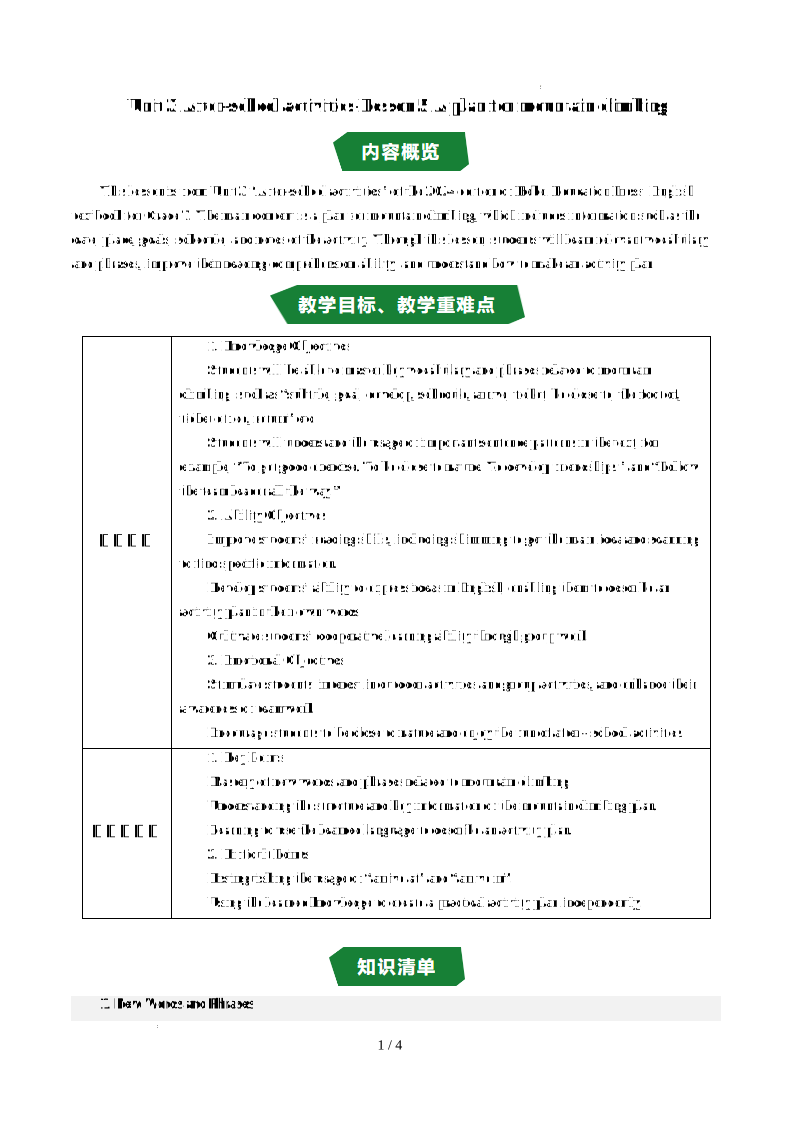
This lesson is from Unit 3 “After-school activities” of the 2024 edition of Hebei Education Press’ English textbook for Grade 7. The main content is a plan for mountain climbing, which includes information such as the date, place, goals, schedule, and notes of the activity. Through this lesson, students will learn relevant vocabulary and phrases, improve their reading comprehension ability, and understand how to make an activity plan.
教学目标
1. Knowledge Objectives
Students will be able to master key vocabulary and phrases related to mountain climbing, such as “subtitle, goal, develop, schedule, arrive, ticket, be close to, the foot of, ticket office, return” etc.
Students will understand the usage of important sentence patterns in the text, for example, “To get good exercise. To be close to nature. To develop friendships.” and “Follow the team leader all the way.”
2. Ability Objectives
Improve students’ reading skills, including skimming to get the main idea and scanning to find specific information.
Develop students’ ability to express ideas in English, enabling them to describe an activity plan in their own words.
Cultivate students’ cooperative learning ability through group work.
3. Emotional Objectives
Stimulate students’ interest in outdoor activities and group activities, and enhance their awareness of teamwork.
Encourage students to be close to nature and enjoy the fun of after - school activities.
教学重难点
1. Key Points
Mastery of new words and phrases related to mountain climbing.
Understanding the structure and key information of the mountain climbing plan.
Learning to use the learned language to describe an activity plan.
2. Difficult Points
Distinguishing the usage of “arrive at” and “arrive in”.
Using the learned knowledge to create a practical activity plan independently.
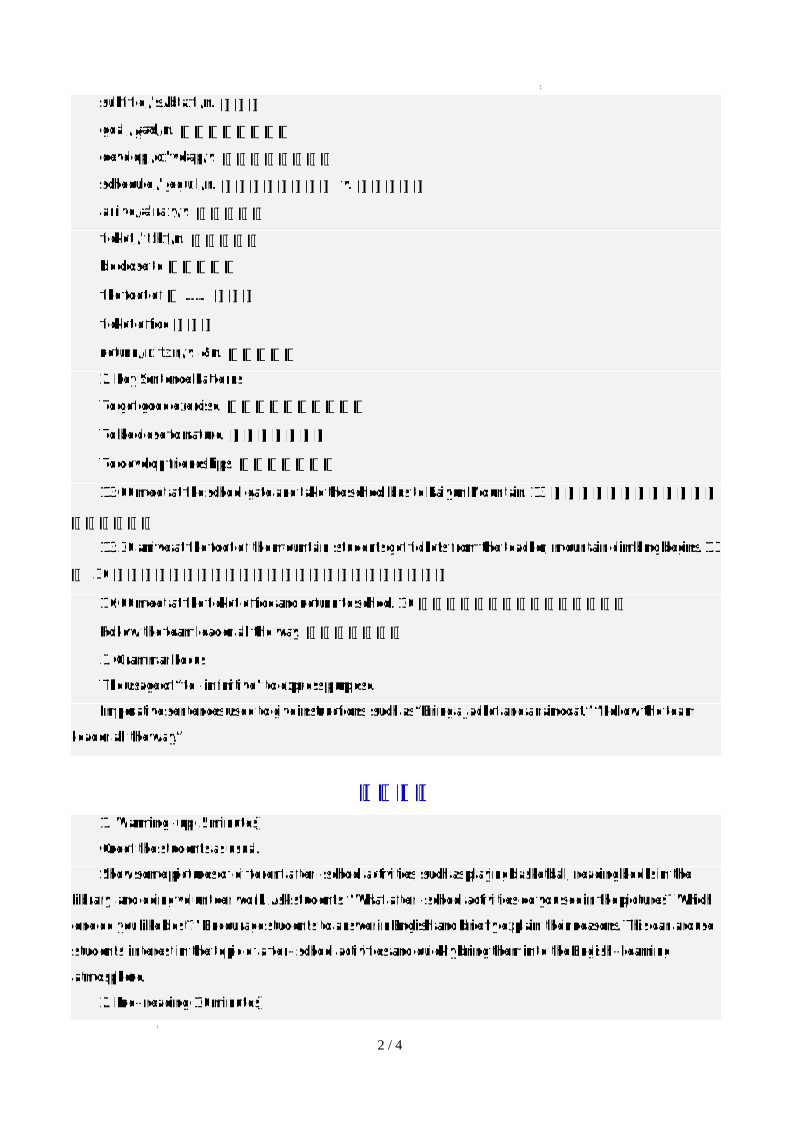
1. New Words and Phrases
subtitle /ˈsʌbtaɪtl/n. 副标题
goal /ɡəʊl/n. 目标;球门;得分
develop /dɪˈveləp/v. 发展;开发;培养
schedule /ˈʃedjuːl/n. 时间表;日程安排 v. 安排;预定
arrive /əˈraɪv/v. 到达;抵达
ticket /ˈtɪkɪt/n. 票;入场券
be close to 靠近;接近
the foot of 在…… 的底部
ticket office 售票处
return /rɪˈtɜːn/v. & n. 返回;归还
2. Key Sentence Patterns
To get good exercise. 为了得到良好的锻炼。
To be close to nature. 为了亲近自然。
To develop friendships. 为了增进友谊。
13:00 meet at the school gate and take the school bus to Baiyun Mountain. 13 点在校门口集合,乘坐校车前往白云山。
13:30 arrive at the foot of the mountain; students get tickets from the teacher; mountain climbing begins. 13 点 30 分到达山脚下,学生从老师那里领取门票,开始爬山。
16:00 meet at the ticket office and return to school. 16 点在售票处集合,然后返回学校。
Follow the team leader all the way. 全程跟随领队。
3. Grammar Focus
The usage of “to - infinitive” to express purpose.
Imperative sentences used to give instructions, such as “Bring a jacket and a raincoat.” “Follow the team leader all the way.”
教学过程
1. Warming - up (5 minutes)
Greet the students as usual.
Show some pictures of different after - school activities, such as playing basketball, reading books in the library, and doing volunteer work. Ask students: “What after - school activities do you see in the pictures? Which one do you like best?” Encourage students to answer in English and briefly explain their reasons. This can arouse students’ interest in the topic of after - school activities and quickly bring them into the English - learning atmosphere.
2. Pre - reading (10 minutes)
Introduce the topic of mountain climbing. Show some pictures of mountains and people climbing mountains. Ask students: “Have you ever climbed a mountain? How do you feel when you are climbing a mountain?” Let students share their experiences in pairs.
Teach new words and phrases related to mountain climbing. Use pictures, body language, and examples to help students understand and remember. For example, when teaching “be close to”, point to a student near you and say “He/She is close to me.” When teaching “arrive at”, show a picture of a school gate and say “We arrive at the school gate every morning.” Drill the new words and phrases with students through individual reading, group reading, and spelling.
3. While - reading (15 minutes)
Skimming: Let students quickly read the text and the picture in the textbook. Then ask them: “What is the text mainly about?” Guide students to answer that it is about a plan for mountain climbing. This step helps students get the general idea of the text.
Scanning: Ask students to read the text carefully again and complete the following tasks:
Read the plan and choose the right subtitles (Date, Place, Goals, Schedule, Notes) to complete it. Check the answers together and ask students to explain why they choose those subtitles.
Answer some detailed questions, such as “What is the aim of the mountain climbing activity?” “Where do the students meet to return to school?” “What time does the mountain climbing start?” “What things should students bring for the activity?” etc. After students answer, ask them to find the relevant sentences in the text to support their answers. This can train students’ ability to find specific information in the text.
Language Points Explanation: Explain some important language points in the text.
“To get good exercise. To be close to nature. To develop friendships.” Explain that the “to - infinitive” here is used to express purpose. Let students make some sentences using “to - infinitive” to express purpose, for example, “To improve my English, I read English stories every day.”
“arrive at” and “arrive in”. Use more examples to help students distinguish their usage. For example, “The train arrived at the small station on time.” “She will arrive in Beijing next week.” Then give students some sentences and let them choose the correct preposition.
“Follow the team leader all the way.” Explain that this is an imperative sentence, which is used to give instructions or commands. Let students make some imperative sentences, such as “Open the window, please.” “Don’t run in the classroom.”
4. Post - reading (10 minutes)
Group Work: Divide students into groups of 4 - 5. Ask each group to plan an after - school activity, such as a picnic in the park, a visit to a museum, or a volunteer activity. Each group needs to fill in a form including Date, Place, Goals, Schedule, and Notes. Then ask each group to present their activity plan to the whole class. During the presentation, other groups can ask questions. This activity can help students use the learned knowledge to create a practical activity plan and improve their cooperative learning ability and oral English expression ability.
Summary: Summarize the key points of this lesson with students, including new words, phrases, sentence patterns, and reading skills. Ask students to recall and repeat.
5. Homework Assignment (5 minutes)
Must - do: Ask students to write a short passage about their favorite after - school activity, introducing its date, place, how they feel, and what they learn from it.
Choose - to - do: Students can choose a family member or friend and invite him/her to their favorite after - school activity, and write a short invitation letter in English.
教学反思
After teaching this lesson, I will reflect on the following aspects:
Teaching Objectives: Check whether the teaching objectives have been achieved. Observe whether students can master the key vocabulary, phrases, and sentence patterns. Evaluate students’ performance in reading comprehension and oral and written expression. If some students still have difficulties, I will design some supplementary exercises or tutoring sessions for them.
Teaching Methods: Consider whether the teaching methods are appropriate. For example, whether the use of pictures, group work, and other methods can effectively arouse students’ interest and help them learn. If some teaching methods do not work well, I will adjust them in future teaching.
Student Participation: Analyze students’ participation in class. Check whether all students have actively participated in classroom activities. If some students are less involved, I will think about how to encourage them to participate more, such as by asking more questions to them, giving more positive feedback, or designing more interesting activities.
Teaching Process: Review the teaching process to see if there are any problems in the time arrangement. If some parts of the teaching process are too rushed or too slow, I will adjust the time allocation in future teaching to ensure a more smooth teaching process.
2 / 37
学科网(北京)股份有限公司
学科网(北京)股份有限公司
$$
资源预览图
1
2
相关资源
由于学科网是一个信息分享及获取的平台,不确保部分用户上传资料的 来源及知识产权归属。如您发现相关资料侵犯您的合法权益,请联系学科网,我们核实后将及时进行处理。