Unit 3 All about me-Lesson 1 Me and my body 教学设计 2025-2026学年冀教版英语七年级上册
2025-09-05
|
5页
|
347人阅读
|
4人下载
普通
资源信息
| 学段 | 初中 |
|---|---|
| 学科 | 英语 |
| 教材版本 | 初中英语冀教版七年级上册 |
| 年级 | 七年级 |
| 章节 | Lesson 1 Me and my body |
| 类型 | 教案-教学设计 |
| 知识点 | - |
| 使用场景 | 同步教学-新授课 |
| 学年 | 2025-2026 |
| 地区(省份) | 全国 |
| 地区(市) | - |
| 地区(区县) | - |
| 文件格式 | DOCX |
| 文件大小 | 55 KB |
| 发布时间 | 2025-09-05 |
| 更新时间 | 2025-09-05 |
| 作者 | 匿名 |
| 品牌系列 | - |
| 审核时间 | 2025-09-05 |
| 下载链接 | https://m.zxxk.com/soft/53772601.html |
| 价格 | 0.50储值(1储值=1元) |
| 来源 | 学科网 |
内容正文:
Unit 3 All about me-Lesson 1 Me and my body
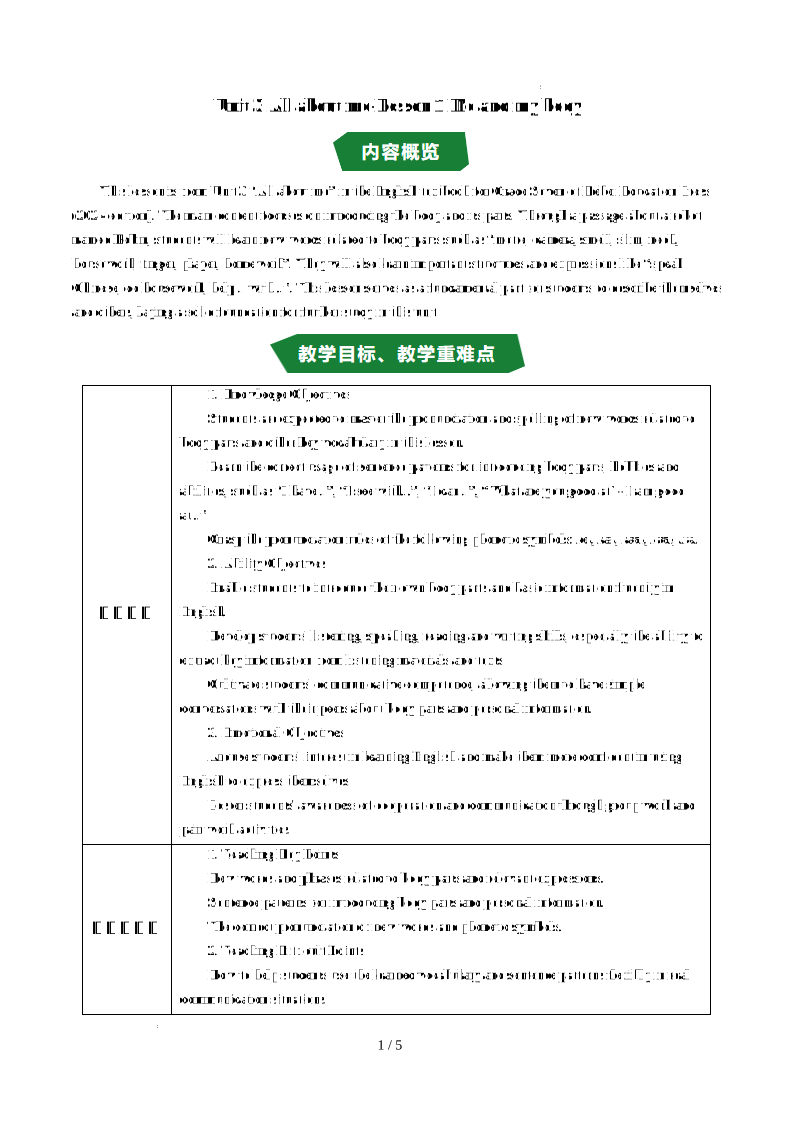
This lesson is from Unit 3 “All about me” in the English textbook for Grade Seven of Hebei Education Press (2024 edition). The main content focuses on introducing the body and its parts. Through a passage about a robot named Robin, students will learn new words related to body parts such as “metre, camera, smell, slim, neck, housework, finger, player, homework”. They will also learn important structures and expressions like “speak Chinese, do housework, help... with...”. This lesson serves as a fundamental part for students to describe themselves and others, laying a solid foundation for further study in this unit.
教学目标
1. Knowledge Objectives
Students are expected to master the pronunciation and spelling of new words related to body parts and other key vocabulary in this lesson.
Learn the correct usage of sentence patterns for introducing body parts, hobbies and abilities, such as “I have...”, “I see with...”, “I can...”, “What are you good at? - I am good at...”
Grasp the pronunciation rules of the following phonetic symbols: /e/, /æ/, /aʊ/, /əʊ/, /ɪə/
2. Ability Objectives
Enable students to introduce their own body parts and basic information fluently in English.
Develop students' listening, speaking, reading and writing skills, especially the ability to extract key information from listening materials and texts.
Cultivate students' communicative competence, allowing them to have simple conversations with their peers about body parts and personal information.
3. Emotional Objectives
Arouse students' interest in learning English and make them more confident in using English to express themselves.
Foster students' awareness of cooperation and communication through group work and pair work activities.
教学重难点
1. Teaching Key Points
New words and phrases related to body parts and relevant expressions.
Sentence patterns for introducing body parts and personal information.
The correct pronunciation of new words and phonetic symbols.
2. Teaching Difficult Points
How to help students use the learned vocabulary and sentence patterns flexibly in real communication situations.
Enable students to distinguish and correctly use some words with similar meanings, such as “speak” and “talk”.
Guide students to understand and apply the grammar knowledge involved in the sentence patterns.
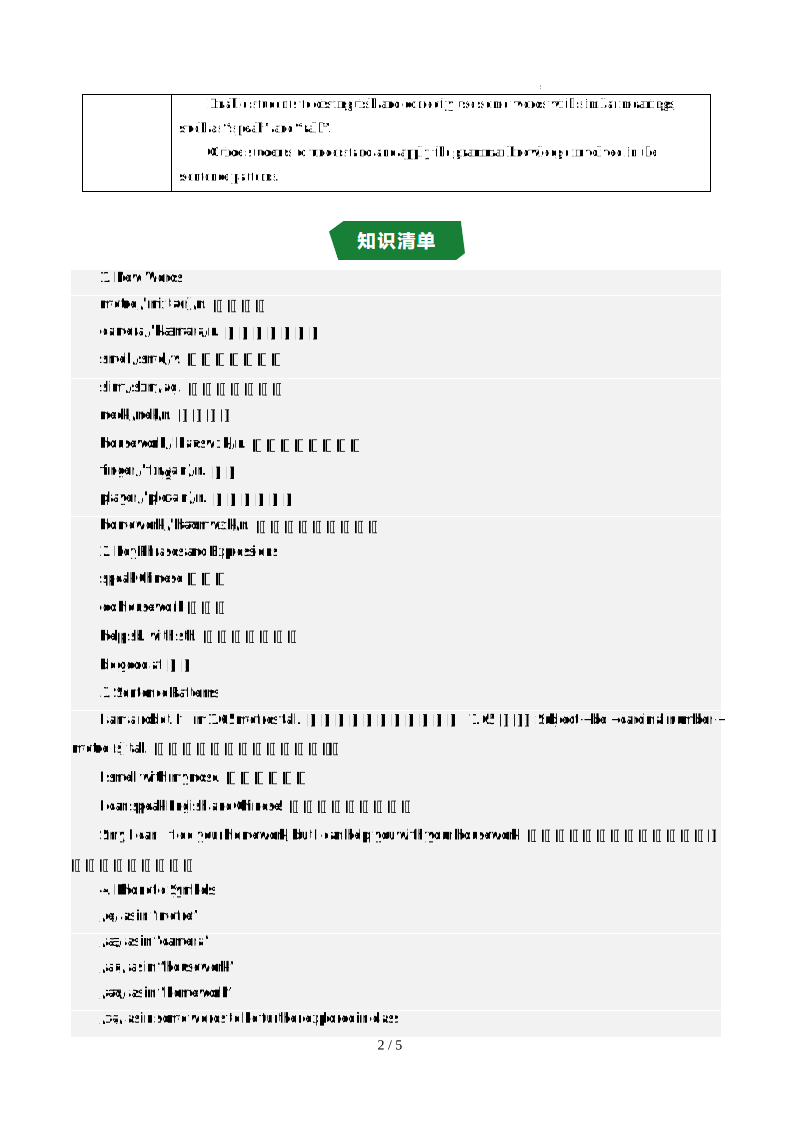
1. New Words
metre /ˈmiːtə(r)/n. 米;公尺
camera /ˈkæmərə/n. 照相机;摄影机
smell /smel/v. 嗅;闻(气味)
slim /slɪm/adj. 苗条的;纤细的
neck /nek/n. 颈;脖子
housework /ˈhaʊswɜːk/n. 家务劳动;家务事
finger /ˈfɪŋɡə(r)/n. 手指
player /ˈpleɪə(r)/n. 运动员;选手
homework /ˈhəʊmwɜːk/n. 家庭作业;课外作业
2. Key Phrases and Expressions
speak Chinese 说汉语
do housework 做家务
help sb. with sth. 帮助某人做某事
be good at 擅长
3. Sentence Patterns
I am a robot. I’m 1.65 metres tall. 我是一个机器人。我身高 1.65 米。(Subject + be + cardinal number + metre (s) tall. 表示身高或物体高度的句型。)
I smell with my nose. 我用鼻子闻。
I can speak English and Chinese! 我会说英语和汉语!
Srry, I can’t do your homework, but I can help you with your housework. 对不起,我不能帮你做作业,但我可以帮你做家务。
4. Phonetic Symbols
/e/ as in “metre”
/æ/ as in “camera”
/aʊ/ as in “housework”
/əʊ/ as in “homework”
/ɪə/ as in some words to be further explored in class
教学过程
1. Warming-up (5 minutes)
Greet the students as usual and then show them some pictures of robots on the PPT. Ask them: “What do you think of robots? Can you name some things robots can do?” Encourage students to express their ideas freely.
Then lead to the topic of this lesson: “Today, we will meet a special robot named Robin. Let’s see what he looks like and what he can do.”
2. Presentation (15 minutes)
Vocabulary Teaching
Show pictures of different body parts on the PPT one by one, such as eyes, nose, mouth, etc. Teach the new words related to body parts. For example, when showing the picture of eyes, say: “This is an eye. We have two eyes. Read after me, eye, eyes.” Repeat several times to let students get familiar with the pronunciation and spelling. Do the same for other body parts.
Use flashcards to review the words quickly. Point to the flashcards and ask students to read the words out loudly.
Teach other new words in the text, such as “metre, camera, smell, slim, neck, housework, finger, player, homework” by showing relevant pictures or giving simple explanations. For example, for “smell”, you can say: “Close your eyes and smell the air. What can you smell? We use our nose to smell. ‘Smell’ means to sense the odor.”
Text Learning
Let students listen to the passage about Robin for the first time. Before listening, ask them two questions: “Is Robin a person or a robot?” and “What does Robin like to do?” Tell them to listen carefully and find the answers.
After listening, ask students to answer the questions. Check the answers together.
Play the recording again. This time, ask students to listen carefully and fill in the blanks on the handout. The blanks can be about some key information in the passage, such as “I am a robot. I’m _ metres tall. I have two _ eyes. I see with _.”
Check the answers and then ask students to read the passage together following the recording, paying attention to the pronunciation and intonation.
Explain the important language points in the passage. For example, for the sentence “I am 1.65 metres tall.”, explain the structure “Subject + be + cardinal number + metre(s) tall.” for expressing height. For “I smell with my nose.”, explain the usage of “smell” as a verb. And for “help sb. with sth.”, give some more examples like “Can you help me with my math homework?”
3. Practice (15 minutes)
Pair Work
Ask students to work in pairs. Each student needs to introduce themselves using the learned sentence patterns. They can talk about their height, body parts, and what they can do. For example: “I am 1.55 metres tall. I have long hair. I can play basketball.” After that, they can exchange information and introduce their partners to the class.
Walk around the classroom to monitor the pairs' conversations and offer help if necessary.
Group Activity - Robot Design
Divide the students into groups of four or five. Each group is required to design a robot on a large piece of paper. They should draw the robot and label its body parts in English. Then, each group member needs to describe one part of the robot using the sentence pattern “This is the _ of our robot. It can _.” For example: “This is the arm of our robot. It can do housework.”
Select some groups to come to the front of the class and present their robot designs and descriptions. The rest of the students can ask questions if they have any.
4. Production (5 minutes)
Writing Task
Ask students to write a short passage about themselves. They should include information about their height, body parts, hobbies, and what they are good at. Provide some sentence starters on the PPT, such as “My name is _. I am _ years old. I am _ metres tall. I have _.”
Give students about 3 - 4 minutes to write. Then ask some students to read out their passages to the class. Offer praise and suggestions for improvement.
5. Summary and Homework (5 minutes)
Summary
Review the new words, phrases, sentence patterns and important language points learned in this lesson with the students. Ask students to recall what they have learned and summarize in their own words.
Emphasize the importance of using English to describe ourselves and communicate with others.
Homework
Ask students to make a poster about themselves. They can draw pictures of themselves and write descriptions in English using the knowledge learned in this lesson.
Require students to record themselves reading the passage about Robin and send the recording to the teacher through the learning platform.
教学反思
After teaching this lesson, I will reflect on the following aspects:
Teaching Objectives Achievement
Check whether the students have achieved the knowledge, ability and emotional objectives. For example, observe if students can master the new words and sentence patterns, and whether they are more confident in using English to communicate. If some students still have difficulties, analyze the reasons and consider providing additional tutoring.
Teaching Methods and Activities
Evaluate the effectiveness of the teaching methods and activities. Were the pair work and group activities engaging enough for the students? Did they help students better understand and apply the knowledge? If some activities did not go as expected, think about how to adjust them in future teaching.
Student Participation
Reflect on the level of student participation. Were all students actively involved in the class? If some students were less active, find out the reasons and think about how to encourage their participation in the future, such as by using more interesting teaching materials or designing more personalized tasks.
Time Management
Consider whether the time allocation for each part of the teaching process was reasonable. If some parts took too much or too little time, adjust the time arrangement in future lessons to ensure a more efficient teaching process.
By reflecting on these aspects, I can continuously improve my teaching quality and better meet the learning needs of students.
2 / 37
学科网(北京)股份有限公司
学科网(北京)股份有限公司
$$
资源预览图
1
2
相关资源
由于学科网是一个信息分享及获取的平台,不确保部分用户上传资料的 来源及知识产权归属。如您发现相关资料侵犯您的合法权益,请联系学科网,我们核实后将及时进行处理。