2.1 Advanced technology and our life-Warm-up&Listening(教学设计)-《英语 基础模块3》(语文版2022版)《上好课》
2025-09-02
|
6页
|
228人阅读
|
1人下载
精品
内容正文:
课程名称
《英语 基础模块3》(语文版2022版)
Unit 2 Advanced Technology and Our Life-Warm-up&Listening
教材分析
1. Position and Role: This lesson is a warm - up and listening practice for Unit 2. The warm - up part introduces topics related to advanced technology and daily life, which can arouse students' interest and lay the foundation for the listening and subsequent learning. The listening part helps students improve their listening skills while deepening their understanding of how technology affects life. It is an important part for students to grasp the theme of the unit and develop language skills.
1. Connection of Knowledge: The warm - up activities connect students' existing knowledge about technology in life with the new content. The listening text is a dialogue about foreigners' experience of Chinese technology in daily life, which is a practical application of the warm - up topics. The textbook presents the content through pictures and dialogues, guiding students to learn from easy to difficult.
1. Suitability of Content: The content is closely related to students' life, and students can easily relate to their own experiences. No additional content is needed for this lesson as the textbook content is sufficient for warm - up and listening practice.
学情分析
1..Knowledge Reserve: Students have basic English vocabulary related to daily life and some simple knowledge about technology, such as words like "phone", "computer", and know some common technological products.
2.Ability Level: Students can understand simple English dialogues and express their opinions with simple sentences. However, their listening skills need to be improved, especially in grasping specific information in long dialogues.
3.Interest and Attitude: Students are interested in topics related to technology and life, as these topics are close to their daily experiences. They are willing to participate in class activities but may be shy to express themselves in English sometimes.
教学目标
1. Knowledge Objective: Students can master vocabulary and phrases related to advanced technology and daily life, such as "shared bikes", "high - speed train", "mobile payment", and understand the listening content about foreigners' experience of Chinese technology.
2. Skill Objective: Students can improve their listening ability to grasp specific information and main ideas. They can also discuss topics about technology and life in pairs or groups.
3. Emotional Objective: Students can realize the convenience brought by advanced technology to life and cultivate their interest in learning English through topics related to daily life.
教学重难点
Teaching Key Points: Mastering the key vocabulary and phrases, and improving listening skills to understand the main content and specific information of the listening text.
Teaching Difficult Points: Accurately grasping detailed information in the listening dialogue and expressing opinions about technology and life fluently in English.
教学方法
1.Task - based Teaching Method
2.Interactive Teaching Method
3.Multimedia Teaching Method:
课前准备
Prepare teaching PPT with pictures of technological products and scenes in life. Check the audio equipment for listening practice. Prepare handouts with warm - up discussion questions and listening exercise blanks.
教学媒体
Multimedia computer, PPT, audio player, handouts.
教学过程
教学环节
教师活动设计
学生活动设计
设计意图
Lead-in
Show pictures of high - speed trains, shared bikes, mobile payment, and online shopping on the PPT. Ask students: "What can you see in these pictures? What do you think of these things?"
Observe the pictures carefully. Answer the teacher's questions one by one, using words like "fast", "convenient", "wonderful" to describe the things in the pictures.
Attract students' attention with vivid pictures, arouse their interest in the topic, and activate their existing knowledge about technology and life.
Warm-up
1. Divide students into pairs.
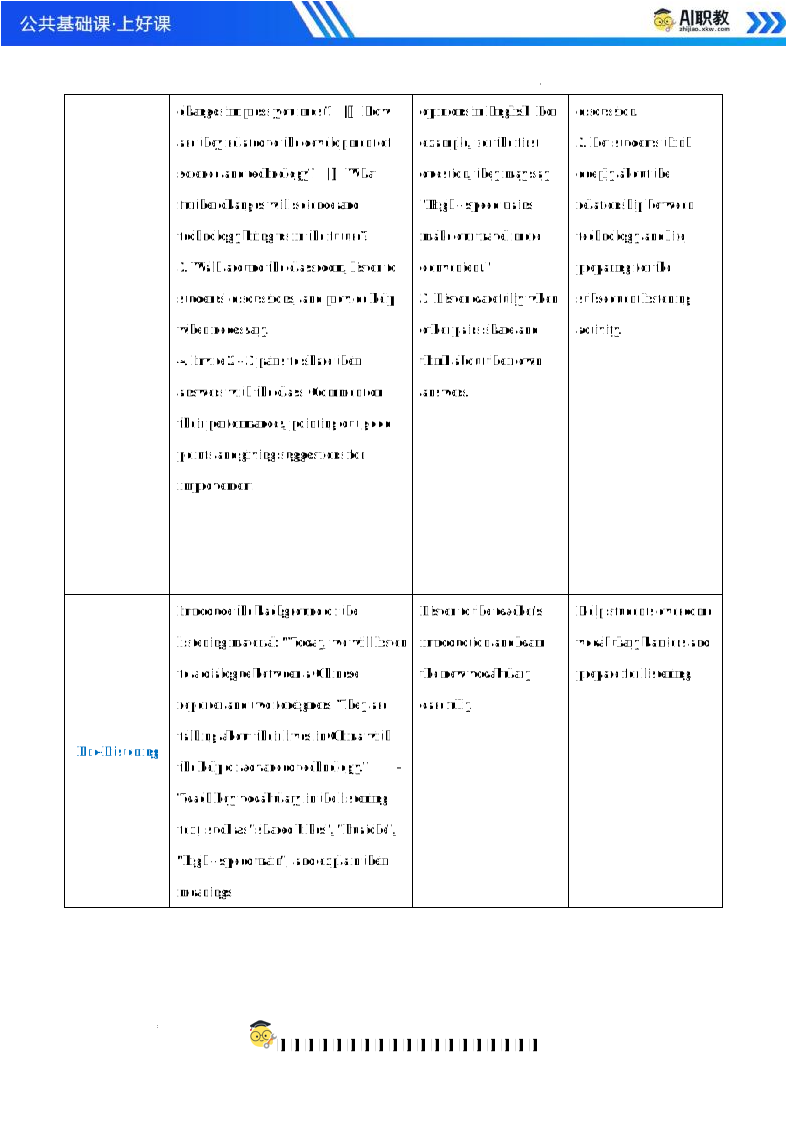
2. Present the four questions on the PPT: ① What is making your life more and more convenient? ② What changes impress you most? ③ How are they related to the development of science and technology? ④ What further changes will science and technology bring us in the future?
3. Walk around the classroom, listen to students' discussions, and provide help when necessary.
4. Invite 2 - 3 pairs to share their answers with the class. Comment on their performances, pointing out good points and giving suggestions for improvement.
1. Work in pairs.
2. Discuss the four questions one by one. Try to express their opinions in English. For example, for the first question, they may say "High - speed trains make our travel more convenient."
3. Listen carefully when other pairs share and think about their own answers.
1. Train students' oral expression ability and cooperative learning ability through pair discussion.
2. Let students think deeply about the relationship between technology and life, preparing for the subsequent listening activity.
Pre-Listening
Introduce the background of the listening material: "Today, we will listen to a dialogue between a Chinese reporter and two foreigners. They are talking about their lives in China with the help of advanced technology." - Teach key vocabulary in the listening text, such as "shared bikes", "kuaiche", "high - speed train", and explain their meanings.
Listen to the teacher's introduction and learn the new vocabulary carefully.
Help students overcome vocabulary barriers and prepare for listening.
While-listening
Play the audio for the first time. Ask students to listen carefully and get the main idea: "What are the two foreigners talking about?" Play the audio for the second time. Ask students to fill in the blanks in the handout. The blanks are: ① ____________ wherever I want and ride until I find an interesting new area. ② ____________ way to get some exercise and help the environment. ③ ____________ to arrive in Beijing. ④ ____________ takes only about 5 hours. - Play the audio for the third time. Let students check their answers.
Listen to the audio for the first time and try to catch the main idea. - Listen to the audio for the second time and fill in the blanks.
Listen to the audio for the third time to check the answers.
Train students' listening skills of grasping main ideas and specific information step by step.
Post-listening
1. Show the pictures in the "Look and discuss with your classmates" part on the PPT.
2. Ask students to discuss in pairs: "What do you think of these things? Use the sentence patterns 'I think...', 'It gives us...', 'I think that it is...' and the words 'fast, safe, excitement, convenience, easy, wonderful' to express."
3. Walk around the classroom, listen to students' discussions, and give guidance. 4. Invite several students to share their discussions in front of the class. Praise their performances.
1. Look at the pictures on the PPT.
2. Work in pairs to discuss the pictures using the given sentence patterns and words.
3. Share their discussions with the class confidently.
Train students' oral expression ability further, and let them express their opinions about technology and life more fluently using the learned sentence patterns and vocabulary.
Summary
1. Summarize the key points of this lesson: the key vocabulary related to technology and life, the main content of the listening text, and the way to discuss topics about technology and life. 2. Ask students: "What have you learned today?"
Homework
1. Write a short passage (about 50 words) to describe the impact of one technological product on their life. 2. Preview the next part of Unit 2.
Blackboard design
Unit 2 Advanced technology and our life
Key Vocabulary:
0. shared bikes high - speed train mobile payment
Key Sentences in Listening:
0. Using shared bikes, I can go wherever I want and ride until I find an interesting new area.
0. It's a great way to get some exercise and help the environment.
0. It took a long time to arrive in Beijing.
0. Today, a high - speed train takes only about 5 hours.
Discussion Sentence Patterns:
0. I think... It gives us... I think that it is...
Teaching Evaluation
Process Evaluation: Observe students' participation in pair discussions, group work, and class sharing. Evaluate their enthusiasm and cooperation ability.
Knowledge and Skill Evaluation: Check students' completion of listening exercises and classroom practice to evaluate their mastery of vocabulary, listening skills, and oral expression ability.
Homework Evaluation: Evaluate students' homework to check their ability to apply the knowledge learned in class to writing.
Teaching reflection
Successes:
The lead - in part successfully aroused students' interest in the topic.
The step - by - step listening training helped most students improve their listening ability.
Students actively participated in pair and group discussions, and their oral expression ability was trained.
Shortcomings:
Some students still had difficulty in grasping detailed information in the listening text, and their listening speed needed to be improved.
A few shy students were not active in class sharing.
Improvement Measures:
For students with listening difficulties, provide extra listening practice after class.
Encourage shy students more in class and create a more relaxed atmosphere for them to express themselves.
精品资源学科网独家享有版权,侵权必究!
学科网(北京)股份有限公司
学科网(北京)股份有限公司
$$
资源预览图

1

2
3

由于学科网是一个信息分享及获取的平台,不确保部分用户上传资料的 来源及知识产权归属。如您发现相关资料侵犯您的合法权益,请联系学科网,我们核实后将及时进行处理。