Unit 7 When Tomorrow Comes Section A 1a-1d 教学设计 2025-2026学年人教版(2024)八年级英语上册
2025-08-25
|
4页
|
396人阅读
|
174人下载
普通
资源信息
| 学段 | 初中 |
|---|---|
| 学科 | 英语 |
| 教材版本 | 初中英语人教版八年级上册 |
| 年级 | 八年级 |
| 章节 | 1a-1d |
| 类型 | 教案-教学设计 |
| 知识点 | - |
| 使用场景 | 同步教学-新授课 |
| 学年 | 2025-2026 |
| 地区(省份) | 全国 |
| 地区(市) | - |
| 地区(区县) | - |
| 文件格式 | DOCX |
| 文件大小 | 49 KB |
| 发布时间 | 2025-08-25 |
| 更新时间 | 2025-08-25 |
| 作者 | 匿名 |
| 品牌系列 | - |
| 审核时间 | 2025-08-25 |
| 下载链接 | https://m.zxxk.com/soft/53602151.html |
| 价格 | 0.00储值(1储值=1元) |
| 来源 | 学科网 |
内容正文:
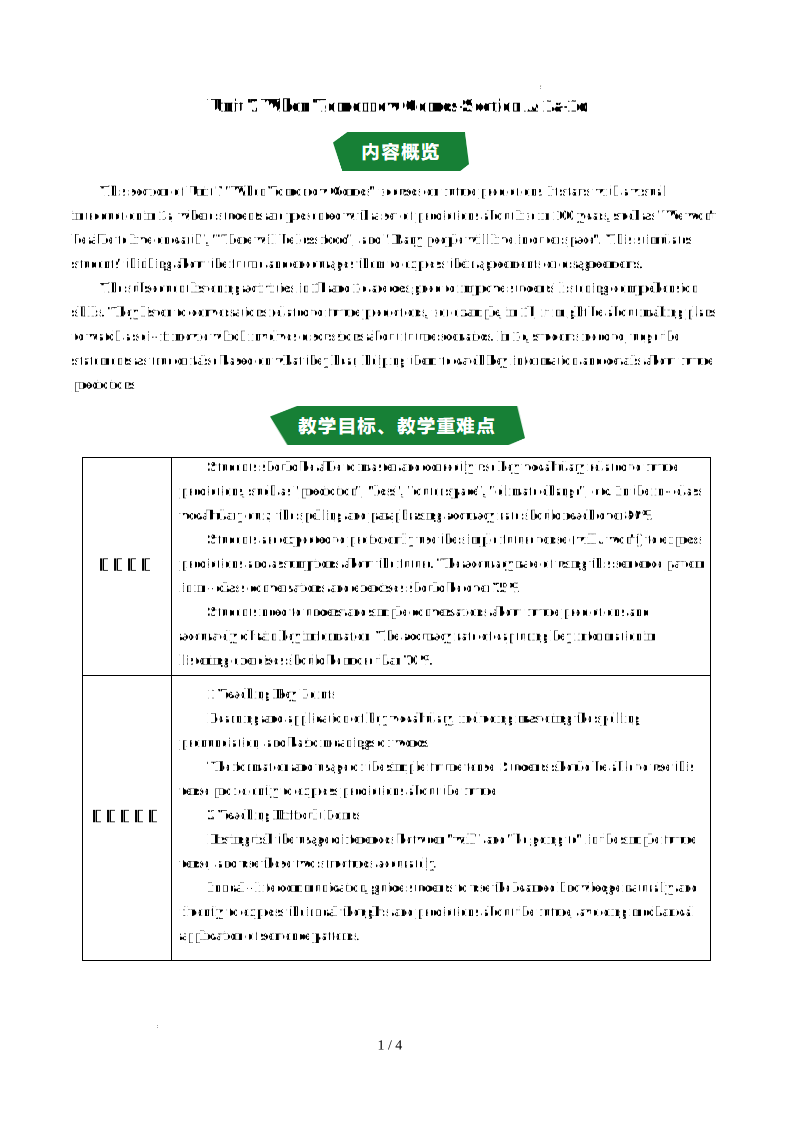
Unit 7 When Tomorrow Comes-Section A 1a-1d
This section of Unit 7 "When Tomorrow Comes" focuses on future predictions. It starts with a visual introduction in 1a, where students are presented with a set of predictions about life in 100 years, such as "We won't be able to live on earth", "There will be less food", and "Many people will live in outer space". This stimulates students' thinking about the future and encourages them to express their agreements or disagreements.
The subsequent listening activities in 1b and 1c are designed to improve students' listening comprehension skills. They listen to conversations related to future predictions, for example, in 1b, it might be about making plans to watch a sci - fi movie which involves discussions about future scenarios. In 1c, students need to judge the statements as true or false based on what they hear, helping them to catch key information and details about future predictions.
教学目标
Students should be able to master and correctly use key vocabulary related to future predictions, such as "prediction", "less", "outer space", "climate change", etc. In the in - class vocabulary quiz, the spelling and paraphrasing accuracy rate should reach over 80%.
Students are expected to proficiently use the simple future tense (will / won't) to express predictions and assumptions about the future. The accuracy rate of using this sentence pattern in in - class conversations and exercises should be over 75%.
Students need to understand simple conversations about future predictions and accurately obtain key information. The accuracy rate of capturing key information in listening exercises should be more than 70%.
教学重难点
1 Teaching Key Points
Learning and application of key vocabulary, including mastering the spelling, pronunciation, and basic meanings of words.
The formation and usage of the simple future tense. Students should be able to use this tense proficiently to express predictions about the future.
2 Teaching Difficult Points
Distinguish the usage differences between "will" and "be going to" in the simple future tense, and use these two structures accurately.
In real - life communication, guide students to use the learned knowledge naturally and fluently to express their real thoughts and predictions about the future, avoiding mechanical application of sentence patterns.
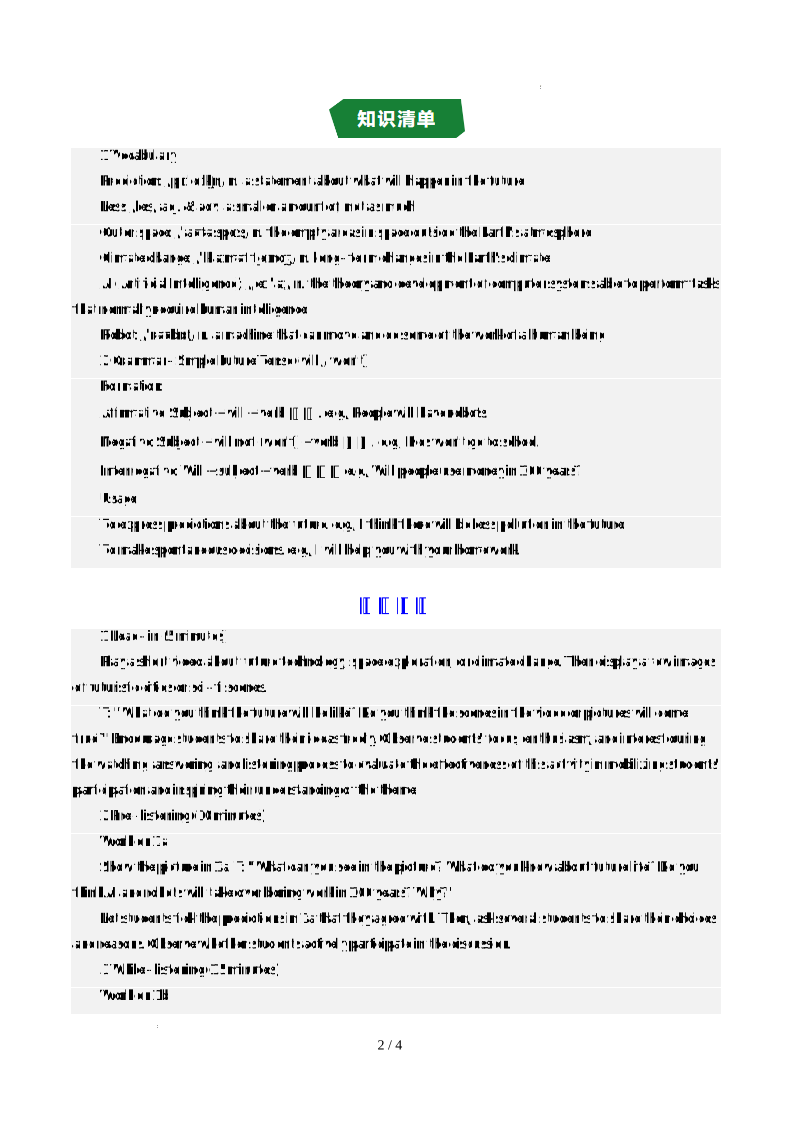
1 Vocabulary
Prediction: /prɪˈdɪkʃn/ n. a statement about what will happen in the future
Less: /les/ adj. & adv. a smaller amount of; not as much
Outer space: /ˈaʊtə speɪs/ n. the empty areas in space outside the Earth's atmosphere
Climate change: /ˈklaɪmət tʃeɪndʒ/ n. long - term changes in the Earth's climate
AI (Artificial Intelligence): /ˌeɪ ˈaɪ/ n. the theory and development of computer systems able to perform tasks that normally require human intelligence
Robot: /ˈrəʊbɒt/ n. a machine that can move and do some of the work of a human being
2 Grammar - Simple Future Tense (will / won't)
Formation:
Affirmative: Subject + will + verb 原形. e.g., People will have robots.
Negative: Subject + will not (won't) + verb 原形. e.g., Kids won't go to school.
Interrogative: Will + subject + verb 原形?e.g., Will people use money in 100 years?
Usage:
To express predictions about the future. e.g., I think there will be less pollution in the future.
To make spontaneous decisions. e.g., I will help you with your homework.
教学过程
1 Lead - in (5 minutes)
Play a short video about future technology, space exploration, or climate change. Then display a few images of futuristic cities or sci - fi scenes.
T: "What do you think the future will be like? Do you think the scenes in the video or pictures will come true?" Encourage students to share their ideas freely. Observe students' focus, enthusiasm, and interest during the watching, answering, and listening process to evaluate the effectiveness of this activity in mobilizing students' participation and inspiring their understanding of the theme.
2 Pre - listening (10 minutes)
Work on 1a
Show the picture in 1a. T: "What can you see in the picture? What do you know about future life? Do you think AI and robots will take over boring work in 100 years? Why?"
Let students tick the predictions in 1a that they agree with. Then, ask several students to share their choices and reasons. Observe whether students actively participate in the discussion.
3 While - listening (15 minutes)
Work on 1b
Play the 1b listening material and have students complete the fill - in - the - blank exercise. After that, check the answers together. Analyze any difficult points or misunderstandings in the listening content.
Work on 1c
Play the 1c listening material and have students determine whether the statements are true or false. Then, divide the students into groups of 4 - 5 to discuss the content and answers from the listening. Each group selects a representative to present their discussion results, and the teacher addresses any questions or doubts the students may have. By observing students' performance in 1b fill - in - the - blank accuracy, answer sharing, 1c true - false judgment, group discussion participation, and representative presentation, as well as feedback during question - answering, evaluate students' listening comprehension and knowledge mastery.
4 Post - listening (15 minutes)
Work on 1d
Pair work: Organize a “Future Chat Session” activity. Divide the students into pairs and have them refer to the provided dialogue example:
A: "Will we be able to live on earth in 100 years?"
B: "Yes, we will. I believe people will make the earth a better place."
A: "Will many people live in outer space?"
B: "Well, I don't think…"
Group work:
Divide students into four groups. Each group needs to hold a conference to share their predictions about life in 100 years. Use the sentences they have learnt (e.g., "Will… I think…"). Include at least 3 predictions from 1a or their own ideas.
Students discuss, design a poster with drawings and key phrases, and prepare the presentation script. Each group presents their poster and predictions to the class. The teacher observes whether students actively participate in the dialogue practice, whether they can use the learned vocabulary and sentences to clearly express their views, and gives feedback and asks questions during the presentation.
教学反思
After the class, it is necessary to reflect on the teaching process. Overall, the use of videos and pictures in the lead - in stage effectively attracted students' attention and aroused their interest in the topic of future predictions. However, some students might still have difficulties in expressing their thoughts due to limited vocabulary.
In the pre - listening stage, most students were actively involved in the discussion of 1a, but a few students seemed a bit passive. Maybe more encouragement and specific guidance could be provided.
During the while - listening stage, the accuracy of students' answers in 1b and 1c varied. Some students had trouble catching key information, indicating that more listening strategies training is needed.
In the post - listening stage, the pair work and group work were quite successful in promoting students' speaking practice. But in the group discussion, some students dominated the conversation, while a few others hardly participated. In the future, it is important to ensure that every student has an equal opportunity to speak and contribute in group activities. Also, more time could be allocated for students to ask questions and have in - depth discussions about the grammar usage in future predictions to strengthen their understanding and application ability.
2 / 37
学科网(北京)股份有限公司
学科网(北京)股份有限公司
$$
资源预览图
1
2
相关资源
由于学科网是一个信息分享及获取的平台,不确保部分用户上传资料的 来源及知识产权归属。如您发现相关资料侵犯您的合法权益,请联系学科网,我们核实后将及时进行处理。