Unit 5 Ancient Civilization(A卷·考点梳理卷)-《英语 基础模块2》(高教版2023版)《同步单元AB卷》(原卷版+解析版)
2025-08-20
|
2份
|
16页
|
147人阅读
|
0人下载
内容正文:
编写说明:本套【湖北专用】《同步单元AB卷》紧扣《英语 基础模块2》(高教版2023修订版)教材,以教材单元为基准精准覆盖核心考点,并紧密贴合湖北省真题题型。A卷为考点梳理卷,侧重考点分层突破;B卷为单元测试卷,强化综合能力检测,助力师生高效把握区域教学重点,提升应试能力与知识应用水平。
本卷是Unit 5 Ancient Civilization的考点梳理卷,主要考查单词拼写、语法选择填空、词组翻译、阅读理解和情景交际。
Unit 5 Ancient Civilization
A卷·考点梳理卷
考试时间:40分钟 满分:100分
班级 姓名 学号 成绩
【考点一:单词拼写】
单词拼写 1-5题 (每小题2分,共10分)
1. The party was ________ (生机勃勃的) with music and dancing. (汉语提示填空)
2.They were given food and shelter in exchange (作为对……的交换) work. (汉语提示填空)
3.My strong (技术经验) and education will make me very competitive for this position. (汉语提示填空)
4.I am (好奇的) about what keeps him abroad.(汉语提示填空)
5.He is a very (吸引人的) man. (汉语提示填空)
【考点二:单项选择(宾语从句)】
单项选择 6-20题 (每小题3分,共45分)
6.I’m really glad _________ I can go back here to work again.
A.which B.that C.unless D.where
7. — Can you tell me ________ he will be away?
— For 2 weeks.
A.how often B.how soon C.how long D.when
8.She asked me ________ I could help her with her English.
A.if B.what C.who D.that
9.My father told me the earth _______ round.
A.was B.is C.are D.were
10.I don’t know ________ he will come tomorrow.
A.whether B.what C.which D.how
11.I will tell him whether he __________back tomorrow.
A.come B.comes C.will come D.coming
12.Do you know ________ ? He looks unhappy.
A.what is the matter with him B.what the matter is with him
C.what was the matter with him D.what the matter was with him
13.The man said, “I have sold six cats so far.”
The man said ________ six cats so far.
A.he has sold B.he had sold C.I have sold D.I had sold
14.—Do you know ________ yesterday afternoon?
—She went to the library to return the books.
A.where is Linda B.where Linda is
C.where was Linda D.where Linda was
15.— Hi, Tom. Could you tell me ________?
— I’ll go there next Sunday.
A.how you will go to Beiling Park B.when you will go to Beiling Park
C.how will you go to Beiling Park D.when will you go to Beiling Park
16.—Can I have two tickets for the Chinese Ancient Poetic Dance?
— ________. All the tickets have been sold out.
A.I’m sorry B.Of course C.Never mind D.Thank you
17.—Shall we go to see the Mogao Caves this summer?
—________. I love ancient civilization so much.
A.I couldn’t agree more B.I’m afraid not
C.I don’t think so D.No way
18.— There is an exhibition on the ancient Silk Road at the City Museum tomorrow. Do you want to go with me?
— ________, but I have to prepare for the coming exam.
A.I’d rather not B.I’d love to
C.It’s just so so D.I can’t afford it
19.— Let’s go to Mr. Yu’s speech on Chinese culture, shall we?
— ________ We can go next time.
A.Why not? B.That’s all right. C.Never mind. D.I’m afraid it’s too late.
20.— How do you find the traditional food in Tianjin Ancient Culture Street?
— ________
A.It’s up to you. B.Can’t be better. C.It was easy to find. D.You got it.
【考点三:词组翻译】
词组翻译21-30题(每小题3分,共30分)
21. 丝绸之路商人
22. 元代中国
23. 激励旅行者
24. 东西方交流
25. 寻找财富
26. Marco Polo and His Book
27. the Yuan Dynasty
28. contribute to exchange
29. the Silk Road
30. search for treasures
【考点四:阅读理解】
阅读理解31-35题(每小题3分,共15分)
People who go to a formal Western dinner party for the first time may be surprised by table manners in Western culture. Knowing them will help you to behave properly.
First you should know how to put knives and forks. The forks are always on the left while the knives on the right of the plate. When you see two spoons, you should know the big one is for soup and the small one for dessert. When you sit down at the table, you can take your napkin, unfold it and put it on your lap.
Then dinner starts with a small dish. Some people pray before they start eating, and other people may keep silent for a moment. After that everybody starts. After the small dish, you will get a bowl of soup — but only one bowl of soup and never ask for a second. Many Westerners like to use their fingers when they eating chicken or other birds at the table, but never touch beef or other meat with bones. It is polite to finish eating everything on your plate, so don’t take more food than you need. Of course you should try to speak quietly and smile a lot, but do not laugh all the time at the table.
However, table manners change over time. They follow the fashion of the day. Besides, table manners are only important at formal dinner parties. If you’re not sure what to do, you can always follow your hosts. Although good manners always make you look good, you do not need to worry about all these rules while having dinner with your friends or family.
31.About table manners, the first you should know in Western countries is ________.
A.how to put your napkin B.to take the spoons politely
C.how to put knives and forks D.to speak quietly and smile a lot
32.What does the underlined word “unfold” probably mean in Chinese?
A.折叠 B.展开
C.打结 D.显露
33.You can ________ at the dinner table.
A.speak loudly B.leave food on the plate
C.laugh all the time D.smile a lot
34.If you don’t know what to do at the table, you can ________.
A.become worried B.follow the hosts
C.leave the table D.keep silent
35.The passage is mainly about ________.
A.table manners in Western culture B.table manners in Chinese culture
C.the history of table manners D.the order of the dinner courses
原创精品资源学科网独家享有版权,侵权必究!
学科网(北京)股份有限公司
学科网(北京)股份有限公司
$$
编写说明:本套【湖北专用】《同步单元AB卷》紧扣《英语 基础模块2》(高教版2023修订版)教材,以教材单元为基准精准覆盖核心考点,并紧密贴合湖北省真题题型。A卷为考点梳理卷,侧重考点分层突破;B卷为单元测试卷,强化综合能力检测,助力师生高效把握区域教学重点,提升应试能力与知识应用水平。
本卷是Unit 5 Ancient Civilization的考点梳理卷,主要考查单词拼写、语法选择填空、词组翻译、阅读理解和情景交际。
Unit 5 Ancient Civilization
A卷·考点梳理卷
考试时间:40分钟 满分:100分
班级 姓名 学号 成绩
【考点一:单词拼写】
单词拼写 1-5题 (每小题2分,共10分)
1. The party was ________ (生机勃勃的) with music and dancing. (汉语提示填空)
【答案】lively
【详解】考查形容词。句意:派对上的音乐和舞蹈使得气氛非常活跃。生机勃勃的:lively,是形容词作表语。故填lively。
2.They were given food and shelter in exchange (作为对……的交换) work. (汉语提示填空)
【答案】for
【详解】考查介词。句意:他们得到了食物和住所,以换取他们工作的回报。固定短语in exchange for意为“作为……的交换;以换取”。根据“They were given food and shelter in exchange”可知,空处表示“得到食物和住所,以换取回报”,应用介词for。故填for。
3.My strong (技术经验) and education will make me very competitive for this position. (汉语提示填空)
【答案】technical experience
【详解】考查名词短语。句意:我丰富的技术经验和教育将使我在这个职位上很有竞争力。根据空后的and education以及汉语提示可知,此处填名词短语technical experience,此处experience是不可数名词,所有直接填写。故填technical experience。
4.I am (好奇的) about what keeps him abroad.(汉语提示填空)
【答案】curious
【详解】考查形容词。句意:我很好奇是什么让他留在国外。根据汉语提示以及“I am”可知,空处应用形容词curious作表语,be curious about意为“对……好奇”,是固定短语。故填curious。
5.He is a very (吸引人的) man. (汉语提示填空)
【答案】attractive
【详解】考查形容词作定语。句意:他是一个非常有吸引力的人。根据汉语“吸引人的”提示,应是形容词attractive作定语,修饰名词man。故填attractive。
【考点二:单项选择(宾语从句)】
单项选择 6-20题 (每小题3分,共45分)
6.I’m really glad _________ I can go back here to work again.
A.which B.that C.unless D.where
【答案】B
【详解】考查宾语从句引导词。句意:我真的很高兴我能回到这里再工作。glad后是宾语从句,从句“ I can go back here to work again”是完整陈述句,语意完整,故that引导宾语从句时无实际意义,只起连接作用,符合。故选B。
7. — Can you tell me ________ he will be away?
— For 2 weeks.
A.how often B.how soon C.how long D.when
【答案】C
【详解】考查宾语从句及副词短语。句意:——你能告诉我他还会离开多久吗?——两周。A. how often多久一次,对频率提问;B. how soon多久,通常对“in+段时间”提问;C. how long多久,可以对“for+段时间”提问;D. when何时。根据“For 2 weeks”可知,应是“how long”。故选C。
8.She asked me ________ I could help her with her English.
A.if B.what C.who D.that
【答案】A
【详解】考查宾语从句。句意:她问我是否能在英语方面帮助她。分析句子结构可知,“... I could help her with her English.”为宾语从句;根据asked可知,宾从存在疑问,需用含有疑问含义的连词引导;从句中不缺成分what、who提问的成分,故用if引导宾语从句,表示“是否”的疑问。故选A。
9.My father told me the earth _______ round.
A.was B.is C.are D.were
【答案】B
【详解】考查宾语从句的时态。句意:我父亲告诉我地球是圆的。本句为宾语从句,通常主句是一般过去时,宾语从句要用相应的过去时态,但当宾语从句表示的是客观真理、自然现象等时,时态不受主句影响,仍用一般现在时。“地球是圆的”是客观真理,所以应用一般现在时,主语“the earth”是单数,be动词用“is”。故选B。
10.I don’t know ________ he will come tomorrow.
A.whether B.what C.which D.how
【答案】A
【详解】考查宾语从句引导词辨析。句意:我不知道他明天是否会来。A. whether是否;B. what什么;C. which哪一个;D. how怎样。分析句子可知,“he will come tomorrow”为宾语从句,根据句意,这里表达不确定他明天来不来,需要一个表示“是否”含义的词来引导宾语从句。故选A。
11.I will tell him whether he __________back tomorrow.
A.come B.comes C.will come D.coming
【答案】C
【详解】考查宾语从句的时态。句意:我会告诉他明天他是否会回来。“whether he … back tomorrow”是宾语从句,作tell的宾语,主句“I will tell him ”是一般将来时,宾从时态由从句时间状语来确定。根据时间状语tomorrow可知,从句要用一般将来时,其结构为“will+动词原形”。故选C。
12.Do you know ________ ? He looks unhappy.
A.what is the matter with him B.what the matter is with him
C.what was the matter with him D.what the matter was with him
【答案】A
【详解】考查宾语从句。句意:你知道他怎么了吗?他看起来不开心。分析句子结构可知,此处是宾语从句。宾语从句要用陈述语序,但当“What’s the matter (with sb. )/ What’s wrong (with sb.)”等用于宾语从句时,不需要改变语序。根据语境 “He looks unhappy (他看起来不高兴)” 可知,询问的是现在的情况,所以用一般现在时。故选A。
13.The man said, “I have sold six cats so far.”
The man said ________ six cats so far.
A.he has sold B.he had sold C.I have sold D.I had sold
【答案】B
【详解】考查间接引语的时态和人称的转换。句意:那人说:“到目前为止,我已经卖出了六只猫。”那人说他已经卖了六只猫。陈述句的直接引语改为间接引语的宾语从句时,主句谓语“said”为一般过去时,从句中也应变成相应的过去时态,即现在完成时需要转换为过去完成时,同时人称也要相应变化,“I”随主句主语“The man”变成相应的代词“he”。故选B。
14.—Do you know ________ yesterday afternoon?
—She went to the library to return the books.
A.where is Linda B.where Linda is
C.where was Linda D.where Linda was
【答案】D
【详解】考查名词性从句。句意:—你知道昨天下午琳达在哪里吗?—她去图书馆还书了。分析句子结构和选项可知,本处为宾语从句,宾语从句要用陈述语序。根据时间状语yesterday afternoon可知描述的是过去的事情,因此要用一般过去时。故选D。
15.— Hi, Tom. Could you tell me ________?
— I’ll go there next Sunday.
A.how you will go to Beiling Park B.when you will go to Beiling Park
C.how will you go to Beiling Park D.when will you go to Beiling Park
【答案】B
【详解】考查宾语从句。句意:——嗨,汤姆。你能告诉我你什么时候去北岭公园吗?——我下周日会去那里。分析句子可知,空处是宾语从句,语序是陈述句语序(连接词+主语+谓语);根据“I’ll go there next Sunday.”可知,此处应是询问什么时候去公园,要用when引导从句。故选B。
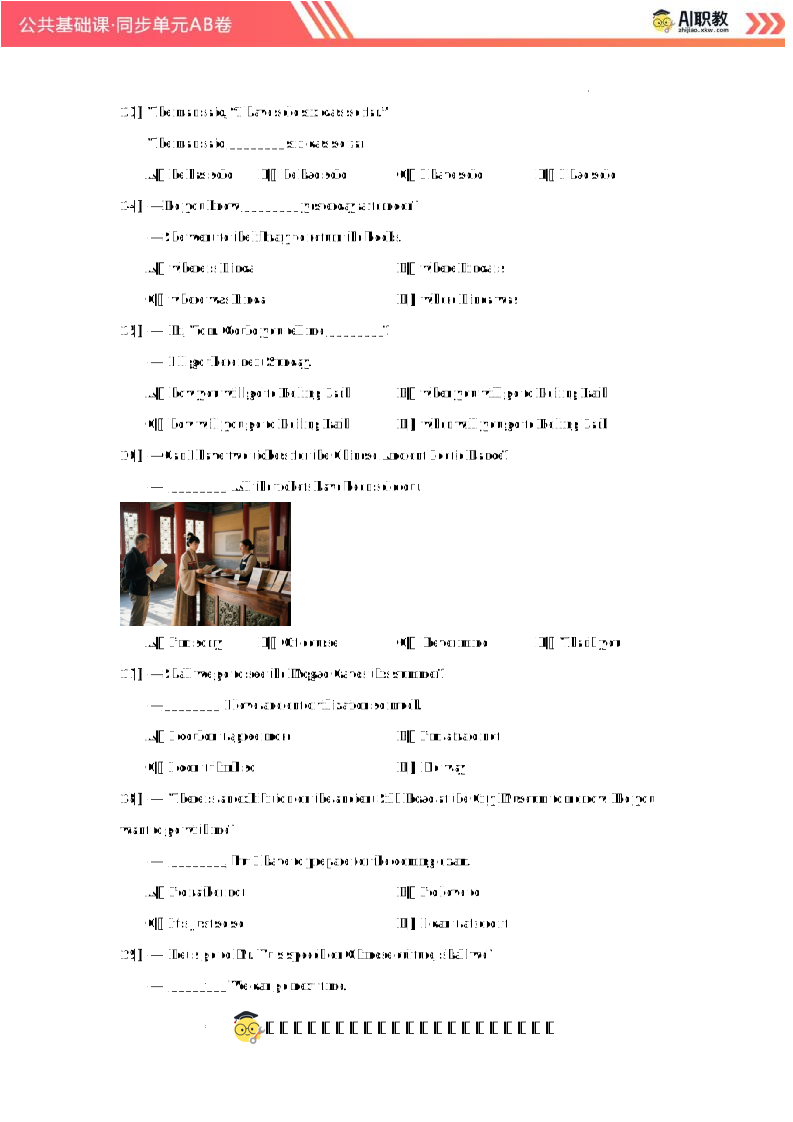
16.—Can I have two tickets for the Chinese Ancient Poetic Dance?
— ________. All the tickets have been sold out.
A.I’m sorry B.Of course C.Never mind D.Thank you
【答案】A
【详解】考查情景交际。句意:——我可以买两张中国古代诗歌舞的票吗?——我很抱歉。所有的票都卖完了。A. I’m sorry我很抱歉;B. Of course当然;C. Never mind没关系;D. Thank you谢谢你。根据“All the tickets have been sold out.”可知,因所有的票都卖完了而感到抱歉。故选A。
17.—Shall we go to see the Mogao Caves this summer?
—________. I love ancient civilization so much.
A.I couldn’t agree more B.I’m afraid not
C.I don’t think so D.No way
【答案】A
【详解】考查情景交际。句意:今年夏天我们去看莫高窟好吗?—我非常赞同。 我非常热爱古代文明。A. I couldn’t agree more我非常赞同;B. I’m afraid not恐怕不是;C. I don’t think so我不这么认为;D. No way不行。根据“I love ancient civilization so much.”可知,说话人接受对方的建议,此处表示赞同语气。故选A。
18.— There is an exhibition on the ancient Silk Road at the City Museum tomorrow. Do you want to go with me?
— ________, but I have to prepare for the coming exam.
A.I’d rather not B.I’d love to
C.It’s just so so D.I can’t afford it
【答案】B
【详解】考查情景交际。句意:——明天市博物馆有一场关于古代丝绸之路的展览。你想和我一起去吗?——我很想去,但我得为即将到来的考试做准备。A. I’d rather not我宁愿不去;B. I’d love to我很想去;C. It’s just so so不过如此;D. I can’t afford it我负担不起。根据对话中后半句“but I have to prepare for the coming exam”可知,对方发出邀请,后半句表明我得准备考试,是转折,说明前半句是“想去”的态度,只是因考试无法前往。故选B。
19.— Let’s go to Mr. Yu’s speech on Chinese culture, shall we?
— ________ We can go next time.
A.Why not? B.That’s all right. C.Never mind. D.I’m afraid it’s too late.
【答案】D
【详解】考查情景交际。句意:——我们去听余先生关于中国文化的演讲,好吗?——我恐怕太晚了。我们可以下次去。A. Why not为什么不(用来提建议);B. That’s all right.没关系;C. Never mind.不要紧;C. I’m afraid it’s too late.我恐怕太晚了。根据“We can go next time.”可知,其拒绝当前邀请,并建议推迟。I’m afraid it’s too late委婉地提供了拒绝的理由(时间来不及),与后半句“下次去”逻辑一致,符合礼貌拒绝邀请的语境。故选D。
20.— How do you find the traditional food in Tianjin Ancient Culture Street?
— ________
A.It’s up to you. B.Can’t be better. C.It was easy to find. D.You got it.
【答案】B
【详解】考查情景交际。句意:—天津古文化街的传统美食怎么样?—好得不能再好了。A. It’s up to you由你决定;B. Can’t be better好得不能再好了;C. It was easy to find很容易找到;D. You got it你明白了。根据“How do you find the traditional food in Tianjin Ancient Culture Street?”可知,此处应回答观点和看法,故用Can’t be better。故选B。
【考点三:词组翻译】
词组翻译21-30题(每小题3分,共30分)
21. 丝绸之路商人
22. 元代中国
23. 激励旅行者
24. 东西方交流
25. 寻找财富
26. Marco Polo and His Book
27. the Yuan Dynasty
28. contribute to exchange
29. the Silk Road
30. search for treasures
【答案】 21. International Volunteer Day 22. apply for volunteer 23. activities at home and abroad 24. be skilled in volunteer service 25. look forward to participation 26. 国际志愿者日 27. 申请成为志愿者 28. 国内外 29. 擅长志愿服务 30. 期待参与
【考点四:阅读理解】
阅读理解31-35题(每小题3分,共15分)
People who go to a formal Western dinner party for the first time may be surprised by table manners in Western culture. Knowing them will help you to behave properly.
First you should know how to put knives and forks. The forks are always on the left while the knives on the right of the plate. When you see two spoons, you should know the big one is for soup and the small one for dessert. When you sit down at the table, you can take your napkin, unfold it and put it on your lap.
Then dinner starts with a small dish. Some people pray before they start eating, and other people may keep silent for a moment. After that everybody starts. After the small dish, you will get a bowl of soup — but only one bowl of soup and never ask for a second. Many Westerners like to use their fingers when they eating chicken or other birds at the table, but never touch beef or other meat with bones. It is polite to finish eating everything on your plate, so don’t take more food than you need. Of course you should try to speak quietly and smile a lot, but do not laugh all the time at the table.
However, table manners change over time. They follow the fashion of the day. Besides, table manners are only important at formal dinner parties. If you’re not sure what to do, you can always follow your hosts. Although good manners always make you look good, you do not need to worry about all these rules while having dinner with your friends or family.
31.About table manners, the first you should know in Western countries is ________.
A.how to put your napkin B.to take the spoons politely
C.how to put knives and forks D.to speak quietly and smile a lot
32.What does the underlined word “unfold” probably mean in Chinese?
A.折叠 B.展开
C.打结 D.显露
33.You can ________ at the dinner table.
A.speak loudly B.leave food on the plate
C.laugh all the time D.smile a lot
34.If you don’t know what to do at the table, you can ________.
A.become worried B.follow the hosts
C.leave the table D.keep silent
35.The passage is mainly about ________.
A.table manners in Western culture B.table manners in Chinese culture
C.the history of table manners D.the order of the dinner courses
【答案】31.C 32.B 33.D 34.B 35.A
【导语】这是一篇说明文。文章介绍了西方正式晚宴的餐桌礼仪,包括刀叉摆放、餐具使用、用餐礼仪等,还提到礼仪会随时间变化,非正式场合无需过度在意。
31.细节理解题。根据第二段“First you should know how to put knives and forks. (首先你应该知道如何摆放刀叉。)”可知,在西方国家,关于餐桌礼仪,你首先应该知道的是如何摆放刀叉。故选C。
32.词句猜测题。根据第二段“When you sit down at the table, you can take your napkin, unfold it and put it on your lap. (当你坐在餐桌旁时,你可以拿起餐巾,把它展开并放在腿上。)”,“unfold”与“put it on your lap”逻辑连贯可知,划线单词“unfold”的中文意思可能是展开。故选B。
33.细节理解题。根据第三段“Of course you should try to speak quietly and smile a lot, but do not laugh all the time at the table. (当然,你应该尽量轻声说话,多微笑,但不要在餐桌上一直笑。)”可知,你可以在餐桌上多微笑。故选D。
34.细节理解题。根据第四段“If you’re not sure what to do, you can always follow your hosts. (如果你不确定该做什么,你可以一直跟着主人做。)”可知,如果你在餐桌上不知道该做什么,你可以跟着主人做。故选B。
35.主旨大意题。通读全文,第一段“People who go to a formal Western dinner party for the first time may be surprised by table manners in Western culture. (第一次参加西方正式晚宴的人可能会对西方文化中的餐桌礼仪感到惊讶。)”点明主题,可知,这篇文章主要是关于西方文化中的餐桌礼仪。故选A。
原创精品资源学科网独家享有版权,侵权必究!
学科网(北京)股份有限公司
学科网(北京)股份有限公司
$$
资源预览图

1

2
3

由于学科网是一个信息分享及获取的平台,不确保部分用户上传资料的 来源及知识产权归属。如您发现相关资料侵犯您的合法权益,请联系学科网,我们核实后将及时进行处理。