Unit 2 Transportation(B卷·单元测试卷)-《英语 基础模块1》(高教版2023版)《同步单元AB卷》(原卷版+解析版)
2025-08-15
|
2份
|
16页
|
140人阅读
|
1人下载
内容正文:
编写说明:本套【湖北专用】《同步单元AB卷》紧扣《英语 基础模块1》(高教版2023修订版)教材,以教材单元为基准精准覆盖核心考点,并紧密贴合湖北省真题题型。A卷为考点梳理卷,侧重考点分层突破;B卷为单元测试卷,强化综合能力检测,助力师生高效把握区域教学重点,提升应试能力与知识应用水平。
本卷是Unit 2 Transportation的单元测试卷,主要考查语音、语法填空、阅读、情景交际。
Unit 2 Transportation
B卷·单元测试卷
考试时间:40分钟 满分:100分
班级 姓名 学号 成绩
一、单项选择(共15小题,每题3分,共45分)
1. —Cindy, ________ to be here at 8:00 am.
—OK.
A. Is sure B.is sure that C.be sure D.Sure
2.________ smoke, dad. It is not allowed here.
A.Don’t be B.Don’t C.Not to be D.Be
3.________ use the lift during an earthquake.
A.Doesn’t B.Didn’t C.Don’t D.Did
4.This is a library. ________ talk loudly.
A.Don’t B.Doesn’t C.No D.Not
5.________ play football in the street. It’s too dangerous.
A.No B.Don’t C.Do D.Doesn’t
6.Don’t ________ too fast on the busy street.
A.drive B.driving C.drives D.drove
7.________ to smile at your life when you are in trouble, and soon you will be happy again.
A.Try B.To try C.Trying D.Tried
8. — Boys and girls, ________ down all your answers on the answer sheets before you hand in your papers.
— OK, we will.
A.to write B.write C.writing D.written
9. —Don’t forget to give my best wishes to you parents.
—________.
A.No, I won’t B.Yes, I will C.No, I don’t D.Yes, I do
10.________ after learning online for 30 minutes, and you can make your eyes relaxed.
A.Taking a short break B.Taken a short break
C.If you took a short break D.Take a short break
11.— I wonder ________ you’ll water this kind of flower.
— Every other day.
A.how often B.how long C.how soon D.how much
12.We drove to the airport the next morning to ________ Susan.
A.pick up B.fill in C.serve as D.make for
13.Can you tell me how to pay attention ______ my mental health?
A.on B.upon C.to D.at
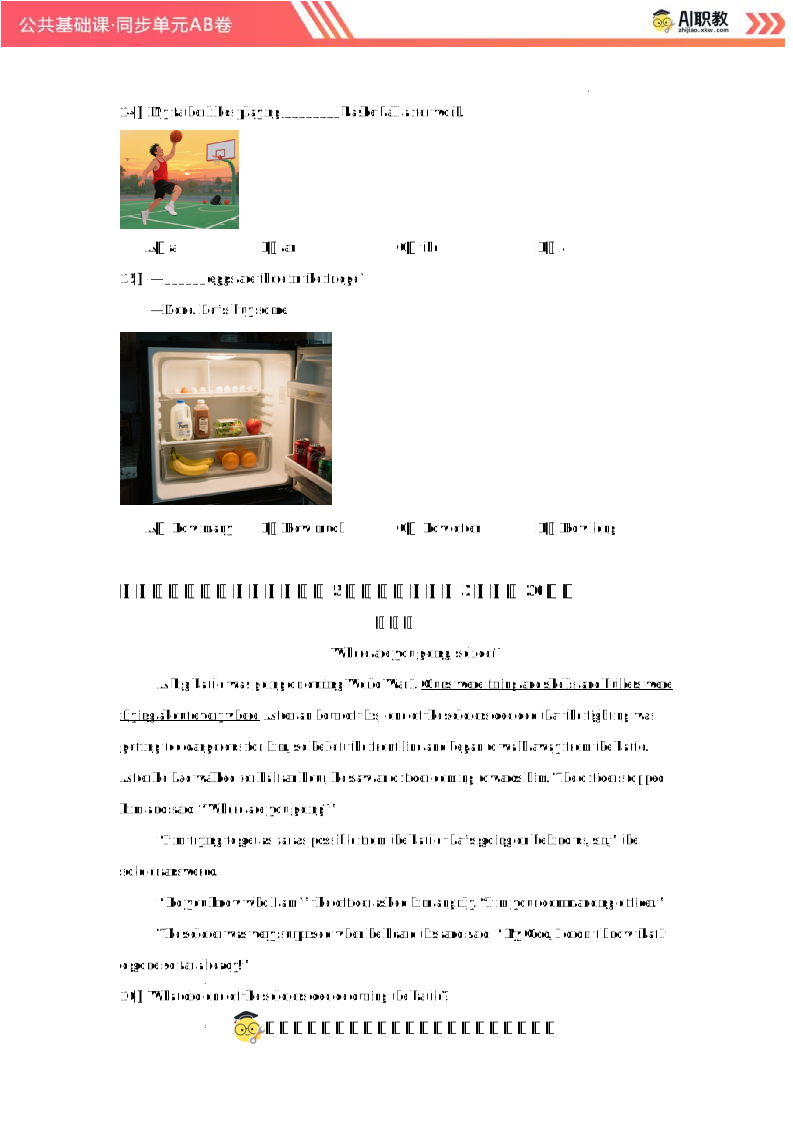
14.My father likes playing ________ basketball after work.
A.a B.an C.the D./
15.—______ eggs are there in the fridge?
—None. Let’s buy some.
A.How many B.How much C.How often D.How long
二、阅读理解(共两篇,每篇5道小题,每小题3分,共30分)
(一)
Where are you going, solider?
A big battle was going on during World War I. Guns were firing and shells and bullets were flying about everywhere. After an hour of this, one of the soldiers decided that the fighting was getting too dangerous for him, so he left the front line and began to walk away from the battle. After he had walked for half an hour, he saw an officer coming towards him. The officer stopped him and said: “Where are you going?”
“I’m trying to get as far as possible from the battle that’s going on behind us, sir,” the soldier answered.
“Do you know who I am?” the officer asked him angrily. “I’m your commanding officer.”
The soldier was very surprised when he heard this and said: “My God, I didn’t know that I’d gone so far already!”
16.What did one of the soldiers decide during the battle?
A.To keep fighting. B.To leave the front line.
C.To ask the way. D.To give up to the enemy.
17.What does the underlined sentence try to tell us?
A.What kinds of weapons were used. B.How dangerous the fighting was.
C.When the war was going to end. D.Which side would be the winner.
18.How long did the soldier walk before he saw the officer?
A.10 minutes B.Half an hour C.One hour D.Two hours
19.How did the soldier answer the officer’s question?
A.He said he wanted to go away from the battle as much as he could.
B.He said he was lost because of a long time fighting.
C.He said he didn’t know who his commanding officer was.
D.He said he was looking for his commanding officer.
20.How did the soldier feel when he found out that the officer was his commanding officer?
A.He was happy and relaxed. B.He was quite surprised.
C.He was excited and tearful. D.He was very calm.
(二)
Asking for directions is the first thing we do when we arrive in a new place, or even when we are trying to find a place. Knowing how to ask for them can make our life much easier!
Use greetings and polite expressions.
Starting the conversation with a greeting like “hello” first or some words like “may”, “can” or “could” will help you express yourself better.
Build your words.
You should know the basic words when asking for directions. It may be useful to remember some famous places. Then try to use the right words while asking for a direction.
Get to know the transportation system.
Sometimes, you are still far from your place and need to choose the proper public transportation. You might ask like this, “Is it far? Do I need to take the bus or the subway there?”
Don’t be afraid of using symbols.
Every city in the world has its own symbols. You can decrease search time if you know the most important symbols in the city. Your place might be around the symbols.
Don’t be too shy to ask.
Learn to relax if you get lost somewhere. We all can do that, especially while visiting a new city. But always make sure you can ask others for help!
21.Which of the following expressions may not help you when asking for directions?
A.May I ask ...? B.Can I know ...? C.Could you please ...? D.Tell me …
22.What does the underlined word “decrease” mean in Chinese?
A.增加 B.减少 C.浪费 D.利用
23.How many ways does the writer give in the text?
A.Two. B.Three. C.Four. D.Five.
24.Which of the following is NOT TRUE according to the text?
A.It’s necessary to express yourself better while asking for directions.
B.Remembering some famous places may be useful while asking for directions.
C.Sometimes you have to use the public transportation in a new city.
D.We all feel so shy that we never ask for directions while getting lost.
25.What’s the best title for the text?
A.How to Ask for Directions B.The Reason for Asking for Directions
C.When to Ask for Directions D.The Importance of Asking for Directions
三、翻译(共10小题,26-30每小题3分,31-35每小题2分,共25分)
26. express subway
27. get to the Summer Palace
28. bus stop near the district
29. worry about directions
30. convenient airport terminal
31. 乘坐快线
32. 颐和园地址
33. 环保游客
34. 临近地铁站
35. 换乘出租车
原创精品资源学科网独家享有版权,侵权必究!
学科网(北京)股份有限公司
学科网(北京)股份有限公司
$$
编写说明:本套【湖北专用】《同步单元AB卷》紧扣《英语 基础模块1》(高教版2023修订版)教材,以教材单元为基准精准覆盖核心考点,并紧密贴合湖北省真题题型。A卷为考点梳理卷,侧重考点分层突破;B卷为单元测试卷,强化综合能力检测,助力师生高效把握区域教学重点,提升应试能力与知识应用水平。
本卷是Unit 2 Transportation的单元测试卷,主要考查语音、语法填空、阅读、情景交际。
Unit 2 Transportation
B卷·单元测试卷
考试时间:40分钟 满分:100分
班级 姓名 学号 成绩
一、单项选择(共15小题,每题3分,共45分)
1. —Cindy, ________ to be here at 8:00 am.
—OK.
A. Is sure B.is sure that C.be sure D.Sure
【答案】C
【详解】考查祈使句。句意:—辛迪,确保早上8点到这里。—好的。分析句子结构可知,本句为肯定的祈使句,肯定的祈使句要以动词原形为开头。故选C。
2.________ smoke, dad. It is not allowed here.
A.Don’t be B.Don’t C.Not to be D.Be
【答案】B
【详解】考查祈使句。 句意:不要在这里抽烟,爸爸。在这不允许吸烟。祈使句的否定形式是:Don’t+动词原形,smoke为实义动词。故选B项。
3.________ use the lift during an earthquake.
A.Doesn’t B.Didn’t C.Don’t D.Did
【答案】C
【详解】句意:不要在地震期间使用电梯。
考查否定形式的祈使句。结合选项和空后的“use the lift during an earthquake.”可知,此处考查否定形式的祈使句,而祈使句变否定形式只需在句首的动词原形前加Don’t。故选C。
4.This is a library. ________ talk loudly.
A.Don’t B.Doesn’t C.No D.Not
【答案】A
【详解】考查祈使句。句意:这是一个图书馆。不要大声说话。分析句子可知,这是一个祈使句,祈使句通常用来表示命令、请求、建议等,根据“talk”是动词原形可知,是考查否定祈使句“Don’t+动词原形”,空处应用Don’t。故选A。
5.________ play football in the street. It’s too dangerous.
A.No B.Don’t C.Do D.Doesn’t
【答案】B
【详解】考查祈使句。句意:不要在街上踢球。太危险了。分析句子结构可知,这是祈使句的否定形式,用“Don’t+动词原形”结构。故选B。
6.Don’t ________ too fast on the busy street.
A.drive B.driving C.drives D.drove
【答案】A
【详解】考查祈使句。句意:在繁忙的街道上不要开得太快。分析句子可知,这是一个表示建议的否定祈使句,助动词“Don’t”后应使用动词原形。故选A。
7.________ to smile at your life when you are in trouble, and soon you will be happy again.
A.Try B.To try C.Trying D.Tried
【答案】A
【详解】考查祈使句。句意:当你处于困境时,试着对生活微笑,你很快就会再次快乐起来。根据“... to smile at your life when you are in trouble, and soon you will be happy again.”可知,句中“and”连接两个简单句,前半部分为祈使句,需以动词原形开头。故选A。
8. — Boys and girls, ________ down all your answers on the answer sheets before you hand in your papers.
— OK, we will.
A.to write B.write C.writing D.written
【答案】B
【详解】考查祈使句。句意:—男孩和女孩们,交卷之前请把你们所有的答案写在答题卡上。—好的,我们会的。根据“Boys and girls”及句意可知,这是老师给出的命令或建议,此句应是一个祈使句。在祈使句中常以动词原形开头。故选B。
9. —Don’t forget to give my best wishes to you parents.
—________.
A.No, I won’t B.Yes, I will C.No, I don’t D.Yes, I do
【答案】A
【详解】考查祈使句的回答。句意:—别忘了代我向你父母问好。—好的,我不会(忘记)的。分析句子可知,“Don’t forget to give my best wishes to your uncle.”是一个否定祈使句,回答时用will或won’t,如果用will,前面则用Yes,如果用won’t,前面则用No,但翻译时意思相反,即“Yes”表示不同意,而“No”表示同意,根据语境可知,此处表示“我不会忘记帮父母带好”,应使用“No, I won’t”来回答。故选A。
10.________ after learning online for 30 minutes, and you can make your eyes relaxed.
A.Taking a short break B.Taken a short break
C.If you took a short break D.Take a short break
【答案】D
【详解】考查祈使句。句意:在网上学习30分钟后稍作休息,你可以让你的眼睛放松。分析句子结构,这里是祈使句+and+陈述句,祈使句表条件,通常以动词原形开头,主语常被省略。根据“after learning online for 30 minutes”可知,学习30分钟后稍作休息,“休息”take a short break。故选D。
11.— I wonder ________ you’ll water this kind of flower.
— Every other day.
A.how often B.how long C.how soon D.how much
【答案】A
【详解】考查副词短语。句意:——我想知道你多久给这种花浇一次水。——每隔一天。A. how often多久一次;B. how long多长;C. how soon多久之后;D. how much多少。根据“Every other day.”可知,问句是在询问浇水的频率。故选A。
12.We drove to the airport the next morning to ________ Susan.
A.pick up B.fill in C.serve as D.make for
【答案】A
【详解】考查动词短语。句意:第二天早上我们开车去机场接苏珊。A. pick up接,搭载;B. fill in填写;C. serve as充当,担任;D. make for走向,前往(某地)。根据“We drove to the airport”以及空后“Susan”可知,我们去机场很可能是接或送苏珊,“pick up”意为“接,搭载”符合题意。故选A。
13.Can you tell me how to pay attention ______ my mental health?
A.on B.upon C.to D.at
【答案】C
【详解】考查动词短语。句意:你应该多关注你的发音。A. on在……上;B. for为了;C. to到、向;D. in在……里。“pay attention to”是固定短语,意为“关注、注意”,此处需用介词to。故选C。
14.My father likes playing ________ basketball after work.
A.a B.an C.the D./
【答案】D
【详解】考查冠词辨析。句意:我爸爸下班后喜欢打篮球。play+球类运动名词,表“进行某种球类运动”,球类运动名词前不需要使用冠词, play basketball意为“打篮球”。故选D。
15.—______ eggs are there in the fridge?
—None. Let’s buy some.
A.How many B.How much C.How often D.How long
【答案】A
【详解】考查疑问词短语辨析。句意:——冰箱里有多少个鸡蛋?——一个都没有。我们买一些吧。A. How many多少(后接可数名词复数,询问数量 );B. How much多少(后接不可数名词,询问数量 );多少钱(询问价格 );C. How often多久一次(询问频率 );D. How long多长(询问长度 );多久(询问时间段 )。 eggs是可数名词复数,根据答语“None.”可知,是询问鸡蛋数量,用How many。故选A。
二、阅读理解(共两篇,每篇5道小题,每小题3分,共30分)
(一)
Where are you going, solider?
A big battle was going on during World War I. Guns were firing and shells and bullets were flying about everywhere. After an hour of this, one of the soldiers decided that the fighting was getting too dangerous for him, so he left the front line and began to walk away from the battle. After he had walked for half an hour, he saw an officer coming towards him. The officer stopped him and said: “Where are you going?”
“I’m trying to get as far as possible from the battle that’s going on behind us, sir,” the soldier answered.
“Do you know who I am?” the officer asked him angrily. “I’m your commanding officer.”
The soldier was very surprised when he heard this and said: “My God, I didn’t know that I’d gone so far already!”
16.What did one of the soldiers decide during the battle?
A.To keep fighting. B.To leave the front line.
C.To ask the way. D.To give up to the enemy.
17.What does the underlined sentence try to tell us?
A.What kinds of weapons were used. B.How dangerous the fighting was.
C.When the war was going to end. D.Which side would be the winner.
18.How long did the soldier walk before he saw the officer?
A.10 minutes B.Half an hour C.One hour D.Two hours
19.How did the soldier answer the officer’s question?
A.He said he wanted to go away from the battle as much as he could.
B.He said he was lost because of a long time fighting.
C.He said he didn’t know who his commanding officer was.
D.He said he was looking for his commanding officer.
20.How did the soldier feel when he found out that the officer was his commanding officer?
A.He was happy and relaxed. B.He was quite surprised.
C.He was excited and tearful. D.He was very calm.
【答案】16.B 17.B 18.B 19.A 20.B
【导语】本文是一篇记叙文,主要讲述了一位士兵在逃跑的途中遇到了他的指挥官的故事。
16.细节理解题。根据“After an hour of this, one of the soldiers decided that the fighting was getting too dangerous for him, so he left the front line and began to walk away from the battle.” 可知,一位士兵决定离开前线,远离战争。故选B。
17.推理判断题。根据划线句子“Guns were firing and shells and bullets were flying about everywhere.”可知,枪声此起彼伏,炮弹和子弹满天飞,战争非常激烈和危险。故选B。
18.细节理解题。根据“After he had walked for half an hour, he saw an officer coming towards him.”可知,当士兵走了半小时,他看见了一位长官。故选B。
19.细节理解题。根据“I’m trying to get as far as possible from the battle that’s going on behind us, sir” 可知,士兵告诉长官他在尽可能远离身后正在进行的战斗。故选A。
20.细节理解题。根据“The soldier was very surprised when he heard this…” 可知,当这位长官时指挥官时,士兵非常地吃惊。故选B。
(二)
Asking for directions is the first thing we do when we arrive in a new place, or even when we are trying to find a place. Knowing how to ask for them can make our life much easier!
Use greetings and polite expressions.
Starting the conversation with a greeting like “hello” first or some words like “may”, “can” or “could” will help you express yourself better.
Build your words.
You should know the basic words when asking for directions. It may be useful to remember some famous places. Then try to use the right words while asking for a direction.
Get to know the transportation system.
Sometimes, you are still far from your place and need to choose the proper public transportation. You might ask like this, “Is it far? Do I need to take the bus or the subway there?”
Don’t be afraid of using symbols.
Every city in the world has its own symbols. You can decrease search time if you know the most important symbols in the city. Your place might be around the symbols.
Don’t be too shy to ask.
Learn to relax if you get lost somewhere. We all can do that, especially while visiting a new city. But always make sure you can ask others for help!
21.Which of the following expressions may not help you when asking for directions?
A.May I ask ...? B.Can I know ...? C.Could you please ...? D.Tell me …
22.What does the underlined word “decrease” mean in Chinese?
A.增加 B.减少 C.浪费 D.利用
23.How many ways does the writer give in the text?
A.Two. B.Three. C.Four. D.Five.
24.Which of the following is NOT TRUE according to the text?
A.It’s necessary to express yourself better while asking for directions.
B.Remembering some famous places may be useful while asking for directions.
C.Sometimes you have to use the public transportation in a new city.
D.We all feel so shy that we never ask for directions while getting lost.
25.What’s the best title for the text?
A.How to Ask for Directions B.The Reason for Asking for Directions
C.When to Ask for Directions D.The Importance of Asking for Directions
【答案】21.D 22.B 23.D 24.D 25.A
【导语】本文是一篇说明文。作者从使用问候语和礼貌的表达方式、构建自己的语言、了解交通系统、不要害怕使用标志、不要太害羞而不问这五个方面来介绍了如何问路。
21.细节理解题。根据第二段“Starting the conversation with a greeting like “hello” first or some words like “may”, “can” or “could” will help you express yourself better. (首先以“你好”等问候语或“可能”、“可以”或“可以”等词语开始对话将帮助您更好地表达自己。)”可知,使用“May I ask...”“Can I know...”“Could you please...”这样带有礼貌性的表达有助于问路,“Tell me ...”这样生硬的表述可能帮不到你。故选D。
22.词句猜测题。根据第五段“You can decrease search time if you know the most important symbols in the city. Your place might be around the symbols. (如果您知道城市中最重要的标志,则可以减少搜索时间。你的位置可能就在符号周围。)”可知,如果你知道城市里最重要的标志,可以减少你的搜索时间,因此decrease意为“减少”。故选B。
23.细节理解题。根据第二段“Use greetings and polite expressions. (使用问候和礼貌用语。)”;第三段“Build your words. (构建你的词语。)”;第四段“Get to know the transportation system. (了解交通系统。)”;第五段“Don’t be afraid of using symbols. (不要害怕使用符号。)”;第六段“Don’t be too shy to ask. (不要不好意思询问。)”可知,作者在文中一共给了五条建议。故选D。
24.细节理解题。根据第六段“Learn to relax if you get lost somewhere. We all can do that, especially while visiting a new city. But always make sure you can ask others for help! (如果你迷路了,要学会放松。我们都能做到这一点,尤其是在游览新城市时。但一定要确保你可以向别人寻求帮助!)”可知,此处鼓励人们不要因害羞而不敢问路,但D项“大多数人通常感到如此的害羞,以至于从不问路”没有提及。故选D。
25.主旨大意题。根据全文可知,文章主要从五个方面介绍了如何问路,因此A项符合题意。故选A。
三、翻译(共10小题,26-30每小题3分,31-35每小题2分,共25分)
26. express subway
27. get to the Summer Palace
28. bus stop near the district
29. worry about directions
30. convenient airport terminal
31. 乘坐快线
32. 颐和园地址
33. 环保游客
34. 临近地铁站
35. 换乘出租车
【答案】 26. 快线地铁 27. 到达颐和园 28. 街区附近的公交站 29. 担心方向 30. 便捷的机场航站楼31. take the express 32. the address of the Summer Palace 33. green visitor 34. near the subway station 35. change to a taxi
原创精品资源学科网独家享有版权,侵权必究!
学科网(北京)股份有限公司
学科网(北京)股份有限公司
$$
资源预览图

1

2
3

由于学科网是一个信息分享及获取的平台,不确保部分用户上传资料的 来源及知识产权归属。如您发现相关资料侵犯您的合法权益,请联系学科网,我们核实后将及时进行处理。