Unit 8 Section A 2a-2e 课件2024-2025学年人教版(2024)七年级英语下册
2025-07-24
|
11页
|
1642人阅读
|
451人下载
普通
内容正文:
Unit 8 Once Upon a Time
Section A 2a-2e
1
A Story Sharing Festival!
Which story would you like to share?
Let’s choose stories from two groups:
Western fables (寓言故事)
Chinese idiom stories (成语故事)
What makes a story good for sharing in English?
Part 1 Learning and Understanding
- Rules of Choosing a Story
Remember three rules:
Choose a simple story – think about the characters (角色)
and plot (情节)
2. Clear its big idea – think about its moral (寓意)
3. Mark the hard words – use strategy to work it out
stories can hold ideas
big
short
2
The Chinese Farmer
Who Lost His Horse
Paint the Dragon,
Dot the Eyes
Lucky or Unlucky
Make the finishing points
画龙点金
塞翁失马
Calling a Deer a Horse
Twisting Truth with Power
Chinese idiom stories
Tip 1 : Create the title by thinking about its character(角色) , plot(情节) or moral(寓意).
指鹿为马
Part 1 Learning and Understanding
- Title Creation
What’s the difference between two English titles?
direct names
meaningful titles
Calling Black White
3
Setting
Tip 2 : Learn to set the framework by using
5-finger strategy.
5-Finger Strategy
Characters
Problem
Events (事件)
Solution
When and where does the story happen?
Who are the story about?
What went wrong?
What happened in the story?
How was the problem worked out?
name
identity (身份)
personality (性格)
A VS B (conflict冲突)
beginning - middle – end
action & saying
time & place
end
Moral (寓意)
Part 1 Learning and Understanding
- Framework (框架) Setting
4
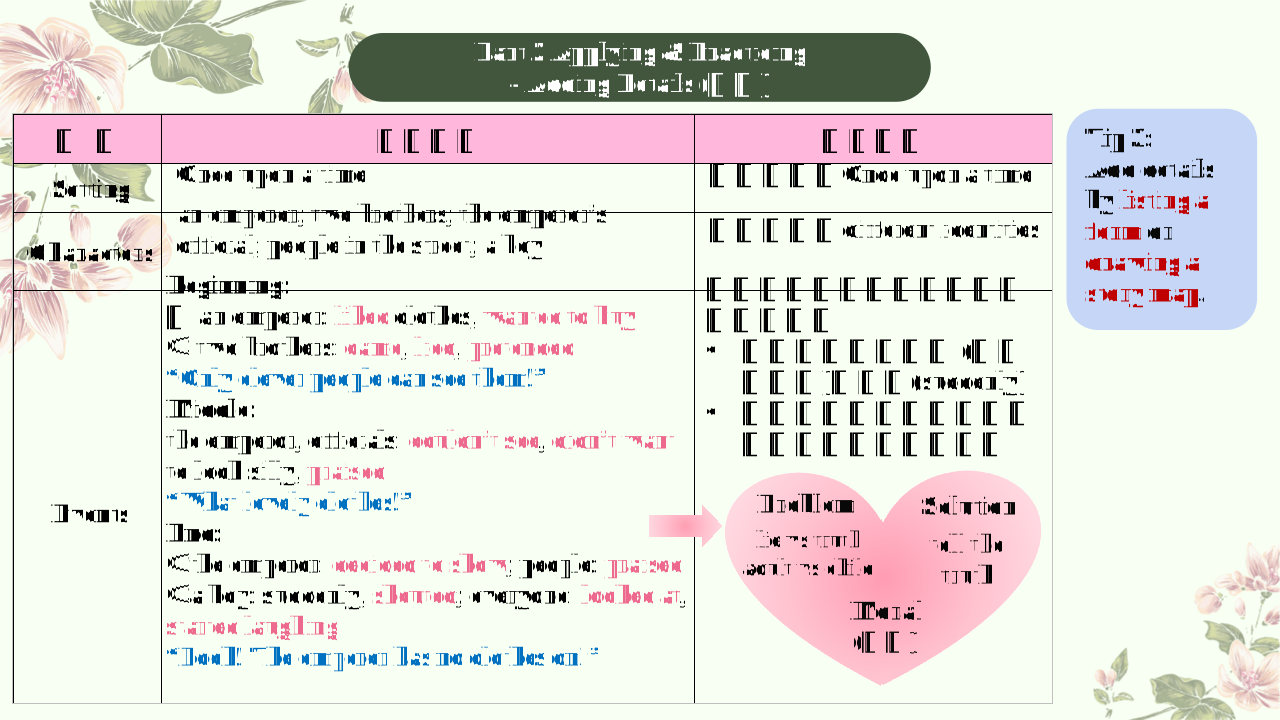
Part 2 Applying & Practicing
- Adding Details (细节)
要 素 文本细节 语言特点
Setting
Characters
Events
Tip 3:
Add details by listing a form or drawing a story map.
Problem
Solution
lie vs truth
adult vs child
tell the truth
Moral
(寓意)
Once upon a time
故事开头:Once upon a time
an emperor; two brothers; the emperor’s official; people in the street; a boy
人物设定:different identities
Beginning:
① an emperor: liked clothes, wanted to buy
② two brothers: came, lied, pretended
“Only clever people can see them!”
Middle:
the emperor, officials: couldn’t see, didn’t want to look silly, praised
“What lovely clothes!”
End:
①the emperor: decided to show; people: praised
②a boy: suddenly, shouted; everyone: looked at, started laughing
“Look! The emperor has no clothes on!”
故事情节由人物的行为和话语共同推动
行为:一般过去时 (动词过去式),副词(suddenly)
话语:直接引用,一般现在时,感叹句,形容词
5
Part 2 Applying & Practicing
- Moral Discovery and Expression
Show the Point
Find Link Translate
坚守诚信
谎言终将被揭穿
独立思考
从众心理隐患多
别让虚荣心支配你
Always tell the truth.
Lies don’t last forever.
Think for yourself.
Following the crowd is dangerous.
Don’t let pride control you.
Tip 4 : Find the moral by focusing on problems and solutions.
title (故事标题):_____________________
characters (主要角色): ______ ______ ______
problem (关键冲突): ______ vs ______
solution (最意外情节): ____________________
6
Part 2 Applying & Practicing
- Acting out
开场 Hi, everyone! I’d like to share my favourite story with you. Its name is...
Do you know the story...?
讲述故事 once, once upon a time, long ago, long ago
past - tense verbs: liked, wanted, came, lied, pretended
what the characters said: “… can / are / has...” he / she said.
connecting words: one day, then, next, the end…
The story teaches us:
结尾 The end! Did you like the story? Please tell me what you think!
Tip 5 : Speak loudly and confidently with facial expressions and body movements.
7
Part 3 Transferring & Innovating
- Story Sharing
Calling a Deer a Horse
Twisting Truth with Power
指鹿为马
Calling Black White
Characters
Beginning
Middle
Problem
End (Solution)
Zhao Gao (a powerful minister),
an emperor, officials
Zhao Gao wanted to know if officials would follow him. He brought a dear but called it horse.
The emperor thought it must be a dear and asked the officials. Some lied, some told the truth, others said nothing.
Zhao hurt the truth-tellers, then everyone acted like the lie was true!
It is a dear or a horse?
To tell truth or lie?
To follow Zhao or not?
Moral
When powerful people make others lie, truth needs courage.
8
Checklist (评价表)
I can tell a story
Content
(内容) begin the story with its name
tell the development of the story with proper verbs
tell the end and the moral of the story
Language
(语言) use the simple present tense and the simple past tense correctly
use connecting words
use adjectives and adverbs to give details
Performance
(表现) speak loudly and confidently
act with facial expressions and body movements
Part 3 Transferring & Innovating
- Sharing
9
Hi everyone! Let me tell you a Chinese story called Calling a Deer a Horse.
Once upon a time, there was a powerful minister named Zhao Gao. He wanted to know if officials would follow him.
One day, he brought a deer to the emperor and said, “Your Majesty, I’m giving you this wonderful horse.” The emperor laughed, “But this is a deer!”
Then Zhao Gao asked the other officials, “Is this a deer or a horse?” Some officials were scared. They lied, “Yes, it’s a horse!” Some stayed quiet. A few brave ones said, “It’s a deer!”
Later, Zhao Gao hurt the truth-tellers. Finally, everyone acted like the lie was true. Whenever they saw a deer, they called it a horse!
The story teaches us: When powerful people make others lie, truth needs courage.
The end! What would you do if you were there? Let me know!
Story Sharing Festival!
10
Must-do:
Use “5-Finger Strategy” to retell the story Calling a Deer a Horse.
Choose-to-do:
Share your favorite story and make a short video in your free time.
11
Audio generated by ttsmaker.cn
null
61536.0
$$
资源预览图

1

2

3

4
5
相关资源
示范课
由于学科网是一个信息分享及获取的平台,不确保部分用户上传资料的 来源及知识产权归属。如您发现相关资料侵犯您的合法权益,请联系学科网,我们核实后将及时进行处理。