精品解析:海南省海口市部分学校2023-2024学年七年级下学期期末考试英语试题(2)
 切换试卷
切换试卷
2025-06-08
|
2份
|
26页
|
266人阅读
|
4人下载
资源信息
| 学段 | 初中 |
|---|---|
| 学科 | 英语 |
| 教材版本 | - |
| 年级 | 七年级 |
| 章节 | - |
| 类型 | 试卷 |
| 知识点 | - |
| 使用场景 | 同步教学-期末 |
| 学年 | 2024-2025 |
| 地区(省份) | 海南省 |
| 地区(市) | 海口市 |
| 地区(区县) | - |
| 文件格式 | ZIP |
| 文件大小 | 4.41 MB |
| 发布时间 | 2025-06-08 |
| 更新时间 | 2025-06-08 |
| 作者 | 匿名 |
| 品牌系列 | - |
| 审核时间 | 2025-06-08 |
| 下载链接 | https://m.zxxk.com/soft/52485941.html |
| 价格 | 4.00储值(1储值=1元) |
| 来源 | 学科网 |
内容正文:
2023—2024学年度第二学期
七年级英语科期末检测题
(温馨提示:本卷满分120分,考试时间90分钟。请将答案写在答题卡上)
第一部分 听力理解(共四节,满分20分)
第一节(共5小题,每小题1分,满分5分)
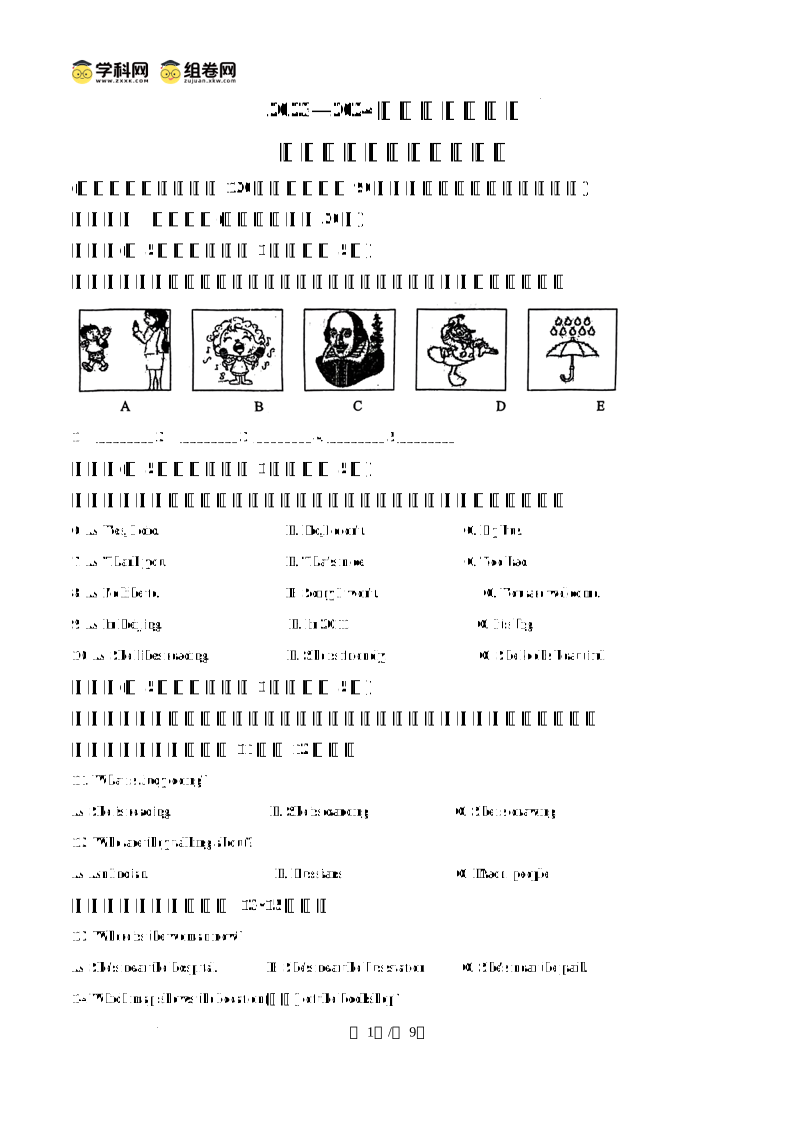
听句子录音,根据所听内容选择与句子意思一致的图画。句子读一遍。
1. ________ 2. ________ 3. ________ 4. ________ 5.________
第二节(共5小题,每小题1分,满分5分)
听句子录音,根据所听内容选出能正确回答句子的答语。句子读两遍。
6. A. Yes, I did. B. No,I didn't. C. By bus.
7. A. Thank you. B. That's nice. C. Too bad.
8. A. I'd like to. B. Sorry,I won't. C. You are welcome.
9. A. In Beijing. B. In 2011. C. It's big.
10. A. She likes reading. B. She is friendly. C. She looks beautiful.
第三节(共5小题,每小题1分,满分5分)
听对话录音,根据所听内容选出能回答所提问题的正确选项。对话读两遍。
听第一段对话,回答第11和第12小题。
11. What is Judy doing?
A. She is reading. B. She is dancing. C. She is drawing.
12. Who are they talking about?
A. An Indian. B. Russians. C. Maori people.
听第二段对话,回答第 13~15小题。
13. Where is the woman now?
A. She's near the hospital. B. She's near the bus station. C. She's near the park.
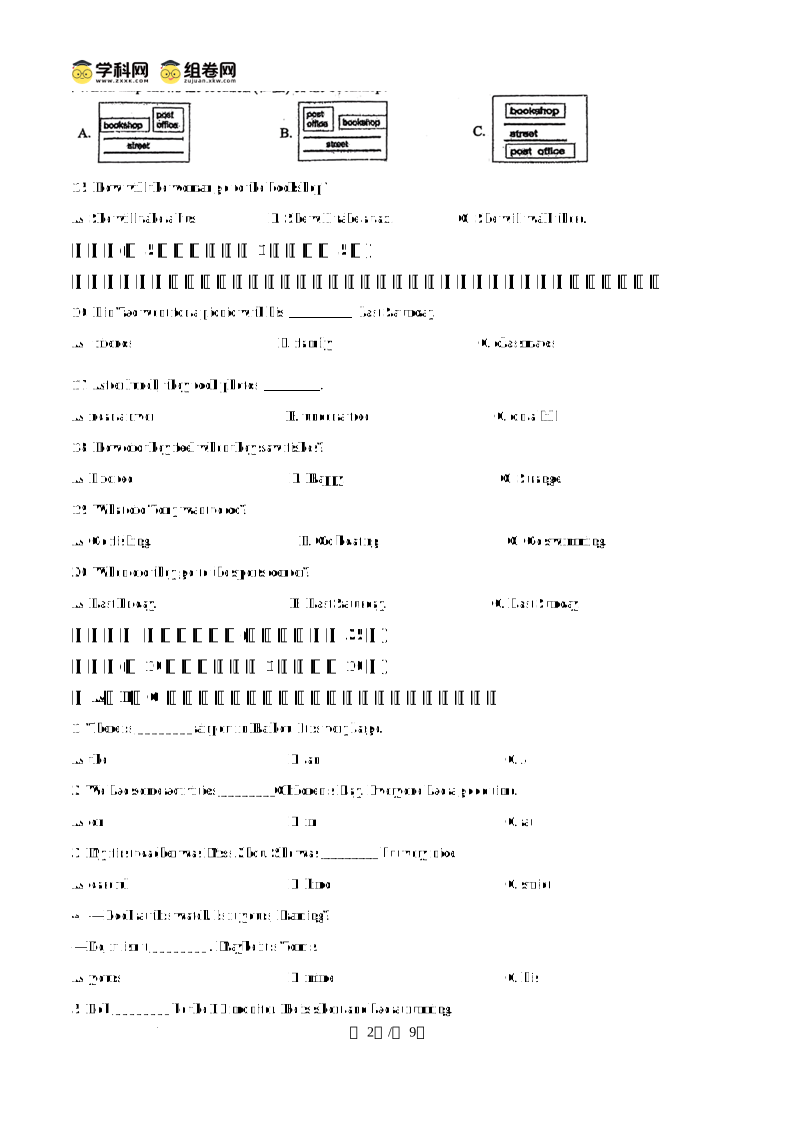
14.Which map shows the location(位置) of the bookshop?
15. How will the woman go to the bookshop?
A. She will take a bus. B. She will take a taxi. C. She will walk there.
第四节(共5小题,每小题1分,满分5分)
听短文录音,根据所听内容选择能填入空白处或回答问题的最佳选项。短文读两遍。
16. Lin Tao went for a picnic with his last Saturday.
A. friends B. family C. classmates
17. After lunch, they took photos .
A. near a river B. under a tree C. on a hill
18. How did they feel when they saw fishes?
A. Excited. B. Happy. C. Strange.
19. What did Tony want to do?
A. Go fishing. B. Go boating. C. Go swimming.
20. When did they go to the sports center?
A. Last Friday. B. Last Saturday. C. Last Sunday.
第二部分 语言知识运用(共两节,满分25分)
第一节(共10小题,每小题1分,满分10分)
从A、B、C 三个选项中选出一个能填入空白处的最佳选项。
1. There is ________ airport in Haikou. It is very large.
A. the B. an C. /
【答案】B
【解析】
【详解】句意:海口有一个机场,它非常大。
考查冠词。空格处需填入冠词,表示“一个机场”(泛指)。airport以元音音素开头,因此用an。故选B。
2. We had some activities ________Children’s Day. Everyone had a good time.
A. on B. in C. at
【答案】A
【解析】
【详解】句意:我们在儿童节有一些活动。每个人都玩得很开心。
考查介词辨析。on表示在具体某一天或某一天的上午、下午、晚上等;in表示在较长的时间段内,如年、月、季节等;at表示在具体的时刻。根据语境可知,此处是在描述儿童节这一具体的日子,所以应该用on。故选A。
3. My first teacher was Miss Zhou. She was ________ but very nice.
A. careful B. kind C. strict
【答案】C
【解析】
【详解】句意:我的第一位老师是周老师。她很严格,但人很好。
考查形容词辨析。careful认真的;kind和蔼的;strict严格的。根据“but very nice”可知很严格,但是人很好。故选C。
4. —Look at this watch. Is it yours, Daming?
—No, it isn’t ________ . Maybe it’s Tom’s.
A. yours B. mine C. his
【答案】B
【解析】
【详解】句意:——看看这只表。大明,这是你的吗?——不,这不是我的。也许是汤姆的。
考查代词辨析。yours你的;mine我的;his他的。根据“Look at this watch. Is it yours, Daming?”可知,此处应回答“不是我的(表)”,用mine。故选B。
5. Bob ________ be the PE monitor. He is short and bad at running.
A. can’t B. could C. needn’t
【答案】A
【解析】
【详解】句意:鲍勃不可能是体育委员。他个子矮,还不擅长跑步。
考查情态动词表推测的用法。can’t不可能;could可能;needn’t不必。根据后半句“He is short and bad at running.”可知,此处需否定推测能力,强调“不可能”。故选A。
6. —________ is it from your home to the school?
—About 10 minutes’ walk.
A. How long B. How far C. How often
【答案】B
【解析】
【详解】句意:——从你家到学校有多远?——步行大约10分钟。
考查特殊疑问句。How long多久;How far多远;How often多久一次。根据“About 10 minutes’ walk.”可知,对距离提问,用How far。故选B。
7. I________ Paris with my family this summer holiday to watch the Olympic Games.
A. visit B. visited C. will visit
【答案】C
【解析】
【详解】句意:今年暑假我将和家人一起去巴黎看奥运会。
考查一般将来时。根据时间状语“this summer”可知,句子时态是一般将来时,谓语动词构成是will+动词原形。故选C。
8. —Liu Ming’s dream is to become a musician like Mozart.
—Great! I hope his dream can ________.
A. come out B. come true C. come back
【答案】B
【解析】
【详解】句意:——刘明的梦想是成为像莫扎特一样的音乐家。 ——太棒了!我希望他的梦想能够实现。
考查动词短语。come out出版,出现;come true实现;come back回来。根据“I hope his dream can”可知,此处是希望刘明的梦想能变为现实,应用“come true”。故选B。
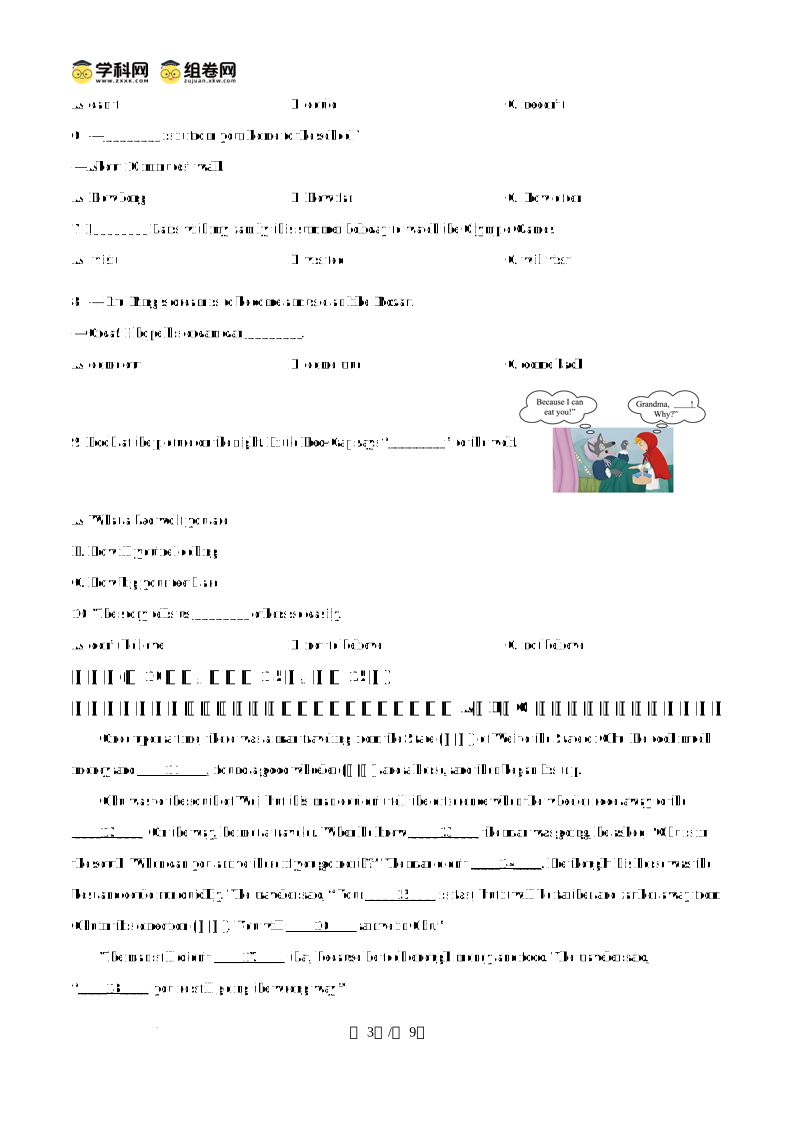
9. Look at the picture on the right. Little Red-Cap says “________” to the wolf.
A. What a bad wolf you are
B. How ill you’re looking
C. How big your teeth are
【答案】C
【解析】
【详解】句意:看右边的图片。小红帽对狼说“你的牙齿好大啊”。
考查常识。What a bad wolf you are你真是一只坏狼;How ill you’re looking你看上去病得很厉害;How big your teeth are你的牙齿好大啊。根据狼的回答“Because I can eat you!”可推知,小红帽应对狼说“你的牙齿好大啊”。故选C。
10. The story tells us ________ others so easily.
A. don’t believe B. not to believe C. not believe
【答案】B
【解析】
【详解】句意:这个故事告诉我们不要轻易相信别人。
考查动词不定式的否定形式。根据“The story tells us...others so easily.”可知,此处是“tell sb. not to do sth.”结构,意为“告诉某人不要做某事”,所以应该用动词不定式的否定形式。故选B。
第二节(共10小题, 每小题1.5分, 满分15分)
阅读下面短文,掌握其大意,然后从短文后各题所给的A、B、C 三个选项中选出最佳选项。
Once upon a time, there was a man traveling from the State (国家) of Wei to the State of Chu. He took much money and ____11____, found a good wheeler (车夫) and a horse, and then began his trip.
Chu was to the south of Wei, but this man couldn’t tell the difference when the wheeler rode away to the ____12____. On the way, he met a traveler. When he knew ____13____ the man was going, he asked, “Chu is in the south. When can you arrive there if you go north?” The man didn’t ____14____. He thought his horse was the best and could run quickly. The traveler said, “Your ____15____ is fast, but it will be farther and farther away from Chu in this direction (方向). You will ____16____ arrive in Chu.”
The man still didn’t ____17____ that, because he took enough money and food. The traveler said, “____18____ you’re still going the wrong way.”
The man answer, “____19____. My wheeler is very good!”
Hearing that, the traveler didn’t say ____20____. He watched helplessly as the man went away.
11. A. clothes B. food C. books
12. A. north B. south C. east
13. A. where B. how C. why
14. A. move B. care C. promise
15. A. horse B. wheeler C. trip
16. A. only B. also C. never
17. A. point at B. worry about C. look for
18. A. So B. And C. But
19. A. Well, I’m not sure B. Wait a moment C. It doesn’t matter
20 A. something B. anything C. everything
【答案】11. B 12. A 13. A 14. B 15. A 16. C 17. B 18. C 19. C 20. B
【解析】
【导语】本文是一篇寓言故事。文章讲述了一个魏国人想要去楚国,却朝着相反的方向走,路人提醒他走错了,他却认为自己的马好、车夫好、盘缠多,一定能到达楚国,却不知方向错了,永远也到不了。
【11题详解】
句意:他带了很多钱和食物,找了一个好车夫和一匹马,然后开始了他的旅行。
clothes衣服;food食物;books书。根据下文“because he took enough money and food”可知,他带了很多钱和食物。故选B。
【12题详解】
句意:楚国在魏国的南面,但当车夫向北走时,这个人却分不清方向。
north北方;south南方;east东方。根据下文“When can you arrive there if you go north?”可知,车夫向北走。故选A。
【13题详解】
句意:当他知道这个人要去哪里时,他问:“楚国在南方。如果你往北走,什么时候能到那里?”
where哪里;how怎样;why为什么。根据下文“Chu is in the south. When can you arrive there if you go north?”可知,此处是问这个人要去哪里。故选A。
【14题详解】
句意:这个人不在乎。
move移动;care在乎;promise承诺。根据下文“He thought his horse was the best and could run quickly.”可知,这个人不在乎方向,他认为自己的马好、跑得快。故选B。
【15题详解】
句意:你的马很快,但在这个方向上,你会离楚国越来越远。
horse马;wheeler车夫;trip旅行。根据上文“He thought his horse was the best and could run quickly.”可知,此处是夸赞他的马跑得快。故选A。
【16题详解】
句意:你永远也到不了楚国。
only仅仅;also也;never从不。根据上文“Your horse is fast, but it will be farther and farther away from Chu in this direction”可知,方向错了,永远也到不了楚国。故选C。
【17题详解】
句意:这个人还是不担心,因为他带了足够的钱和食物。
point at指着;worry about担心;look for寻找。根据下文“because he took enough money and food”可知,这个人认为自己带了足够的钱和食物,所以不担心。故选B。
【18题详解】
句意:但是你还是走错了路。
So因此;And和;But但是。根据上文“The man still didn’t worry about that”及下文“you’re still going the wrong way”可知,此处表示转折关系,用but连接。故选C。
【19题详解】
句意:没关系。我的车夫很好!
Well, I’m not sure嗯,我不确定;Wait a moment等一下;It doesn’t matter没关系。根据下文“My wheeler is very good!”可知,这个人认为没关系,他的车夫很好。故选C。
【20题详解】
句意:听到这话,旅行者什么也没说。
something某事;anything任何事;everything一切。根据“He watched helplessly as the man went away.”可知,旅行者什么也没说,否定句中用anything。故选B。
第三部分 阅读理解(共三节,满分55分)
第一节 (共15小题,每小题2分,满分30分)
阅读下列短文,从每小题所给的A、B、C三个选项中选出最佳选项。
A
SUNSHINE TOWN CARNIVAL (嘉年华)
(This Sunday, 14th July)
Place: The square in front of City Library
Time: 11:00 am to 9:00 pm
Activities:
11:00 am Magic Show
12:00 noon Learn to Make Healthy Sandwiches
2:00 pm Tell-a-story Time (for children under 12 years old)
3:00 pm Three-legged Race (for families)
4:00 pm Balloon Twisting Show
5:00 pm Dinner party
Payment: $1 for children under 12 years old, $2 for adults
21. When will the Carnival start?
A. In June. B. In July. C. In August.
22. How long will the Carnival last?
A. 9 hours. B. 10 hours. C. 11 hours.
23. What activity can we take part in at 2:30 pm?
A. Magic Show. B. Three-legged Race. C. Tell-a-story Time.
24. If 11-year-old Betty goes to the Carnival with her parents, how much should they pay?
A. $5. B. $6. C. $8.
25. Which of the following is NOT mentioned (未提及) about the Carnival?
A. The place. B. The payment. C. The gifts.
【答案】21. B 22. B 23. C 24. A 25. C
【解析】
【导语】本文主要介绍了Sunshine Town Carnival的活动信息,包括时间、地点、各项活动安排和收费标准等内容。
【21题详解】
细节理解题。根据“This Sunday, 14th July”可知,嘉年华将在7月举行。故选B。
【22题详解】
细节理解题。根据“Time: 11:00 am to 9:00 pm”可知,活动持续10小时。故选B。
【23题详解】
细节理解题。根据“2:00 pm;Tell-a-story Time (for children under 12 years old)”可知,下午2:30可以参加的活动是“Tell-a-story Time”。故选C。
【24题详解】
推理判断题。根据“$1 for children under 12 years old, $2 for adults”可知,12岁以下的儿童每人1美元,成人每人2美元,1+2+2=5,他们需要支付5美元。故选A。
【25题详解】
细节理解题。根据“Place: The square in front of City Library”和“Payment: $1 for children under 12 years old, $2 for adults”可知,文中提及地点和费用,但未提及礼物。故选C。
B
People often say, “The more you work the land, the better your crops (庄稼) will be.” That’s what we learn during our school’s Growing Week!
In the morning we went to our rooms. Then, the teachers showed us how to make the bed and where to put our things. At first, we didn’t know why we needed to learn such simple tasks. But the teacher said, “Even small things can be difficult until you know how to do them.”
At lunchtime, the teachers told us, “You have to wash the dishes after eating.” At first, we didn’t do it very well. So the teachers showed us the right way to clean them. After that, the dishes looked much better!
In the evening, the teachers taught us how to cook rice. We did something wrong at first, but finally we got it right! We were so happy, because we were eating food cooked by ourselves. That night, we finished all the rice.
Time went by quickly, and Growing Week ended. Now, I think it’s time for me to help out more at home.
26. The writer thinks their school’s Growing Week is ________.
A. interesting B. helpful C. difficult
27. In Paragraph 2, the underlined word “simple” means “_______” in Chinese.
A. 简单的 B. 激烈的 C. 危险的
28. When did the writer and his classmates learn to cook?
A. In the morning. B. In the afternoon. C. In the evening.
29. Which of the following is TRUE?
A. The children showed how to make the bed first.
B. At first the children couldn’t wash the dishes well.
C. The children finished all the rice cooked by the teachers.
30. What will the writer do after Growing Week?
A. He will study harder.
B. He will help with the housework.
C. He will ask his friend to join in Growing Week.
【答案】26. B 27. A 28. C 29. B 30. B
【解析】
【导语】本文主要讲述了作者在学校开展的“成长周”学到了很多生活技能。
【26题详解】
推理判断题。根据“‘The more you work the land, the better your crops(庄稼) will be.’ That’s what we learn during our school’s Growing Week!”以及文章内容可知,作者在“成长周”学到了很多生活技能,所以他可能认为学校的“成长周”是有帮助的。故选B。
【27题详解】
词义猜测题。根据“Then, the teachers showed us how to make the bed and where to put our things. At first, we didn’t know why we needed to learn such simple tasks”可知作者他们认为像铺床以及把东西放在哪里这样的认为很简单,故此处划线部分意为“简单的”。故选A。
【28题详解】
细节理解题。根据“In the evening, the teachers taught us how to cook rice”可知作者和他的同学是晚上学习的做饭。故选C。
【29题详解】
细节理解题。根据“‘You have to wash the dishes after eating.’At first, we didn’t do it very well”可知刚开始,他们碗洗得不好。故选B。
【30题详解】
推理判断题。根据“ Now, I think it’s time for me to help out more at home.”可知作者认为是时候在家里多帮忙了,所以他会帮助做家务。故选B。
C
What was the life like in the past? Let’s have a look together!
Today people usually enjoy two-day weekends. Did people in ancient China have a weekend? No. But they had their own way to relax. During the Han Dynasty (朝代), after people worked for five days, they could relax for a day. During the Tang Dynasty, they had to work for ten days and then they could have one day to relax. From then on, people could relax on special festivals. During the Ming and Qing dynasties, people could even relax on the emperors’ birthdays.
In summer, it’s easy for us to stay cool and comfortable with an air conditioner (空调). How did people get through hot summer in the past? As early as the Zhou Dynasty, some workers’ job was to find ice in winter and keep them for the next summer. When it came, people could use them to make their rooms cooler. The ice could also be used to make cold drinks.
Are takeouts new? Of course not. People in the Song Dynasty already had it. The emperor Xiaozong liked to order takeouts late at night. His servants would go and find dishes and bring them back to him. Common people also ordered takeouts. Restaurant waiters would go on streets and tell people about the dishes they could order that day. After ordering food, customers could wait for the dishes at home.
31. How often did people in the Tang Dynasty relax?
A. About 3 times a month. B. About 4 times a month. C. About 5 times a month.
32 When did people make it easy to stay cool and comfortable in summer?
A. In the Han Dynasty. B. In the Ming Dynasty. C. In the Zhou Dynasty.
33. Which question can get an answer from the passage?
A Why could people relax on the emperors’ birthdays?
B. How did people in the past keep ice for the next summer?
C. Who would order takeouts from restaurants in the Song Dynasty?
34. How may we feel about the life in the past after reading the passages?
A. Sorry. B. Surprised. C. Bored.
35. In which part of a magazine can we read these passages?
A. Travel around the World. B. Food and Holiday. C. History and Culture.
【答案】31. A 32. C 33. C 34. B 35. C
【解析】
【导语】本文是一篇说明文,主要介绍了中国古代不同时期的休闲方式、避暑方法及外卖文化等生活细节。
【31题详解】
推理判断题。根据第二段“During the Tang Dynasty, they had to work for ten days and then they could have one day to relax.”可知,唐代人们工作十天可休息一天,每月约30天,则可休息3次。故选A。
【32题详解】
细节理解题。根据第三段“As early as the Zhou Dynasty, some workers’ job was to find ice in winter and keep them for the next summer. When it came, people could use them to make their rooms cooler.”可知, 在周朝,人们已开始用冰降温。故选C。
【33题详解】
推理判断题。根据最后一段“Common people also ordered takeouts. Restaurant waiters would go on streets and tell people about the dishes they could order that day. After ordering food, customers could wait for the dishes at home.”可知,宋朝的普通百姓会从餐馆点外卖,所以文章回答了“在宋朝谁可以从餐馆点外卖?”。故选C。
【34题详解】
推理判断题。全文通过对比古今生活方式(如休假频率、避暑智慧、外卖起源),呈现古代生活的趣味性,最可能引发读者的“惊讶”感。故选B。
【35题详解】
推理判断题。本文主要介绍了中国古代不同时期的休闲方式、避暑方法及外卖文化等生活细节。因此,我们可以在杂志的“历史与文化”板块读到这篇文章。故选C。
第二节(共5小题,每小题2分,满分10分)
根据短文内容,从短文后选项中选出能填入空白处的最佳选项,选项中有一项为多余选项。
People all around the world enjoy music. _____36_____ Some music is fast, and some music is slow. Some music is high and some music is low.
_____37_____ Slow music can make us feel sleepy, and fast music can make us feel excited. For example, Pedro listens to slow music at night, so he can fall asleep easily. ____38____ In this way, she can wake up quickly. Also, the same music can make one person feel sad and another person feel happy. _____39_____
Music can help us imagine (想象) things such as animals. When the music is fast, we can imagine an animal running. When it’s low and slow, we can imagine an animal that is in danger. Next time you listen to music, draw a picture of what you imagine. Look at it a week later. _____40_____ Don’t you think it’s very interesting?
A. Does it help you to remember the music?
B. Amanda listens to fast music in the morning.
C. There are many different kinds of music.
D. I don’t like rock music because it’s too noisy.
E. When we listen to music, we feel different things.
F. There are no right feelings or wrong feeling about music.
【答案】36. C 37. E 38. B 39. F 40. A
【解析】
【导语】本文主要介绍了音乐对人们的不同影响以及音乐能引发的想象。
【36题详解】
根据“Some music is fast, and some music is slow. Some music is high and some music is low.”可知,此处应是说音乐有很多不同的种类,选项C“有很多不同种类的音乐。”符合语境。故选C。
【37题详解】
根据“Slow music can make us feel sleepy, and fast music can make us feel excited.”可知,此处应是说当我们听音乐时,会有不同的感受,选项E“当我们听音乐时,我们会感受到不同的东西。”符合语境。故选E。
【38题详解】
根据“For example, Pedro listens to slow music at night, so he can fall asleep easily.”以及“In this way, she can wake up quickly.”可知,此处应是说另一个人听快节奏音乐的例子,选项B“阿曼达早上听快节奏的音乐。”符合语境。故选B。
【39题详解】
根据“Also, the same music can make one person feel sad and another person feel happy.”可知,此处应是说对于音乐没有正确或错误的感受,选项F“关于音乐,没有正确的感受或错误的感受。”符合语境。故选F。
【40题详解】
根据“Next time you listen to music, draw a picture of what you imagine. Look at it a week later.”可知,此处应是说这样做是否有助于记住音乐,选项A“它有助于你记住音乐吗?”符合语境。故选A。
第三节(共8小题, 61至65每小题1分; 66、67每小题2分; 68小题6分, 满分15分)
阅读下面短文,根据短文内容按要求完成任务。
Yu Guangzhong was a poet famous for the homesickness (思乡之情) in his poems. On December 14, 2017, famous Chinese poet Yu Guangzhong died in Taiwan. Now, it’s time for us to show our missing for him.
Born in 1928 in Nanjing, Jiangsu, Yu entered the University of Nanjing in 1947, and then went to Xiamen University in 1949. He worked so hard in the university that he got good grades during the university and started to write poems. At the age of 22, Yu and his family moved to Taiwan from Hong Kong. He lived and worked there until he died. He was famous for his works.
Nostalgia is one of Yu’s most famous poems. In the poem, he showed his homesickness for the motherland when he was in Taiwan. The poem came out in 1971. It is popular among Chinese speakers around the world. Even some people know little about Yu Guangzhong, they know some lines from the poem.
Yu spent his whole life writing. “The reason why I keep writing till today comes down to my great love for the Chinese language,” he once said in 2015. He also worked on the Chinese and Western literature translation (文学翻译) and won the hearts of people from all over the world.
Task 1: According to the passage, finish the chart with no more than three words.
41. ________
42. ________
43. ________
44. ________
45. ________
Task 2: According to the passage, answer the following questions.
46. When did Yu Guangzhong start to write poems?
________________________________________
47. How long did Yu Guangzhong stay in Taiwan?
________________________________________
48. What do you think of Yu Guangzhong? Explain your reasons in 20 words.
________________________________________
【答案】41. poet
42. writing
43. 1950 44. died
45. homesickness 46. In 1949.
47. For 67 years.
48. I think he is successful because he is famous for his poems and works of translation.
【解析】
【导语】本文主要介绍著名诗人余光中和他的作品。
【41题详解】
根据“Yu Guangzhong was a poet famous for the homesickness (思乡之情) in his poems.”可知,余光中是一位诗人,故填poet。
【42题详解】
根据“The reason why I keep writing till today comes down to my great love for the Chinese language”可知,余光中喜欢写诗,故填writing。
【43题详解】
根据“Born in 1928 in Nanjing, Jiangsu ... At the age of 22, Yu and his family moved to Taiwan from Hong Kong.”可知,余光中与1950年搬去台湾,故填1950。
【44题详解】
根据“On December 14, 2017, famous Chinese poet Yu Guangzhong died in Taiwan.”可知,余光中与2017年在台湾去世,故填died。
【45题详解】
根据“Nostalgia is one of Yu’s most famous poems. In the poem, he showed his homesickness for the motherland when he was in Taiwan.”可知,《乡愁》表达了他在台湾时对祖国的思念。故填homesickness。
【46题详解】
根据“and then went to Xiamen University in 1949. He worked so hard in the university that he got good grades during the university and started to write poems”可知,余光中1949年开始写诗,故填In 1949.
【47题详解】
根据“Born in 1928 in Nanjing, Jiangsu ... At the age of 22, Yu and his family moved to Taiwan from Hong Kong.”和“On December 14, 2017, famous Chinese poet Yu Guangzhong died in Taiwan.”可知,余光中1950年搬去台湾,2017年在台湾去世,他在台湾待了67年。故填For 67 years.
【48题详解】
本题属于开放性试题,言之有理即可,参考答案:I think he is successful because he is famous for his poems and works of translation.
第四部分 写作(满分20分)
49. 古人云:“读万卷书,行万里路。”本周英语角话题要求大家分享最难忘的一次旅行经历。请根据以下提示以“My Wonderful Trip to ________”为题写一篇讲稿,谈谈你最难忘的一次旅行经历及旅行收获。
要求:
1.内容需涵盖所有要点;
2.语句通顺,意思连贯,语法正确,书写规范;
3.文中不得出现真实的人名、校名;
4.100词左右(文章开头已给出,不计入总词数)。
My Wonderful Trip to ________
As an old saying goes, “Read as many as ten thousand books and travel as far as ten thousand miles.” I had a wonderful trip to ...
________________________________________________________________________________________________________________________________________________________________________________________________________________________________________________________________________________________________________________________________________________________________________________________________________________________________________________________________________________________________________________________________________________________________________________________________________________________________________________________________________________________________________________________
【答案】例文
My Wonderful Trip to Beijing
As an old saying goes, “Read as many as ten thousand books and travel as far as ten thousand miles.” I had a wonderful trip to Beijing with my family. It was a wonderful trip that I will never forget. We took a train to Beijing. It took us about 12 hours, but we were very excited.
When we arrived, we visited many famous places. The Great Wall was my favorite. It was so long and beautiful. We climbed up and down the steep steps. It was tiring, but I felt very proud when I reached the top. I also visited the Forbidden City and the Summer Palace. They were full of history and culture.
This trip was really great. I learned a lot about Chinese history. I also made new friends. I hope I can go there again someday.
【解析】
【详解】[总体分析]
①题材:本文是一篇演讲稿;
②时态:时态为一般过去时;
③提示:根据提示内容介绍自己的一次旅行经历,适当增加细节,突出写作重点。
[写作步骤]
第一步,介绍自己去了哪里旅行以及是如何去的;
第二步,介绍自己的旅行经历;
第三步,介绍自己的感受。
[亮点词汇]
①be full of充满
②learn a lot about学到很多关于……
[高分句型]
①It was a wonderful trip that I will never forget. (that引导的定语从句)
②When we arrived, we visited many famous places. (when引导的时间状语从句)
第1页/共1页
学科网(北京)股份有限公司
$$
2023—2024学年度第二学期
七年级英语科期末检测题
(温馨提示:本卷满分120分,考试时间90分钟。请将答案写在答题卡上)
第一部分 听力理解(共四节,满分20分)
第一节(共5小题,每小题1分,满分5分)
听句子录音,根据所听内容选择与句子意思一致的图画。句子读一遍。
1. ________ 2. ________ 3. ________ 4. ________ 5.________
第二节(共5小题,每小题1分,满分5分)
听句子录音,根据所听内容选出能正确回答句子的答语。句子读两遍。
6. A. Yes, I did. B. No,I didn't. C. By bus.
7. A. Thank you. B. That's nice. C. Too bad.
8. A. I'd like to. B. Sorry,I won't. C. You are welcome.
9. A. In Beijing. B. In 2011. C. It's big.
10. A. She likes reading. B. She is friendly. C. She looks beautiful.
第三节(共5小题,每小题1分,满分5分)
听对话录音,根据所听内容选出能回答所提问题的正确选项。对话读两遍。
听第一段对话,回答第11和第12小题。
11. What is Judy doing?
A. She is reading. B. She is dancing. C. She is drawing.
12. Who are they talking about?
A. An Indian. B. Russians. C. Maori people.
听第二段对话,回答第 13~15小题。
13. Where is the woman now?
A. She's near the hospital. B. She's near the bus station. C. She's near the park.
14.Which map shows the location(位置) of the bookshop?
15. How will the woman go to the bookshop?
A. She will take a bus. B. She will take a taxi. C. She will walk there.
第四节(共5小题,每小题1分,满分5分)
听短文录音,根据所听内容选择能填入空白处或回答问题的最佳选项。短文读两遍。
16. Lin Tao went for a picnic with his last Saturday.
A friends B. family C. classmates
17. After lunch, they took photos .
A. near a river B. under a tree C. on a hill
18. How did they feel when they saw fishes?
A. Excited. B. Happy. C. Strange.
19. What did Tony want to do?
A. Go fishing. B. Go boating. C. Go swimming.
20. When did they go to the sports center?
A. Last Friday. B. Last Saturday. C. Last Sunday.
第二部分 语言知识运用(共两节,满分25分)
第一节(共10小题,每小题1分,满分10分)
从A、B、C 三个选项中选出一个能填入空白处的最佳选项。
1. There is ________ airport in Haikou. It is very large.
A. the B. an C. /
2. We had some activities ________Children’s Day. Everyone had a good time.
A. on B. in C. at
3. My first teacher was Miss Zhou. She was ________ but very nice.
A. careful B. kind C. strict
4. —Look at this watch. Is it yours, Daming?
—No, it isn’t ________ . Maybe it’s Tom’s.
A. yours B. mine C. his
5. Bob ________ be the PE monitor. He is short and bad at running.
A. can’t B. could C. needn’t
6. —________ is it from your home to the school?
—About 10 minutes’ walk.
A. How long B. How far C. How often
7. I________ Paris with my family this summer holiday to watch the Olympic Games.
A visit B. visited C. will visit
8. —Liu Ming’s dream is to become a musician like Mozart.
—Great! I hope his dream can ________.
A. come out B. come true C. come back
9. Look at the picture on the right. Little Red-Cap says “________” to the wolf.
A. What a bad wolf you are
B. How ill you’re looking
C. How big your teeth are
10. The story tells us ________ others so easily.
A. don’t believe B. not to believe C. not believe
第二节(共10小题, 每小题1.5分, 满分15分)
阅读下面短文,掌握其大意,然后从短文后各题所给的A、B、C 三个选项中选出最佳选项。
Once upon a time, there was a man traveling from the State (国家) of Wei to the State of Chu. He took much money and ____11____, found a good wheeler (车夫) and a horse, and then began his trip.
Chu was to the south of Wei, but this man couldn’t tell the difference when the wheeler rode away to the ____12____. On the way, he met a traveler. When he knew ____13____ the man was going, he asked, “Chu is in the south. When can you arrive there if you go north?” The man didn’t ____14____. He thought his horse was the best and could run quickly. The traveler said, “Your ____15____ is fast, but it will be farther and farther away from Chu in this direction (方向). You will ____16____ arrive in Chu.”
The man still didn’t ____17____ that, because he took enough money and food. The traveler said, “____18____ you’re still going the wrong way.”
The man answer, “____19____. My wheeler is very good!”
Hearing that, the traveler didn’t say ____20____. He watched helplessly as the man went away.
11. A. clothes B. food C. books
12. A. north B. south C. east
13. A. where B. how C. why
14. A. move B. care C. promise
15 A. horse B. wheeler C. trip
16. A. only B. also C. never
17. A. point at B. worry about C. look for
18. A. So B. And C. But
19. A. Well, I’m not sure B. Wait a moment C. It doesn’t matter
20. A. something B. anything C. everything
第三部分 阅读理解(共三节,满分55分)
第一节 (共15小题,每小题2分,满分30分)
阅读下列短文,从每小题所给的A、B、C三个选项中选出最佳选项。
A
SUNSHINE TOWN CARNIVAL (嘉年华)
(This Sunday, 14th July)
Place: The square in front of City Library
Time: 11:00 am to 9:00 pm
Activities:
11:00 am Magic Show
12:00 noon Learn to Make Healthy Sandwiches
2:00 pm Tell-a-story Time (for children under 12 years old)
3:00 pm Three-legged Race (for families)
4:00 pm Balloon Twisting Show
5:00 pm Dinner party
Payment: $1 for children under 12 years old, $2 for adults
21. When will the Carnival start?
A. In June. B. In July. C. In August.
22 How long will the Carnival last?
A. 9 hours. B. 10 hours. C. 11 hours.
23. What activity can we take part in at 2:30 pm?
A. Magic Show. B. Three-legged Race. C. Tell-a-story Time.
24. If 11-year-old Betty goes to the Carnival with her parents, how much should they pay?
A. $5. B. $6. C. $8.
25. Which of the following is NOT mentioned (未提及) about the Carnival?
A. The place. B. The payment. C. The gifts.
B
People often say, “The more you work the land, the better your crops (庄稼) will be.” That’s what we learn during our school’s Growing Week!
In the morning, we went to our rooms. Then, the teachers showed us how to make the bed and where to put our things. At first, we didn’t know why we needed to learn such simple tasks. But the teacher said, “Even small things can be difficult until you know how to do them.”
At lunchtime, the teachers told us, “You have to wash the dishes after eating.” At first, we didn’t do it very well. So the teachers showed us the right way to clean them. After that, the dishes looked much better!
In the evening, the teachers taught us how to cook rice. We did something wrong at first, but finally we got it right! We were so happy, because we were eating food cooked by ourselves. That night, we finished all the rice.
Time went by quickly, and Growing Week ended. Now, I think it’s time for me to help out more at home.
26. The writer thinks their school’s Growing Week is ________.
A. interesting B. helpful C. difficult
27. In Paragraph 2, the underlined word “simple” means “_______” in Chinese.
A. 简单的 B. 激烈的 C. 危险的
28. When did the writer and his classmates learn to cook?
A. In the morning. B. In the afternoon. C. In the evening.
29. Which of the following is TRUE?
A. The children showed how to make the bed first.
B. At first the children couldn’t wash the dishes well.
C. The children finished all the rice cooked by the teachers.
30. What will the writer do after Growing Week?
A. He will study harder.
B. He will help with the housework.
C. He will ask his friend to join in Growing Week.
C
What was the life like in the past? Let’s have a look together!
Today people usually enjoy two-day weekends. Did people in ancient China have a weekend? No. But they had their own way to relax. During the Han Dynasty (朝代), after people worked for five days, they could relax for a day. During the Tang Dynasty, they had to work for ten days and then they could have one day to relax. From then on, people could relax on special festivals. During the Ming and Qing dynasties, people could even relax on the emperors’ birthdays.
In summer, it’s easy for us to stay cool and comfortable with an air conditioner (空调). How did people get through hot summer in the past? As early as the Zhou Dynasty, some workers’ job was to find ice in winter and keep them for the next summer. When it came, people could use them to make their rooms cooler. The ice could also be used to make cold drinks.
Are takeouts new? Of course not. People in the Song Dynasty already had it. The emperor Xiaozong liked to order takeouts late at night. His servants would go and find dishes and bring them back to him. Common people also ordered takeouts. Restaurant waiters would go on streets and tell people about the dishes they could order that day. After ordering food, customers could wait for the dishes at home.
31. How often did people in the Tang Dynasty relax?
A. About 3 times a month. B. About 4 times a month. C. About 5 times a month.
32. When did people make it easy to stay cool and comfortable in summer?
A. In the Han Dynasty. B. In the Ming Dynasty. C. In the Zhou Dynasty.
33. Which question can get an answer from the passage?
A. Why could people relax on the emperors’ birthdays?
B. How did people in the past keep ice for the next summer?
C. Who would order takeouts from restaurants in the Song Dynasty?
34. How may we feel about the life in the past after reading the passages?
A. Sorry. B. Surprised. C. Bored.
35. In which part of a magazine can we read these passages?
A. Travel around the World. B. Food and Holiday. C. History and Culture.
第二节(共5小题,每小题2分,满分10分)
根据短文内容,从短文后的选项中选出能填入空白处的最佳选项,选项中有一项为多余选项。
People all around the world enjoy music. _____36_____ Some music is fast, and some music is slow. Some music is high and some music is low.
_____37_____ Slow music can make us feel sleepy, and fast music can make us feel excited. For example, Pedro listens to slow music at night, so he can fall asleep easily. ____38____ In this way, she can wake up quickly. Also, the same music can make one person feel sad and another person feel happy. _____39_____
Music can help us imagine (想象) things such as animals. When the music is fast we can imagine an animal running. When it’s low and slow, we can imagine an animal that is in danger. Next time you listen to music, draw a picture of what you imagine. Look at it a week later. _____40_____ Don’t you think it’s very interesting?
A. Does it help you to remember the music?
B. Amanda listens to fast music in the morning.
C. There are many different kinds of music.
D. I don’t like rock music because it’s too noisy.
E. When we listen to music, we feel different things.
F. There are no right feelings or wrong feeling about music.
第三节(共8小题, 61至65每小题1分; 66、67每小题2分; 68小题6分, 满分15分)
阅读下面短文,根据短文内容按要求完成任务。
Yu Guangzhong was a poet famous for the homesickness (思乡之情) in his poems. On December 14, 2017, famous Chinese poet Yu Guangzhong died in Taiwan. Now, it’s time for us to show our missing for him.
Born in 1928 in Nanjing, Jiangsu, Yu entered the University of Nanjing in 1947, and then went to Xiamen University in 1949. He worked so hard in the university that he got good grades during the university and started to write poems. At the age of 22, Yu and his family moved to Taiwan from Hong Kong. He lived and worked there until he died. He was famous for his works.
Nostalgia is one of Yu’s most famous poems. In the poem, he showed his homesickness for the motherland when he was in Taiwan. The poem came out in 1971. It is popular among Chinese speakers around the world. Even some people know little about Yu Guangzhong, they know some lines from the poem.
Yu spent his whole life writing. “The reason why I keep writing till today comes down to my great love for the Chinese language,” he once said in 2015. He also worked on the Chinese and Western literature translation (文学翻译) and won the hearts of people from all over the world.
Task 1: According to the passage, finish the chart with no more than three words.
41. ________
42. ________
43. ________
44. ________
45. ________
Task 2: According to the passage, answer the following questions.
46. When did Yu Guangzhong start to write poems?
________________________________________
47. How long did Yu Guangzhong stay in Taiwan?
________________________________________
48. What do you think of Yu Guangzhong? Explain your reasons in 20 words.
________________________________________
第四部分 写作(满分20分)
49. 古人云:“读万卷书,行万里路。”本周英语角话题要求大家分享最难忘的一次旅行经历。请根据以下提示以“My Wonderful Trip to ________”为题写一篇讲稿,谈谈你最难忘的一次旅行经历及旅行收获。
要求:
1.内容需涵盖所有要点;
2.语句通顺,意思连贯,语法正确,书写规范;
3.文中不得出现真实的人名、校名;
4.100词左右(文章开头已给出,不计入总词数)。
My Wonderful Trip to ________
As an old saying goes, “Read as many as ten thousand books and travel as far as ten thousand miles.” I had a wonderful trip to ...
________________________________________________________________________________________________________________________________________________________________________________________________________________________________________________________________________________________________________________________________________________________________________________________________________________________________________________________________________________________________________________________________________________________________________________________________________________________________________________________________________________________________________________________
第1页/共1页
学科网(北京)股份有限公司
$$
资源预览图
1
2
3
相关资源
由于学科网是一个信息分享及获取的平台,不确保部分用户上传资料的 来源及知识产权归属。如您发现相关资料侵犯您的合法权益,请联系学科网,我们核实后将及时进行处理。