Unit 2 Exploring English Understanding Ideas Neither Pine nor Apple in Pineapple 知识点 课件-2024-2025学年高中英语外研版(2019)必修第一册
2025-04-14
|
15页
|
2109人阅读
|
581人下载
普通
内容正文:
Neither Pine nor Apple in Pineapple
语法分析
Have you ever asked yourself why people often have
trouble learning English? I hadn’t, until one day my five-
year-old son asked me whether there was ham in a
hamburger. There isn’t. This made me realize that
there’s no egg in eggplant either. Neither is there pine
nor apple in pineapple. This got me thinking how
English can be a crazy language to learn.
引导宾语从句
有困难做某事
你曾经有没有问过你自己,为什么人们常常觉得
学英语很困难?
引导宾语从句
我没有过,直到有一天,
我5岁的儿子问我hamburger(汉堡包)里面是否有ham(火腿)。
答案是没有。
make sb do sth使某人做某事
这使我意识到,
eggplant(茄子)里面也没有egg
Pineapple(菠萝)里既没有
pine(松树),也没有(苹果).
这使我陷入思考:
英语是一门(学起来)如此疯狂的语言。
trouble
have difficulty (in) doing sth
there is problem with sth
a hard time
trouble表具体的麻烦事/人,c.n.
表抽象的麻烦、苦恼等,u.n.
difficulty表具体的困难、难题、难点、难处等,c.n.
表抽象的艰难、辛苦,u.n.
problem表具体的问题,c.n.
表抽象的麻烦,u.n.
Neither is there pine nor apple in pineapple.
neither…nor…意为“既不…也不…”
neither表示否定意义,位于句首时,句子用部分倒装语序。
正常语序:=There is neither pine nor apple in pineapple.
试着把下列句子改为否定提前的句子
He didn’t come back until 10 o’clock.
I neither knew nor cared about him.
将谓语的一部分(be.v./助v./情态v.)提前至主语之前。若无可添加do/does/did。
Not until 10 o’clock ___________________.
Neither did I know him, nor did I care about him.
did he come back
get+宾语+宾补
get sb doing使某人一直做某事或处于某种状态
习惯性、经常性、正在做
get sb to do使某人做某事
一次性、要去做
get sb/sth done使某人/某事被…
get sb/sth +adj./adv./介词短语 使某人/某事怎样
我让他晚饭前做作业。
I got him__________his hoemwork before dinner.
想让他每天晚饭前做作业是很难的。
It is hard to get him __________his homework before dinner.
to do
doing
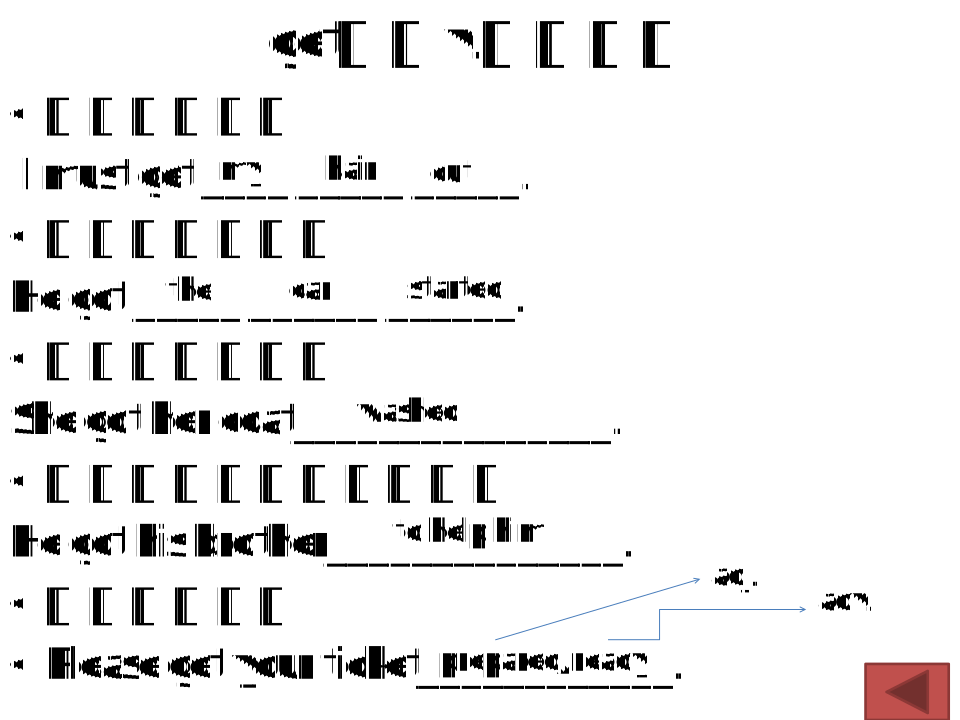
get使役v.用法练习
我得理发了。
I must get ____ _____ _____.
他发动了汽车。
He got _____ ______ ______.
她把外套洗了。
She got her coat_______________.
他让他的兄弟来帮助他。
He got his brother______________.
请准备好票。
Please get your ticket____________.
my
hair
cut
the
car
started
washed
to help him
prepared/ready
adj.
adv.
第2段
For example, in our free time we can sculpt a sculpture and
paint a painting, but we take a photo. And when we are
traveling we say that we are in the car or the taxi, but on the
train or bus! While we’re doing all this traveling, we can get
seasick at sea, airsick in the air and carsick in a car, but we don’t
get homesick when we get back home. And speaking of home,
why aren’t homework and housework the same thing?
例如,在我们的空闲时间里,我们可以雕一座雕像(sculpt a sculpture)、
画一幅画(paint a painting),但只能拍一张照片(take a photo)。
当我们旅行时,我们坐汽车或出租车时是说坐在里面(in),但坐
火车或公共汽车时却要说坐在上面(on)! 当我们旅行时,我们会在海上晕船,
在飞机里晕机,在车里晕车,但
当回到家里时,我们却不会“晕家”。 说到家,
为什么homework(家庭作业)和housework(家务)不是一回事呢?
(也就是说:这两个英语单词看起来很像,但意思却不是一回事。)
in/on+交通工具
小型封闭型交通工具
大型非封闭型交通工具
in
on
在车里
在直升机上
在小船上
在出租车上
in a car
in a helicopter
in a boat
in a taxi
在大巴上
在火车上
在大船上
在飞机上
在单车上
在马上
在滑板上
on a bus
on a train
on a ship
on a plane
on a bike
on a horse
on a skateboarding
speaking of提起;说到
有的分词短语可以独立存在,在句子中没有逻辑上的主语。这是一种习惯用法。
talking of/speaking of 提起;说到
generally speaking总体而言;一般说来
frankly speaking坦白说
judging from/by根据…判断
supposing假设
providing/provided只要;如果…的话
considering/given考虑到
填空:说到哈利,你最近见过他吗?
__________ Harry, have you seen him recently?
翻译:总的来说,你不应该迟到。
_______________________________.
Supposing you are wrong, what will you do?
________________________________.
Speaking of
Generally speaking, you shouldn’t be late
假设你错了,你该怎么 办?
第3段
If “hard” is the opposite of “soft”, why are “hardly”
and “softly” not an opposing pair? If harmless actions
are the opposite of harmful actions, why are
shameless and shameful behaviors the same?
如果说hard(硬)是soft(软)的反义词,为什么hardly(几乎不)
和softly(柔和地)却不是一对反义词? 如果说harmless actions(无害行为方式)
如果说harmful actions(有害行为方式)意思相反,为什么
shameless behaviors(无耻行为)和shameful behaviors(可耻行为)是一回事?
第4段
When we look out of the window and see rain or
snow, we can say “it’s raining” or “it’s snowing”.
But when we see sunshine, we can’t say “it’s
sunshining”.
当我们望向窗外,看到雨(rain)或
雪(snow)时,我们可以说“正在下雨”或“正在下雪”。
但当我们看见阳光时,却不能说“正在下阳光”。
It is raining.和It is snowing.中的raining和snowing是动词的现在分词形式。即rain和snow这两个动词的ing形式
而sunshine不是动词,只能做n.阳光
shine v.闪耀;发光
n. 光泽
sunshining adj.阳光照耀的
动景
动景
静景
第5段
Even the smallest words can be confusing. When
you see the capitalized “WHO” in a medical report,
do you read it as the “who” in “Who’s that?” What
about “IT” and “US”?
就算是最短小的单词,都让人困惑。
如果你在一篇医学报告中看到大写的WHO,
你会把它读成 “Who’s that?”中的 “who”吗?
那么IT和US又该怎么读呢?
World Health Organization
第6段
You also have to wonder at the unique madness
of a language in which a house can burn up as it
burn down, in which you fill in a form by filling it
out, and in which an alarm is only heard once it
goes off!
英语这门语言独有的疯狂令你不得不感到惊奇。
对……感到吃惊
在英语里,房子烧成灰烬的时候可以说burn up(烧上去),
也可以说burn down(烧下去);填表的时候,你可以fill in a form(填入表里),
也可以fill out a form(填到表外);而且只有闹钟走了(字面意思“离开”)以后
你才能听到铃声!
突然发出巨响;(电灯)熄灭
第7段
English was invented by people, not computers, and
it reflects the creativity of the human race. That is
why when the stars are out, they are visible, but
when the lights are out, they are invisible. And that is
why when I wind up my watch, it starts, but when I
wind up this passage, it ends.
英语是人创造的,不是计算机发明的,
它反映了人类的创造力。
那就是为什么星星out(出来)的时候,我们能看到星星,
而灯out(熄灭)的时候,我们却看不见灯光。
那也是当我wind up my watch(给手表上紧发条)后,表针开始走,而我wind up this passage(将本文收尾)
wind up this passage(将本文收尾)后,这篇文章结束的原因。
Choose the author’s purpose in writing the passage
A. To tell us that English is very difficult to learn.
B. To give advice on how to learn English.
C. To show that English is interesting and creative.
D. To explain how English was created.
$$
资源预览图

1

2

3

4

5
6
相关资源
示范课
由于学科网是一个信息分享及获取的平台,不确保部分用户上传资料的 来源及知识产权归属。如您发现相关资料侵犯您的合法权益,请联系学科网,我们核实后将及时进行处理。