Unit 3 Diverse Cultures Discovering Useful Structures 课件-2024-2025学年高中英语人教版(2019)必修第三册
2025-04-02
|
16页
|
4420人阅读
|
1706人下载
普通
内容正文:
Discovering Useful Structures
Diverse Culture
U3
Learning Objectives
1. learn the definition, structure, functions and features of ellipsis.
2. find out and summarize some common ellipsis forms.
3. master the functions of the ellipsis in the context and use it in real situations.
Lead in
1. I enjoy playing soccer, and my brother enjoys playing soccer too.
→ I enjoy playing soccer, and my brother does too.
Omitted: "enjoys playing soccer"
2. A: "Did you finish your homework?"
B: "Not yet. Still working on it."
Omitted: "I did not finish my homework" (implied by context)
3. John can speak French better than I can speak French.
→ John can speak French better than I can.
Omitted: "speak French"
Why do we use ellipsis?
Conciseness: It helps in making sentences shorter and to the point.
Natural Flow: It makes conversations and texts sound more natural and less repetitive.
Contextual Understanding: It relies on the listener or reader to understand the omitted parts from the context.
Practice
Activity 1 Read the following sentences and find the words that have been omitted to avoid repetition.
A: Oh, I just love nachos! Mexican corn chips covered in cheese!
B: Me, too.
2. A: So it’s the food of many different cultures, all
in one dish?
B: Exactly.
3. A real mix of cultures here!
4. Can’t wait!
There are Mexican corn chips...
I love nachos, too.
and they are all in one dish?
Exactly, it’s the food of many different cultures, and they are all in one dish.
There is a real mix of cultures here!
I can’t wait to go there!
Practice
Activity 2 Rewrite the sentences by taking out the unnecessary parts.
You mean you are planning a trip across the Atlantic for a holiday? It sounds like a good idea.
He tried to solve his financial problems, but he couldn’t solve the problems.
If it is necessary, I’ll finish my report on American poetry as soon as it is possible.
Are you going to dress like that? Wearing a dress might be better than wearing jeans and boots.
Some wild mushrooms are poisonous and some are not poisonous.
I really like that paper folding book, and my son likes that paper folding book, too.
Practice
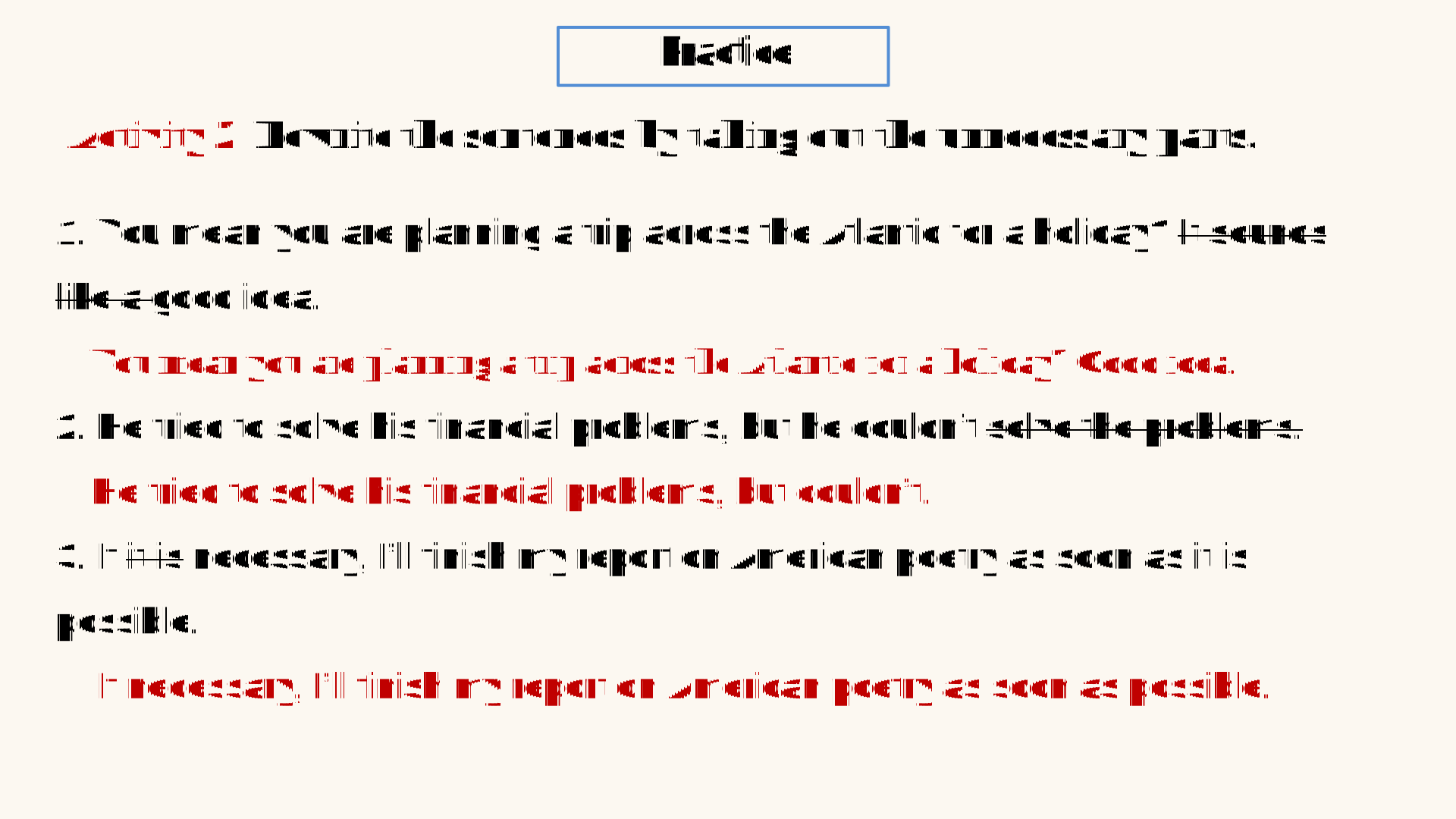
Activity 2 Rewrite the sentences by taking out the unnecessary parts.
1. You mean you are planning a trip across the Atlantic for a holiday? It sounds like a good idea.
You mean you are planning a trip across the Atlantic for a holiday? Good idea.
2. He tried to solve his financial problems, but he couldn’t solve the problems.
He tried to solve his financial problems, but couldn’t.
3. If it is necessary, I’ll finish my report on American poetry as soon as it is possible.
If necessary, I’ll finish my report on American poetry as soon as possible.
Practice
Activity 2 Rewrite the sentences by taking out the unnecessary parts.
4. Are you going to dress like that? Wearing a dress might be better than wearing jeans and boots.
Are you going to dress like that? A dress might be better than jeans and boots.
5. Some wild mushrooms are poisonous and some are not poisonous.
Some wild mushrooms are poisonous and some are not.
6. I really like that paper folding book, and my son likes that paper folding book, too.
I really like that paper folding book, and my son, too.
Activity 3 Read the conversation. Find out which words have been left out.
Practice
Justin: Linlin, I’m going to Guizhou Province next month. I’m super excited! Any recommendations for places to visit?
(Do you have) Any recommendations for places to visit (in Guizhou Province)?
Linlin: Wow, cool! Guizhou is a province with a lot of cultural diversity. Places to visit … well, definitely the Huangguoshu Waterfall first.
Wow, (that’s) cool!
(What are some) Places to visit (in Guizhou)?
Well, definitely the Huangguoshu Waterfall (is the) first (place to visit in Guizhou Province).
Justin: What’s special about the waterfall?
Activity 3 Read the conversation. Find out which words have been left out.
Practice
Linlin: Well, have you ever heard of the Chinese novel Journey to the West?
Justin: Yes, I have. Why?
Yes, I have (heard of the Chinese novel Journey to the West).
Why (do you ask if I have heard of the Chinese novel Journey to the West)?
Linlin: In the back of the waterfall, you will find a cave, which is the home of the Monkey King.
In the back of the (Huanguoshu) Waterfall…
…the Monkey King (from Journey to the West).
Activity 3 Read the conversation. Find out which words have been left out.
Practice
Justin: Really? Cool! I’ll definitely check it out.
(That’s) Really (true)?
(It’s) Cool!
Linlin: And I strongly recommend the ethnic minority villages. You’ll find Chinese culture is much more diverse than you thought.
And I strongly recommend the ethnic minority villages (on your trip to Guizhou Province).
…than you thought (it was).
Justin: Sounds great, thanks!
This all (sounds great)!
Activity 3 Read the conversation. Find out which words have been left out.
Practice
Practice
写出划线句的省略形式
Jack: Hi, Henry! Did you watch the documentary about environmental protection on TV yesterday?
Henry: 1.No, I didn't watch the documentary about environmental protection on TV yesterday.
Jack: What a pity! I highly recommend it. 2.You can watch it online if you want to watch the documentary about environmental protection. It is about some of the worst environmental problems we are facing today. Global warming, for example, is a major problem caused by greenhouse gases. 3.I felt uncomfortable when I was watching the documentary.
Practice
写出划线句的省略形式
Henry: Does it also talk about solutions to these problems?
Jack: Yes. It includes interviews with more than 20 of the world's leading experts on environmental issues. All of them come up with
creative ideas on how to solve the problems. 4. Some call for the application of modern technology,and others call for a change of lifestyle.
Henry: I wish we could also do something to help. 5. Have you got any ideas?
Jack: What about making a brochure about environmental problems?
Henry: 6. It sounds great! Let's get started after lunch.
Practice
1. No, I didn’t.
【解析】 在简短对话中,答句常保留主语和助动词/系动词,省略其后主要动词及问句出现过的其他内容。根据问句中的"Did you"可知,此处答句可省略为"No, I didn't."。
2. You can watch it online if you want to.
【解析】 有时为避免重复,一些不定式作宾语时,可省略不定式符号to后的内容,即用to代替整个不定式。
3. I felt uncomfortable when watching the documentary.
【解析】 时间状语从句中,如果从句主语与主句主语一致,且从句谓语
中含有be动词的某种形式时,常省略从句中的主语和be动词。
Practice
4. Some call for the application of modern technology, and others a change of lifestyle.
【解析】 在并列句中,后一分句常省略与前一分句中语法形式和作用都相同的成分。此处"Some...and others..."构成并列句,others后的call for可省略。
5. Got any ideas?/Any ideas?
【解析】 在与朋友闲谈、对话等非正式场合,在语境清晰且不影响理解
的前提下,可省略主语或主语和动词。
6. Sounds great!/Great!
【解析】 解析同上。
THANK YOU
$$
资源预览图

1

2

3

4

5
6
相关资源
示范课
由于学科网是一个信息分享及获取的平台,不确保部分用户上传资料的 来源及知识产权归属。如您发现相关资料侵犯您的合法权益,请联系学科网,我们核实后将及时进行处理。