Unit 5 Section Ⅰ Listening and Speaking-【正禾一本通】2024-2025学年高中英语必修第三册同步课堂高效讲义教师用书(人教版2019)
2025-06-05
|
6页
|
60人阅读
|
1人下载
教辅

资源信息
| 学段 | 高中 |
|---|---|
| 学科 | 英语 |
| 教材版本 | 高中英语人教版必修第三册 |
| 年级 | 高一 |
| 章节 | Listening and Speaking |
| 类型 | 教案-讲义 |
| 知识点 | - |
| 使用场景 | 同步教学-新授课 |
| 学年 | 2025-2026 |
| 地区(省份) | 全国 |
| 地区(市) | - |
| 地区(区县) | - |
| 文件格式 | DOCX |
| 文件大小 | 523 KB |
| 发布时间 | 2025-06-05 |
| 更新时间 | 2025-06-05 |
| 作者 | 山东正禾大教育科技有限公司 |
| 品牌系列 | 正禾一本通·高考一轮总复习高效讲义 |
| 审核时间 | 2025-03-14 |
| 下载链接 | https://m.zxxk.com/soft/51006803.html |
| 价格 | 2.00储值(1储值=1元) |
| 来源 | 学科网 |
内容正文:
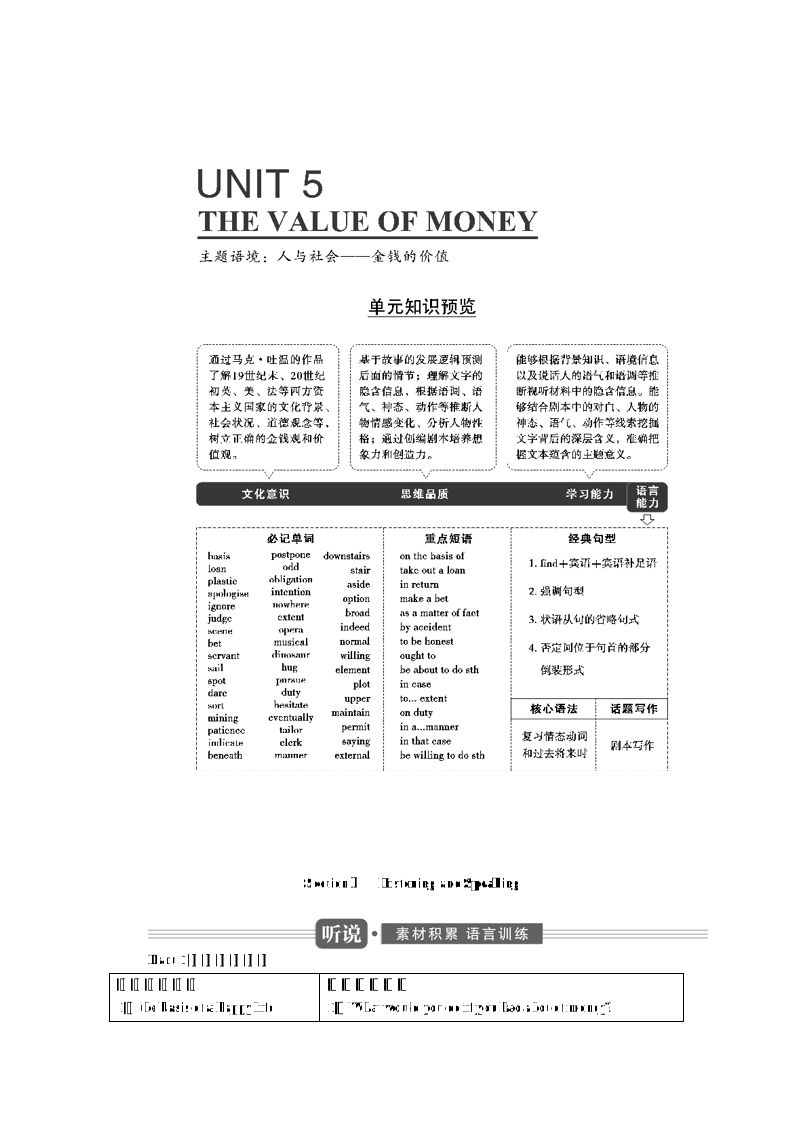
Section Ⅰ Listening and Speaking
Part 1话题素材积累
【教材词汇】
1.the basis of a happy life 幸福生活的基础
2.take out a large loan 借一笔钱
3.a small plastic bag 一个小塑料袋
4.apologise to sb 向某人道歉
5.ignore the speakers' tone 忽视说话者的语气
6.get something in return 得到回报
7.judge people based on money 根据金钱判断人
【话题佳句】
1.What would you do if you had a lot of money?
如果你有很多钱,你会怎么做?
2.When we help someone, should we expect to get something in return?
当我们帮助一个人时,我们是否应该期望得到回报?
3.Money is like a mirror, which reflects the beauty and ugliness of people's souls.
金钱就像一面镜子,它反映了人们心灵的美和丑。
4.Money is neither good nor bad, but all depends on what use is made of it.金钱本身无好坏,要看你怎样利用它。
5.A little kitchen makes a large house.生活俭朴,家业兴旺。
Part 2教材听力再利用(听教材P50的听力,完成以下内容)
Ⅰ.Listen to the news report and choose the best answer.
1.What is Chen Liyan?
A.A cleaner. B.A reporter.
C.A doctor.
2.How did she feel when she found 100, 000 yuan in a small plastic bag?
A.Pleased. B.Shocked.
C.Afraid.
3.Who is 16yearold Liu Xia?
A.Wang Zheng's daughter.
B.Chen Liyan's daughter.
C.Chen Liyan's neighbour.
4.Why did Ma Dongbao set up a fundraising website?
A.To thank Chen repeatedly.
B.To encourage others to learn from Chen Liyan.
C.To pay for Liu's hospital bills.
答案:1~4 ABBC
Ⅱ.Listen to the news report again and fill in the blanks.
5.Recently, a cleaner by the name of Chen Liyan has made the headlines for her generous and honest act.The 45yearold Chen was sweeping the floor at Taiyuan Railway Station early Last Tuesday morning when she found a small plastic bag near a chair and discovered 100, 000 yuan inside.Chen was shocked but she was determined to return the money to its owner.
6.When interviewed by the local paper yesterday, Chen said, “I would have felt bad if I had kept the money.After all, the owner might have needed it badly.”
7.While working, Chen watched carefully for anyone who might have been the owner.She waited for over two hours, but having no luck, she went to the nearest police station to turn the money in.There, it was finally returned to its owner, Wang Zheng.
8.Wang thanked Chen repeatedly and apologised for the inconvenience, even offering her 5,000 yuan as a reward.To his surprise, however, Chen refused, believing that it would be wrong to accept money that she had not earned.
9.But what is even more surprising, perhaps, is that Chen's daughter, 16yearold Liu Xia is currently seriously ill.Chen had already spent the last of her savings on the ongoing treatments and has also taken out a large loan.
10.Fortunately, Ma Dongbao, who works at the police station, stepped in.Living in the same apartment building as Chen's family, Ma was well aware of Chen's difficulties.When Wang was told about Chen's situation, he decided to set up a fundraising website to pay for Liu's hospital bills.
11.Chen Liyan's example shows a different way of thinking about money.Money is important, but to people like Chen, it definitely isn't everything.And that's a great attitude to take.
Part 3场景交流模拟
李萍和张玲是同班同学。周末两人相遇后闲聊, 她们的话题是“What would you do if you found a wallet on the street?”请根据提示完成对话。
Li Ping:Zhang Ling, what will you do if you happen to 1.find a wallet on the street (在大街上发现钱包)?
Zhang Ling:2.I will return it to its owner (我会还给失主) or give it to the police.
Li Ping:3.It is very kind of you to do that (你那样做真是太好了).But will you ask for some money in return?
Zhang Ling:What?I have never heard of this kind of thing.
Li Ping:There are always some of this kind of reports.Some people even think it is normal to 4.ask for some money in return (索要金钱作为回报) for good deeds.
Zhang Ling:As far as I am concerned, 5.I think good deeds can't be connected with money (我认为做好事不能和金钱联系起来).
Li Ping:Me too.We should encourage people to do good deeds out of kindness.
Zhang Ling:A good idea.
Part 4语音知识
降调及其他组合调
语调指英语口语中的音高模式,第二单元已讲了升调的用法,本单元主要讲降调及其他组合调的用法。
1.降调
表示肯定、决断、坚决,但有时也含有生硬、不容置疑的意味。常用于陈述句、特殊疑问句、祈使句、感叹句和并列句中并列连词前后的两个分句。
(1)用于陈述句,如:I have already read that ↓ book.
(2)用于特殊疑问句,如:What has happened to ↓ him?
【点拨】 特殊疑问句有时可用升调表示请别人重复刚说过的话,如:What is your ↑ major?
(3)用于祈使句表示命令时,如:Go back to your ↓ seat!
(4)用于感叹句,如:What a ↓ small world!
(5)用于并列句中并列连词前后的两个分句,如:Let's ↓ run,or we'll be late for ↓ school.
2.语调的组合用法
在表达语义比较复杂的句子中,会构成升降调或降升调,使得语调变得复杂。
(1)逐项列举事物时,先升后降,如:We study ↑ Chinese, ↑ history, ↑ geography,and ↓ English.
(2)主句前的短语或从句用升调,主句用降调,如:After ↑ dinner,I read a magazine and made telephone ↓ calls.
(3)用于选择疑问句,先升后降,如:Do you want to ↑ ride or ↓ walk?
(4)附加疑问句
①以疑问为主的附加疑问句,先降后升,如:I'm not ↓ late,am ↑ I?
②以肯定为主的附加疑问句,前后均降,如:You're going to have a ↓ meeting,aren't ↓ you?
basis n.基础;根据;基点
(1)on the basis of... 在某事的基础上;根据某事
on a regular basis 定期地
(2)base vt.以……为根据 n.(pl.bases) 基部;基地;基础
base...on/upon... 把……建立在……基础上
be based on/upon... 以……为基础/依据
(3)basic adj.基础的;基本的
basically adv.基本上;大体上
【练透】 单句语法填空/完成句子
①They want all groups to be treated on an equal basis.
②我们应该根据学生的语言能力和个人喜好为他们配对英语口语练习伙伴。(2023·新高考Ⅰ卷应用文写作)
We should base pairing up students for the oral English practice partner on their language abilities and personal preferences.
③基于你当前的健康状况,我强烈建议你定期锻炼身体,因此,你应该买一些基础的健身设备。(建议信)
On the basis of/Based on your current state of health,I strongly suggest that you (should) work out on a regular basis,and as a result,you should buy some basic fitness facilities.
apologise vi.道歉;谢罪
(1)apologise to sb for (doing) sth 因(做)某事向某人道歉
(2)apology n.道歉;谢罪
make an apology to sb for sth 因某事向某人道歉
accept/refuse one's apology 接受/拒绝某人的道歉
owe sb an apology 应向某人道歉
【练透】 完成句子/一句多译
①由于今天早晨我意外碰了你的车,我应该向你道歉。
I owe you an apology for the fact that I hit your car by accident this morning.
②他为没能通知我计划变动而向我道歉。(道歉信)
→He apologised to me for his not being able to inform me of the change in the plan.(apologise)
→He made an apology to me for his not being able to inform me of the change in the plan.(apology)
ignore vt.忽视;对……不予理会
(1)ignore sb/sth 无视/不理会某人/某物
(2)ignorant adj.不了解的,无知的
be ignorant of... 不知道……
(3)ignorance n.无知
in ignorance of... 对……不知道
【练透】 一句多译
有些人总是只做他们想做的事,而忽视了别人的感受。
①Some people always do what they like, but ignore others' feelings.(ignore)
②Some people always do what they like, but are ignorant of others' feelings.(ignorant)
③Some people always do what they like, but are in ignorance of others' feelings.(ignorance)
judge vt.& vi.评价;评判;判断 n.法官;审判员;裁判员
(1)judge(...)from/by... 从……判断/看(……)
judge between right and wrong 判断是非
as far as I can judge 据我判断;依我看
(2)judgment (=judgement) n.看法;判断力;裁决;判决
【练透】 完成句子
①从你的上封信看,我得知你正忙于准备高考。
Judging from/by your last letter,I learn that you are busy making preparations for the college entrance examination.
②我写信真诚地邀请您做这次英语演讲比赛的评委。在我看来,您可以根据选手们的表现和您以前的经验极好地来评判参赛者。(邀请信)
I am writing to sincerely invite you to be a judge for the English Speech Competition.As far as I can judge,you can judge the contestants perfectly from/by their performance and your former experience.
in return 作为回报;作为回应
in return for... 作为……的交换;作为对……的报答
in turn 轮流;依次;反过来
by turns 轮流;时而……时而……
【练透】 单句语法填空/完成句子
①Nature offers us what we need to live on.In return,we should protect the environment we rely/depend on.
②我非常感谢你的帮助,并且我希望有机会能带你参观北京以报答你的好意。(感谢信)
I deeply appreciate your help and I hope to have the opportunity to show you around Beijing in return for your kindness.
学科网(北京)股份有限公司
$$
资源预览图
1

2

3
相关资源
由于学科网是一个信息分享及获取的平台,不确保部分用户上传资料的 来源及知识产权归属。如您发现相关资料侵犯您的合法权益,请联系学科网,我们核实后将及时进行处理。