Unit 2 Success Lesson 2 Top Five Secrets of Success Listening 教学设计-2024-2025学年高中英语北师大版(2019)选择性必修第一册
2025-03-01
|
6页
|
578人阅读
|
5人下载
普通
资源信息
| 学段 | 高中 |
|---|---|
| 学科 | 英语 |
| 教材版本 | 高中英语北师大版选择性必修第一册 |
| 年级 | 高二 |
| 章节 | Lesson 2 Top Five Secrets of Success |
| 类型 | 教案-教学设计 |
| 知识点 | - |
| 使用场景 | 同步教学-新授课 |
| 学年 | 2024-2025 |
| 地区(省份) | 全国 |
| 地区(市) | - |
| 地区(区县) | - |
| 文件格式 | DOCX |
| 文件大小 | 33 KB |
| 发布时间 | 2025-03-01 |
| 更新时间 | 2025-03-01 |
| 作者 | 匿名 |
| 品牌系列 | - |
| 审核时间 | 2025-03-01 |
| 下载链接 | https://m.zxxk.com/soft/50739435.html |
| 价格 | 0.50储值(1储值=1元) |
| 来源 | 学科网 |
内容正文:
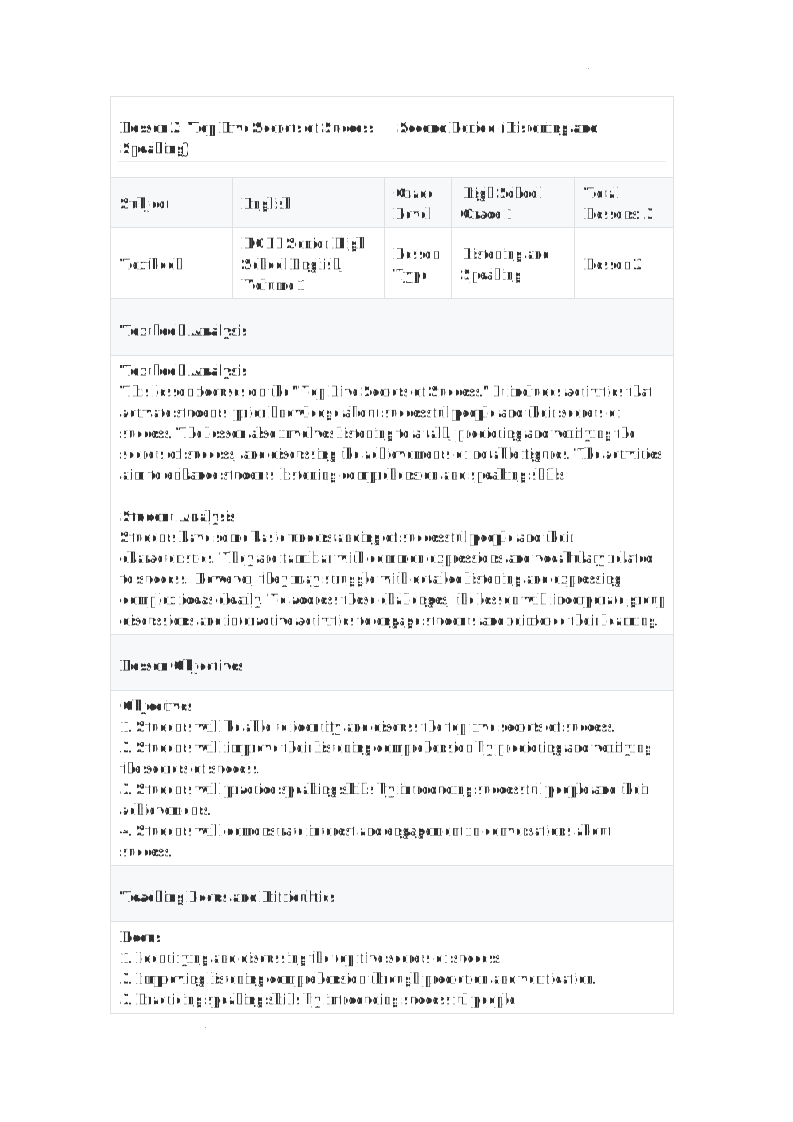
Lesson 2: Top Five Secrets of Success Second Period (Listening and Speaking)
Subject
English
Grade Level
High School Grade 1
Total Lessons: 2
Textbook
NCEP Senior High School English, Volume 1
Lesson Type
Listening and Speaking
Lesson 2
Textbook Analysis
Textbook Analysis
This lesson focuses on the "Top Five Secrets of Success." It includes activities that activate students' prior knowledge about successful people and their secrets of success. The lesson also involves listening to a talk, predicting and verifying the secrets of success, and discussing the achievements of notable figures. The activities aim to enhance students' listening comprehension and speaking skills.
Student Analysis
Students have some basic understanding of successful people and their characteristics. They are familiar with common expressions and vocabulary related to success. However, they may struggle with detailed listening and expressing complex ideas clearly. To address these challenges, the lesson will incorporate group discussions and interactive activities to engage students and reinforce their learning.
Lesson Objectives
Objectives
1. Students will be able to identify and discuss the top five secrets of success.
2. Students will improve their listening comprehension by predicting and verifying the secrets of success.
3. Students will practice speaking skills by introducing successful people and their achievements.
4. Students will demonstrate interest and engagement in conversations about success.
Teaching Focus and Difficulties
Focus
1. Identifying and discussing the top five secrets of success.
2. Improving listening comprehension through prediction and verification.
3. Practicing speaking skills by introducing successful people.
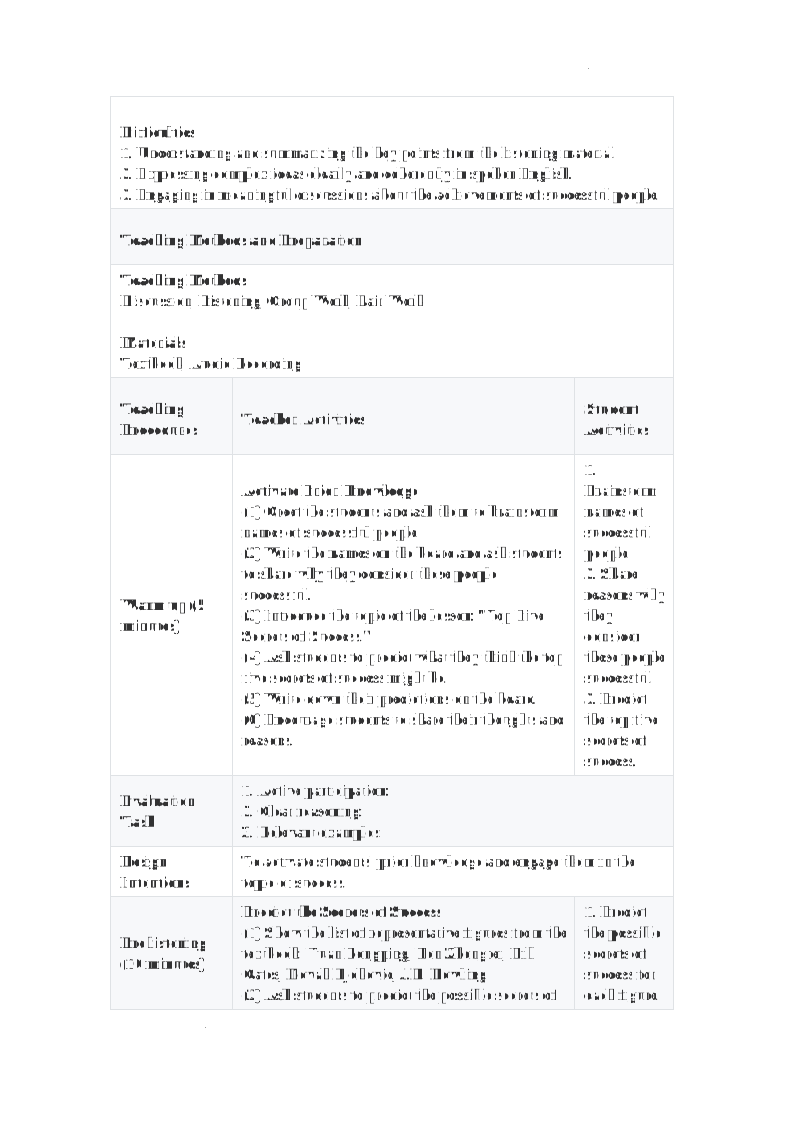
Difficulties
1. Understanding and summarizing the key points from the listening material.
2. Expressing complex ideas clearly and coherently in spoken English.
3. Engaging in meaningful discussions about the achievements of successful people.
Teaching Methods and Preparation
Teaching Methods
Discussion, Listening, Group Work, Pair Work
Materials
Textbook, Audio Recording
Teaching Procedures
Teacher Activities
Student Activities
Warm up (5 minutes)
Activate Prior Knowledge
(1) Greet the students and ask them to brainstorm names of successful people.
(2) Write the names on the board and ask students to share why they consider these people successful.
(3) Introduce the topic of the lesson: "Top Five Secrets of Success."
(4) Ask students to predict what they think the top five secrets of success might be.
(5) Write down their predictions on the board.
(6) Encourage students to share their thoughts and reasons.
1. Brainstorm names of successful people.
2. Share reasons why they consider these people successful.
3. Predict the top five secrets of success.
Evaluation Task
1. Active participation: ☆☆☆
2. Clear reasoning: ☆☆☆
3. Relevant examples: ☆☆☆
Design Intentions
To activate students' prior knowledge and engage them in the topic of success.
Pre listening (10 minutes)
Predict the Secrets of Success
(1) Show the list of representative figures from the textbook: Yuan Longping, Ren Zhengfei, Bill Gates, Novak Djokovic, J.K. Rowling.
(2) Ask students to predict the possible secrets of success for each figure.
(3) Write their predictions on the board.
(4) Distribute the activity sheet and ask students to fill in their predictions.
(5) Review the predictions as a class.
(6) Prepare students for the listening activity.
1. Predict the possible secrets of success for each figure.
2. Fill in the predictions on the activity sheet.
Evaluation Task
1. Accurate predictions: ☆☆☆
2. Logical reasoning: ☆☆☆
3. Active participation: ☆☆☆
Design Intentions
To prepare students for the listening activity by activating their thinking and setting expectations.
While listening (15 minutes)
Listen and Check Predictions
(1) Play the audio recording of the talk titled "Top Five Secrets of Success."
(2) Instruct students to listen carefully and check their predictions.
(3) Pause the recording after each secret to allow students to take notes.
(4) Play the recording again if necessary.
(5) Ask students to write down the five secrets they hear in the first column of the activity sheet.
(6) Discuss the secrets as a class and clarify any misunderstandings.
1. Listen to the audio recording.
2. Check predictions and take notes.
3. Write down the five secrets heard.
Evaluation Task
1. Correct notes: ☆☆☆
2. Active listening: ☆☆☆
3. Clear understanding: ☆☆☆
Design Intentions
To improve students' listening comprehension and ensure they understand the key points of the talk.
Post listening (15 minutes)
Complete Supporting Facts
(1) Play the audio recording again, focusing on the supporting facts and achievements of the representative figures.
(2) Instruct students to complete the second and third columns of the activity sheet with the supporting facts and achievements.
(3) Allow students to work in pairs to verify their answers.
(4) Review the completed activity sheets as a class.
(5) Discuss any discrepancies and provide feedback.
(6) Highlight the importance of each secret in the context of the figures' achievements.
1. Listen to the audio recording again.
2. Complete the supporting facts and achievements.
3. Verify answers with a partner.
Evaluation Task
1. Accurate completion: ☆☆☆
2. Detailed notes: ☆☆☆
3. Effective collaboration: ☆☆☆
Design Intentions
To reinforce students' understanding of the secrets of success and their application in real life examples.
Group Work (15 minutes)
Introduce Successful People
(1) Divide the class into small groups.
(2) Each group member selects one successful person to introduce to the others based on the notes in the activity sheet.
(3) Provide a few minutes for students to prepare their introductions.
(4) Instruct students to use the Talk Builder sentences to show interest and engagement during the presentations.
(5) Monitor the group discussions and provide guidance as needed.
(6) Debrief the activity by asking a few groups to share their introductions with the class.
1. Select a successful person to introduce.
2. Prepare the introduction using the activity sheet.
3. Present the introduction to the group.
Evaluation Task
1. Clear presentation: ☆☆☆
2. Use of Talk Builder: ☆☆☆
3. Active participation: ☆☆☆
Design Intentions
To provide students with an opportunity to practice their speaking skills and demonstrate interest in their peers' presentations.
Pair Work (10 minutes)
Find and Introduce Stories/Books/Films
(1) Instruct students to find stories, books, or films about successful people.
(2) Each student should choose one and introduce it to their partner.
(3) Encourage students to use the Talk Builder sentences to show interest and engagement.
(4) Monitor the pair work and provide feedback.
(5) Ask a few pairs to share their introductions with the class.
(6) Summarize the main points and conclude the lesson.
1. Find a story, book, or film about a successful person.
2. Introduce it to a partner.
3. Use Talk Builder sentences to show interest.
4. Share introductions with the class.
Evaluation Task
1. Clear introduction: ☆☆☆
2. Use of Talk Builder: ☆☆☆
3. Active participation: ☆☆☆
Design Intentions
To extend students' learning by connecting the lesson to real world examples and encouraging them to apply the language skills learned.
Homework Assignment
Tasks
1. Write a short paragraph about one of the successful people discussed in class, including their top secret of success and a supporting fact.
2. Find and read an article or watch a video about another successful person and write a summary.
3. Practice using the Talk Builder sentences in a conversation with a family member or friend.
4. Prepare a short presentation on a successful person for the next class.
Board Design
Top Five Secrets of Success
1. Ambition
2. Passion
3. Clear Goal
4. Persistence
5. Continuous Learning
Representative Figures
Yuan Longping: Father of Hybrid Rice
Ren Zhengfei: Founder of Huawei
Bill Gates: Co founder of Microsoft
Novak Djokovic: Tennis Player
J.K. Rowling: Author of Harry Potter
Talk Builder Sentences
Oh, what's the name of the book?
Mm, what kinds of things have you learned?
Really? I'm interested in it.
It sounds like a useful book.
Please tell me about it.
Wow, you've convinced me to read this book!
Teaching Reflection
Areas for Improvement
1. The pace of the lesson was sometimes too fast, leaving some students behind. Adjusting the timing and providing more opportunities for individual practice could be beneficial.
2. Some students had difficulty using the Talk Builder sentences naturally in conversations. Additional practice and modeling could help them internalize these expressions.
学科网(北京)股份有限公司
$$
资源预览图
1
2

3
相关资源
由于学科网是一个信息分享及获取的平台,不确保部分用户上传资料的 来源及知识产权归属。如您发现相关资料侵犯您的合法权益,请联系学科网,我们核实后将及时进行处理。