Unit 2 Healthy Lifestyle Reading and Thinking 导学案-2024-2025学年高中英语人教版(2019)选择性必修第三册
2025-02-20
|
6页
|
1023人阅读
|
3人下载
精品
内容正文:
Book 3 Unit 2 Health Lifestyle
Reading and Thinking
Step 1 Warm Up and Pre-reading.
1. Which is the genre of this passage
A. exposition B. narration C. argumentation D. novel
2. What is the text mainly about?
A. How teenagers make a choice.
B. How teenagers feel relaxed.
C. How teenagers change their bad habits.
D. How teenagers become more independent.
Step 2 Read for the main idea.
Activity 1: Please match the main ideas with each paragraph and divide them into 3 parts.
Paragraph 1 How to change a bad habit and create good onesPart 1
Paragraph 2 The cycle of how habits are formed.
Paragraph 3 Changing habits gradually.Part 2
Paragraph 4 No easy way to change bad habits
Paragraph 5 What a habit is?Part 3
Paragraph 6 Why bad teenage habits should be changed?
Step 3 Read for detailed information.
Activity 1: Read part1 (Para 1) and answer the following questions.
1. Why should bad teenage habits be changed?
_______________________________________________________________________________
2. What should they do to prevent the possible harmful effects caused by the bad habits?
_______________________________________________________________________________
Activity 2: Read Part 2 (Para 2-Para 3) and finish the following questions.
1. What are the three stages of the habit cycle?
_______________________________________________________________________________
2. How does the author further explain the "habit cycle"?
_______________________________________________________________________________
3. What examples did the author give us about the habit cycle to help us understand?
The habit cycle
Bad habit
New habit
Cue
Routine
Reward
Activity 3: Read Part3 (Para 4-Para 6) to finish the following questions
1. How can a person use discipline to help change a bad habit?
2. Chinese philosopher Laozi told us that one step seems small, but it is________. It is _________ for most of us to change bad habits quickly. To reach the goal of change, we must __________________ and __________ take ________________.
3. What can we learn from the last paragraph?
A. Changing habits is very easy.
B. It takes a long period of time to change bad habits.
C. There are shortcuts to change bad habits.
D. There are some ways to help you build a healthy life.
Step 4 Read for structure
Exposition
raise, analyse, solve, conclusion
Structure
1. Why bad teenage habits should be changed_____________ the problem
2. What a habit is
_____________ the problem
3. The cycle of how habits are formed
4. How to change a bad habit and create good ones_____________ the problem
5. Changing habits gradually.
6. No easy way to change bad habits. _____________
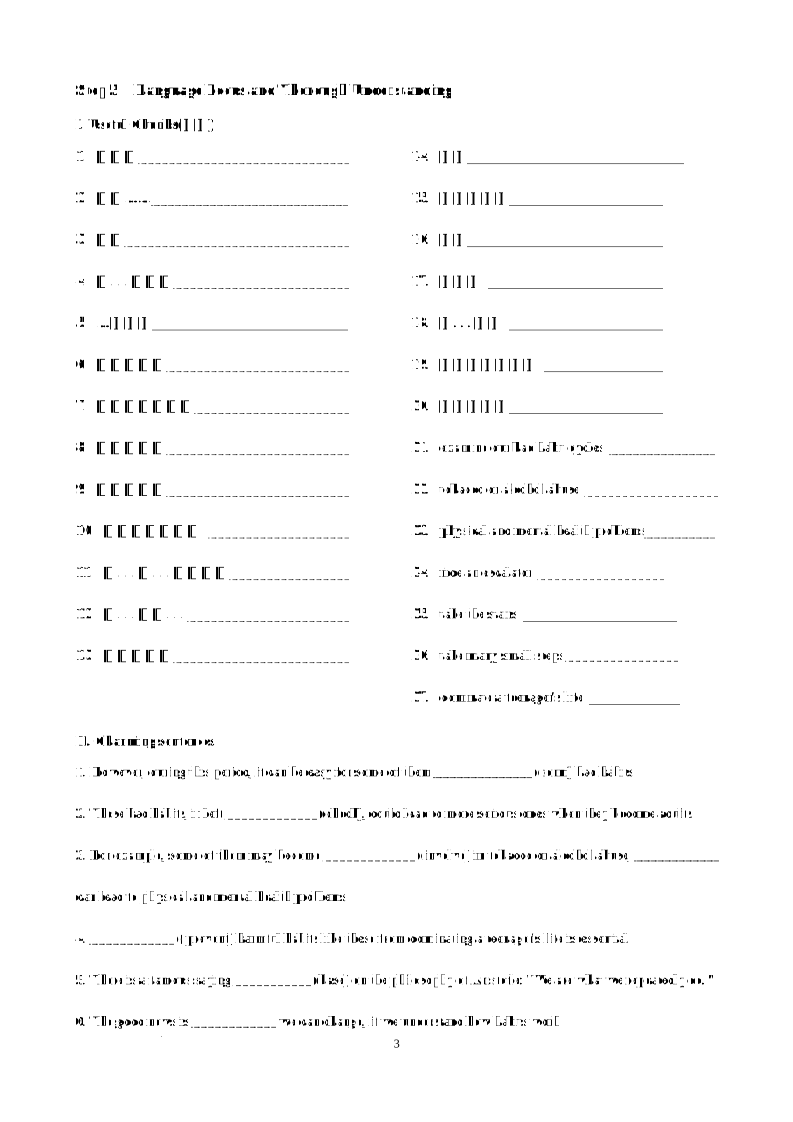
Step 5 Language Focus and Thorough Understanding
I. Useful Chunks(词块)
7
学科网(北京)股份有限公司
1. 做决定______________________________
2. 参与……____________________________
3. 阻止________________________________
4. 以...为基础_________________________
5. …的总和____________________________
6. 选择做某事__________________________
7. 一再地,反复地______________________
8. 充当,担当__________________________
9. 回复,答复__________________________
10. 依赖,依靠醒来 ____________________
11. 把...和...结合起来_________________
12. 用...代替..._______________________
13. 打破坏习惯_________________________
14. 放弃_______________________________
15. 大量,很多______________________
16. 决定____________________________
17. 而不是 _________________________
18. 除...以外 ______________________
19. 养成良好的习惯 _________________
20. 立即,马上______________________
21. examine our bad habit cycles _______________
22. tobacco or alcohol abuse ___________________
23. physical and mental health problems__________
24. ride an escalator __________________
25. take the stairs ______________________
26. take many small steps ________________
27. dominate a teenager's life _____________
II. Charming sentences.
1. However, during this period, it can be easy for some of them ______________ (form) bad habits.
2. These bad habits, if left _____________ (check), could lead to more serious ones when they become adults.
3. For example, some of them may become _____________ (involve) in tobacco or alcohol abuse, ____________ can lead to physical and mental health problems.
4. ____________ ( prevent) harmful habits like these from dominating a teenager's life is essential.
5. There is a famous saying ___________ (base) on the philosophy of Aristotle: "We are what we repeatedly do. "
6. The good news is ____________ we can change, if we understand how habits work
7. For example, when we feel unhappy (cue), we eat lots of unhealthy snacks (routine) __________ makes us feel happy (reward).
8. The reward makes us much more likely _____________ (continue) the cycle, and the bad habit of ____________ (依赖,依靠) unhealthy snacks is formed
9. _____________ (facilitate) a positive change in our bad habits, we must first examine our bad habit cycles and then try adapt them.
10. So, when we feel unhappy again (cue), ______________ (而不是) eat snacks, we could listen to some of our favourite music instead (routine) ____________ will make us feel ____________ (relax) (reward).
III. Fill in the blanks
With teenagers growing up,1________ can be easy for some to form bad habits. For example,some of them may become 2_________ (involve) in tobacco or alcohol abuse. If 3________(leave) unchecked,these bad habits could lead to more serious ones. To change harmful habits, teenagers must learn to understand how habits work—the “habit cycle”. Then adapt the bad habit cycles by combining the information from our habit cycles 4________ our own positive ideas.
Don’t try to change bad habits quickly,for the most successful way to change is over a period of time. As the Chinese philosopher Laozi 5________ (write),“A journey of a thousand miles begins with a single step.” 6 ________ (reach) the goal of change,a person must show some discipline and 7_________ (repeat) take many small steps.
The good news is 8________ there is plenty of time for young people to change bad habits. However,there is no “magic pill” and you have to think about your bad habits and decide on some 9_________(change). You have the power to build a happy and 10 ________(health) life that is full of good habits!
Book 3 Unit 2 Health Lifestyle
Reading and Thinking 答案
Step 1 Warm Up and Pre-reading.
1.A 2. C
Step 2 Read for the main idea
Activity 1: Please match the main ideas with each paragraph and divide them into 3 parts.
Paragraph 1 : Why bad teenage habits should be changed?Part1(para1) 1(para1)
Paragraph 2 : What a habit is?Part2(para2-3)
Paragraph 3 : The cycle of how habits are formed.
Paragraph 4 : How to change a bad habit and create good ones
Paragraph 5 : Changing habits gradually.Part3(para4-6)
Paragraph 6 : No easy way to change bad habits
Step 3 Read for detailed information.
Activity 1: Read para1 (Para 1) and answer the following questions.
1. Why should bad teenage habits be changed?
These bad habits, if left unchecked, could lead to more serious ones when they become adults.
2. What should they do to prevent the possible harmful effects caused by the bad habits?
They must learn to recognize bad habits early and make appropriate changes.
Activity 2: Read Part 2 (Para 2-Para 3) and finish the following questions.
1. What are the three stages of the habit cycle?
According to modern psychology, they are "cue,routine and reward".
2. How does the author further explain the "habit cycle"?
By giving examples
3. What examples did the author give us about the habit cycle to help us understand?
The habit cycle
Bad habit
New habit
Cue
feel unhappy
feel unhappy
Routine
eat lots of unhealthy snacks
listen to some music
Reward
feel happier but it’s not healthy
feel happier and relaxed
Activity 3: Read Para3 (Para 4-Para 6) to finish the following questions
1. How can a person use discipline to help change a bad habit?
We must first examine our bad habit cycles,and then try to adapt them by combining the information from our habit cycles with something more positive.
2. Chinese philosopher Laozi told us that one step seems small, but it is essential__. It is not easy for most of us to change bad habits quickly. To reach the goal of change, we must show some discipline and repeatedly take many small changes.
3. B
Step 4 Read for structure
raise; analyse; solve; conclusion
Step 5 Language Focus and Thorough Understanding
1. make a decision 2. become/be involved in
3. prevent...from... 4. be based on
5. the sum of... 6. make a choice to do sth.
7. over and over again 8. act as
9. in response to 10. rely on
11. combine...with... 12. replace...with...
13. break bad habits 14. give up
15. plenty of 16. decide on
17. rather than(do sth.) 18. aside from
19. create good habits 20. straight away
21. 审视我们的不良习惯的循环e 22. 吸烟成瘾或酗酒
23. 身心健康问题 24. 乘电梯
25. 走楼梯 26. 迈出许多小步
27. 主宰青少年的生活
II. Charming sentences.
1. to form 2. unchecked 3. involved ; which 4. To prevent 5. based
6. that 7. which 8. to continue ; relying on 9. To facilitate
10. rather than ; which ; relaxed
III. Fill in the blanks
1. it 2. involved 3. left 4. with 5. wrote
6. To reach 7. repeatedly 8. that 9. changes 10. healthy
$$
资源预览图

1

2
3
相关资源
示范课
由于学科网是一个信息分享及获取的平台,不确保部分用户上传资料的 来源及知识产权归属。如您发现相关资料侵犯您的合法权益,请联系学科网,我们核实后将及时进行处理。