Unit 4 Body Language 一轮复习单元学案-2025届高三英语人教版(2019)选择性必修第一册
2025-01-20
|
2份
|
9页
|
180人阅读
|
2人下载
普通
内容正文:
选必修一 UNIT 4 BODY LANGUAGE答案
1、 词性转换
1. act v.&n. 行动_________ n.行动;行为__________v.互动_____________n.互动__________v.反应
___________n.反应
2. vary v.变化__________adj.各种各样的;许多的___________n.多样化___________n.变异___________adj.多变的;多种多样的;形形色色的
3. approve v. 批准;赞同___________n.赞同___________adj.赞同的___________v.不赞成___________n.不赞同___________adj.不赞同的
4. demonstrate v.表现;显露;证明;演示___________________n.演示;表现
5. employ vt.雇佣;使用___________n.雇主___________n.雇员______________n.雇佣___________adj.失业的______________n.失业
6. interpret v.把......理解为;(口头)翻译______________n.口译___________n.口译者
7. differ vi.不同___________adj.不同的______________n.不同
8. favour n.恩惠;喜爱;赞同___________adj.赞成的;有利的___________adj.最喜欢的
9. anger n.生气___________adj.生气的
10. rely v.依靠___________adj.可信赖的
11. slight adj.轻微的___________adv.稍微
12. verbal adj.言语的___________adj.非言语的
13. assess vt.评价______________n.评价;估价
14. reveal vt.显露;揭露______________n.揭示;揭露
15. clear adj.清晰的 v.清理___________vt.澄清;阐明
16. educate vt.教育;教导___________n.教育工作者____________n.教育______________ adj.受过教育的
17. tend v.倾向____________n.趋势;倾向
18. low adj.低的___________adj.较低的 vt.把......放低;降低
19. bare adj.赤裸的___________adv.仅仅;勉强
20. occupy vt.占领;占用;使......忙碌______________n.工作;职业;占用_____________adj.被占用的
21. distract vt.分散;使分心____________adj.注意力分散的____________n.分心___________vt.吸引
22. anxious adj.焦虑的;渴望的___________n.焦虑;渴望
23. embarrass vt.使尴尬_____________adj.令人尴尬的___________adj.感到尴尬的_____________n.尴尬
24. mere adj.仅仅的;极不重要的_________adv.仅仅;只不过
25. inquire/enquire v.打听;询问____________/____________n.询问
26. ultimate adj.最后的;最终的_____________adv.最后
27. adjust v.调整;适应_____________adj.可调整的;可调节的_____________n.调整;调节;适应
答案:1.action; interact; interaction; react; reaction 2.various; variety; variation; varied 3.approval; approving; disapprove; disapproving 4.demonstration 5.employer; employee; employment; unemployed; unemployment 6.interpretation; interpreter 7.different; difference 8.favourable; favourite 9.angry 10.reliable 11.slightly 12.nonverbal 13.assessment 14.revelation 15.clarify 16.educator; education; educated 17.tendency 18.lower 19.barely 20.occupation; occupied 21.distracted; distraction; attract 22.anxiety 23.embarrassing; embarrassed; embarrassment 24.merely 25.inquiry/enquiry 26.ultimately 27.adjustable; adjustment
2、 短语默写
1. vary from...to... 由......到......不等 various/a variety of / varieties of 各种各样的
2. approve of (sb./sb.’s) doing sth.
赞同(某人)做某事
3. differ/be different from 与......不同 differ in在......方面不同
make a/no difference 有/没有影响
4. break away from 脱离,打破 break in插嘴,闯入break out爆发
break down出故障, 分解, 垮掉, 失败
5. in a word总之keep/break one’s word遵守/不守诺言
have a word with sb与......谈一谈 have words with 与......争吵
beyond words无法用语言表达
6. tend to do sth.经常做某事;有做某事的倾向
7. stare at sb./sth.盯着某人/某物
8. distinguish...from...把......与......区分开来be distinguished for/as..因/作为......而出名
9. with anxiety=anxiously焦虑地be anxious to do sth.渴望做某事
10. it's a shame that...真遗憾......
11. call on sb. to do sth. 号召某人做某事 call off取消
12. in conflict with和......有矛盾
13. adjust to sth.适应于(做)某事
14. by contrast相比之下
15. be in employed in doing sth.忙于做某事
16. do sb. a favour帮某人一个忙 in favour of赞同,支持 in sb’s favour 对某人有利
17. a barrier to success成功的障碍
3、 单词语法填空
1.The woman couldn’t speak English so her daughter __________(interpret) for her.
2.In my opinion, men and women should be treated equally in ___________(employ).
3.The manager thought he was a _________(rely) person, so he told him all about the new plan.
4.Mr Smith was fired for ____________(reveal) trade secrets, which shocked all the staff.
5.I think it’s really hard for such a little child ______________(distinguish) between right and wrong.
6.I felt ____________(embarrass) about how untidy the house was when my friend came to see me.
7.The little girl showed no __________(anxious) before the competition.
8.I had a meeting with a woman from Japan and she wouldn’t stop _________(bow).
9.The child was unable to offer a clear ___________(describe) of what she ________________(witness).
10.He decided to go abroad for further study with the __________(approve) of his parents.
11.__________(vary) of flowers are on show in the street _____ National Day.
12.__________(vary) flowers are on show in the street _____ National Day.
13.The secretary worked for the same __________(employ) for 20 years.
14.London was ___________(differ) from most European capitals.
15.There was hurt and real ________(angry) in her voice.
16.React ______________(appropriate), without overreacting because it isn’t as you hoped or wanted.
17.Price is determined through the ______________(interact) of demand and supply.
18.These _________(incident) were the latest in a series of disputes between the two nations.
19.Once _________(bend) out of shape, wires don’t return to the original position.
20.Don’t let yourself be ___________(distract) by fashionable theories.
21.His ___________(occupy) brings him great fame and fortune.
22.He will have to make major __________(adjust) to his thinking if he is to survive in office.
23.In college I had been taught that a successful _________(educate) should ignore bad behaviour.
24.On our second question, we have noted that he has made a _____________(clarify).
25.These plants have a _________(tend) to grow in the more rural areas.
26.She arrived ___________(weep), wiping her eyes with a tissue.
27._____________(ultimate), you will have to make the decision yourself.
28.It was very cold yesterday; ______ contrast, it seems a bit warm today.
29._________(judge) from his expression, I knew he was not ______ favor of my plan.
30.I can’t call _____ you this afternoon since I have something urgent ___________(deal) with.
31.The computer has been repaired and now it is ______ work.
32.He is good at all subjects. ______ other words, he does well _____ all subjects.
33.He stared _______ the exam paper blankly, not knowing what to write.
34.Eddie felt ________ after being criticized by his parents.
35.I’m glad to hear that she got __________ the exam, for which she has prepared for a long time.
36.Wedding traditions and customs vary from one country ______ another.
37.It took them about one month to figure _______ how to start the equipment.
38.She had been waiting for Simon to break ________ the barrier between them.
39.______ comparison, British artists seemed to lack imagination and invention.
40.Would you mind _________(give) me the book?
41.Seeing the funny scene, I can’t help __________(laugh).
42.We are looking forward to __________(hear) from Mr Li.
43.The windows haven’t been cleaned for a long time. They need ________________________(clean).
答案: 1.interpreted; 2.employment; 3.reliable; 4.revealing; 5.to distinguish; 6.embarrassed; 7.anxiety; 8.bowing; 9.description; had witnessed; 10.approval; 11.Varieties; on; 12.Various; on; 13.employer; 14.different; 15.anger; 16.appropriately; 17.interaction; 18.incidents; 19.bent; 20.distracted; 21.occupation; 22.adjustments; 23.educator; 24.clarification; 25.tendency; 26.weeping; 27.Ultimately; 28.by; 29.Judging; in; 30.on; to deal; 31.at; 32.in; in; 33.at; 34.down; 35.through; 36.to; 37.out; 38.down; 39.By; 40.giving; 41.laughing; 42.hearing; 43.cleaning/to be cleaned
4、 单词、短语填空
1.选词填空
tone, lack, employ, component, embarrassment, interpret, demonstrate, nonverbal, crucial, stare
There are three 1________ in any face-to-face communication: words, 2____of voice, and body language. It is said that most of what we communicate with others is 3_________. So when interacting with people, perceiving the message conveyed by body language is 4_______. You cannot succeed in business and social encounter if you 5________ inappropriate body language. For example,6 ______ at someone too long can be 7_______ as a threat, standing too close may cause _8_______ and uneasiness, and touching your neck when talking to others probably 9_______ that you feel nervous and 10_______confidence. Sometimes body language speaks louder than words.
答案:1.components 2. tone 3. nonverbal 4.crucial 5. employ 6. staring 7. interpreted 8. embarrassment 9. demonstrates 10. Lack
2.短语填空
make inferences; in other words; at work; straighten up; by contrast; call on; break down
1.It takes a long time to ____________ prejudices, but we will keep trying.
2.I'm at a loss whether I should bring a small gift or not when I ____________ him.
3.A human can sometimes ____________based on previous knowledge.
4.After so many years of hard work, she is tired out and can not ____________ at all.
5.The computer has been repaired and now it is ____________normally.
6.They refused to employ him. ____________, he didn't get the job.
7.It was very cold yesterday, but ____________,it seems a bit warm today.
答案:1. break down 2. call on 3.make inferences 4.straighten up 5.at work 6. In other words 7.by contrast
5、 课文语法填空
Text 1
We use both words and body language to express our thoughts and opinions when 1____________ (communicate) with other people. Body language can make us learn a lot about 2.________ people are thinking. Just like 3.____________(speak) language, body language 4.__________(vary) from culture to culture. The crucial thing is using body language in 5.________ way that is appropriate to the culture you are in. For example, the gesture for “OK” has 6.____________(differ) meanings in different cultures. Even the gestures we use for “yes” and “no” differ around the world. Some gestures seem to have the same 7._________(mean) everywhere. 8._________(place) your hands together and resting them on the side of your head while closing your eyes means “sleep”. Some body language has many different uses. Perhaps the best example is smiling. A smile can help us get 9.___________difficult situations and find friends in a world of strangers. If we are feeling down or lonely, there is nothing 10.__________(good) than seeing the smiling face of a good friend.
答案:1.communicating; 2.what; 3.spoken; 4.varies; 5.a; 6.different; 7.meaning; 8.Placing; 9.through; 10.better
Text 2
How Do I Know My Students?
1.____ an educator, people often ask me 2.____ I know what is going on in the minds of my students. In a classroom of more than forty students, it is hard 3._____ (have) many one-on-one conversations with each person. So, how can I really know 4._____ makes each student tick? My answer? I look at their body language.
It is easy to recognise when students are interested in a lesson. Most tend to look up and make eye contact. When I make a joke, they smile. When I talk about something difficult, they look 5._______ (confuse). I know when students are really interested, however, because they lean forward and look at me. People have a tendency to lean towards whatever they are interested in. So if a student has his head 6. ____ (lower) to look at his watch, it implies he is 7.______(bore) and just counting the minutes for the class 8._______(end). If two friends are leaning their heads together, they are probably writing notes to each other. Some students look up, but there is 9.___ absence of eye contact. Their eyes 10.______ (bare) move, and they always have the same distant expression on their faces. It is as though they are asleep with their eyes open.
答案:1. as; 2. how; 3.to have; 4.what; 5.confused; 6.lowered; 7.bored; 8.to end; 9.an; 10.barely
6、 句式仿写
1. 不是每个人都有弹钢琴的天赋。
Not everyone has a gift for playing the piano.
2. 不是每个成员都赞成你的计划。
Not every member will be in favour of your plan.
Every member won't be in favour of your plan.
3. 遵循以下建议,你的问题就会得到解决。
Take the following advice and you can have your problems settled.
4.总之,我们应该意识到没有什么比健康更宝贵。
In conclusion, we should be aware that nothing is more valuable than health.
5. 没有什么比在乡下散步更能振奋我们的精神了.
There's nothing better than a walk in the countryside for lifting our spirits.
选必修1 UNIT4 BODY LANGUAGE 解析版 选必修1 UNIT4 BODY LANGUAGE 解析版第 1 页 共 8 页
学科网(北京)股份有限公司
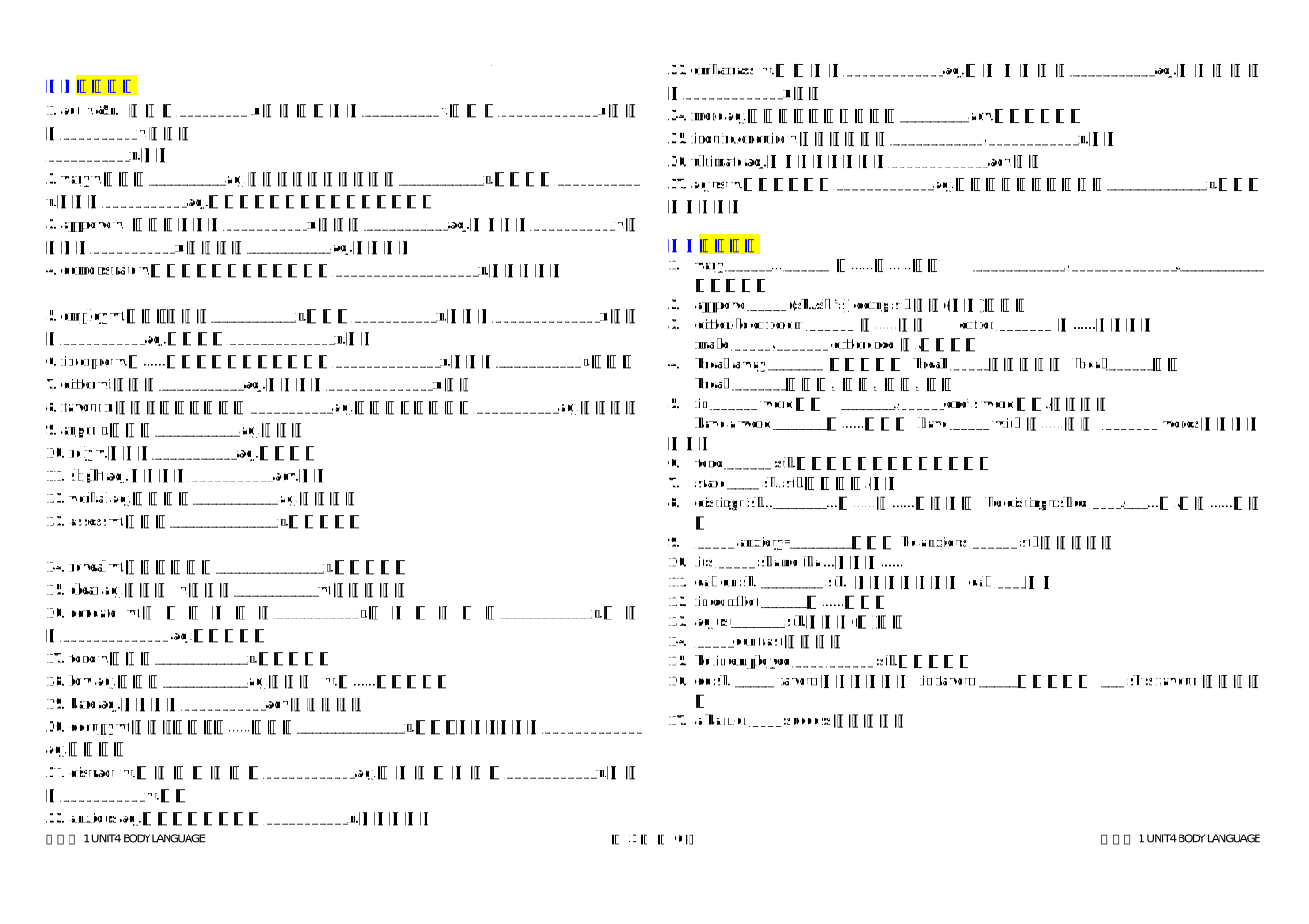
$$选择性必修一 UNIT 4 Body Language一轮复习学案 一、英译中单词默写 序号 英文 中文 序号 英文 中文 1 interaction 25 trial 2 vary 26 slight 3 appropriate 27 slightly 4 by contrast 28 twin 5 approve 29 nonverbal 6 demonstrate 30 assessment 7 gesture 31 assess 8 witness 32 internal 9 employ 33 straighten up 10 identical 34 slump 11 interpret 35 pose 12 differ 36 bend 13 by comparison 37 reveal 14 cheek 38 clarify 15 favour 39 in other words 16 bow 40 educator 17 waist 41 tick 18 make inferences 42 tendency 19 breakdown 43 lower 20 barrier 44 imply 21 fake 45 barely 22 anger 46 chin 23 reliable 47 occupy 24 incident 48 stare 序号 英文 中文 序号 英文 中文 49 ceiling 59 bother 50 distract 60 weep 51 perceive 61 at work 52 distinguish 62 conflict 53 anxiety 63 inquire 54 chest 64 ultimately 55 embarrassed 65 adjust 56 ashamed 66 intervene 57 merely 67 react 58 call on 68 component 选必修1 UNIT4 BODY LANGUAGE 选必修1 UNIT4 BODY LANGUAGE第 1 页 共 8 页 学科网(北京)股份有限公司 二、英译中单词默写 1. _ n. 交流;相互影响 2. _ vi. (根据情况)变化;改变 3. _adj. 合适的;恰当的 4. _ 相比之下 5. _ vi. 赞成;同意vt.批准;通过 6. _ vt. 表现;表达;说明;证明 7. _ n. 手势;姿势;姿态 8. _vt. 当场看到;目击;见证n.目击者;证人 9. _ vt. 使用;应用;雇用 10. _ adj. 相同的 11. _ vt. 把…理解(解释)为vi.&vt.口译 12. _ vi. 相异;不同于 13. _ (与…)相比较 14. _ vt. 较喜欢;选择;有利于n.帮助;恩惠;赞同 15. _ vi. 鞠躬;点头v.低(头) n.弓;蝴蝶结 16. _ 推理;推断 17. _ 消除;分解;打破 18. _ n. 隔阅;障碍 19. _ adj 假装的;假的;冒充的 20. _ n. 愤怒;怒气vt.使生气;激怒 21. _ adj. 可靠的;可信赖的 22. _ n. 发生的事情;严重事件;冲突 23. _ n.&v.审讯;审判;试验;试用 24. _ adj. 轻微的;略微的;细小的 25. _ adv. 略微;稍微 26. _ adj. 不涉及言语的;非言语的 27. _ n. 评价;评定 28. _ vt. 评估;评价 29. _ adj. 内部的;里面的 30. _ 直起来;整理;收拾整齐 31. _ v. 垂头弯腰地走(或坐等) 32. _ n. 故作姿态;(为画像、拍照等摆的)姿势vi.摆好姿势vt.造成(威胁、问题等) 33. _ vt.&v.( _,_)(使)弯曲;倾斜;偏向 34. _ vt. 揭示;显示;露出 35. _ vt. 使更清晰易懂;阐明;澄清 36. _ 换句话说;也就是说 37. _ n. 教师;教育工作者;教育家 38. _ vt. 给(试卷、问题等)打钩号vi.(钟表)发出嘀嗒声n.钩号 39. _ n. 趋势;倾向 40. _ vt. 把…放低;降低;减少adj下面的;下方的;较小的 41. _ vt. 意味着;暗示 42. _ adv. 几乎不;勉强才能;刚刚 43. _ vt. 占据;占用 44. _ vi. 盯着看;凝视n.凝视 45. _ vt. 分散(注意力);使分心 46. _ vt. 察觉;看待;理解 47. _ vi.&vt.区分;辨别 48. _n. 焦虑;担心;害怕 49. _ adj. 难堪的;尬的 50. _ adj. 羞愧;惭愧 51. _ adv.只是;仅仅;只不过 52. _ (短暂地)访问;要求(某人讲话等);正式邀请 53. _ vi.&vt.费心;麻烦;因…操心;麻烦;不便 54. _ vi.&vt.哭泣;流泪 55. _ 有某种影响;在工作 56. _ n. 矛盾;冲突 vi.冲突;抵触 57. _ vi.&vt.(or:enquire)询问;打听 58. _ adv 最终;最后 59. _ vt. 调整;调节vi,&.适应;(使)习惯 60. _ vi. 干预;介入 61. _ vi. (对…)起反应;回应;(对食物等)有不良反应 62. _ n. 组成部分;零件 63._ n. 语气 三、词性转换 1. act v.&n. 行动_ n.行动;行为_v.互动_n.互动_v.反应 _n.反应 2. vary v.变化_adj.各种各样的;许多的_n.多样化_n.变异_adj.多变的;多种多样的;形形色色的 3. approve v. 批准;赞同_n.赞同_adj.赞同的_v.不赞成_n.不赞同_adj.不赞同的 4. demonstrate v.表现;显露;证明;演示_n.演示;表现 5. employ vt.雇佣;使用_n.雇主_n.雇员_n.雇佣_adj.失业的_n.失业 6. interpret v.把......理解为;(口头)翻译_n.口译_n.口译者 7. differ vi.不同_adj.不同的_n.不同 8. favour n.恩惠;喜爱;赞同_adj.赞成的;有利的_adj.最喜欢的 9. anger n.生气_adj.生气的 10. rely v.依靠_adj.可信赖的 11. slight adj.轻微的_adv.稍微 12. verbal adj.言语的_adj.非言语的 13. assess vt.评价_n.评价;估价 14. reveal vt.显露;揭露_n.揭示;揭露 15. clear adj.清晰的 v.清理_vt.澄清;阐明 16. educate vt.教育;教导_n.教育工作者_n.教育_ adj.受过教育的 17. tend v.倾向_n.趋势;倾向 18. low adj.低的_adj.较低的 vt.把......放低;降低 19. bare adj.赤裸的_adv.仅仅;勉强 20. occupy vt.占领;占用;使......忙碌_n.工作;职业;占用_adj.被占用的 21. distract vt.分散;使分心_adj.注意力分散的_n.分心_vt.吸引 22. anxious adj.焦虑的;渴望的_n.焦虑;渴望 23. embarrass vt.使尴尬_adj.令人尴尬的_adj.感到尴尬的_n.尴尬 24. mere adj.仅仅的;极不重要的_adv.仅仅;只不过 25. inquire/enquire v.打听;询问_/_n.询问 26. ultimate adj.最后的;最终的_adv.最后 27. adjust v.调整;适应_adj.可调整的;可调节的_n.调整;调节;适应 四、短语默写 1. vary _..._ 由......到......不等 _/_/_各种各样的 2. approve _ (sb./sb.’s) doing sth.赞同(某人)做某事 3. differ/be different _ 与......不同 differ _ 在......方面不同 make _/_ difference 有/没有影响 4. break away _ 脱离,打破 break _插嘴,闯入 break_爆发 break _出故障, 分解, 垮掉, 失败 5. in _ word总之 _/_one’s word遵守/不守诺言 have a word _与......谈一谈 have _ with 与......争吵 _ words无法用语言表达 6. tend _ sth.经常做某事;有做某事的倾向 7. stare _ sb./sth.盯着某人/某物 8. distinguish..._...把......与......区分开来 be distinguished _/_...因/作为......而出名 9. _ anxiety=_焦虑地be anxious _ sth.渴望做某事 10. it's _ shame that...真遗憾...... 11. call on sb. _ sth. 号召某人做某事 call _取消 12. in conflict _和......有矛盾 13. adjust_sth.适应于(做)某事 14. _contrast相比之下 15. be in employed _ _ sth.忙于做某事 16. do sb. _ favour帮某人一个忙 in favour _赞同,支持 _ sb’s favour 对某人有利 17. a barrier _ success成功的障碍 五、单词语法填空 1.The woman couldn’t speak English so her daughter _(interpret) for her. 2.In my opinion, men and women should be treated equally in _(employ). 3.The manager thought he was a _(rely) person, so he told him all about the new plan. 4.Mr Smith was fired for _(reveal) trade secrets, which shocked all the staff. 5.I think it’s really hard for such a little child _(distinguish) between right and wrong. 6.I felt _(embarrass) about how untidy the house was when my friend came to see me. 7.The little girl showed no _(anxious) before the competition. 8.I had a meeting with a woman from Japan and she wouldn’t stop _(bow). 9.The child was unable to offer a clear _(describe) of what she _(witness). 10.He decided to go abroad for further study with the _(approve) of his parents. 11._(vary) of flowers are on show in the street _ National Day. 12._(vary) flowers are on show in the street _ National Day. 13.The secretary worked for the same _(employ) for 20 years. 14.London was _(differ) from most European capitals. 15.There was hurt and real _(angry) in her voice. 16.React _(appropriate), without overreacting because it isn’t as you hoped or wanted. 17.Price is determined through the _(interact) of demand and supply. 18.These _(incident) were the latest in a series of disputes between the two nations. 19.Once _(bend) out of shape, wires don’t return to the original position. 20.Don’t let yourself be _(distract) by fashionable theories. 21.His _(occupy) brings him great fame and fortune. 22.He will have to make major _(adjust) to his thinking if he is to survive in office. 23.In college I had been taught that a successful _(educate) should ignore bad behaviour. 24.On our second question, we have noted that he has made a _(clarify). 25.These plants have a _(tend) to grow in the more rural areas. 26.She arrived _(weep), wiping her eyes with a tissue. 27._(ultimate), you will have to make the decision yourself. 28.It was very cold yesterday; _ contrast, it seems a bit warm today. 29._(judge) from his expression, I knew he was not _ favor of my plan. 30.I can’t call _ you this afternoon since I have something urgent _(deal) with. 31.The computer has been repaired and now it is _ work. 32.He is good at all subjects. _ other words, he does well _ all subjects. 33.He stared _ the exam paper blankly, not knowing what to write. 34.Eddie felt _ after being criticized by his parents. 35.I’m glad to hear that she got _ the exam, for which she has prepared for a long time. 36.Wedding traditions and customs vary from one country _ another. 37.It took them about one month to figure _ how to start the equipment. 38.She had been waiting for Simon to break _ the barrier between them. 39._ comparison, British artists seemed to lack imagination and invention. 40.Would you mind _(give) me the book? 41.Seeing the funny scene, I can’t help _(laugh). 42.We are looking forward to _(hear) from Mr Li. 43.The windows haven’t been cleaned for a long time. They need _(clean). 六、单词、短语填空 1. 选词填空 tone, lack, employ, component, embarrassment, interpret, demonstrate, nonverbal, crucial, stare There are three 1_ in any face-to-face communication: words, 2_of voice, and body language. It is said that most of what we communicate with others is 3_. So when interacting with people, perceiving the message conveyed by body language is 4_. You cannot succeed in business and social encounter if you 5_ inappropriate body language. For example,6 _ at someone too long can be 7_ as a threat, standing too close may cause _8_ and uneasiness, and touching your neck when talking to others probably 9_ that you feel nervous and 10_confidence. Sometimes body language speaks louder than words. 2. 短语填空 make inferences; in other words; at work; straighten up; by contrast; call on; break down 1.It takes a long time to _ prejudices, but we will keep trying. 2.I'm at a loss whether I should bring a small gift or not when I _ him. 3.A human can sometimes _based on previous knowledge. 4.After so many years of hard work, she is tired out and can not _ at all. 5.The computer has been repaired and now it is _normally. 6.They refused to employ him. _, he didn't get the job. 7.It was very cold yesterday, but _,it seems a bit warm today. 七、课文语法填空 Text 1 We use both words and body language to express our thoughts and opinions when 1_ (communicate) with other people. Body language can make us learn a lot about 2._ people are thinking. Just like 3._(speak) language, body language 4._(vary) from culture to culture. The crucial thing is using body language in 5._ way that is appropriate to the culture you are in. For example, the gesture for “OK” has 6._(differ) meanings in different cultures. Even the gestures we use for “yes” and “no” differ around the world. Some gestures seem to have the same 7._(mean) everywhere. 8._(place) your hands together and resting them on the side of your head while closing your eyes means “sleep”. Some body language has many different uses. Perhaps the best example is smiling. A smile can help us get 9._difficult situations and find friends in a world of strangers. If we are feeling down or lonely, there is nothing 10._(good) than seeing the smiling face of a good friend. Text 2 How Do I Know My Students? 1._ an educator, people often ask me 2._ I know what is going on in the minds of my students. In a classroom of more than forty students, it is hard 3._ (have) many one-on-one conversations with each person. So, how can I really know 4._ makes each student tick? My answer? I look at their body language. It is easy to recognise when students are interested in a lesson. Most tend to look up and make eye contact. When I make a joke, they smile. When I talk about something difficult, they look 5._ (confuse). I know when students are really interested, however, because they lean forward and look at me. People have a tendency to lean towards whatever they are interested in. So if a student has his head 6. _ (lower) to look at his watch, it implies he is 7._(bore) and just counting the minutes for the class 8._(end). If two friends are leaning their heads together, they are probably writing notes to each other. Some students look up, but there is 9._ absence of eye contact. Their eyes 10._ (bare) move, and they always have the same distant expression on their faces. It is as though they are asleep with their eyes open. 八、句式仿写 1. 不是每个人都有弹钢琴的天赋。 _playing the piano. 2. 不是每个成员都赞成你的计划。 Not every member will be in favour of your plan. _in favour of your plan. 3. 遵循以下建议,你的问题就会得到解决。 _and you can _. 4.总之,我们应该意识到没有什么比健康更宝贵。 In conclusion, we should be aware that _. 5. 没有什么比在乡下散步更能振奋我们的精神了. _ a walk in the countryside for_. 9、 应用文写作模板 一、高考英语议论文的满分结构: 结构:议论文通常分为三个部分: 引言 :引入话题并表明立场,简单介绍你将要讨论的问题。清晰地表明你支持或反对的观点。 正文 :提供论点和论据支持你的立场。每个段落应集中讨论一个论点,并通过事实、例子、数据等进行支撑。可以提出2-3个理由支持你的立场。 结论 :总结全文,重申你的观点。回顾文章中的主要论点。最后重申你的立场,并可以对未来提出建议或展望。 说明利弊型模板 目前,关于_有一个热烈的讨论。事实上,_利弊皆有。 一般来说,它的优点有如下几个方面。首先,_.其次_.然而,正如一句俗语所说,“凡事都有两面性”_也不例外。它还有一些消极的方面。首先是_. 其次是_。 综上所述,我们应该充分发挥_的优势,同时将劣势降至最低。在这种情况下,我们一定会更好地利用_(讨论主题)。 Nowadays, there is a widespread concern over/on_(讨论议题). In fact, there are both advantages and disadvantages in_(讨论议题). Generally speaking, its advantages can be seen as follows.Firstly,_(优点一). And secondly, _(优点二). On the contrary, Just as a popular saying goes, “every coin has two sides”, _(讨论议题) is no exception. Its negative aspects are also obvious To begin with, _(缺点一). In addition, _(缺点二). To sum up, we should try to bring the advantages of _(讨论议题) into full play, and reduce the disadvantages to the minimum at the same time. In that case, we will definitely make better use of the _(讨论议题). $$
资源预览图

1

2
3
相关资源
示范课
由于学科网是一个信息分享及获取的平台,不确保部分用户上传资料的 来源及知识产权归属。如您发现相关资料侵犯您的合法权益,请联系学科网,我们核实后将及时进行处理。