Unit 5 What are the shirts made of(同步阅读)The four elements(书籍音频+Word)-九年级英语教材同步单元主题阅读(人教版)
2024-12-23
|
2份
|
17页
|
82人阅读
|
0人下载
教辅

内容正文:
null
Let's Learn About . . .
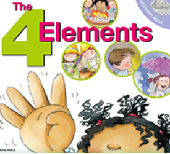
4. The Four Elements
Núria Roca
Illustrations: Rosa M. Curto
Close your eyes and imagine the planet where you live with your family and your friends and aaaaall the rest of the people in the world. Also imagine all the animals, and flowers, and even tiny forms of life called microbes. You live on a planet with air that ruffles your hair, water that gets you wet, fire that keeps you warm, and the earth that allows all kinds of plants and trees to grow.
Guesswhat it is: You can't touch it or see it but it is all around. When it is still, you don't realize it is there, but when it moves, it shakes the leaves on the trees, whistles in your ears, and makes the clothes you are wearing begin to dance. Sometimes it blowsso hard it seems it doesn't let you walk. Did you guess? It's the air!
Breathe in air through your nose and then blow it out of your mouth. Can you notice how your lungs become filled with air and then get empty? People need the oxygen in the air to be able to breathe. That's why we can't stay long under the water.
If you were a shark or other fish, what would you need to breathe in the water? Gills! A fish's gills can take air out of the water and then the fish can breathe.
Air is strong enough to hold birds up in the sky as well as planes, kites, air balloons ... and a lot more things! It is so strongit can turn the blades of a windmill to create electricity!
Sometimes we forget how important air is, and we pollute it with car exhaust and factory fumes. But we all need clean air!
Can youname everything you see on the opposite page?
When it rains, the waterfrom the clouds falls in the shape of tiny drops. Everything outside gets wet and the water slides down the windows. Dropsof water may become ice, clouds, seas, and rivers. Our tears are drops of water, too.
Water may be salty, like seawater or your teardrops, or fresh, like the water in rivers and ponds. We use water to nourish our crops, to drink, to wash and to cook with. Firemen need water to put out fires!
Water is so important, that you always will find it around you.
Have you ever been so thirsty that you could hardly wait to get a drink? Water is so important for our bodies that we can't live without it.
If the earth went dry, there would be no plants, animals or people left. All living things would die.
Can you imagine how sad that would be?
Water refreshes. What about fire?What do you feel when you get near a flame? Heat is very nice when it is cold, but if you get too close you may burn yourself. And it hurts very, very much, so you better not try it.
Fire is never still: It moves,and when the wind carries it, flames jump quickly from place to place. That's why fires can destroy everything in their way. We are lucky to have firemen! And never play with matches or fire.
A very, very long time ago, humans did not know how to make fire. At night there was no light except that from the moon or, if there was a storm, from the flashes of lightning.
And without fire, food couldn't be cooked either, so there was no bread, no spaghetti, or popcorn.
Have you ever noticed the smell of wet earth when it has stopped raining? And its color? It may be brown, yellow, or black . . . and isn't it fun making mud pies and skipping pebbles on the water? Have you ever tried this?
The earth has a million hidden treasures: Seeds, caves and tunnels, little animals, the roots from plants . . . even very old objects waiting for curious people to dig them out. Did you ever guess that there were so many things underground?
Our planet has plenty of land, where you may find rocks and metals, valleys, mountains, and volcanoes. Sometimes the land is covered by trees and plants; at other times by snow or water. However, underneath it all, there is always earth.
When you come back from playing in the country, there is earth even in you hair!
Water, air, fire and earth are always mixing with one another. Sometimes they work together and at other times they seem to fight each other. Do you know which element wins over the others? It is not easy to guess!
ACTIVITIES
Earth, Air, Fire, Water
When you have friends over, you may play the game of the four elements. All of you sit on the floor forming a circle, except It, who stands in the middle holding a handkerchief tied up in a ball. This boy or girl counts up to ten and then tosses the handkerchief (the "ball") into the lap of one of the players sitting down while saying aloud "earth," "air," "water," or "fire." If the word is "earth," the player who got the handkerchief must immediately name an animal that lives on the surface of the earth; if the word is "water," the player must name some fish; if the word is "fire," the player must name something that is fireresistant; and if It says "air," the player must name a bird. If the player gives a wrong answer or lets It count up to ten without saying anything, the player must pay a fine.
Good luck!
Colored Flowers
Did you know plants get water from the earth so they can live? If you want to check, you just need some white flowers, a celery stick, two glasses of water and two dyeing agents (red and blue, for
example).
1. Mix one of the dyeing agents in each glass of water.
2. With the help of a grown-up, split the stem of one of the flowers but not all the way, leaving the flower uncut.
3. Place each split half of the flower stem in a different glass and the celery stick in any one of the two (the one with the color of your choice).
4. Leave both glasses in a warm room.
5. After a few hours have passed, you will see that the flower is dyed in two colors and the celery in just one: The plants have absorbed the colored water, which has reached the petals of the flower and the celery leaves.
6. If you cut the celery stick now, you will see the channels through which the water was absorbed, because now they are colored.
Surprise one of your friends by giving her a bicolor flower.
Putting Soil in Order
1. Get some soil from your backyard and put it in a glass jar until it is four-finger full (place your hand around the jar and make sure that the soil reaches your fourth finger).
2. Fill up the jar with water and shake it well using a stick.
3. Now wait for about ten minutes and you will see that the chunks of stone have dropped to the bottom and the smaller pieces of soil have mixed with the water and made it dark. On the surface there will be little sticks, tiny pieces of grass and remains of plants and animals floating, as well as numerous bubbles. These tiny bubbles are full of the air there was in the soil.
If you let the jar rest for a whole day, the water will be transparent again because all the elements in it will have dropped to the bottom. Everything will appear in perfect order: at the very bottom there will be bigger chunks of stone, then smaller and smaller grains, and on top very tiny grains of clay.
Seeing the result, can you imagine what the bottom of the sea must look like?
Floating Ice
Fire Needs Air!
Water increases in volume when it freezes, that is, frozen water takes up more space than liquid
water.
You may check it at home. You just need a glass bottle with a narrow neck, water, and some aluminum foil.
1. Fill up the bottle with water.
2. Cover the mouth of the bottle with a piece of aluminum foil (not too tight!) and put the bottle in the freezer.
3. A few hours later, take the bottle out of the freezer. Because frozen water occupies more volume, you will see that now it does not fit in the bottle and it pushes the aluminum foil upward. When it is very cold, the water in the pipelines may freeze over. When that happens, as the ice does not have enough room, it bursts the pipelines! Ice occupies more volume than water but it weighs less, Get a big glass jar, a candle and a grown-up to help you. Light the candle and cover it completely with the upturned jar. Be careful not to touch it, because it burns! When the flame has consumed all the oxygen in the air, it will go out. Just out of curiosity, check with a watch how long it takes.
that's why icebergs float in the sea.
CAUTION: Don't ever play with fire when you are alone, because you could burn yourself or start a fire.
Guidelines for Parents
The Voyage of a Drop of Water
From the sea we get clouds, from the clouds we get rain, the rain creates rivers, and the rivers form the seas. When it rains, a large part of the water flows and filters through the cracks in permeable rocks and then runs underground, where it may remain stored for hundreds or thousands of years until it comes out through a spring or it is extracted through a well. This is the cycle of water. A few days or months may pass from the moment a molecule of water evaporates and until it goes back to the sea. And if it is a matter of a snowflake falling in a polar region, it may take thousands of years. Some of these molecules go through our bodies when we take water as a drink or in food (all foods contain water, in smaller or bigger proportion). Water circulates everywhere and gets recycled again and again. Unfortunately, we pollute water by using it for washing, watering the crops, or in different industrial processes. That's why it is so important to purify it before returning it to the environment. If we did not, the dirty water would pollute everything and life on the planet would come to an end.
Scarce Water
Without water there may be no plants, animals, or people. In old times, humans settled close to places where they could find water, but little by little they learned different techniques to obtain water, store it, and take it wherever it was needed. In many parts of the world, water is a scarce good that must be economized. There are extremely dry regions where people must walk for hours to reach a well that seldom is enough to satisfy everyone's needs.
Air for the Fire
Fire is possible when there is a combustible material (such as wood), oxygen (included in the air), and enough heat. When the gas produced by the combustible material burns, there is a flame. What the fire does is transform matter into light and heat; for example, gasoline is a fuel that burns inside an engine. There are also many materials that will not burn but, when they are heated, they become red-hot, so hot in fact that they radiate light and heat, as is the case with metals and volcanic magma. They are so hot that they are also identified with fire, even when they do not produce a flame.
Fires
The pages describing fire may be useful to talk about some safety rules. Even when you are dealing with small children, they should know what to do if there is a fire. Here are is some advice: Put a lid on the pan that has caught fire, never throw water into it. Unplug all electrical appliances that may be burning. If the fire affects a building, close the gas supply. Put a wet handkerchief over your mouth, a wet towel around the head, and crawl on the floor (there are less poisonous gases close to the floor). Climb down the stairs, do not use elevators. If the fire is located at a lower level, go up to the roof of the building and make yourself visible to the rescue team. Close doors and windows behind you to avoid air drafts, because these rekindle the fire and help it to spread. Do not run if your clothes catch fire but wrap yourself in a blanket and roll on the floor to put out the flames. In public places, as soon as you go in, it is a good idea to find out where the emergency exits are. When explaining these norms to children, tell them not to panic: spending a few seconds considering all the possibilities always is a lifesaving factor.
Air
Even when they cannot see it, children may imagine the air as formed by tiny balls that are constantly moving and colliding among themselves. These tiny balls move so much that, when we blow up a balloon, they constantly bump against its wall and keep it tense. What we call atmospheric pressure is the weight of all the air above us. As we go higher from the ground, the air becomes less dense and it weighs less, because the layer of air over us is thinner. This layer diminishes more and more until it disappears when we go over 600 miles high. In space there is no air because all tiny little balls are trapped by the earth's gravity.
Wind
Wind is air in motion. Hot air loses density and floats over cold air, which is more dense. That's how winds are formed all over the world. The sun heats unevenly the different areas of the planet and even of the same region, for it does not heat rocks the same way it heats a wooded area. These movements in the air are the origin of all kinds of winds, from light sea breezes to hurricanes. The intensity with which the winds blow will depend on the temperatures involved.
The Ground Beneath Our Feet
The ground we walk on results from the erosion, disintegration, and decomposition rocks experience due to the action of water, wind, and temperature changes. In addition, countless worms, bacteria, and fungi contribute to the formation of soil and its aeration. If we observe the ground, we will see that it is formed by a mixture of humus, pieces of rock, sand, clay, and lime. In deserts and beaches, almost all the ground is composed of sand, which, due to its consistency, does not keep water and for this reason hardly harbors any animal or vegetal life. The ground formed by clay is easy to distinguish, because it sticks to everything it touches when wet. Clay is easy to mold (ceramic pieces are made from this type of soil). Also, clay-rich ground is virtually waterproof, which means that water cannot filter toward deeper layers and stays on top. When it dries up, it cracks and offers a very characteristic aspect. The ground with abundant humus has a very dark color because it is full of vegetal and animal remains. Such a ground keeps water well, is full of microscopic life, and is very fertile. It is typical of wet forests.
学科网(北京)股份有限公司
$$
资源预览图

1

2

3
所属专辑
相关资源
示范课
由于学科网是一个信息分享及获取的平台,不确保部分用户上传资料的 来源及知识产权归属。如您发现相关资料侵犯您的合法权益,请联系学科网,我们核实后将及时进行处理。