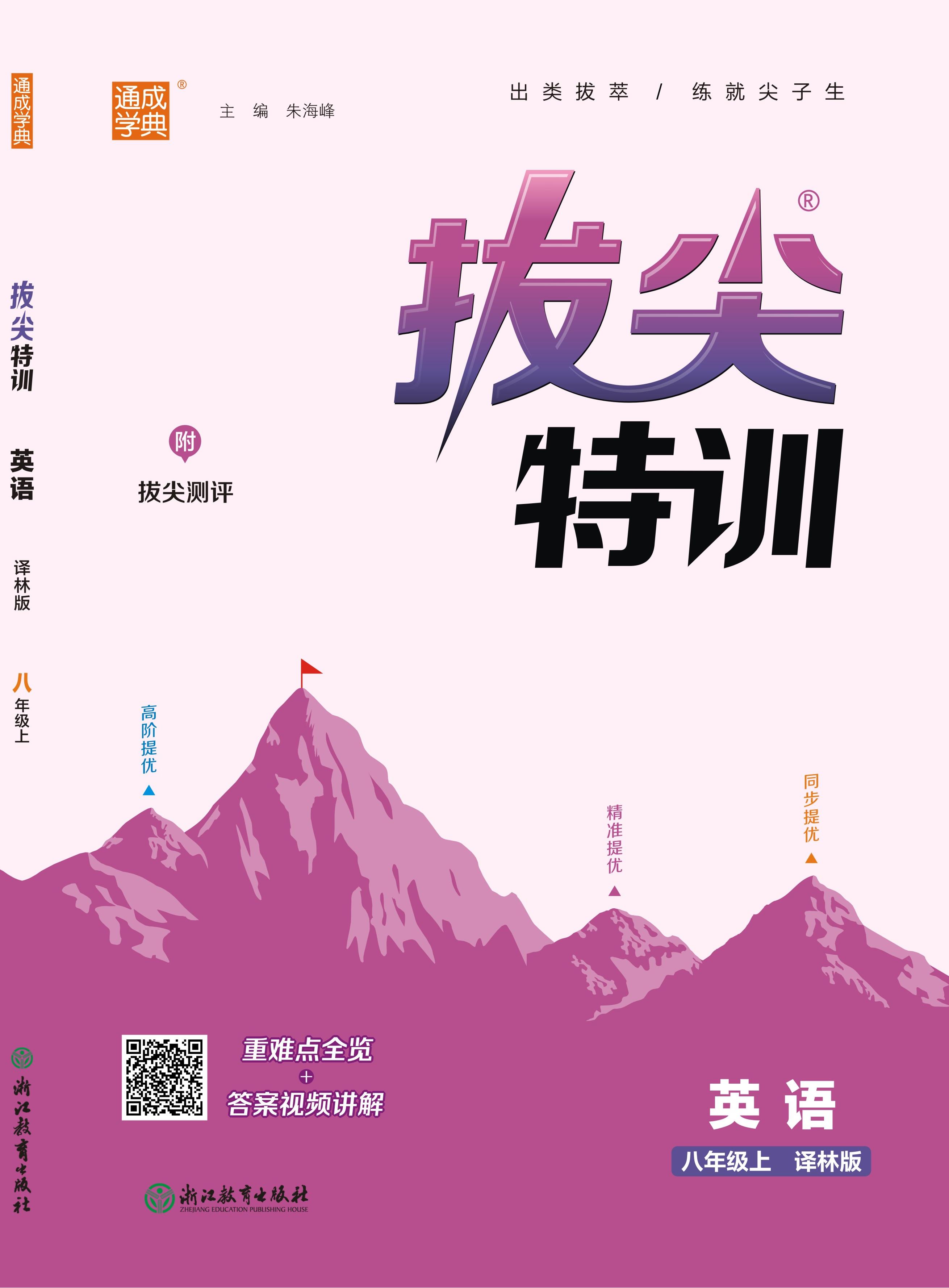
Unit 2 第1课时 Comic strip & Welcome to the unit-【拔尖特训】2024-2025学年八年级上册英语(牛津译林版)
2024-11-11
|
2份
|
5页
|
74人阅读
|
0人下载
内容正文:
听第一篇短文,回答第13~15小题,请根据短文内容,
选择正确答案,完成信息记录表。答题完毕,请等待“嘀”的
信号,进入下一篇短文。
Dear
Tom,
Thanks
for
your
email.
I
am
happy
to
know
about
your
family.
I
hope
I
can
visit
you
one
day.
Let
me
tel
you
something
about
my
family.
My
father
works
in
a
language
school
as
a
teacher.
He
is
always
very
busy
and
he
works
hard.
He
loves
his
students.
He
is
short
and
fat.
He
has
short
black
hair.
My
mother
is
a
nurse.
She
has
long
golden
hair.
There
is
always
a
smile
on
her
face.
She
is
good
at
singing
and
dancing.
She
often
helps
my
sister
and
me
with
our
lessons.
I
am
sixteen
years
old,
and
my
sister
is
two
years
younger
than
me.
We
are
fond
of
playing
sports.
Yours,
Mary
听第二篇短文,回答第16~20小题。
Everybody
has
his
or
her
best
friend,
and
so
do
I.
My
name
is
Shirley.
Today,
I
want
to
tel
you
something
about
my
best
friend
Cindy.
We
became
friends
two
years
ago.
She
is
an
outgoing
and
talented
girl.
She
likes
voleybal
and
plays
it
every
day.
She
wins
many
prizes
in
different
games.
In
fact,
Im
quite
different
from
her.
Im
not
as
tal
as
her.
I
like
music.
I
dont
like
sports,
but
I
always
go
to
play
voleybal
with
her.
She
thinks
it
is
good
for
me.
Im
more
hard-working.
I
always
get
better
grades
than
she
does,
so
maybe
I
should
help
her
more.
Its
not
necessary
to
be
the
same.
I
like
Cindy
because
she
is
kind
and
she
can
make
me
laugh.
We
can
share
many
things.
Though
we
are
not
similar,
we
care
about
each
other.
Thats
the
most
important
thing.
[参考答案]
1.
C 2.
A 3.
B 4.
B 5.
A 6.
C 7.
B 8.
C
9.
B 10.
B 11.
B 12.
B 13.
C 14.
B 15.
A
16.
B 17.
C 18.
B 19.
A 20.
C
外刊阅读拓展
一、
1.
C 推理判断题。由第二段中I
went
to
the
kitchen
where
Grandma
was
preparing
the
meals与第五段中“Sure
enough,
the
cat
folowed
me,
happy
to
be
out
of
the
rubbish
box.”可推知,作者进入厨房是为了拿食物引猫出
垃圾桶。
2.
C 推理判断题。上文提及拿出了一罐猫粮,下文顺承
表示:把猫粮倒进碗里。
3.
D 推理判断题。由倒数第三段中“Wel,
it
seems
that
Il
need
to
change
our
menu.
It
may
include
something
delicious
for
the
cat.”可推知,奶奶第二天可能会为猫烹饪
食物。
4.
A 推理判断题。本文讲述作者救助一只藏在垃圾桶
的流浪猫的经历,由此推断,本文摘自长篇故事。
5.
D 推理判断题。本文讲述作者救助一只藏在垃圾桶的
流浪猫的经历,由此可推知,本文与“人与动物”有关。
二、
1.
B 上文提及孩子们每天赤脚在建筑工地上走来走
去,就像这是他们的日常练习一样,空处对应表示:希娅为
孩子们感到难过。
2.
A 上文提及希娅成立了一个慈善组织,该慈善组织为
有需要的人提供鞋子,空处对应表示:希娅的梦想是:“送一
双鞋,救一颗心。”
3.
G 下文提及希娅说这种(对鞋的)需求是无止境的,空
处对应表示:今年在它(成立)的第五年,该组织仍在向有需
要的人赠送鞋子。
4.
F 上文提及在第一次志愿活动中,该组织募集并分发
了700双鞋,空处对应表示:今天,这一数字在四个国家达
到约28000。
5.
C 上文提及她的捐鞋工作还没有完成,空处顺承表示:
她说:“我们的梦想一直是想触摸一百万只脚(捐五十万
双鞋)。”。
Unit
2 School
life
第1课时 Comic
strip
&
Welcome
to
the
unit
[课时新知特训]
一、
1.
advertisements 2.
eraser 3.
British 4.
vacation
5.
movies
二、
1.
playing practise
doing
sth.意为“练习做某事”。
2.
work
harder 根据句中的than可知,副词hard用它的
比较级形式harder。
3.
smarter 4.
saw
a
film 5.
ask
三、
1.
B 2.
B 3.
B 4.
C 5.
D
5
[阅读提优特训]
四、
1.
true 2.
almost 3.
dream 4.
spent 5.
quickly
6.
fun 7.
sense 8.
learned 9.
tired 10.
able
五、
1.
A 根据语境可知,“我”以为看到的是期末试卷,悄
悄地把它放进书包并离开,
secretly符合语境。
2.
D 根据下文中“My
History
teacher
always
encouraged
me
to
work
harder
and
get
better
grades
...”可知,历史是
“我”最差的学科。
3.
A 根据语境可知,“我”看到了试卷,觉得自己能提前
知道题目,所以很兴奋。
4.
A 根据语境可知,“我”拿出“我”的历史书并开始找答
案。
work
on
the
answer在此处表示“找答案”。
5.
C dream
of
doing
sth.意为“想象做某事”。
6.
D 根据句意可知,“我”的历史老师总是鼓励“我”更加
努力地学习,取得更好的成绩,但“我”一次次让他失望。
let
sb.
down意为“让某人失望”。
7.
B a
big
surprise意为“一个大的惊喜”。
8.
D 根据语境可知,试卷上的题目与“我”看到的不同。
9.
A 根据语境可知,“我”偷拿了试卷,考试后应找一个
人少的地方查看,
toilet应是一个合适的地点。
10.
B 从这件事上“我”得到的教训是,“我”应该脚踏
实地。
六、
1.
Between
the
ages
of
4
and
7. 2.
Desks,
chairs
and
four
treasures
of
the
study. 3.
To
show
their
deep
respect. 4.
Ring
a
certain
bel
to
start
a
new
term.
5.
Its
important.(言之有理即可)
第2课时 Reading
[课时新知特训]
一、
1.
discuss 2.
won 3.
languages 4.
basebal
5.
foreign 6.
ends 7.
offers 8.
During
二、
1.
mixed 2.
difference(s)
3.
dancing 动词practise后接动词-ing形式,
practise
doing
sth.意为“练习做某事”。
4.
playing 5.
the
most
interesting 6.
heroes
三、
1.
does
sports 2.
learnt/learned
more
about
3.
caled 4.
seems 5.
French
四、
1.
D 2.
B 3.
C 4.
B 5.
A 6.
C
7.
D 句意:戴维在足球比赛快要结束时进了一个漂亮的
球,最终帮球队赢得比赛。near
the
end
of意为“在……快
结束时”;
in
the
end意为“最后”。
8.
D 9.
B 10.
D
五、
1.
History;
French;
subjects 2.
discuss;
classmates
3.
earlier
than
usual
on 4.
Mr
Smith
offered/offers
to
help
me
with
my
English.
[阅读提优特训]
六、
1.
take
an
exam 2.
most 3.
to
read 4.
have
problems
with 5.
going
七、
1.
D slowly缓慢地;
quickly快速地;
quietly安静地;
smoothly顺利地。根据下文中“But
as
most
students
progressed,
I
seemed
to
...behind.”可知,前后句之间为
转折关系,因此应是第一年进展顺利,但随着大多数学生
的进步,“我”似乎落后了。
2.
B 句意:但当大多数学生进步时,我似乎落后了。fal
behind意为“落后”。
3.
A fear恐惧;
regret遗憾;
joy欢乐;
courage勇气。根
据上文中“But
as
most
...fal
behind.”可知,当老师让大
家在课堂上表演时,“我”应是充满了恐惧。
4.
C novel小说;
piece块;
story故事,叙述;
part部分。
but表示转折关系,上文中my
rhythms
were
good讲“我”
的节奏好,所以这里是说“我”的音调不好。another
story
意为
“另一回事,不同情况(通常指不好的一面)”。
5.
B relaxed放松的;
embarrassed尴尬的;
worried担心
的;
nervous紧张的。根据上文中“‘Didnt
you
practise
your
lesson?’
the
teacher
shouted
at
me.”可知,老师质疑
“我”的演奏,怀疑“我”没有练习,为此“我”应是感到很尴
尬的。
6.
C love喜欢;
keep保持;
hate厌恶;
start开始。根据
下文中I
was
getting
worse可知,“我”应是讨厌吹单簧管。
7.
D finaly最后;
hopefuly有希望地;
suddenly突然;
increasingly越来,愈发。根据下文中“In
a
moment
of
panic,
I
asked
for
sick
leave.”可知,一时慌乱之下,“我”请
了病假,由此可知,“我”越来越心烦意乱。
8.
B hard困难的;
easy容易的;
sily愚蠢的;
painful疼
痛的。根据上文可知,“我”讨厌吹单簧管,因此“我”请了病
假,这是一种很容易让“我”解脱的方式,这样“我”可以不再
面对单簧管表演了。
6
22
第1课时 Comic
strip
&
Welcome
to
the
unit ▶ “答案与解析”见P5
一、
根据首字母或汉语提示写出单词。
1.
She
is
influenced
by
the
(广告)
and
buys
lots
of
useless
things.
2.
—
What
can
I
do
for
you?
—
Two
notebooks
and
an
(橡皮).
3.
A
(英国的)
school
welcomed
some
Chinese
teachers
to
teach
Maths
to
its
students.
4.
We
are
going
to
visit
the
Forbidden
City
this
summer
v .
5.
—
What
shal
we
do
for
the
coming
weekend,
dear?
—
Lets
go
to
the
m .
A
new
film
is
on
show
these
days.
二、
选用方框中所给的单词或短语并用其适当
形式填空,有一个单词或短语是多余的。
see
a
film ask work
hard learn
about
play smart
1.
—
Where
is
Simon?
—
He
is
practising
foot-
bal
with
the
other
team
members
in
the
playground.
2.
If
you
want
to
be
among
the
top
students,
you
should
than
before.
3.
—
Do
you
think
dogs
are
than
people?
—
No,
I
dont
think
so.
4.
—
Did
you
go
to
the
concert
yesterday?
—
No.
We
at
Sunshine
Cinema.
5.
Why
dont
you
your
teacher
for
help
when
you
have
problems?
三、
单项选择。
1.
—
Its
sunny
today.
Why
go
out
for
a
walk?
—
!
Lets
go
now.
A.
not
to;
Good
idea
B.
not;
Good
idea
C.
dont;
Thats
al
right
D.
not;
Youre
welcome
2.
—
your
school
life
?
—
Its
busy
and
interesting.
School
is
realy
ful
of
fun.
A.
What
does;
like B.
What
is;
like
C.
How
does;
like D.
How
is;
like
3.
(2023·盐城市滨海县模拟)In
American
English,
“ ”
has
the
same
meaning
as
“biscuit”
in
British
English.
A.
store B.
cookieC.
movie D.
eraser
4.
—
What
about
Johns
schoolwork?
—
He
is
very
clever
he
doesnt
do
his
schoolwork
carefuly.
A.
or B.
and C.
but D.
because
答案讲解
5.
My
Chinese
teacher
Mr
Wang
together
with
his
two
sons
early
every
morning.
A.
practise
running B.
practise
to
run
C.
practises
to
run D.
practises
running
四、
(2024·原创)根据首字母提示补全短文。
What
is
a
teacher?
A
teacher
is
someone
who
teaches.
They
say
things
and
you
remember
them.
But
I
didnt
understand
the
1.
t
meaning
of
the
teacher
until
I
met
my
music
teacher.
When
I
first
arrived
at
my
music
class
at
school,
I
had
2.
a
no
knowledge
of
英语(译林版)八年级上Unit
2 School
life
23
how
to
play
the
violin.
I
couldnt
get
the
basic
notes
right.
It
was
an
impossible
3.
d
for
me
to
perform(表演)
in
front
of
the
public.
However,
my
music
teacher,
Mr
Smith,
inspired
me
to
stick
to
my
dream.
He
helped
me
to
find
the
right
violin
books
and
he
always
4.
s
time
teaching
me.
When
I
wasnt
able
to
remember
notes,
he
told
me
a
trick:
FACE.
F
means
“fa”;
A
means
“la”;
C
means
“do”;
E
means
“mi”.
In
this
way,
I
could
remember
the
notes
much
more
5.
q .
He
also
tried
to
make
his
music
class
6.
f .
We
always
played
games.
They
could
help
develop
our
7.
s
of
music.
We
talked
about
the
background
of
pieces
of
music
from
al
over
the
world
and
8.
l
about
the
development
of
music
in
China.
Sometimes
when
we
were
too
9.
t
to
practise,
Mr
Smith
talked
about
relaxing
things
instead
of
only
teaching
music
knowledge.
Thanks
to
Mr
Smith,
I
truly
fel
in
love
with
the
violin.
After
six
months
practice,
I
was
10.
a
to
perform
the
violin
smoothly
in
front
of
the
public.
I
am
proud
of
it.
I
am
grateful
to
Mr
Smith,
because
he
helped
me
make
my
dream
come
true.
五、
完形填空。
One
day
after
school,
I
went
to
the
teachers
office
to
see
my
teacher,
but
nobody
was
there.
As
I
was
about
to
leave,
I
noticed
a
piece
of
paper
on
the
floor.
I
picked
it
up
and
saw
the
words
“FINAL-TERM
EXAMINATION”
at
the
top.
I
put
the
paper
into
my
schoolbag
1
and
ran
out
of
the
room.
After
I
came
back
home,
I
took
out
the
paper
quickly.
It
was
the
exam
paper
of
my
2
subject,
History.
I
felt
3 .
My
heart
(心脏)
beat
fast.
I
took
out
my
History
book
and
started
4
on
the
answer.
I
had
never
answered
any
questions
so
carefuly.
On
the
day
of
the
History
exam,
I
went
into
the
exam
hal
confidently.
When
the
paper
was
sent
to
me,
I
5
of
getting
the
highest
mark
in
the
whole
grade
and
could
not
help
smiling.
“My
History
teacher
always
encouraged
me
to
work
harder
and
get
better
grades,
but
I
6
him
down
time
and
time
again.
This
time
I
wil
give
him
a
big
7 ,”
I
thought.
When
the
teacher
said
we
could
start,
I
turned
the
paper
over.
To
my
surprise,
al
the
questions
were
8 .
Later
I
felt
nervous.
In
the
end,
I
almost
left
the
paper
undone.
After
the
exam,
I
ran
to
the
9 ,
took
out
the
paper
and
carefuly
read
it
from
the
beginning.
Oh!
It
was
last
years
exam
paper.
I
had
read
al
the
questions
except
the
date.
This
was
a
lesson
and
I
knew
I
had
to
keep
my
feet
on
the
10 .
I
regretted(后悔)
doing
such
a
sily
thing.
After
that,
I
told
the
teacher
the
truth
and
I
promised
to
be
honest.
From
then
on,
I
worked
harder
than
before.
1.
A.
secretly B.
sadly
C.
slowly D.
suddenly
2.
A.
new B.
favourite
C.
best D.
worst
3.
A.
excited B.
interested
C.
amazed D.
tired
4.
A.
working B.
putting
C.
holding D.
carrying
5.
A.
talked B.
heard
C.
dreamt D.
consisted
Unit
2 School
life
24
6.
A.
put B.
looked
C.
planned D.
let
7.
A.
party B.
surprise
C.
meal D.
smile
8.
A.
important B.
same
C.
difficult D.
different
9.
A.
toilet B.
office
C.
hospital D.
park
10.
A.
way B.
groundC.
head D.
sky
答案讲解
六、
[传统文化]
(2023·临沂)任务型
阅读。
中国古代的“开学仪式”
September
is
a
big
month
for
students
in
China
since
the
new
term
begins
from
now
on.
In
ancient
China,
the
school
entrance
ceremony
(入学典礼)
was
one
of
the
most
important
ceremonies.
Children
began
school
between
the
ages
of
4
and
7
in
ancient
China.
Since
there
was
no
certain
time
to
begin
a
new
term
at
that
time,
the
most
important
thing
for
parents
was
to
choose
a
lucky
day
for
their
children
to
enter
school.
Next,
parents
would
prepare
some
school
things
for
their
children,
including
desks,
chairs
and
four
treasures
of
the
study.
In
ancient
times,
teachers
were
usualy
very
knowledgeable
local
persons.
Parents
would
prepare
many
gifts,
and
then
write
a
letter
of
invitation
to
ask
a
knowledgeable
man
to
be
their
childrens
teacher.
On
the
day
their
children
entered
school,
parents
would
take
them
to
take
part
in
the
First
Writing
Ceremony.
Before
that,
children
would
kowtow(叩头)
to
the
statue
of
Confucius
(孔子像)
9
times
and
then
to
their
teacher
3
times
to
show
their
deep
respect(尊敬).
During
the
ceremony,
the
teacher
would
put
a
red
point
on
the
students
forehead(前额)
as
it
meant
opening
the
wisdom
eye.
Children
would
also
ring
a
certain
bel
to
start
a
new
term.
After
that,
they
could
finaly
sit
down
in
their
seats
and
begin
to
study.
The
First
Writing
Ceremony
was
a
very
important
ceremony
for
every
student.
Every
day,
students
would
arrive
at
school
earlier
than
their
teacher,
kowtow
to
the
statue
of
Confucius,
and
then
go
back
to
the
seats.
Usualy
the
teacher
would
give
every
student
a
new
name,
which
was
used
for
the
future
Imperial
Examination(科举考试).
Today,
some
schools
are
starting
to
hold
an
entrance
ceremony
like
they
did
in
ancient
times.
Students
put
on
traditional
costumes
and
bow
to
the
statue
of
Confucius
and
their
teachers.
This
means
that
from
this
moment
on,
they
take
a
step
in
the
lifelong
journey
of
learning.
根据短文内容,回答问题。(每题答案不超
过
9个词)
1.
At
what
age
did
children
begin
school
in
ancient
China?
2.
What
did
parents
prepare
for
children
to
enter
school
in
ancient
China?
3.
Why
would
children
kowtow
to
the
statue
of
Confucius
and
their
teacher
before
the
First
Writing
Ceremony?
4.
What
would
children
do
during
the
First
Writing
Ceremony?
5.
What
do
you
think
of
the
school
entrance
ceremony?
英语(译林版)八年级上
资源预览图

1
相关资源
示范课
由于学科网是一个信息分享及获取的平台,不确保部分用户上传资料的 来源及知识产权归属。如您发现相关资料侵犯您的合法权益,请联系学科网,我们核实后将及时进行处理。