第2部分 第2节 五、介词-中职高考英语考试教程
2024-08-26
|
2份
|
7页
|
249人阅读
|
0人下载
教辅

资源信息
| 学段 | 中职 |
|---|---|
| 学科 | 英语 |
| 教材版本 | - |
| 年级 | - |
| 章节 | - |
| 类型 | 教案 |
| 知识点 | 介词 |
| 使用场景 | 中职复习 |
| 学年 | 2024-2025 |
| 地区(省份) | 全国 |
| 地区(市) | - |
| 地区(区县) | - |
| 文件格式 | ZIP |
| 文件大小 | 1.13 MB |
| 发布时间 | 2024-08-26 |
| 更新时间 | 2024-08-26 |
| 作者 | 重庆大学电子音像出版社有限公司 |
| 品牌系列 | - |
| 审核时间 | 2024-08-26 |
| 下载链接 | https://m.zxxk.com/soft/46974987.html |
| 价格 | 2.00储值(1储值=1元) |
| 来源 | 学科网 |
内容正文:
A. million of B. millions of C. the million D. a million of
4. are in the army.
A. Two their sons B. Their two sons C. Their sons two D. Two sons their
5. My sister is a student of .
A. the First Class B. Class One C. One Class D. Class First
6. The boy can count from one to .
A. hundred B. a hundred C. one hundred D. hundreds
7. Their house is about as big as ours.
A. times three B. three time C. time three D. three times
8. —Would you like some fruit, madam?
—Oh, yes. , please.
A. 5 kilo bananas B. 5 kilos of banana
C. 5 kilos of bananas D. 5 kilos of banana
9. This building is for a .
A. family of three B. three people
C. three peoples family D. three people’s family
10. Ten and five is .
A. five B. fifty C. fifteen D. two
11. There are in a day.
A. 24 hours B. 12 hours C. four hours D. 365 hours
12. Over four died from a tornado in the Yangtze River on the evening of June 1st, 2015.
A. hundreds people B. hundred people
C. hundreds peoples D. hundred peoples
13. It’s far from here to the railway station: can take you there.
A. No. Bus 201 B. The No. 201 bus C. The Bus No. 201 D. Bus 201
14. His grandparents live . He visits them twice a week.
A. at Ren Ming Road 23 B. at 23 Ren Ming Road
C. on 23 Ren Ming Road D. by Ren Ming Road
15. Every year more than people are killed on the roads in the city.
A. five thousands B. five thousand
C. five thousands of D. five thousand of
五、介词
(一)考点指导
基本点:介词的含义和作用。
重点:介词分类及用法。
难点:不同介词的选择,其他介词如 in the front of 和 in front of 等的区别以及一些固定词组。
(二)复习精讲
介词是一种虚词,起连接作用。 一般用于名词、代词或者名词性短语的前面,与这些词或其短语结构配
合,以表示主体的地点、时间、方式、原因、目的、比较等。
03
中职高考英语考试教程
1. 表示地点、方位的介词
at 在小地方 I will wait for you at the school gate. 我会在学校大门口等你。
in 在……范围之内;在……里面
He stayed in Chongqing last week. 他上周待在重庆。
Nanjing is in the east of China. 南京在中国的东部。
There is a cat in the box. 箱子里有一只猫。
on 与……毗邻或接壤;在……上面
Russia lies on the north of China. 俄国与中国的北边接壤。
The book is on the desk. 书在桌子上。
to
在 …… 范 围 外 ( 不 强 调 是 否 接
壤);到……
South Korea is to the east of China. 韩国在中国东面。
He will go to Beijing next week. 他下周要去北京。
above
over
on
above 指“在……上方”,强调位置较
高;
over 指……正上方,与物体有一定的
空间,不与之接触;
on 表示在某物体上面并与之接触。
The Greens live above us. 格林一家住在我们上面。
The picture is over the blackboard. 那副图在黑板上方。
The computer is on the desk. 电脑在桌上。
under
below
under 表示“在……正下方”;
below 表示“在……下”,只强调位置
相对较低。
An old man is sitting under the big tree. 一个老人正坐在树下。
There is a house below the hill. 山脚下有一栋房屋。
in front of
in the front of
in front of 表示“在……前面”,其反义
词是 behind(在……的后面);
in the front of 表示“在……的前部”,
强调物体本身或内部,反义词是 at the
back of (在……范围内的后部)。
There is a hill in front of the house. 房前有一座小山。
There are five chairs in the front of the meeting room.
会议室前面有五把椅子。
by / beside
behind
by / beside 在……旁边;
behind 在……后面。
The man sitting beside me is our teacher.
坐在我旁边的那个人是我们老师。
There is a chair behind the classroom. 教室后面有把椅子。
between among
between 指在两个对象之间;
among 指在三个或以上的人或事物之
间。
The building stands between the park and river.
那栋楼位于公园和小河之间。
There is a little boy among the people. 人群中有一个小男孩。
near
beside
near 表示“在……附近”;
beside 表示“靠近,在……旁边”;比
near 距离更近。
There is a hotel near our school. 我们学校附近有一家酒店。
There is a hospital beside our school. 我们学校旁边有一家医院。
through across
through 指从某物内部穿过;
across 指“横穿”某一平面。
It takes us five minutes to drive through the tunnel.
开车穿过这条隧道花了我们五分钟时间。
They fled across the border. 他们穿越边界逃走了。
along / down 沿着……
Walk along / down the street and you can see the bank.
沿着这条街走,你就会看到那家银行。
around 在……周围
You will feel very warm with so many nice people around you.
有这么多善良的人在你周围,你会感觉很温暖。
13
第二部分 语法 • 第二节 语法详解
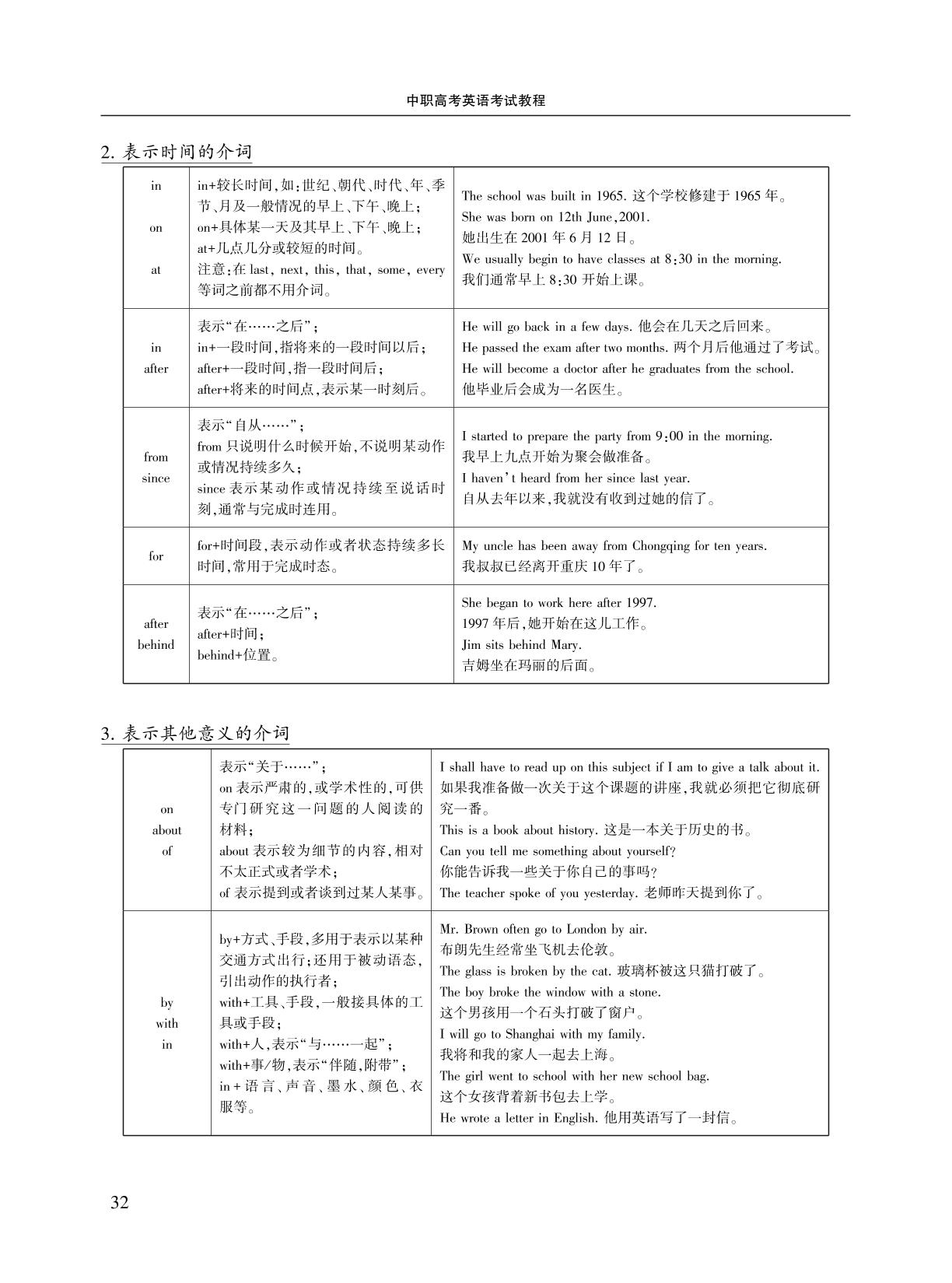
2. 表示时间的介词
in
on
at
in+较长时间,如:世纪、朝代、时代、年、季
节、月及一般情况的早上、下午、晚上;
on+具体某一天及其早上、下午、晚上;
at+几点几分或较短的时间。
注意:在 last, next, this, that, some, every
等词之前都不用介词。
The school was built in 1965. 这个学校修建于 1965 年。
She was born on 12th June,2001.
她出生在 2001 年 6 月 12 日。
We usually begin to have classes at 8:30 in the morning.
我们通常早上 8:30 开始上课。
in
after
表示“在……之后”;
in+一段时间,指将来的一段时间以后;
after+一段时间,指一段时间后;
after+将来的时间点,表示某一时刻后。
He will go back in a few days. 他会在几天之后回来。
He passed the exam after two months. 两个月后他通过了考试。
He will become a doctor after he graduates from the school.
他毕业后会成为一名医生。
from
since
表示“自从……”;
from 只说明什么时候开始,不说明某动作
或情况持续多久;
since 表示某动作或情况持续至说话时
刻,通常与完成时连用。
I started to prepare the party from 9:00 in the morning.
我早上九点开始为聚会做准备。
I haven’t heard from her since last year.
自从去年以来,我就没有收到过她的信了。
for
for+时间段,表示动作或者状态持续多长
时间,常用于完成时态。
My uncle has been away from Chongqing for ten years.
我叔叔已经离开重庆 10 年了。
after
behind
表示“在……之后”;
after+时间;
behind+位置。
She began to work here after 1997.
1997 年后,她开始在这儿工作。
Jim sits behind Mary.
吉姆坐在玛丽的后面。
3. 表示其他意义的介词
on
about
of
表示“关于……”;
on 表示严肃的,或学术性的,可供
专门研究这一问题的人阅读的
材料;
about 表示较为细节的内容,相对
不太正式或者学术;
of 表示提到或者谈到过某人某事。
I shall have to read up on this subject if I am to give a talk about it.
如果我准备做一次关于这个课题的讲座,我就必须把它彻底研
究一番。
This is a book about history. 这是一本关于历史的书。
Can you tell me something about yourself?
你能告诉我一些关于你自己的事吗?
The teacher spoke of you yesterday. 老师昨天提到你了。
by
with
in
by+方式、手段,多用于表示以某种
交通方式出行;还用于被动语态,
引出动作的执行者;
with+工具、手段,一般接具体的工
具或手段;
with+人,表示“与……一起”;
with+事 /物,表示“伴随,附带”;
in + 语言、 声音、 墨 水、 颜 色、 衣
服等。
Mr. Brown often go to London by air.
布朗先生经常坐飞机去伦敦。
The glass is broken by the cat. 玻璃杯被这只猫打破了。
The boy broke the window with a stone.
这个男孩用一个石头打破了窗户。
I will go to Shanghai with my family.
我将和我的家人一起去上海。
The girl went to school with her new school bag.
这个女孩背着新书包去上学。
He wrote a letter in English. 他用英语写了一封信。
23
中职高考英语考试教程
续表
except
besides
except 指“除……之外”,不包括所
说对象在内;
besides 表示“除了……”,包括所
说对象在内。
Except for Mr. Wang, we went to see the film.(不包括王先生)
Besides Mr. Wang, we also went to see the film.(包括王先生)
as 作为……
She is working in the shopping mall as a cashier.
她在购物中心当收银员。
for 为了……;对于……
My sister made a birthday cake for me.
我姐姐为我做了一个生日蛋糕。
It is very important for me. 这对于我来说很重要。
like 像…… The twins are like their father. 这对双胞胎像他们的父亲。
off 离开……;在……之外
The young man got off the train quickly.
那个年青人很快下了火车。
outside 在……外边 They are waiting outside the school gate. 他们正在校门外等着。
within 在……(时间)之内
You must finish the work within three days.
你必须在三天内完成这项工作。
without 没有;不;在……之外
We couldn’t live without air and water.
没有空气和水,我们就不能生存。
be made of
be made from
表示“由……制成”。 前者看得出
原材料,后者看不出原材料。
The desk is made of trees. 书桌由树木制成。
The cake is made from egg and milk. 这种蛋糕由鸡蛋和牛奶制成。
※ 习题 1 ※
1. Bill Gates was born October 28th,1955? (2018 年真题)
A. in B. on C. at D. for
2. My sister Lily is good swimming.(2019 年真题)
A. at B. under C. on D. of
3. English is widely used travelers and business people all over the world.(2016 年真题)
A. to B. of C. as D. by
4. It’s important us to learn a foreign language. (2015 年真题)
A. for B. to C. with D. on
5. He gets on well everything around him. (2016 年真题)
A. at B. for C. with D. about
6. —How can I go to the supermarket, Paul?
— bike. It’s not far from here.
A. On B. By C. In D. With
7. I have not heard from him a long time.
A. on B, in C, last D. for
8. My brother said he could return 30 minutes, but now two hours have passed.
33
第二部分 语法 • 第二节 语法详解
A. in B. on C. for D. last
9. Mary is an active girl, and she likes taking part outdoor activities.
A. in B. on C. at D. of
10. I’m reading a book Chinese history.
A. about B. on C. in D. of
11. He looked me and,without a word, smiled. (2015 年真题)
A. of B. on C. at D. into
12. Miss Brown can talk with people different languages.
A. by B. from C. in D. with
13. There are millions people living the city.
A. of, on B. in, about C. of, in D. on, by
14. The foreigners arrived Shanghai night.
A. at; at B. in; at C. in; in D. at; in
15. Li Ping was late work yesterday.
A. for B. to C. wit D. of
※ 习题 2 ※
1. The glass of wine is made grapes.
A. from B. for C. of D. by
2. There is a desk he classroom. It’s for the teacher.
A. outside B. in front of C. in the front of D. behind
3. Nobody likes him, his mother.
A. beside B. besides C. except D. except for
4. We had two English classes Tuesday. (2014 年真题)
A. in B. for C. at D. on
5. Can you see the picture the wall?
A. on B. in C. among D. between
6. It’s not polite to talk a woman’s age.
A. on B, by C, about D. over
7. Some shops open 10 a.m. to 3:30 p.m. during the Spring Festival holidays.
A. at B. between C. from D. about
8. —We’ll have a hiking trip, but when shall we meet?
—Let’s make it half past eight the morning of June 21.
A. at; in B. / ; on C. / ; in D. at; on
9. My American friend is learning to eat chopsticks.
A. about B. with C. for D. use
10. Because of the heavy rain, I decide to go to school bus.
A. by B. on C. with D. in
11. Do you often go home foot?
A. by B. in C. on D. with
12. She is talking her mother what happened yesterday.
A. with; on B. on; about C. on; with D. with; about
43
中职高考英语考试教程
13. Let’s have a rest the big tree.
A. through B. across C. below D. under
14. Ha Erbin lies the northeast of China.
A. in B. to C. of D. at
15. I only saw her once my stay in London.
A. on B. at C. during D. in
六、连词
(一)考点指导
基本点:掌握并列连词、从属连词的意义。
重难点:掌握并列连词、从属连词的用法。
(二)复习精讲
1. 定义
连词是虚词,用于连接单词、短语、从句或句子,在句子中不单独用作句子成分,按其性质可分为并列连
词和从属连词。
2. 分类
1) 并列连词
(1) 定义:连接具有并列关系的词、短语或句子的连词叫并列连词。
(2) 用法:
连 词 例 句
and 和
both and 二者都
as well as 也,除……之外也……
not only but also 不 但 …… 而
且……
neither nor 既不……也不……
I can speak English and Russian. 我会讲英语和俄语。
Both Mike and Susan are good students. 迈克和苏珊都是好学生。
I’m learning French as well as English. 我正在学法语以及英语。
He is not only kind but also honest. 他不仅善良而且友好。
Today is neither too cold nor too hot. 今天既不太冷也不太热。
or 或者
otherwise 不然;否则
either or 要么……;或……;不是
……就是……
Would you prefer tea or coffee? 你喜欢茶还是咖啡?
The book must be here, or you’ve lost it. 书肯定在这儿,不然就是你弄丢了。
We must go early, otherwise we may not get a seat.
我们必须早点去,否则会找不到座位。
I want to visit either Italy or London. 我想要去意大利或者伦敦。
but 但是
yet 然而
while 而;然而
still 尽管如此;仍然
however 然而;但是
She is young but very experienced. 她年轻,但经验丰富。
I have failed, yet I will try again. 我失败了,但我会再试。
You like tennis, while I’d rather read. 你喜欢网球,而我喜欢看书。
I explained twice, still she couldn’t get it. 我解释了两次,但她仍然不明白。
He worked hard, however, he failed. 他很努力,但是,却失败了。
so 因此;所以
for 因为;由于
It was late, so I went home. 时间已经不早了,我要回家了。
He couldn’t go to school, for he is ill. 因为生病了,他不能去上学。
53
第二部分 语法 • 第二节 语法详解
附录Ⅵ 参考答案
名 词
习题 1:1—5 BBBDB 6—10 ABCBA 11—15 BACAA
习题 2:1—5 BCBBB 6—10 AABDC 11—15 ACBDB
习题 3:1—5 BACCC 6—10 BCDAD 11—15 BBCBC
冠 词
习题 1:1—5 BCDAC 6—10 AAACA 11—15 CDBCB
习题 2:1—5 ADCCA 6—10 BCBDD 11—15 ADDAD
代 词
习题 1:1—5DBCDA 6—10 BCDAC 11—15 CCCAD
习题 2:1—5 DACBA 6—10 BDAAA 11—15 BACCB
习题 3:1—5 BDADB 6—10 CCDAB 11—15 BBBCA
数 词
习题 1:1—5 CBBBD 6—10 BAADA 11—15 CDCAD
习题 2:1—5 DABBB 6—10 CDCDC 11—15 ABBBB
介 词
习题 1:1—5 BADAC 6—10 BDAAB 11—15 CCCAA
习题 2:1—5 ACCDA 6—10 CCDBA 11—15 CADAC
连 词
习题 1:1—5 DDDCB 6—10 DCCAC 11—15 BBADC
习题 2:1—5 BBBAA 6—10 DABDD 11—15 CABCD
形容词和副词
习题 1:1—5 ABAAD 6—10 CCBDC 11—15 DABAC
习题 2:1—5 CCBDD 6—10 CDABA 11—15 DCACB
动 词
习题 1:1—5 DCDBA 6—10 DACBB 11—15 CCBDC
习题 2:1—5 DCBAD 6—10 DABBD 11—15 BCBBA
习题 3:1—5 DACDD 6—10 ACDCA 11—15 DCDCB
习题 4:1—5 CBAAD 6—10 DABDD 11—15 DBADC
习题 5:1—5 BABCD 6—10 CCAAC 11—15 CDCBD
习题 6:1—5 BCCDA 6—10 CCAAA 11—15 DCCDD
581
资源预览图

1

2
3

由于学科网是一个信息分享及获取的平台,不确保部分用户上传资料的 来源及知识产权归属。如您发现相关资料侵犯您的合法权益,请联系学科网,我们核实后将及时进行处理。