第2部分 第2节 十、动词语态-中职高考英语考试教程
2024-08-26
|
2份
|
7页
|
178人阅读
|
0人下载
教辅

资源信息
| 学段 | 中职 |
|---|---|
| 学科 | 英语 |
| 教材版本 | - |
| 年级 | - |
| 章节 | - |
| 类型 | 教案 |
| 知识点 | 动词 |
| 使用场景 | 中职复习 |
| 学年 | 2024-2025 |
| 地区(省份) | 全国 |
| 地区(市) | - |
| 地区(区县) | - |
| 文件格式 | ZIP |
| 文件大小 | 1.12 MB |
| 发布时间 | 2024-08-26 |
| 更新时间 | 2024-08-26 |
| 作者 | 重庆大学电子音像出版社有限公司 |
| 品牌系列 | - |
| 审核时间 | 2024-08-26 |
| 下载链接 | https://m.zxxk.com/soft/46974976.html |
| 价格 | 3.00储值(1储值=1元) |
| 来源 | 学科网 |
内容正文:
※ 习题 4 ※
1. John wanted a camera for his birthday. (改为否定句)(2016 年真题)
John a camera for his birthday.
2. He is interested in reading poems.(改为一般疑问句)(2016 年真题)
interested in reading poems?
3. Our school will hold a sports meeting next week. (对画线部分提问)(2015 年真题)
your school hold a sports meeting?
4. Mary enjoyed herself at her birthday party last night. (改为否定句)(2015 年真题)
Mary herself at her birthday party last night.
5. There is something wrong with my watch. (改为否定句)(2014 年真题)
There is wrong with my watch.
6. I get up at six o’clock every day. (对画线部分提问)(2014 年真题)
you get up every day?
7. Tom did well in the Chinese test yesterday. (改为否定句)(2013 年真题)
Tom well in the Chinese test yesterday.
8. Uncle Max is going to visit us next Sunday. (对画线部分提句)(2013 年真题)
going to visit you next Sunday?
9. I went to see the doctor last Sunday. (对画线部分提句)(2017 年真题)
you go to see the doctor?
10. He goes swimming in the morning. (改为否定句)(2017 年真题)
He swimming in the morning.
11. They are learning Chinese in China. (对画线部分提句)(2018 年真题)
they learning Chinese?
12. Sam will visit his grandparents this summer. (改为否定句)(2018 年真题)
Sam his grandparents this summer.
13. Betty called her best friend last weekend. (对画线部分提句)(2019 年真题)
Betty call last weekend?
14. We are going to have an English test tomorrow. (改为否定句)(2019 年真题)
We to have an English test tomorrow.
15. I have already finished my homework.(改为否定句)
I finished my homework .
十、动词语态
(一)考点指导
基本点:主动语态与被动语态的区别;主动语态与被动语态的变化形式;被动语态的基本结构。
重难点:一般现在时、一般过去时、一般将来时态下的被动语态结构与用法;带双宾语的被动语态。
(二)复习精讲
1. 定义
英语的语态有两种,即主动语态和被动语态。 二者分别强调动作的执行者和承受者或对象。 在被动语
86
中职高考英语考试教程
态中,提到动作的执行者时,通常由介词 by 引出。 被动语态和主动语态可互相转换。
语 态 主 语 谓语动词 宾 语
主动语态 动作的执行者 行为动词 动作的承受者 /对象
被动语态 动作的承受者 /对象 be+v.⁃ed(动词过去分词) by+动作的执行者
2. 主动句变被动句的方法以及注意事项
1) 基本形式
主动语态:He wrote a book last year.
主语(执行者) 谓语 宾语(承受者) 时间状语
被动语态:A book was written by him last year.
主语(承受者 /对象) 谓语 状语(执行者) 时间状语
2) 动词带双宾语和复合宾语形式
(1) 动词带双宾语:在主动语态中,有些动词带有双宾语,即直接宾语和间接宾语,变被动语态时,可以
把其中任意一个宾语变为主语,另一个放在被动结构里。 如果把直接宾语变为被动语态的主语时,间接宾
语前面通常要加 to。 常带双宾语的词有 give, pass, tell, ask 等。
(2) 动词带复合宾语:在主动语态中,有些动词带有复合宾语,即宾语和宾语补足语。 变为被动语态时,
只把宾语变为被动语态的主语,宾补仍留在原处。 如宾补是省去 to 的不定式时,变为被动语态时,这个 to 要
还原。 常带不定式做复合宾语的词有 make, let, see,hear,watch, feel 等。
宾语类型 变化方法 主动句 被动句
单宾语 直接将宾语变为主语 They play football. Football is played by them.
双宾语 将其中的一个宾语变为主语 He gave me a flower.
I was given a flower by him.
A flower was given to me by him.
复合宾语
宾语变为被动语态的主语,宾
补仍留在原处
We choose him as our monitor. He was chosen as our monitor by us.
宾补是省去“ to”的不定式,变
为被动语态时,to 要还原。
They make us do all the work.
We are made to do all the work by
them.
3. 被动语态
1) 基本形式
被动语态和主动语态一样,也有人称、数、时态的变化。 这些都是由 be+v.⁃ed(过去分词)中的 be 动词变
化来实现的。 具体见下表:
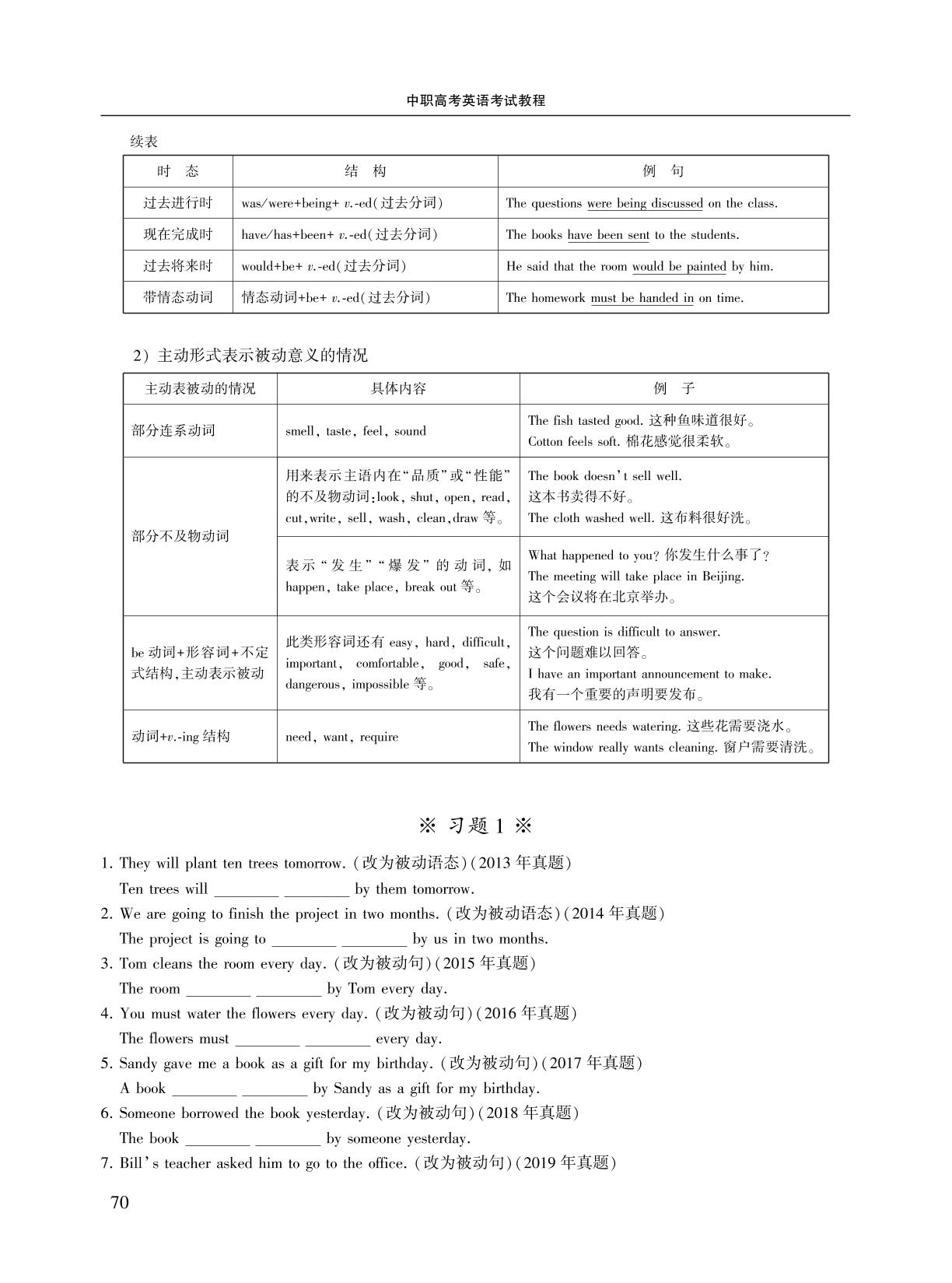
时 态 结 构 例 句
一般现在时 am / is / are +v.⁃ed(过去分词) English is widely used all over the world.
一般过去时 was / were + v.⁃ed(过去分词) The building was built last year.
一般将来时 will+be+ v.⁃ed(过去分词) A lot of trees will be planted in the park.
现在进行时 am / is / are+being+ v.⁃ed(过去分词) The old man is being looked after by his son.
96
第二部分 语法 • 第二节 语法详解
续表
时 态 结 构 例 句
过去进行时 was / were+being+ v.⁃ed(过去分词) The questions were being discussed on the class.
现在完成时 have / has+been+ v.⁃ed(过去分词) The books have been sent to the students.
过去将来时 would+be+ v.⁃ed(过去分词) He said that the room would be painted by him.
带情态动词 情态动词+be+ v.⁃ed(过去分词) The homework must be handed in on time.
2) 主动形式表示被动意义的情况
主动表被动的情况 具体内容 例 子
部分连系动词 smell, taste, feel, sound
The fish tasted good. 这种鱼味道很好。
Cotton feels soft. 棉花感觉很柔软。
部分不及物动词
用来表示主语内在“品质”或“性能”
的不及物动词:look, shut, open, read,
cut,write, sell, wash, clean,draw 等。
The book doesn’t sell well.
这本书卖得不好。
The cloth washed well. 这布料很好洗。
表示 “ 发 生 ” “ 爆 发 ” 的 动 词, 如
happen, take place, break out 等。
What happened to you? 你发生什么事了?
The meeting will take place in Beijing.
这个会议将在北京举办。
be 动词+形容词+不定
式结构,主动表示被动
此类形容词还有 easy, hard, difficult,
important, comfortable, good, safe,
dangerous, impossible 等。
The question is difficult to answer.
这个问题难以回答。
I have an important announcement to make.
我有一个重要的声明要发布。
动词+v.⁃ing 结构 need, want, require
The flowers needs watering. 这些花需要浇水。
The window really wants cleaning. 窗户需要清洗。
※ 习题 1 ※
1. They will plant ten trees tomorrow. (改为被动语态)(2013 年真题)
Ten trees will by them tomorrow.
2. We are going to finish the project in two months. (改为被动语态)(2014 年真题)
The project is going to by us in two months.
3. Tom cleans the room every day. (改为被动句)(2015 年真题)
The room by Tom every day.
4. You must water the flowers every day. (改为被动句)(2016 年真题)
The flowers must every day.
5. Sandy gave me a book as a gift for my birthday. (改为被动句)(2017 年真题)
A book by Sandy as a gift for my birthday.
6. Someone borrowed the book yesterday. (改为被动句)(2018 年真题)
The book by someone yesterday.
7. Bill’s teacher asked him to go to the office. (改为被动句)(2019 年真题)
07
中职高考英语考试教程
Bill by his teacher to go to the office.
8. They’ll broadcast this program again. (改为被动句)
This program again.
9. People can’t hear our radio outside the room. (改为被动句)
Our radio outside the room.
10. They won’t finish the new road this week. (改为被动句)
The new road this week.
11. Nobody asked Bill to sing. (改为被动句)
Bill to sing.
12. They are offering John an opportunity now. (改为被动句)
John an opportunity now.
13. Someone has found your wallet. (改为被动句)
Your wallet found.
14. Someone will introduce me to Professor Black soon. (改为被动句)
I to Professor Black soon.
15. People all know him as a great artist. (改为被动句)
He as a great artist.
※ 习题 2 ※
1. The meeting room yesterday afternoon.
A. cleaned B. is cleaned C. was cleaning D. was cleaned
2. The workers were made ten hours a day.
A. work B. to work C. working D. worked
3. Food in a cool place in summer.
A. must keep B. mustn’t keep C. must be kept D. mustn’t be kept
4. His father to work in Hangzhou 3 years ago.
A. sent B. was sent C. has sent D. has been sent
5. The pen well.
A. writes B. is written C. was written D. writing
6. Great changes in the city since 1998.
A. have taken place B. have been taken place
C. has taken place D. has been taken place
7. Our presentations must next Monday.
A. be hand in B. be handed in C. handed in D. be handing in
8. The child will back to his parents next month.
A. sent B. send C. be sent D. be sending
9. his work yet?
A. Have been finished B. Has been finished
C. Has finished D. Have finished
10. The classroom now.
A. is cleaning B. is being cleaning C. is being cleaned D. is cleaned
11. I promise that matter will .
17
第二部分 语法 • 第二节 语法详解
A. be taken care B. be taken care of C. take care D. take care of
12. No permission has for anybody to enter the building.
A. been given B. given C. to give D. be given
13. I ten minutes to make a decision.
A. gave B. was given C. was giving D. had given
14. Can such a thing happening again?
A. prevent from B. prevented from C. be prevented from D. to prevent from
15. A new house at the end of the road.
A. is building B. is being built C. been built D. be building
※ 习题 3 ※
1. This bike last year.
A. bought B. has been bought C. was bought D. had been bough
2. Did you see the church that by fire last year?
A. was destroying B. destroyed C. would destroy D. was destroyed
3. It whether she will get her work in the hospital.
A. hasn’t been decided B. isn’t deciding C. doesn’t decide D. hasn’t decided
4. The pen me. It is hers.
A. isn’t belong to B. wasn’t belong to C. doesn’t belong to D. didn’t belong to
5. I can’t use my bike because it .
A. is repairing B. is being repaired C. will repair D. was repairing
6. This book well. Who it?
A. sell; writes B. sells; wrote C. is sold; wrote D. was sold; was written
7. —The window is dirty.
—I know. It for weeks.
A. hasn’t cleaned B. didn’t clean C. wasn’t cleaned D. hasn’t been cleaned
8. Telephone messages for the manager on her desk but she didn’t notice them.
A. were left B. was left C. was leaving D. were leaving
9. Tony was very unhappy for to the party.
A. having not been invited B. not having invited
C. having not invited D. not having been invited
10. Books of this kind well.
A. sell B. sells C. are sold D. is sold
11. Do let your mother know all the truth. She appears everything.
A. to tell B. to be told C. to be telling D. to have been told
12. The bike which you borrowed from the school .
A. needs to repair B. need to repair C. needs repairing D. need repair
13. He said he wouldn’t mind at home.
A. leaving alone B. being left alone C. to be left lonely D. to leave alone
14. Hundreds of jobs if the factory closes.
A. lose B. will be lost C. are lost D. will lose
15. A new cinema here. They hope to finish it next month.
27
中职高考英语考试教程
A. will be built B. is built C. has been built D. is being built
十一、简单句、并列句和复合句
(一)考点指导
基本点:判断简单句、并列句及复合句。
重难点:分清句子结构并理解句子。
(二)复习精讲
1. 简单句
只含有一个主谓结构,且句子各成分都只由单词或短语构成的独立句子。
简单句的 5 种基本结构:
主语+系动词+表语
He is a student.
主语 系动词 表语
主语+谓语+宾语
I can sing the song.
主语 谓语 宾语
主语+谓语+间接宾语+直接宾语
My father bought me a car.
主语 谓语 间接宾语 直接宾语
主语+谓语+宾语+宾补
Tom made the baby laugh.
主语 谓语 宾语 宾补
主语+谓语+状语
Snow falls in winter.
主语 谓语 状语
2. 并列句
两个以上的简单句用并列连词连在一起构成的句子,叫作并列句,其基本结构是“简单句+并列连词+简
单句”。 并列句中的各简单句意义同等重要,相互之间没有从属关系,是平行并列的关系。
关系连词 例 句
表示平行关系,常用 and, not only but also,
neither nor, then 等。
The teacher’s name is Smith, and the student’s name is John.
老师的名字叫史密斯,学生的名字叫约翰。
表示选择关系,常用 or, either or, otherwise
等。
Hurry up, or you’ll miss the train.
快一点,否则你会赶不上火车。
表示转折关系, 常用 but, still, however, yet,
while, when 等。
He knows London very well, but I don’t know it.
他非常了解伦敦,但是我不了解。
表示因果关系,常用 so, for, therefore 等。
She always helps others, so she has many good friends.
她经常帮助别人,所以她有很多好朋友。
3. 复合句
由一个主句和一个或一个以上的从句构成的句子叫复合句。 主句是全句的主体,通常可以独立存在;
从句则是一个句子成分,不能独立存在。 从句须由一个关联词或引导词引导。 根据从句所充当的句子成分
37
第二部分 语法 • 第二节 语法详解
习题 7:1—5 AAABB 6—10 CCBCA 11—15 AAACC
习题 8:1—5 BCCBA 6—10 DDBAC 11—15 BBCBB
动词时态
习题 1:1—5 CDCDB 6—10 BACCB 11—15 CABBA
习题 2:1—5 CDDBD 6—10 DDBBA 11—15 CACCB
习题 3:1—5 CBAAC 6—10 AADDA 11—15 CBAAB
习题 4:1. didn’t want 2. Is he 3. When will 4. didn’t enjoy
5. not anything 6. When do 7. didn’t do 8. Who is
9. When did 10. doesn’t go 11. Where are 12. won’t visit
13.Who did 14. aren’t going 15. haven’t;yet
动词语态
习题 1:1. be planted 2. be finished 3. is cleaned 4. be watered
5.was given 6.was borrowed 7. was asked 8. will be broadcast
9.can’t be heard 10. won’t be finished 11. wasn’t asked 12. is being offered
13. has been 14. will be introduced 15. is known
习题 2:1—5 DBCBA 6—10 ABCBC 11—15 BABCB
习题 3:1—5 BBAAB 6—10 BDADA 11—15 DCBBC
简单句、并列句和复合句
习题:1—5 BCCCA 6—10 CBABC 11—15 CBBCA
陈述句
习题 1:1. aren’t any 2. doesn’t know 3. didn’t do 4. not anything
5. didn’t enjoy 6. didn’t want 7. doesn’t go 8. won’t visit
9. are not 10. don’t do 11. doesn’t have 12. doesn’t do any
13. doesn’t like 14. didn’t have 15. didn’t do
习题 2:1. didn’t read 2. haven’t learned 3. hasn’t been 4. hasn’t finished; yet
5. not get 6. are some 7. knows 8. did
9. is something 10. enjoyed 11. wanted 12. can; also
13. knew 14. did 15. will climb
一般疑问句
习题 1:1. Is he 2. Can he 3. Was swim 4. Would you; any
5. Will; give you 6. Must; be 7. Do; need 8. Do; do
9. Do; collect 10. Does; have 11. Does; want 12. Does; leave
13. Did; use 14. Did; buy 15. Did; hear
习题 2:1. Has; lived 2. Did; have 3. Have; caught 4. Has; written; yet
5. Had; go 6. does 7. sang 8. wants
9. did 10. must hand 11. went 12. is interested
681
中职高考英语考试教程
资源预览图

1

2
3

由于学科网是一个信息分享及获取的平台,不确保部分用户上传资料的 来源及知识产权归属。如您发现相关资料侵犯您的合法权益,请联系学科网,我们核实后将及时进行处理。