第2部分 第2节 七、形容词和制词-中职高考英语考试教程
2024-08-26
|
2份
|
7页
|
199人阅读
|
1人下载
教辅

资源信息
| 学段 | 中职 |
|---|---|
| 学科 | 英语 |
| 教材版本 | - |
| 年级 | - |
| 章节 | - |
| 类型 | 教案 |
| 知识点 | 形容词、副词 |
| 使用场景 | 中职复习 |
| 学年 | 2024-2025 |
| 地区(省份) | 全国 |
| 地区(市) | - |
| 地区(区县) | - |
| 文件格式 | ZIP |
| 文件大小 | 1.14 MB |
| 发布时间 | 2024-08-26 |
| 更新时间 | 2024-08-26 |
| 作者 | 重庆大学电子音像出版社有限公司 |
| 品牌系列 | - |
| 审核时间 | 2024-08-26 |
| 下载链接 | https://m.zxxk.com/soft/46974974.html |
| 价格 | 3.00储值(1储值=1元) |
| 来源 | 学科网 |
内容正文:
A. after B. when C. unless D. besides
15. We mustn’t cross the road the traffic lights turn green.
A. after B. since C. while D. until
七、形容词和副词
(一)考点指导
基本点:形容词作定语、表语和宾语补足语的用法;副词表示时间、地点、原因、方式、条件、程度、连接和
关系等用法。
重点:形容词和副词的区别,形容词和副词的比较级和最高级的构成和基本用法。
难点:掌握比较级和最高级的常用句型。
(二)复习精讲
1. 形容词
1) 定义
用来修饰名词或代词,表示人或事物的特征、性质、状态或属性的词叫作形容词。 例如:long 长的, smart
聪明的, fine 好的,cold 冷的,strong 强大的。
2) 作用
在句子中可以作定语、表语、宾语补足语等。
(1) 作定语,一般放在所修饰的名词前。
The young man is expecting a bright future. 这个年轻人正在期待一个美好的未来。
I don’t like the hot weather in Chongqing. 我不喜欢重庆炎热的天气。
注:当形容词修饰由 some,every,any,no 构成的复合不定代词时,形容词后置,即:复合不定代词+形
容词。
It’s cold today.Would you like something hot to drink? 今天好冷,你想喝点热饮吗?
He had nothing important to tell his parents. 他没什么重要的事情要告诉父母。
(2) 作表语,用于联系动词后。
The university is large and modern. 这所大学又大又现代。
(3) 作宾语补足语,即:及物动词+宾语+形容词。
Tom made his little brother happy. 汤姆让他的小弟弟很高兴。
2. 副词
1) 定义
副词是指在句子中表示行为或状态特征的词,用以修饰动词、形容词、其他副词或全句,表示时间、地
点、程度、方式等概念。
2) 分类
时间副词、频率副词、地点副词、方式副词、程度副词、疑问副词、连接副词、关系副词等。
3) 副词的构成
本身就是副词 now, already, still, very, often, much, there
形容词+ly quick—quickly careful—carefully slow—slowly true—truly happy—happily polite—politely
93
第二部分 语法 • 第二节 语法详解
4) 副词的分类
分 类 举 例 作 用
时间副词 now, today, soon, before, ago 时间状语
地点副词 here, there, everywhere, downstairs 地点状语
方式副词 carefully, warmly, quickly, hard, well 方式状语
程度副词 very, much, almost, nearly, quite,little 程度状语
频度副词 seldom, often, usually, always, never, sometimes 频率状语
关系副词 when, where, why 引导定语从句
5) 副词的用法
(1) 修饰动词,如:Bill runs away quickly. 比尔快速地跑掉了。
(2) 修饰形容词,如:The people in Canadian are very friendly. 加拿大人很友好。
(3) 修饰表语,如:He felt terribly ill. 他感觉很不舒服。
(4) 作宾语补足语,如:Please let them in. 请让他们进来。
3. 形容词和副词的等级
副词和形容词一样,有原级、比较级和最高级三个等级。 通常它们的比较级和最高级都是由原级变化
而来。
1) 具体构成
(1) 单音节词和少数双音节词的比较级和最高级的构成。
情 况 构成方式 原 级 比较级 最高级
一般情况 加⁃er 或⁃est
new
long
newer
longer
newest
longest
以 e 结尾的词 加⁃r 或⁃st
fine
late
finer
later
finest
latest
以“辅音+y” 结尾的词 变 y 为 i 再加⁃er 或⁃est
early
happy
earlier
happier
earliest
happiest
重读闭音节的词末尾只有
一个辅音字母
先双写末尾的辅音字母,再加
⁃er或⁃est。
hot
thin
fat
hotter
thinner
fatter
hottest
thinnest
fattest
(2) 多音节词和部分双音节词在其前面加 more 或 most。
原 级 比较级 最高级
useful 有用的 more useful 更有用的 most useful 最有用的
difficult 难的 more difficult 更难的 most difficult 最难的
delicious 美味的 more delicious 更美味的 most delicious 最美味的
04
中职高考英语考试教程
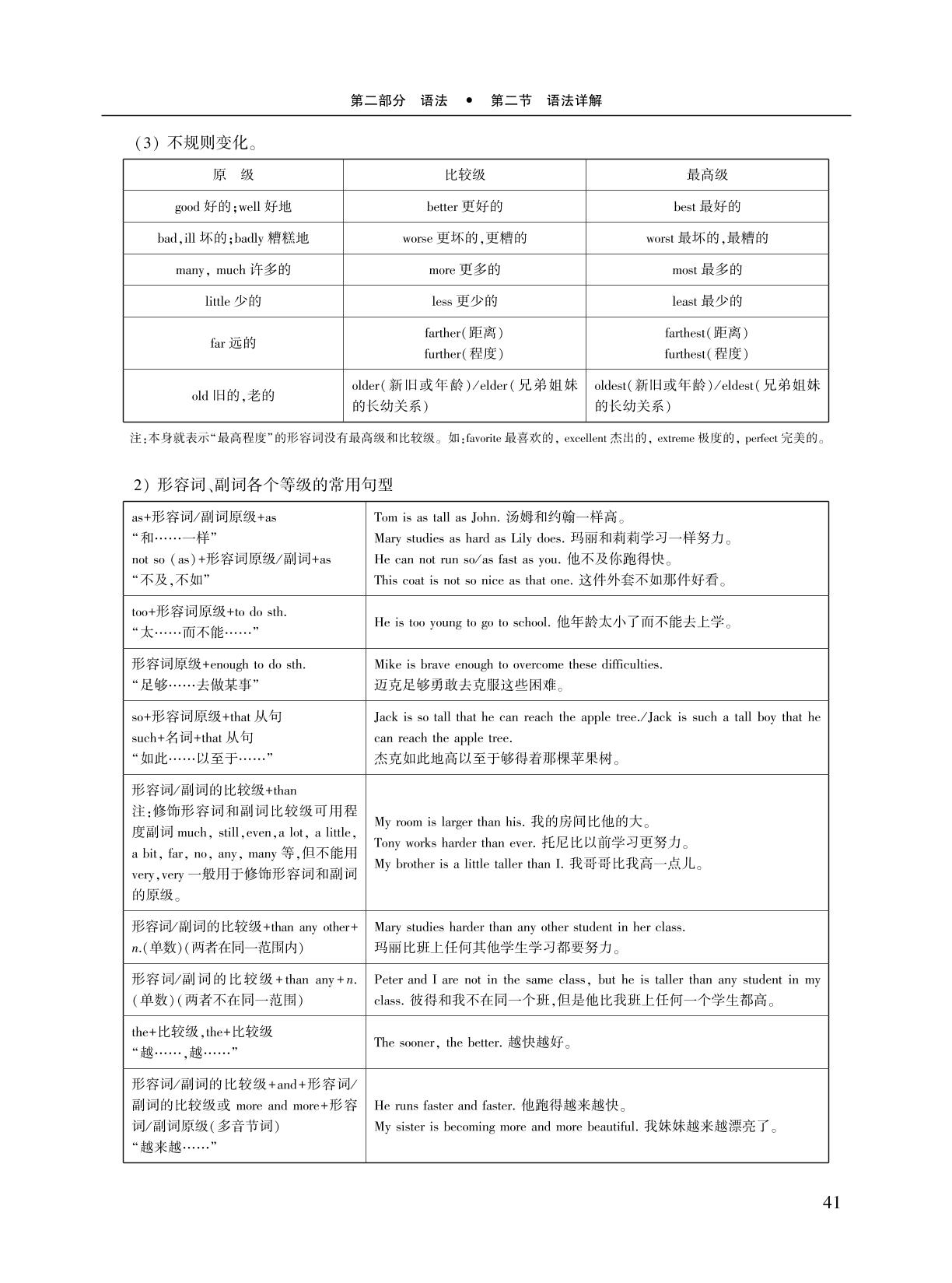
(3) 不规则变化。
原 级 比较级 最高级
good 好的;well 好地 better 更好的 best 最好的
bad,ill 坏的;badly 糟糕地 worse 更坏的,更糟的 worst 最坏的,最糟的
many, much 许多的 more 更多的 most 最多的
little 少的 less 更少的 least 最少的
far 远的
farther(距离)
further(程度)
farthest(距离)
furthest(程度)
old 旧的,老的
older(新旧或年龄) / elder(兄弟姐妹
的长幼关系)
oldest(新旧或年龄) / eldest(兄弟姐妹
的长幼关系)
注:本身就表示“最高程度”的形容词没有最高级和比较级。 如:favorite 最喜欢的, excellent 杰出的, extreme 极度的, perfect 完美的。
2) 形容词、副词各个等级的常用句型
as+形容词 /副词原级+as
“和……一样”
not so (as)+形容词原级 /副词+as
“不及,不如”
Tom is as tall as John. 汤姆和约翰一样高。
Mary studies as hard as Lily does. 玛丽和莉莉学习一样努力。
He can not run so / as fast as you. 他不及你跑得快。
This coat is not so nice as that one. 这件外套不如那件好看。
too+形容词原级+to do sth.
“太……而不能……”
He is too young to go to school. 他年龄太小了而不能去上学。
形容词原级+enough to do sth.
“足够……去做某事”
Mike is brave enough to overcome these difficulties.
迈克足够勇敢去克服这些困难。
so+形容词原级+that 从句
such+名词+that 从句
“如此……以至于……”
Jack is so tall that he can reach the apple tree. / Jack is such a tall boy that he
can reach the apple tree.
杰克如此地高以至于够得着那棵苹果树。
形容词 /副词的比较级+than
注:修饰形容词和副词比较级可用程
度副词 much, still,even,a lot, a little,
a bit, far, no, any, many 等,但不能用
very,very 一般用于修饰形容词和副词
的原级。
My room is larger than his. 我的房间比他的大。
Tony works harder than ever. 托尼比以前学习更努力。
My brother is a little taller than I. 我哥哥比我高一点儿。
形容词 /副词的比较级+than any other+
n.(单数)(两者在同一范围内)
Mary studies harder than any other student in her class.
玛丽比班上任何其他学生学习都要努力。
形容词 /副词的比较级 + than any + n.
(单数)(两者不在同一范围)
Peter and I are not in the same class, but he is taller than any student in my
class. 彼得和我不在同一个班,但是他比我班上任何一个学生都高。
the+比较级,the+比较级
“越……,越……”
The sooner, the better. 越快越好。
形容词 /副词的比较级+and+形容词 /
副词的比较级或 more and more+形容
词 /副词原级(多音节词)
“越来越……”
He runs faster and faster. 他跑得越来越快。
My sister is becoming more and more beautiful. 我妹妹越来越漂亮了。
14
第二部分 语法 • 第二节 语法详解
续表
the+形容词 /副词比较级 + of the two
(+n.)
“两者之中较……”
The one is the bigger of the two baskets. 这个篮子是两个中较大的一个。
the+形容词最高级+of / in
Spring is the best season of the year in the city.
在这个城市,春天是一年中最好的季节。
one of the+形容词最高级+名词复数
“最……之一”
Michael Jordan was one of the most popular players in NBA.
迈克尔·乔丹曾是 NBA 最受欢迎的球员之一。
this be the 形容词最高级+n. + that 定
语从句
This is the most delicious dish that I have ever eaten.
这是我吃过的最可口的菜肴。
注:副词的原级、比较级和最高级的用法与形容词基本相同,只是形容词的最高级前必须要有 the, 而副词的最高级前可有可无。
3) 形容词和副词易混淆点解析
very 用于形容词或副词的原级前, very
much 修饰动词,常用于句子主干后或句
尾。
The apple is very big. 这个苹果很大。
He runs very fast. 他跑得非常快。
Tom works much harder than any others in the office.
汤姆比办公室其他任何人工作都努力得多。
I love my family very much. 我爱我家。
时间段+ago,表示在一段时间之后,常用
于一般过去时态。
He went to France two years ago. 两年前他去过法国。
before+时间点,表示某个时间之前。
He hopes to get to the subway station before 8 a.m.
他希望在上午 8 点之前到达地铁站。
later 表示一段时间后
Two hours later, he went back to fetch the basketball.
两小时后,他回去取篮球。
after+一段时间,用于一般过去时;after+时
间点,用于一般将来时。
He went to the gym after two hours. 两小时后他去了健身房。
She will go home after 5 o’clock. 五分钟之后她会回家。
in+时间段,常用于将来时态。
They will start to repair the machine again in two weeks.
在两周内他们又要去修理这台机器。
already 表示某事已经发生 I have already finished reading the novel. 我已经读完这本小说了。
still 和 yet 都可以理解为“还”,但 still 常
用于肯定句,而 yet 用于否定句和疑问句。
Though we are poor, we’re are still happy. 虽然我们穷,但是我们快乐。
Lucy hasn’t finished her homework yet. 露西还没有完成家庭作业。
※ 习题 1 ※
1. The cake tasted so that the kids asked for more. (2010 年真题)
A. delicious B. deliciously C. badly D. bad
2. Which one is , the moon or the sun, do you know? (2010 年真题)
A. small B. smaller C. the smallest D. smallest
3. My younger brother could run me. (2011 年真题)
A. as fast as B. as faster as C. so fast as D. so faster as
24
中职高考英语考试教程
4. Their son is busy with his work and he comes back to visit them. (2011 年真题)
A. seldom B. often C. usually D. always
5. Young woman eat meat than before to lose weight. (2012 年真题)
A. much B. more C. little D. less
6. Alice never worked , so she failed in her exam. (2012 难真题)
A. hardest B. harder C. hard D. hardly
7. I can’t hear you. Would you please speak ? (2013 年真题)
A. loudly B. loudest C. louder D. loud
8. Which do you like ,tea or coffee? (2014 年真题)
A. well B. better C. best D. good
9. Daniel sits at the back of the classroom since he is boy in our classroom. (2015 年真题)
A. tall B. taller C. tallest D. the tallest
10. The busier he is, the he feels. (2016 年真题)
A. happy B. happily C. happier D. happiest
11. Students should keep and listen in class.
A. quiet; careful B. silent; carefully C. quietly; careful D. quiet; carefully
12. The film Home Alone is . Most of us are in it.
A. interesting; interested B. interesting; interesting
C. interested; interested D. interested; interesting
13. This chemical problem is that one. Could you please help me with it?
A. so easy as B. as difficult as C. much difficult than D. less easier than
14. —Did you enjoy yourself in the concert?
—Yes, I’ve never been to one before.
A. a more exciting B. the most excited C. a most excited D. the most exciting
15. Now, it is raining so that people could go out.
A. hardly; hard B. hardly, hardly C. hard; hardly D. hard; hard
※ 习题 2 ※
1. There’s with your radio. It works very well.
A. wrong nothing B. anything wrong C. nothing wrong D. wrong anything
2. The pencil⁃box is small hold all these things.
A. so; that B. very; to C. too; to D. such; that
3. When the basketball match began, we all felt .
A. excited; exciting B. exciting; excited C. excited; excited D. exciting; exciting
4. It’s difficult that we can’t finish it in short time.
A. so; such B. such; so C. so a; such a D. so; such a
5. In my hometown, it is in July, but it is even in August.
A. hotter; hottest B. hot; hot C. hotter; hot D. hot; hotter
6. Nowadays the computer can work than those early ones.
A. hundred of times faster B. a hundred time faster
C. hundreds of times faster D. hundreds of time faster
7. Sam writes than me.
34
第二部分 语法 • 第二节 语法详解
A. much carefully B. more carefullier
C. much more carefullier D. much more carefully
8. Here is news for you.
A. some exciting B. an exciting C. some excited D. an excited
9. The tennis match wasn’t exciting at all, so people liked it.
A. a little B. few C. little D. a few
10. Ann is than John.
A. a head shorter B. taller a head C. shorter a head D. a head tall
11. The film is worth seeing.
A. very B. much C. very much D. well
12. This kind of cloth feels and sells .
A. well; well B. good; good C. good; well D. well; good
13. It was so dark that we see anything.
A. could hardly B. hardly could C. could hardly not D. couldn’t hardly
14. There’s something I want to tell you.
A. too B. still C. else D. also
15. The weather in Chongqing was hot last summer.
A. too much B. much too C. much D. too many
八、动词
(一)考点指导
基本点:行为动词、连系动词、助动词、情态动词四类动词的含义和作用。
重难点:以上四种动词的用法,包括行为动词分别做谓语动词和非谓语动词时的形式及其用法;四类系
动词后加表语的情况;助动词帮助构成疑问句和否定句;情态动词后面必须接动词原形。
(二)复习精讲
1. 行为动词
1) 含义
行为动词,也叫实义动词,表示行为或动态的动词。
2) 作用
根据词义的完整性,可分为及物动词和不及物动词。 根据在句中的功能,可分为谓语动词和非谓语
动词。
及物动词 vt. 后面必须跟宾语意义才完整
不及物动词 vi. 意义完整,后面不须接宾语,如要接宾语,须有相应的介词配合
3) 行为动词做谓语动词的形式和用法(v.是动词 verb 的简写)
谓语动词指在句中可单独做谓语的实义动词或动词短语。 作为一个句子不可缺少的部分,谓语动词还
要体现主语的人称和数、句子时态和语态。
44
中职高考英语考试教程
附录Ⅵ 参考答案
名 词
习题 1:1—5 BBBDB 6—10 ABCBA 11—15 BACAA
习题 2:1—5 BCBBB 6—10 AABDC 11—15 ACBDB
习题 3:1—5 BACCC 6—10 BCDAD 11—15 BBCBC
冠 词
习题 1:1—5 BCDAC 6—10 AAACA 11—15 CDBCB
习题 2:1—5 ADCCA 6—10 BCBDD 11—15 ADDAD
代 词
习题 1:1—5DBCDA 6—10 BCDAC 11—15 CCCAD
习题 2:1—5 DACBA 6—10 BDAAA 11—15 BACCB
习题 3:1—5 BDADB 6—10 CCDAB 11—15 BBBCA
数 词
习题 1:1—5 CBBBD 6—10 BAADA 11—15 CDCAD
习题 2:1—5 DABBB 6—10 CDCDC 11—15 ABBBB
介 词
习题 1:1—5 BADAC 6—10 BDAAB 11—15 CCCAA
习题 2:1—5 ACCDA 6—10 CCDBA 11—15 CADAC
连 词
习题 1:1—5 DDDCB 6—10 DCCAC 11—15 BBADC
习题 2:1—5 BBBAA 6—10 DABDD 11—15 CABCD
形容词和副词
习题 1:1—5 ABAAD 6—10 CCBDC 11—15 DABAC
习题 2:1—5 CCBDD 6—10 CDABA 11—15 DCACB
动 词
习题 1:1—5 DCDBA 6—10 DACBB 11—15 CCBDC
习题 2:1—5 DCBAD 6—10 DABBD 11—15 BCBBA
习题 3:1—5 DACDD 6—10 ACDCA 11—15 DCDCB
习题 4:1—5 CBAAD 6—10 DABDD 11—15 DBADC
习题 5:1—5 BABCD 6—10 CCAAC 11—15 CDCBD
习题 6:1—5 BCCDA 6—10 CCAAA 11—15 DCCDD
581
资源预览图

1

2
3

由于学科网是一个信息分享及获取的平台,不确保部分用户上传资料的 来源及知识产权归属。如您发现相关资料侵犯您的合法权益,请联系学科网,我们核实后将及时进行处理。