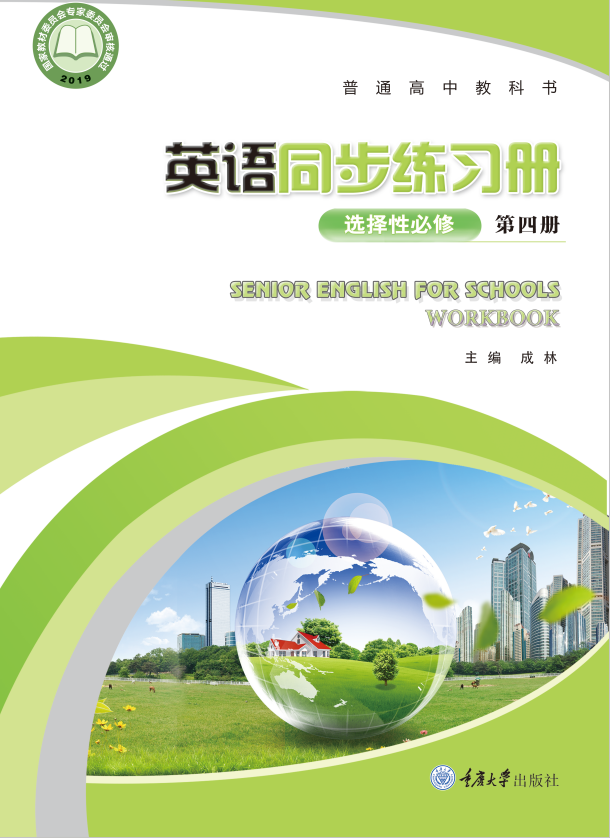
Challenging Yourself B Mysterious Planet-高中英语选择性必修第四册同步练习册(重大版2019)
2024-08-19
|
2份
|
8页
|
49人阅读
|
2人下载

内容正文:
Complete the sentences with proper words.
1. (rare) have I seen her display any sign of emotion.
2. The doctor told me to take the medicine (regular) three times a day.
3. Though (lack) money, his parents managed to send him to university.
4. They desire (help) those who are in need of help.
5. Everyone concerned acted with great courage and (determine).
6. Yang Liwei is one of the most famous (astronaut) in the world.
7. These exercises will help to (flat) your stomach.
8. Whether space science will become a force for good or ill (depend) on man.
9. Babies are not born knowing the basic fact of universe.
10. No man can (full) grasp how far and how fast we have come.
Complete the passage with proper words.
The probe of Chinas first Mars mission Tianwen⁃1 flew a total of 100 million kilometres by 10:08
a.m. 1 Friday, according to China National Space Administration.
2 ( launch) on July 23, the probe was sent into the Earth⁃Mars transfer trajectory (轨道) by
the countrys Long March⁃5 carrier rocket. It becomes 3 artificial planet to circle the Sun together
with the Earth and the Moon, 4 ( fly) away from the Earth and approaching the red planet. It is
now 10.75 million kilometres away from the Earth 5 36 days travel. When arriving at the Mars, the
probe will be about 195 million kilometres from the Earth with an actual flight 6 ( distant) of
roughly 70 million kilometres.
During the flight, the probe has 7 ( success) captured a photo of the Earth and the Moon,
and completed the first mid⁃course orbital correction.
It is expected 8 (carry) out deep⁃space maneuvers and multiple mid⁃course corrections later,
and conduct orbiting, landing and roving missions after approaching the Mars orbit.
The Tianwen⁃1 9 (schedule) to make a second orbital correction in September to ensure that
95
the probe is flying accurately in 10 (it) preset orbit.
Read the following passage and choose the correct answer to fill in each blank.
On Saturday, Juliet and Darcy, 17⁃year⁃old friends, were enjoying sunshine at Furness Park when
they noticed a man fall down on the sidewalk. They hurried to 1 the man.
Darcy felt 2 he was going to die in front of them. She took a closer look. Then she observed
his chest not going up and down, which meant he wasnt 3 .
The girls knew they needed to 4 help. While Darcy stayed with the 5 man, Juliet ran to
nearby homes and began ringing doorbells, but no one 6 . “ I am really afraid he is going to die
without help,” Darcy said 7 .
Juliet continued to run for help. She finally found some men fixing a car and told them the 8 .
But they didnt believe what the girl said at first. They asked, “ Is what you said a joke?” And she
answered, “No, call 911 right now.”
The repairmen got it and then 9 CPR (心肺复苏术) on the unconscious man until doctors
arrived and used a defibrillator (除颤器) to restart his 10 . Doctors said the man was in critical
condition and should be 11 to hospital.
A doctor said, “ To their 12 , the two girls took fast action which is called ‘ a chain of
survival, which can save the 13 of a patient in a dangerous situation.” But doctors didnt get the
girls names at that time, so they launched a(n) 14 to the public to find them.
Finally, the two girls were found and praised for helping save a mans life on the weekend. “We
were brave,” Darcy said. “We got a bit scared at the beginning, but later we realised 15 wont
help the man.”
1. A. recognise B. applaud C. aid D. seize
2. A. confused B. terrified C. pleased D. curious
3. A. bleeding B. breathing C. starving D. choking
4. A. forbid B. appreciate C. quit D. seek
5. A. unconscious B. familiar C. absent⁃minded D. ragged
6. A. enquired B. remembered C. answered D. succeeded
7. A. anxiously B. occasionally C. eagerly D. merrily
8. A. consequence B. emergency C. concept D. mystery
9. A. searched for B. put off C. carried out D. broke down
10. A. hands B. stomach C. feet D. heart
11. A. rushed B. admitted C. persuaded D. guided
12. A. disappointment B. credit C. annoyance D. horror
06
13. A. reputation B. prospect C. life D. honour
14. A. appeal B. comment C. attempt D. apology
15. A. prejudice B. regret C. offence D. panic
Read the passages and choose the most suitable answer to each question.
A
Space is where our future is—trips to the Moon, Mars and beyond. Most people would think that
aside from comets and stars, there was little else out there. But, since our space journey started we have
left so much trash there that scientists are now concerned that if we dont clean it up, we may all be in
great danger.
The first piece of space junk was created in 1964, when the American satellite Vanguard Ⅰ
stopped operating and lost its connection with the ground centre. However, since it kept orbiting around
the Earth without any results, scientists became increasingly comfortable abandoning things that no
longer served any useful purposes in space.
It is said that there are now over 500,000 pieces of man⁃made trash orbiting the Earth at speeds of
up to 17,500 miles per hour. The junk varies from tiny pieces of paint chipped off rockets to cameras,
huge fuel tanks, and even odd items like the million⁃dollar tool kit that astronaut Heidemarie
Stefanyshyn Piper lost during a spacewalk.
The major problem with the space trash is that it may hit working satellites and damage travelling
spaceships. Moreover, pieces of junk may crash with each other and break into pieces which fall back to
the Earth. To avoid this, scientists have invented several ways for clearing the sky. Ground stations have
been built to monitor larger pieces of space trash to prevent them from crashing into working satellites or
space shuttles. Future plans include a cooperative effort among many nations to stop littering in space
and to clean up the trash already there.
1. What was the first piece of man⁃made space trash?
A. A camera. B. A tool kit.
C. A fuel tank. D. A broken satellite.
2. Why were scientists NOT concerned about space trash in the beginning?
A. It no longer served any useful purposes.
B. It was millions of miles away from the Earth.
C. It did not cause any problems.
D. It was regarded as similar to comets and stars.
16
3. What can we conclude from the passage about space junk?
A. It is huge, heavy machines.
B. It never changes position.
C. It floats slowly around the Earth.
D. It may cause problems for space shuttles.
4. What has been done about the space trash problem?
A. Scientists have cleaned up most of the trash.
B. Large pieces of space trash are being closely watched.
C. Many nations have worked together to stop polluting space.
D. Ground stations are built to help store the trash properly in space.
B
The Earth is the only planet that scientists think has life. Why does the Earth have life while the
other planets dont? For one thing, the Earth has the right temperature. As the third planet from the
Sun, the Earth seems to be just the right distance away. The planets which are closer to the Sun are so
hot that their surfaces bake in the sun. The farthest planets are cold balls.
When the Earth developed—which scientists believe may have happened about 4 billion years
ago—many gases covered the Earth. The gases caused the Earth to be hot. But something wonderful
happened. The temperature was just right for thick clouds to form. It rained very hard for a very long
time. This gave the Earth its oceans. Water made it possible for plants to grow. The plants created
oxygen in the atmosphere. Oxygen is the gas that humans and animals breathe.
Only one other planet in the solar system seems to be something like the Earth. That planet is the
Mars. The Mars is smaller than the Earth, and it is quite a bit cooler. But it is not too cold for humans.
On some days, the temperature is as low as a winter day in the northern United States. If you wore a
special spacesuit, you could walk around on the Mars. You would have to bring your own air to breathe,
because the air on the Mars is too thin to breathe.
The Mars has the largest volcano in the solar system. It is sixteen miles high. The highest volcano
on the Earth is five miles high. The most unexpected sight on the Mars is dried⁃up river beds. Scientists
believe that the Mars was once much better than it is now. Does this mean there could have been living
things on the Mars? Scientists are not sure, but there has been no sign so far.
5. Which of the following is NOT the reason why the Earth has life?
A. The Earth has the right temperature.
B. The volcanoes on the Earth are lower than those on the Mars.
26
C. There is oxygen in the atmosphere of the Earth.
D. The Earth seems to be just the right distance away from the Sun.
6. The underlined phrase “the third planet” in the first paragraph refers to .
A. the Sun B. the Moon
C. the Earth D. the Mars
7. What cannot be concluded from the passage about the Mars?
A. There could have been living things on the Mars.
B. The Mars has the largest volcano in the solar system.
C. There is almost no oxygen in the air on the Mars.
D. The Mars is smaller than the Earth, and it is quite a bit cooler.
8. Which of the following is probably the best title for the passage?
A. The Earth.
B. The Moon.
C. Planets in the Solar System.
D. The Mars is Most Like the Earth.
Write a passage.
随着世界太空技术的发展,人类的太空梦不再是梦。 但是也有人觉得耗费大量的人力和财
力来研究和开发太空资源不切实际,不如将这些人力和财力用来着重解决人类当前面临的重大
问题,改善地球的生存环境。 对此你有何看法? 以“Developing Space Technology, Worthwhile or
Not?”为题写一篇 80 词左右的短文。
36
Accumulating
Recommendation.
Shape and Size of the Earth
The Earth is almost a perfect ball. The Earth is slightly pear shaped—
peaked at the North Pole and bulbous at the South Pole.
The following chart shows the difference in several measurements.
These differences are why the Earth is not a perfect sphere.
Diameter at the Equator 7,926 Miles
Diameter through the Poles (Axis) 7,900 Miles
Circumference at the Equator 24,902 Miles
Circumference at the Poles 24,860 Miles
The Area of the Earths surface is 196,800,000 square miles. About 70% of that area (139,500,000
square miles) is covered by water.
My contribution.
46
4. wide 改为 wider
5. 在 which 前加 on 或改为 where
6. explore 改为 exploring
Ⅱ. 1. was launched; orbited 2. resources
3. to recycle 4. understandably
5. shrinks 6. possessions
Ⅲ. 1. Understandably, the most progress is being made in agriculture.
2. I have a tendency to talk too much when Im nervous.
3. Many of the things we now benefit from would not be around but for Thomas Edison.
4. These measures cant help to lessen the existing tension.
5. The more you pay, the more you get.
Ⅳ. A: 1—3 CBC
B: 4. Food supply.
5. Technologies can help to improve our living quality.
6. It is about whether it is worth spending much money on space research.
Challenging Yourself B
Ⅰ. 1. Rarely 2. regularly
3. lacking 4. to help
5. determination 6. astronauts
7. flatten 8. depends
9. the 10. fully
Ⅱ. 1. on 2. Launched
3. an 4. flying
5. after 6. distance
7. successfully 8. to carry
9. is scheduled 10. its
Ⅲ. 1—5 CBBDA
6—10 CABCD
11—15 ABCAD
Ⅳ. A: 1—4 DCDB
701
B: 5—8 BCAD
Ⅴ.
Developing Space Technology, Worthwhile or Not?
With the development of space technology, human beings are exploring further into the space. Those
space experiments and explorations cost huge sums of money, which, quite a number of people think, should
have been used to protect human natural environment and solve the problems we all are facing.
This might be true, but I think in the long run human will have to turn to other planets when all the
resources are used up. For example, human could make use of the mines on the Moon and conduct special
experiments in the space. Moreover, some of the new technologies employed in space could be used in our
daily life and thus created a better life for us.
All in all, space technology development is sure to benefit all human beings and it is well worth it.
Unit 5
Reading Actively
Ⅰ. 1. horrified 2. appealing
3. perspective 4. disbelief
5. research 6. historic
7. shock 8. bomb
Ⅱ. 1. agreement 2. bored
3. anxiety 4. Colourful
5. particularly 6. recognition
7. connection
Ⅲ. 1. Take your time to search for something that you want.
2. We need to appeal to a wider customer base.
3. “Are you joking?” she asked in disbelief.
4. No other organisation was able or willing to take on the job.
5. The goal of life is living in agreement with nature.
6. The job is great in terms of salary, but it has its disadvantages.
7. You must turn in your pass when you leave the building.
Ⅳ. 1. Origin
2. 1) C 2) E 3) A 4) F 5) B 6) D
801
资源预览图

1

2

3
相关资源
示范课
由于学科网是一个信息分享及获取的平台,不确保部分用户上传资料的 来源及知识产权归属。如您发现相关资料侵犯您的合法权益,请联系学科网,我们核实后将及时进行处理。