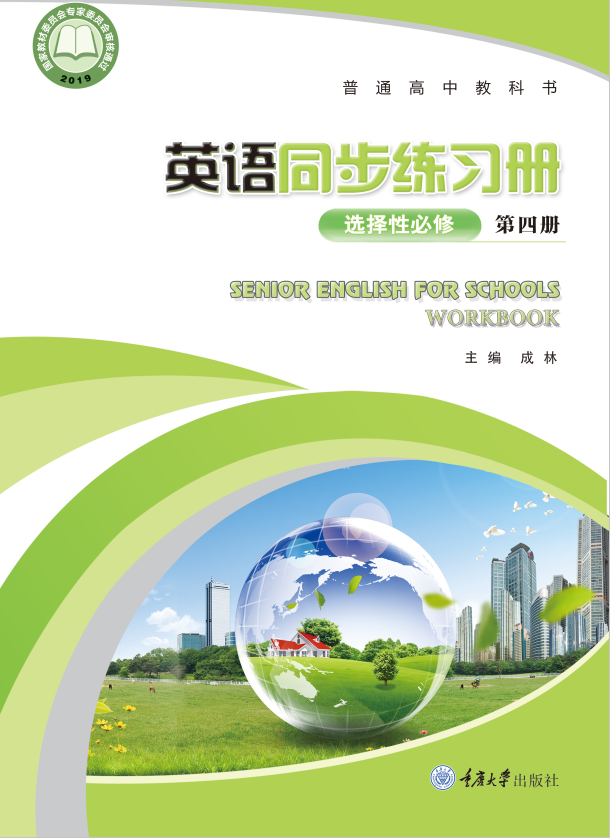
Unit 3 Earth Protection-高中英语选择性必修第四册同步练习册(重大版2019)
2024-08-19
|
2份
|
16页
|
69人阅读
|
1人下载

内容正文:
Theme B Nature and
Environmental Protection
Reading Actively
Match the words and phrases in the box with the definitions.
flood damage atmosphere emission
underwater make a difference figure out be to blame for
1. to come to understand sb. or sth. by thinking
2. to harm or spoil sth. or sb.
3. to be responsible for sth. bad
4. situated, used or done below the surface of the water
5. the mixture of gases that surrounds the Earth
6. to be filled or covered with water
7. to have an effect or influence on sth. or sb.
8. the production or sending out of light, heat, gas, etc.
Complete the sentences with the correct forms of the words in the box.
damage flood environment definite association decide different
1. The doctor is quite about Toms having a cold.
2. Roger, an expert, said the increase of greenhouse gases will cause global warming.
53
3. Our today are going to shape the world where we live in.
4. If we keep the environment, the world will be a very different place.
5. The truth is that climate change is with every one of us.
6. The sea air has made a to her health.
7. The heavy rain has caused in many parts of the country.
Make sentences with the underlined parts.
1. Too much greenhouse gas is to blame for global warming.
2. People on the Earth are fighting for food and clean water.
3. It took them about one month to figure out how to start the equipment.
4. We need more time to see how things develop before we take action.
5. If we combine our efforts, we can make a difference.
6. El Ninos are associated with abnormally dry conditions in Australia.
7. Energy taxes, already high, may be about to rise.
Read the passage and complete the tasks.
The global temperature last month was warmer than every previous January on record, just edging
out the previous record from January 2016, the Copernicus Climate Change Service reported.
And in Europe, it was the warmest January ever recorded at 0. 2 ℃ warmer than the previous
record in 2007, the European Unions system for monitoring the Earth said.
The rise is even more striking through the lens of history—compared to the average January
temperature in the pre⁃industrial years before the 20th century, it was about 1.4 degrees Celsius (2.7
degrees Fahrenheit) warmer.
Last month, temperatures in Europe were warmer than the 1981—2010 January average,
especially over parts of northern Europe, the report said. Some areas were more than 6 ℃ above the
average, but overall, it was 3.1 ℃ warmer than the average January in that time period.
It also brought the warmest January day ever recorded in Norway, which saw the second warmest
January overall since 1900.
63
And in Central and southern Finland, it was its warmest January recorded since 1961.
The heatwave extended to several parts of Russia, too.
Temperatures from east of Greenland to the northwest of Svalbard were warmer, and had below⁃
average sea⁃ice cover.
Globally, last year was 0.59 ℃ warmer than the 1981—2010 average. Thats the second warmest
year on record. The warmest 12⁃month period remains October 2015 to September 2016, when it was
0.66 ℃ above 1981—2010.
Those averages are pushing global temperatures close to red lines set by both climate scientists and
world leaders.
Scientists have warned that global temperatures should be kept well below 2 degrees Celsius (3.6
degrees Fahrenheit) of warming. The international community, as outlined through the Paris Climate
Agreement, stated that participating countries would strive to keep global warming limited to 1.5
degrees Celsius.
But coupled with a rise since pre⁃industrial temperatures, last months average is between 1.2 and
1.4 deg. C of warming—putting it near the Paris Climate Agreements ceiling.
1. Skim the passage and find the sentence which contains its main idea.
2. Match the words with the definitions.
1) previous A. to affect people, things, or places
2) monitor B. existing or occurring before in time or order
3) overall C. generally
4) extend D. to try very hard to achieve sth.
5) strive E. to make continuous observation of sth.
3. Translate the following sentences into Chinese with the help of a dictionary.
1) The rise is even more striking through the lens of history.
2) It also brought the warmest January day ever recorded in Norway, which saw the second warmest
January overall since 1900.
3) Those averages are pushing global temperatures close to red lines set by both climate scientists
and world leaders.
73
Exploring and Using
Complete the sentences with proper words.
1. The electricity (generate) by solar panels is pure and clean.
2. Convenience foods and electrical household (apply) are finding their way into families.
3. Obviously, she (emit) a sound like a laughter.
4. Different from the houses we live today, “green” houses have a few (notice) features.
5. “Green” houses are built largely from ( recycle) materials, such as plastics, paper and
rubber.
6. Ill need some help (install) the software.
7. Only in this way can we ease the burden on the environment for raw (material) .
Decide the function of each underlined part and write it in the brackets.
( ) 1. Having installed a new booking system, the hotel chain is more popular than ever.
( ) 2. Generating the electricity, solar panels dont pollute the environment around.
( ) 3. Whitney blinked, emitting a long, low whistle.
( ) 4. Not knowing the truth, people cant realise the disastrous effects global warming will cause.
( ) 5. With the temperature going up and up, the Earth is becoming warmer and warmer.
( ) 6. Being burned, fossil fuels will give off all kinds of harmful gases into the air.
Make sentences according to the given sentence patterns.
1. Not having received an answer, he wrote again.
2. Seeing the cat, the mouse ran off.
3. Being protected by many guards then, he felt safe.
4. The fire lasted nearly a month, leaving nothing valuable.
5. I couldnt do my homework with all that noise going on.
83
Read the passage and complete the tasks.
There is no doubt that the environment is in trouble. Factories burn fossil fuels, producing acid
rain and killing trees. At the same time, greenhouse gases rising into the air 1) global
warming which threatens to melt the polar ice cap. Meanwhile farmers clear huge areas of rainforest in
places such as the Amazon to produce feeding land for cattle or produce wood for building. Rivers and
oceans are so heavily 2) by industrial waste that it is no longer safe to go swimming. Cars
pump out poisonous emissions we all have to breathe in. Illegal hunting and overfishing are killing off
millions of animals, 3) whales, elephants and other endangered species. In fact, all around
us, all living things, large and small, which comprise (构成) our finely balanced ecosystem, are
being systematically destroyed by human greed and thoughtlessness.
There is a lot we can do, 4) , to help prevent this. The easiest thing, of course, is to
recycle waste material such as paper and glass 5) we can use it again. We should also check
that the things we buy from supermarkets are packaged in biodegradable (可生物降解的) packaging
which decomposes (分解) easily. At the same time, we should make a conscious effort to avoid foods
which are genetically modified ( 转 基 因 的 ). If you are truly committed to 6 ) the
environment, of course, you should only buy organic fruit and vegetables, safe in the knowledge that
they have been naturally grown. Finally, of course, we should buy a small car that uses unleaded (不
含铅的) petrol which is less harmful to the environment or, even better, make more use of public
transport.
1. Fill in the blanks with suitable words or phrases according to the context.
2. Fill in the blanks with a word from the passage. Change the form if necessary.
1) He was accustomed to early.
2) It is illegal for factories to black smoke into the air.
3) my desk, I left.
4) They prefer cheap toilet paper to toilet paper.
3. Study the underlined parts in the following sentences and analyse their elements.
( ) 1) Factories burn fossil fuels, producing acid rain and killing trees.
( ) 2) At the same time, greenhouse gases rising into the air contribute to global warming.
( ) 3) Meanwhile farmers clear huge areas of rainforest in places such as the Amazon to produce
feeding land for cattle or produce wood for building.
( ) 4) The easiest thing, of course, is to recycle waste material such as paper and glass so that
we can use it again.
( ) 5) There is a lot we can all do, however, to help prevent this.
93
Listening, Understanding and Communicating
Listen and fill in the blanks with the words you hear.
Working with is one of the most popular volunteer activities in Thailand. And for good
reason, these creatures are huge, cute, and very intelligent. Often elephants are looked as
animals, but its good to remember that this isnt always the . Sadly, many
elephants have faced terrible treatment, into giving performances or overworked at money⁃
hungry tourist attractions. A terribly⁃treated elephant can become angry and kill people if it
feels .
Now, as for volunteering for elephant protection, it can be a very experience. The
important thing is to find the right . There are a number of elephants and parks,
especially in Thailand. There you can do meaningful work to the lives of elephants.
Read the passage and choose the correct answer to fill in each blank.
Chinese scientists are again becoming excited about the fact that a large hairy animal may live in
central China. Now they think it wont be too long 1 they are able to prove its existence. Their 2
is the result of a new discovery of the mystery animal in Hubei Province. Ten Chinese 3 , enjoying
a holiday in a National Forest Park, were driving down a road. As their bus turned a corner, the men
were suddenly 4 by what they saw. Three tall animals, covered with long black hair, were crossing
the road. On 5 the animals, the engineers immediately stopped and ran after them. However, when
they saw how the animals moved through the forest with great speed and strength, they did not dare to
6 any further. The men did not take any 7 . However, scientists are 8 by the discovery,
because the engineers were all very educated people and scientists feel they can 9 what they
described. After the 10 , scientists returned to the forest, 11 some hair and measured the
footprints. About 20 12 appears to be the animals foot! Chinese scientists have now 13 a
special group to exchange information and make a study of the forest. But in the meantime, some people
14 to believe that this half⁃man, half⁃monkey exists. They will not believe that it is 15 until
one of the animals has been caught.
1. A. after B. before C. until D. since
2. A. confidence B. hope C. idea D. desire
3. A. travellers B. explorers C. scientists D. engineers
4. A. frightened B. upset C. amazed D. inspired
5. A. tasting B. feeling C. touching D. seeing
6. A. follow B. move C. walk D. run
7. A. bullets B. tools C. medicines D. photographs
04
8. A. surprised B. delighted C. disturbed D. supported
9. A. write down B. deal with C. rely on D. pass on
10. A. discovery B. invention C. result D. interview
11. A. cut B. pulled C. collected D. tore
12. A. inches B. metres C. miles D. kilometres
13. A. set about B. set off C. set down D. set up
14. A. come B. refuse C. prefer D. have
15. A. wrong B. alive C. real D. correct
Listening, Speaking and Writing
Listen to the passage for the first time and complete its main idea.
The passage is mainly about .
Listen to the passage again and fill in the blanks with the words you hear.
1. There is a creative way .
2. This rooftop garden helps and grow food at the same time.
3. Architect David Bell designed five green roofs .
4. In an urban environment, you dont have all that many spaces to .
5. The biggest surprise was that the five green roofs produced pounds of produce the first
year.
Study the underlined parts of the sentences and use them to make sentences about
protecting the Earth.
1. Rain is essential for all mankind, but too much of it can lead to flooding.
2. This rooftop garden helps absorb rainwater and grow food at the same time.
3. And this project is really exciting, because it started to do something more than just dealing with
storm water management.
4. It took advantage of a resource above the city.
14
Study the passage and write a short paragraph calling on people to protect the Earth.
Step 1: Study the structure of the passage.
Step 2: List some ideas to improve your writing skills. For example:
be essential for; lead to; a way to do; more than;
Step 3: Use appropriate conjunctions and adverbs to connect your ideas.
Step 4: Write the first draft and revise it.
Step 5: Write the final draft.
Reading Further
Correct the mistake in each of the sentences.
1. As much as one million species of land plants and animals are in danger of becoming extinct.
2. The result is both land and sea temperatures increase.
3. With the Earth heats up, the balance of nature changes.
4. Worse of all, the huge amount of ice in the Arctic and Antarctic regions will melt.
5. With sea level risen gradually, the world will be a very different place.
6. We should immediately take actions to reduce greenhouse gas emissions.
24
Fill in the blanks with proper words.
1. The books in the library (classify) by / according to subject.
2. If many of the plants we eat dont grow well, many people may die starvation.
3. Jason is an evolutionary (biology) who studies insects.
4. The disease has spread at an (alarm) rate.
5. (deforest) and desertification reduce the net uptake of CO2 and lead to global warming.
6. Were seeing biological communities respond very rapidly climate warming.
Translate the following sentences into English.
1. 两个警觉的科学家发现了这个错误。 (alert)
2. 他们遭遇扒窃的危险大于遭受枪击。 (in danger of)
3. 他们对这则消息有什么反应? (respond)
4. 如果你的行动像个领导者,并且感觉自己像个领导者,那么你就是一位领导者。 (act like)
5. 运动给许多人带来无穷的乐趣。 (amount)
Read the passages and complete the tasks.
A
How does an ecosystem (生态系统) work? What makes the populations of different species the
way they are? Why are there so many flies and so few wolves? To find an answer, scientists have built
mathematical models of food webs, noting who eats whom and how much each one eats.
With such models, scientists have found out some key principles operating in food webs. Most food
webs, for instance, consist of many weak links rather than a few strong ones. When a predator (掠食动
物) always eats huge numbers of a single prey (猎物), the two species are strongly linked; when a
predator lives on various species, they are weakly linked. Food webs may be dominated by many weak
links because that arrangement is more stable over the long term. If a predator can eat several species,
it can survive the extinction of one of them. And if a predator can move on to another species that is
easier to find when a prey species becomes rare, the switch allows the original prey to recover. The
weak links may thus keep species from driving one another to extinction.
34
Mathematical models have also revealed that food webs may be unstable, where small changes of
top predators can lead to big effects throughout entire ecosystems. In the 1960s, scientists proposed that
predators at the top of a food web had a surprising amount of control over the size of populations of other
species—including species they did not directly attack.
And unplanned human activities have proved the idea of top⁃down control by top predators to be
true. In the ocean, we fished for top predators such as cod on an industrial scale, while on land, we
killed off large predators such as wolves. These actions have greatly affected the ecological balance.
Scientists have built an early⁃warning system based on mathematical models. Ideally, the system
would tell us when to adapt human activities that are pushing an ecosystem towards a breakdown or
would even allow us to pull an ecosystem back from the borderline. Prevention is key, scientists say,
because once ecosystems pass their tipping point (临界点), it is remarkably difficult for them to
return.
1. What have scientists discovered with the help of mathematical models of food webs?
A. The living habits of species in food webs.
B. The rules governing food webs of the ecosystems.
C. The approaches to studying the species in the ecosystems.
D. The differences between weak and strong links in food webs.
2. A strong link is found between two species when a predator .
A. has a wide food choice
B. can easily find new prey
C. sticks to one prey species
D. can quickly move to another place
3. What will happen if the populations of top predators in a food web greatly decline?
A. The prey species they directly attack will die out.
B. The species they indirectly attack will turn into top predators.
C. The living environment of other species will remain unchanged.
D. The populations of other species will experience unexpected changes.
4. What conclusion can be drawn from the examples in Paragraph 4?
A. Uncontrolled human activities greatly upset ecosystems.
B. Rapid economic development threatens animal habitats.
C. Species of commercial value dominate other species.
D. Industrial activities help keep food webs stable.
5. How does an early⁃warning system help us maintain the ecological balance?
A. By getting illegal practices under control.
B. By stopping us from killing large predators.
44
C. By bringing the broken⁃down ecosystems back to normal.
D. By signaling the urgent need for taking preventive action.
B
By the end of the century, if not sooner, the worlds oceans will be bluer and greener thanks to a
warming climate, according to a new study.
At the heart of the phenomenon lie tiny marine microorganisms ( 海 洋 微 生 物 ) called
phytoplankton. Because of the way light reflects off the organisms, these phytoplankton create colourful
patterns at the ocean surface. Ocean colour varies from green to blue, depending on the type and
concentration of phytoplankton. Climate change will fuel the growth of phytoplankton in some areas,
while reducing it in other spots, leading to changes in the oceans appearance.
Phytoplankton live at the ocean surface, where they pull carbon dioxide into the ocean while giving
off oxygen. When these organisms die, they bury carbon in the deep ocean, an important process that
helps to regulate the global climate. But phytoplankton are vulnerable to the oceans warming trend.
Warming changes key characteristics of the ocean and can affect phytoplankton growth, since they need
not only sunlight and carbon dioxide to grow, but also nutrients.
Stephanie Dutkiewicz, a scientist in MITs Centre for Global Change Science, built a climate
model that projects changes to the oceans throughout the century. In a world that warms up by 3℃, it
found that multiple changes to the colour of the oceans would occur. The model projects that currently
blue areas with little phytoplankton could become even bluer. But in some waters, such as those of the
Arctic, a warming will make conditions riper for phytoplankton, and these areas will turn greener. “Not
only are the quantities of phytoplankton in the ocean changing,” she said, “ but the type of
phytoplankton is changing.”
And why does that matter? Phytoplankton are the base of the food web. If certain kinds begin to
disappear from the ocean, Dutkiewicz said, “it will change the type of fish that will be able to survive.”
Those kinds of changes could affect the food chain.
Whatever colour changes the ocean experiences in the coming decades will probably be too gradual
and unnoticeable, but they could mean significant changes. “Itll be a while before we can statistically
show that the changes are happening because of climate change,” Dutkiewicz said, “but the change in
the colour of the ocean will be one of the early warning signals that we really have changed our planet.”
6. What are the first two paragraphs mainly about?
7. What does the underlined word “vulnerable” in Paragraph 3 probably mean?
8. What is the main purpose of writing the passage?
54
Accumulating
Recommendation.
Earth Day
Earth Day is an annual event, celebrated each year on the Vernal
Equinox (春分) and on April 22, on which days events worldwide are
held to demonstrate support for environmental protection. It was first
celebrated in 1970 on both dates. The April 22 date is now coordinated
(协调) globally by the Earth Day Network and celebrated in more than
193 countries each year. The Vernal Equinox Earth Day, approved by
the United Nations and celebrated around the world with the ringing of the Peace Bell at the United
Nations Headquarters is now globally coordinated by The Earth Society Foundation and the Earth Flag
Foundation.
On the April 22nd Earth Day 2016, the landmark Paris Agreement is scheduled to be signed by
the United States, China, and some other countries. This signing satisfies a key requirement for the
entry into force of the historic draft climate protection treaty adopted by consensus (共识) of the 195
nations present at the 2015 United Nations Climate Change Conference in Paris.
My contribution.
64
Ⅱ. 1. appointment 2. promptly
3. have completed 4. responsibility
5. escaped 6. misunderstands
Ⅲ. 1. Never delay what you can do today until tomorrow.
2. With the help of my teacher, I have made great progress in my English learning.
3. Wed better prepare everything well in case some problems arise.
4. No matter what you do, you should do it well.
5. Students should attach great importance to their handwriting.
Ⅳ. 1—5 CFDBA
6—9 BADC
Challenging Yourself A
Ⅰ. 1. Apparently 2. wrapped
3. for 4. acceptance
5. variety 6. informal
7. convention 8. witnesses
9. significance 10. honourable
Ⅱ. 1. establishing 2. incomplete
3. what 4. celebrated
5. Traditionally 6. a
7. Although 8. decorated
9. in 10. relatives
Ⅲ. 1—5 CDABC
6—10 ABCDB
11—15 CDADA
Ⅳ. 1—4 ADBC 5—8 BBAD
Ⅴ. Omitted.
Unit 3
Reading Actively
Ⅰ. 1. figure out 2. damage
3. be to blame for 4. underwater
001
5. atmosphere 6. flood
7. make a difference 8. emission
Ⅱ. 1. definite 2. environmental
3. decisions 4. damaging
5. associated 6. difference
7. floods
Ⅲ. 1. He was in no way to blame for that.
2. A hero is brave enough to fight for his country.
3. I cant figure out why he quitted his job.
4. We must take action to stop the fire spreading.
5. The rain didnt make a / much difference to the game.
6. Whisky is usually associated with Scotland.
7. I was about to leave when the telephone rang.
Ⅳ. 1. The global temperature last month was warmer than every previous January on record, just edging out
the previous record from January 2016.
2. 1) B 2) E 3) C 4) A 5) D
3. 1) 从历史的角度看,这种增长更加引人注目。
2) 它还带来了挪威有史以来最热的一月份的一天,这是自 1900 年以来第二热的一月份。
3) 这些平均气温正使全球气温接近气候科学家和世界领导人设定的红线。
Exploring and Using
Ⅰ. 1. generated 2. appliances
3. emitted 4. noticeable
5. recycled 6. to install
7. materials
Ⅱ. 1. adverbial 2. adverbial
3. adverbial 4. adverbial
5. object complement 6. adverbial
Ⅲ. 1. Not having received a reply, I wrote to her again.
2. “Cant you read?” Mary said angrily pointing to the notice.
3. Being used by me now, the bike cant be lent to you.
4. The snow lasted a week, resulting in a serious traffic confusion in the whole area.
5. She fell asleep with the light burning.
Ⅳ. 1. 1) contribute to 2) polluted
3) including 4) however
101
5) so that 6) protecting
2. 1) rising 2) emit
3) Having cleared 4) recycled
3. 1) adverbial 2) attribute
3) attribute; object 4) predicative
5) adverbial
Listening, Understanding and Communicating
Ⅰ. 1. elephants 2. amazing
3. gentle 4. case
5. beaten 6. threatened
7. valuable 8. opportunity
9. reserves 10. improve
Ⅱ. 1—5 BADCD
6—10 ADBCA
11—15 CADBC
Listening, Speaking and Writing
Ⅰ. a creative way to deal with too much rainwater in the city
Ⅱ. 1. to deal with that
2. absorb rainwater
3. on a campus
4. choose from
5. four thousand two hundred and fifty
Ⅲ. 1. The Earth is essential for mankind.
2. At the same time, some marine animals are at risk and air pollution is becoming serious in many
industrial cities.
3. We can do more than whats mentioned above.
4. As far as Im concerned, we can take advantage of all ways to deal with it.
Ⅳ.
With the World Earth Day approaching, I am writing to call on all of us to take action to protect the
Earth.
The Earth is essential for mankind. However, with the rapid development of society, the globe is
warming, leading to a large number of natural disasters. At the same time, some marine animals are at risk
and air pollution is becoming serious in many industrial cities. What shall we do to prevent the Earth from
becoming warm? As far as Im concerned, we can take advantage of all ways to deal with it. First, lets save
201
energy and reduce the emissions of the greenhouse gases. Second, we should form the habit of recycling used
items. Besides, we can travel by public transport as much as possible. In a word, we can do more than
whats mentioned above.
If we take action from now on, we can make the Earth a better place to live in.
Script:
Rain is essential for all mankind, but too much of it can lead to flooding, carrying dangerous substances
to nearby river systems. There is a creative way to deal with that. This rooftop garden helps absorb rainwater
and grow food at the same time. Architect David Bell designed five green roofs on a campus. And this project is
really exciting, because it started to do something more than just dealing with storm water management. It took
advantage of a resource above the city you see all over where you have these flat roofs that arent doing
anything, and it really made it something that was about urban agriculture. In an urban environment, you
dont have all that many spaces to choose from, and so rooftops are just the space. So its a really good way
because there is no necessity to rebuild your city to bring fresh food into cities where you wouldnt necessarily
have that access. The biggest surprise was that the five green roofs produced four thousand two hundred and fifty
pounds of produce the first year, which was distributed to people in need. This is the future for food.
Reading Further
Ⅰ. 1. much 改为 many
2. is 后加 that
3. With 改为 As 或 heats 改为 heating
4. Worse 改为 Worst
5. risen 改为 rising
6. actions 改为 action
Ⅱ. 1. are classified 2. from
3. biologist 4. alarming
5. Deforestation 6. to
Ⅲ. 1. Two alert scientists spotted the mistake.
2. They were more in danger of having their pockets picked than being shot at.
3. How did they respond to the news?
4. If you act like a leader and feel like a leader, you are a leader.
5. Sport gives an enormous amount of pleasure to many people.
Ⅳ. A: 1—5 BCDAD
B: 6. The cause of the changes in ocean colour.
7. It means “sensitive”.
8. To explain the effects of climate change on oceans.
301
资源预览图

1

2

3

4
相关资源
示范课
由于学科网是一个信息分享及获取的平台,不确保部分用户上传资料的 来源及知识产权归属。如您发现相关资料侵犯您的合法权益,请联系学科网,我们核实后将及时进行处理。