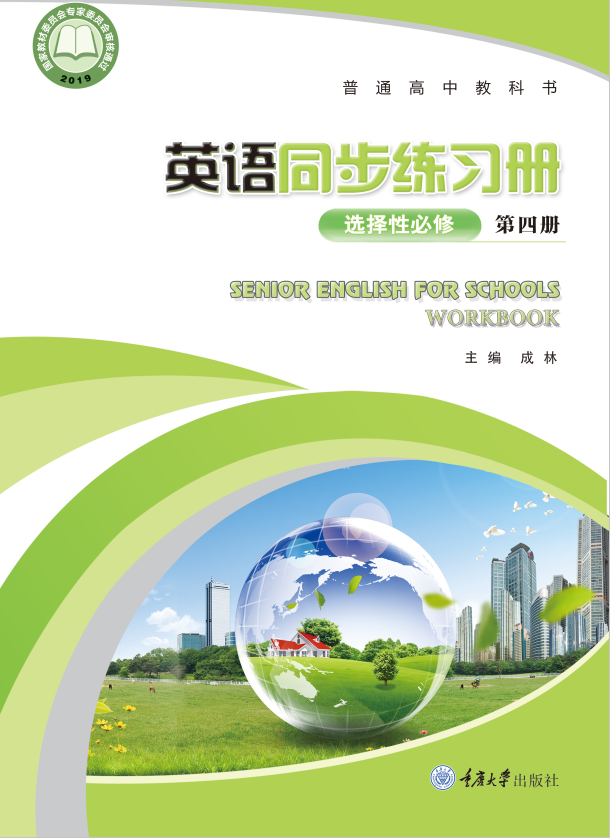
Unit 2 Non-verbal Communication-高中英语选择性必修第四册同步练习册(重大版2019)
2024-08-19
|
2份
|
18页
|
53人阅读
|
1人下载

内容正文:
Reading Actively
Find the words and phrases with the following meanings in the corresponding
paragraphs.
1. in an uncontrolled way (Para. 1)
2. to be a member of a group of people and act to speak on their behalf at an event or a meeting
(Para. 3)
3. a group or type of people or things that are similar in a particular way (Para. 4)
4. to be different from each other in size or shape (Para. 4)
5. to be a sign of sth. (Para. 5)
6. to give a spoken or written answer to sb. or sth. (Para. 5)
7. to think or accept that sth. is true but without having proof of it (Para. 5)
8. to put sb. or sth. in a particular place (Para. 6)
Complete the sentences with the correct forms of the words in the box.
function casual element whereas caution expect perceive
1. If someone you, they warn you about problems or danger.
2. He was dressed in jeans and a T⁃shirt.
3. Students have for themselves the relationship between success and effort.
4. The move from school to middle school can be difficult.
5. If a machine or system is , it is working or operating.
6. Some of the studies show positive results, others do not.
7. She succeeded beyond our .
41
Make sentences with the underlined parts.
1. The boy acts cool, crossing his legs and affecting a casual air—even though his heart is beating
wildly.
2. That means people pick up more from non⁃verbal communication than from the words.
3. When studying a foreign culture, therefore, we should pay attention to how people use non⁃verbal
cues.
4. In other words, they like to keep each other “at arms length”.
5. People in Latin or Arab cultures, in contrast, stand very close to each other, and touch each other
often.
6. Thats why its possible, as the saying goes, to “read someone like a book”.
Read the passage and complete the tasks.
Body Language
Body language is an important part of nonverbal communication and it is connected with culture. In
order to make successful exchange in cross⁃cultural communication, we should know some body
language from different cultures.
in body language
If two Arabians are in conversation, they will look at each other warmly, because they think eyes
are the key of their existence. But in American eyes, they think this behaviour is unsuitable. The
educated Englishmen believe direct eye contact with our communicators is gentlemanly. The French like
to look attentively at the other communicators with admiration. Japanese often look at the other
communicators neck when they are in conversation. They believe eye contact is impolite.
in body language
Americans often touch their temples (太阳穴) to express somebodys cleverness. But this action
51
means there is something wrong with ones mind or one is stupid to Chinese. Chinese are often surprised
to see Americans lay their hands on their necks when they are full, because it is a suicide action to
Chinese, who express fullness by patting their stomachs.
in body language
People from English speaking countries prefer kneeling or sitting on the ground to bending down.
They think it is the posture of uncultivated people when they are surrounding the fire, and they are
willing to kneel or sit on the ground. But people from the countryside of Northern China get used to this
posture. In Indonesia, people often bow and put the other peoples hand on their forehead to express
modesty.
in body language
In many cultures, smiles are signs of happiness or friendliness, like America and China. We will
find out others will return a smile to the person who is smiling at them but will turn away or stop talking
with the person who are pulling a long face.
1. Read the passage quickly and fill in the blanks.
2. Read the passage again and decide whether the sentences are true (T) or false (F).
1) Americans think looking at each other is impolite. ( ) ( )
2) Japanese often look at the other communicators eyes when they are in conversation.
( ) ( )
3) Americans express fullness by patting their stomachs. ( ) ( )
4) Indonesians often put the other peoples hand on their forehead to express pride.
( ) ( )
5) Smiles are universally regarded as a sign of happiness or friendliness. ( ) ( )
3. Translate the following sentences into Chinese with the help of a dictionary.
1) Body language is an important part of nonverbal communication and it is connected with culture.
2) The French like to look attentively at the other communicators with admiration.
3) They think it is the posture of uncultivated people when they are surrounding the fire, and they
are willing to kneel or sit on the ground.
61
4) In many cultures, smiles are signs of happiness or friendliness, like America and China.
Exploring and Using
Complete the sentences with proper forms of the given words.
1. (play) cellphone games is his favourite.
2. The boy (wear) a white shirt is my classmate.
3. This is such an ( interest) story that every one of us wants to read it.
4. The meeting (hold) now is very important.
5. The farmers had their tractors (work) day and night during the harvest time.
6. The teacher walked around in the classroom, (wait) for the students to ask questions.
7. (eat) at the cafeteria before, Tina didnt want to eat there again.
8. When (walk) along the street, he met Lao Wang.
Combine the two given sentences into one with the ⁃ing form.
Example: I heard you saying so. I felt heart⁃broken.
Hearing you saying so, I felt heart⁃broken.
1. The question is being discussed at the meeting now. The question is quite important.
2. The leader didnt wear a face mask (口罩). He was not allowed to enter the hall.
3. Big fires in Australia lasted for 4 months. They destroyed huge forests, killed about one billion
animals and produced millions of tons of carbon dioxide.
4. All the doctors and nurses have worked for three days in a row (连续地). They are tired and
exhausted.
5. If the weather permits, well go hiking tomorrow.
71
Correct the mistake in each of the sentences.
1. Im looking forward to receive your earliest reply.
2. Working hard and you will pass the entrance exam.
3. There is a boy stand under the tree, waiting for you.
4. The trees and flowers planting last year have grown much taller.
5. Seeing from the top of the mountain, the city of Chongqing looks more beautiful.
Read the passage and fill in the blanks with proper forms of the given words.
Its still exciting to see Chaplins films today. Some people will stand in line for hours 1
(wait) to buy a ticket 2 (see) one of his films. Though Chaplins films are mostly silent, they are
still popular. People just love the films starred by the great comic actor.
3 (star) in many famous films, Chaplin was one of the greatest actors in the world. In one
famous film, Chaplin acted as a poor worker 4 (wear) old shoes, a round hat, and 5 (hold)
a walking stick. This character 6 (create) by Chaplin might come from his childhood experiences.
Born in London in 1889, Chaplin 7 (abandon) by his father. Then his mother died, 8
(leave) him as an orphan. He became interested in 9 (act) at the age of five. After leaving school
at ten, he began to travel with a British acting company. In 1910, he made his first trip to America. He
was talented and hard⁃working. And by 1916, he had achieved great success. He was then the highest⁃
paid actor in the world. He produced, directed and wrote the movies he starred 10 . In 1972,
Chaplin was given a special Oscar for his outstanding work.
81
Listening, Understanding and Communicating
Listen and fill in the blanks with the words you hear.
What is known to us all is that is of great importance in our daily life. It involves various
, which contribute to improving peoples . When dealing with others, we use more
than spoken and words. We use body language as well because it can help us a lot, although
not all body language we could be of. As body language from culture to culture,
country to country, we are to know more about it especially when in a foreign country in
order to communicate better.
Read the passage and choose the correct answer to fill in each blank.
I had just arrived in this Asian country for a one⁃year teaching position. One day, I took the
subway to visit some ancient palaces and temples in the downtown. The following account of what
happened to me has taught me much about culture 1 .
Since all the 2 were taken, I stood. Suddenly, I felt someone pulling on my bag. Assuming I
probably was in someones way, I moved over slightly. But in one quick motion (动作), I felt my bag
removed from my back, and in a flash it was 3 . I turned around to see who the thief was. I looked
at the people standing behind me, but didnt see my bag or any 4 person. My heart sank and I
began to 5 .
I glanced around the car only to find directly across from me was an elderly lady, and sitting on
her lap was my bag. I tried to get it back from her lap. But as I began to 6 it up, she quickly
grabbed (抓住) it back and held onto it. I looked around at the people standing beside me, and those
sitting beside her, but no one took any 7 of the situation. Trying not to cause a scene, I tried to
negotiate through gestures. I used my hands as best as I could, but she 8 my requests for my bag
and pointed to my back. She picked up my bag, showing how 9 it was. I finally began to
understand. She was holding my bag to 10 me.
At the next stop, a middle⁃aged woman got on the crowded subway. Another elderly woman sitting
down took her bag, setting it on her lap. They didnt talk; 11 this older woman was more than
pleased to sit with this strangers bag on her lap throughout her journey.
As the subway pulled into the main downtown station and I was getting ready to get off, the woman
12 handed me back my bag. But 13 I had a chance to thank her, she had disappeared into
91
the crowd.
Sadly, this considerate custom was more 14 to me than if I had been robbed. Everyone back
home had heard of being robbed—that was usual city behaviour—but having a stranger hold onto
someones bag out of 15 , in a city of twelve million people—that was truly unusual.
1. A. loss B. aim C. cause D. difference
2. A. cars B. seats C. buses D. stations
3. A. broken B. emptied C. opened D. gone
4. A. suspicious B. nervous C. cautious D. dangerous
5. A. panic B. scream C. leave D. regret
6. A. pull B. bring C. check D. wrap
7. A. advantage B. charge C. notice D. photo
8. A. received B. handled C. considered D. ignored
9. A. small B. useful C. heavy D. special
10. A. remind B. tease C. help D. warn
11. A. yet B. so C. or D. because
12. A. angrily B. gratefully C. anxiously D. gently
13. A. until B. once C. before D. while
14. A. amusing B. surprising C. annoying D. disappointing
15. A. curiosity B. pity C. kindness D. desperation
Listening, Speaking and Writing
Listen to the passage for the first time and complete its main idea.
The passage is mainly about .
Listen to the passage again and note down the key words to answer the following
questions.
1. Why should we pay special attention to some things while travelling in Australia?
2. Where do Australians like sitting when taking a taxi?
02
3. Can you take photos of Australian children whenever you like?
4. What do Australians do when they meet each other?
5. What are you supposed to bring when you visit an Australian?
Listen to the passage again and fill in the blanks with the words you hear.
Dear friends,
Were going to Australia to go . Here are several things for us to pay special attention to
so that we can being misunderstood in travelling.
Australians like with strangers, but they never speak in public. When taking
a taxi, Australians always like sitting alongside the driver and they think it is a sign of the
driver. In Australia, taking photos of children without their parents permission is the law.
When people meet each other, they generally shake hands, yet some women or close friends
tend to kiss each other on the . Invited to the house of an Australian, youd better bring a
small gift like a of flowers or a box of chocolates for your hostess, or a bottle of wine for your
host.
Finally, I believe that with the information above, your trip to Australia will become more
and meaningful.
Thanks for your listening.
Study the underlined parts and use them to make up sentences to introduce Chinese
customs.
1. Here are several things for us to pay special attention to so that we can avoid being misunderstood in
travelling.
2. When people meet each other, they generally shake hands, yet some women or particularly close
friends tend to kiss each other on the cheek.
3. Invited to the house of an Australian, youd better bring a small gift like a bunch of flowers or a box
12
of chocolates for your hostess, or a bottle of wine for your host.
4. When taking a taxi, Australians always like sitting alongside the driver and they think it is a sign of
respecting the driver.
5. I believe that with the information above, your trip to Australia will become more enjoyable and
meaningful.
Study the passage and write a short introduction of Chinese customs.
Step 1: Study the language feature of the passage.
Step 2: List some phrases or sentence patterns to introduce the Chinese customs. For example:
pay special attention to; avoid being misunderstood...
Step 3: Use words like so that, but, when, finally to connect the introduction.
Step 4: Write the first draft and revise it.
Step 5: Write the final draft.
Reading Further
Correct the mistake in each of the sentences.
1. The time choosing for the call communicates its importance.
2. Guests tend to feel they are not high regarded if the invitation to a dinner party is extended only three
22
or four days before the party date.
3. The meaning of time differs from different parts of the world.
4. This way of treating time is quite different from which of several other cultures.
5. In the country where this story took place, a forty⁃five⁃minutes waiting period was not unusual.
Fill in the blanks with proper words.
1. She made an (appoint) for her son to see the doctor.
2. Customers shall be informed ( prompt) in the event that their products have not been
shipped.
3. I (complete) my assignment, so I can go now.
4. I am quite ready to take on my new (responsible).
5. The (escape) prisoner is said to have been caught again.
6. She doesnt express her thoughts with precision, so he often (misunderstand) what she
says.
Translate the following sentences into English.
1. 今日事,今日毕。 (delay)
2. 在老师的帮助下,我在英语学习上取得了很大进步。 (progress)
3. 我们最好做好充分准备以防产生一些问题。 (arise)
4. 不管你做什么,都应该把它做好。 (no matter what)
5. 学生应该重视书写。 (attach... to)
32
Read the passages and complete the tasks.
A
Gift Giving
1
There are many occasions for giving gifts in modern industrialised societies: birthdays,
naming ceremonies, weddings, anniversaries, New Year. It is common to give gifts on many of
these celebrations in Western cultures. In addition, special events, such as ones first day of school
or graduation from university, often require gift giving.
2
What is happening when we give gifts? Most importantly, we are exchanging gifts. If someone
gives me a gift for my birthday, I know that I am usually expected to give one on his or her next
birthday. A gift builds up or confirms a social obligation.
3
Gifts tighten personal relationships and provide a means of communication between loved
ones. People say that a gift lets the recipient (接受者) know we are thinking of them, and that we
want to make the person “feel special” . We want people to feel wanted, to feel part of our social or
family group. We give presents to say “Im sorry.” Sometimes it is difficult for us to find a present
that someone will like. Sometimes we give things that we like or would feel comfortable with. In all
these cases, the gifts are sending out messages—often very expressive ones.
4
People tend to talk about presents in a fairly loving way. A woman whose mother had died
years ago described the many gifts around her house. These were gifts that her mother had given
her over the years: “ I appreciate these, and they mean something to me,” the woman said,
“because I remember the occasions they were given on, and that they were from my mother, and
the relationship weve had.” The gifts remain and keep the relationship alive in mind. This woman
felt the same way about the gifts she gave to others. She hoped that the recipients would look at her
gifts in years to come and remember her.
5
Emotions like these suggest that a positive spirit still lies behind gift giving. They prove that
the anthropologist Claude Levi⁃Strauss was wrong to say that modern Western gift giving is highly
42
wasteful. Studies in Canada and elsewhere have also shown that this is not the case. Each gift is
unique even if so many are given. The emotional benefit for those who exchange gifts is the very
reason for the tradition to continue.
A. Gift giving proven to be valuable.
B. Memories from gift giving.
C. Moments and events for gift giving.
D. Various functions of gift giving.
E. Gift giving as a wasteful practice.
F. Gift giving as a two⁃way social activity.
G. Choices of gift giving.
B
“Time is a problem for children,” states a news report for a new Swiss watch. Children in some
countries “learn time slowly” because “they dont wear watches” and “parents dont really know how to
teach them time”. The children grow up with this handicap and become adults—and then cant get to
work on time. Is there an answer to this problem? Of course—its the Flick Flak, made by a famous
Swiss watch company.
The Flick Flak is being marketed as something teaching watch for children aged 4 to 10. The watch
itself does not teach children how to tell time, of course; it merely “ takes their imagination” by
presenting the “hour” hand as a beautiful red girl named Flak and the “minute” hand as a tall blue boy
named Flick. Flick points to related “ blue” minutes on the dial, while Flak points to “ red” hour
numbers. The characters and colours, combined with parental help, are supposed to teach young
children how to tell time.
The watch comes equipped with a standard battery and a nylon band (尼龙表带). Peter Lipkin,
the United States sales manager for the Flick Flak, calls it “childproof: if it gets dirty you can throw the
whole watch in the washing machine”. The product is being sold in select department stores in Europe,
Asia and the United States for a suggested price of $25. Parents who buy the watch may discover that it
is one thing to tell time; its quite another for them to be on time.
6. From the news report we know that .
A. parents are patient when teaching children time
B. parents have little idea of how to teach children time
C. children are likely to learn time quickly
52
D. children enjoy wearing the Flick Flak watch
7. The author doesnt seem to believe .
A. children will be on time if they have not learnt how to tell time
B. a Flick Flak can help parents teach their children how to tell time
C. the Flick Flak can take childrens imagination
D. children usually have trouble telling time if they dont wear watches
8. The underlined word “handicap” in Paragraph 1 means .
A. displeasure B. discouragement
C. disappointment D. disadvantage
9. The United State sales manager calls the new watch “childproof” because .
A. it is designed to teach children to be on time
B. it proves to be effective in teaching children time
C. it is made so as not to be easily damaged by children
D. it is the childrens favourite watch
Accumulating
Recommendation.
It is impossible to overstate the importance of good communication skills. In todays society, we
have to work cooperatively with others. A good communicator finds it easier to put forth his ideas clearly.
In this way there will be fewer misunderstandings, which can lead to bad feelings as well as lost time
and effort.
Body language includes vision, facial expression and body kinematics and so on. We can explore
ones inner secrets by ones body language even if we dont say anything.
62
My contribution.
72
names from other countries. Americans are interested in the names that famous actors, entertainers and athletes
give their children. Some famous people like names that have been around for many years. Last names as first
names are also popular. Middle names have become important because many famous people use them. A middle
name is also a way for parents to honour a family member or hero. Some parents give a girl a boys middle
name. Some American women use their former last name as a middle name after they marry.
Reading Further
Ⅰ. 1. Basing 改为 Based
2. that 改为 which
3. loyal 改为 loyalty
4. when 改为 while
5. are 改为 is
6. emerged 前加上 have
Ⅱ. 1. celebration 2. conveyed
3. courageous 4. fixes
5. originated 6. to exaggerate
Ⅲ. 1. The low salary is her principal reason for leaving the job.
2. The whole procedure can be divided into five steps.
3. In general, there is more rain in south China.
4. Most of his novels have been adapted into films.
5. There are numerous methods to solve this problem.
Ⅳ. 1—4 ACDC 5—8 AAAC
Unit 2
Reading Actively
Ⅰ. 1. wildly 2. represent
3. a sort of 4. vary
5. indicate 6. respond
7. assume 8. position
Ⅱ. 1. cautions 2. casually
3. perceived 4. elementary
5. functioning 6. whereas
7. expectations
79
Ⅲ. 1. Even though he is a little boy, he knows a lot.
2. When I stayed in American, I picked up a lot of English.
3. Mind your behaviour and pay attention to what you say.
4. In other words, any problem can be solved with hard work.
5. It was cold yesterday, but in contrast its very hot today.
6. Thats why I was late for your class.
Ⅳ. 1. Eye language; Gestures; Postures; Facial expressions
2. 1) T 2) F 3) F 4) F 5) T
3. 1) 身势语是非语言交际的重要组成部分,它与文化密切相关。
2) 法国人喜欢用赞赏的目光聚精会神地看着其他的交流者。
3) 他们认为弯腰围着火堆是没有教养的仪态,他们乐意跪着或坐在地上。
4) 在许多文化中,微笑是幸福或友好的标志,比如在美国和中国。
Exploring and Using
Ⅰ. 1. Playing 2. wearing
3. interesting 4. being held
5. working 6. waiting
7. Having eaten 8. walking
Ⅱ. 1. The question being discussed at the meeting now is quite important.
2. Not wearing a face mask, the leader was not allowed to enter the hall.
3. Big fires in Australia lasted for 4 months, destroying huge forests, killing about one billion animals
and producing millions of tons of carbon dioxide.
4. Having worked for three days in a row, all the doctors and nurses are tired and exhausted.
5. Weather permitting, well go hiking tomorrow.
Ⅲ. 1. receive 改为 receiving
2. Working 改为 Work
3. stand 改为 standing
4. planting 改为 planted
5. Seeing 改为 Seen
Ⅳ. 1. waiting 2. to see
3. Having starred 4. wearing
5. holding 6. created
7. was abandoned 8. leaving
9. acting 10. in
89
Listening, Understanding and Communicating
Ⅰ. communication; interactions; relationship; written; aware; varies; requested
Ⅱ. 1—5 DBDAA
6—10 ACDCC
11—15 ADCBC
Listening, Speaking and Writing
Ⅰ. the things we should pay attention to while travelling in Australia
Ⅱ. 1. To avoid being misunderstood in travelling.
2. Australians always like sitting alongside the driver.
3. No, we cant.
4. They generally shake hands.
5. A small gift.
Ⅲ. sightseeing; avoid; communicating; loudly; respecting; against; particularly; cheek; bunch; enjoyable
Ⅳ. Omitted.
Ⅴ. Omitted.
Script:
Dear friends,
We are going to Australia to go sightseeing. Here are several things for us to pay special attention to so
that we can avoid being misunderstood in travelling.
Australians like communicating with strangers, but they never speak loudly in public. When taking a taxi,
Australians always like sitting alongside the driver and they think it is a sign of respecting the driver. In
Australia, taking photos of children without their parentspermission is against the law. When people meet each
other, they generally shake hands, yet some women or particularly close friends tend to kiss each other on the
cheek. Invited to the house of an Australian, youd better bring a small gift like a bunch of flowers or a box of
chocolates for your hostess, or a bottle of wine for your host.
Finally, I believe that with the information above, your trip to Australia will become more enjoyable and
meaningful.
Thanks for your listening.
Reading Further
Ⅰ. 1. choosing 改为 chosen
2. high 改为 highly
3. from 改为 in
4. which 改为 that
5. a forty⁃five⁃minutes 改为 a forty⁃five⁃minute
99
Ⅱ. 1. appointment 2. promptly
3. have completed 4. responsibility
5. escaped 6. misunderstands
Ⅲ. 1. Never delay what you can do today until tomorrow.
2. With the help of my teacher, I have made great progress in my English learning.
3. Wed better prepare everything well in case some problems arise.
4. No matter what you do, you should do it well.
5. Students should attach great importance to their handwriting.
Ⅳ. 1—5 CFDBA
6—9 BADC
Challenging Yourself A
Ⅰ. 1. Apparently 2. wrapped
3. for 4. acceptance
5. variety 6. informal
7. convention 8. witnesses
9. significance 10. honourable
Ⅱ. 1. establishing 2. incomplete
3. what 4. celebrated
5. Traditionally 6. a
7. Although 8. decorated
9. in 10. relatives
Ⅲ. 1—5 CDABC
6—10 ABCDB
11—15 CDADA
Ⅳ. 1—4 ADBC 5—8 BBAD
Ⅴ. Omitted.
Unit 3
Reading Actively
Ⅰ. 1. figure out 2. damage
3. be to blame for 4. underwater
001
资源预览图

1

2

3

4
相关资源
示范课
由于学科网是一个信息分享及获取的平台,不确保部分用户上传资料的 来源及知识产权归属。如您发现相关资料侵犯您的合法权益,请联系学科网,我们核实后将及时进行处理。