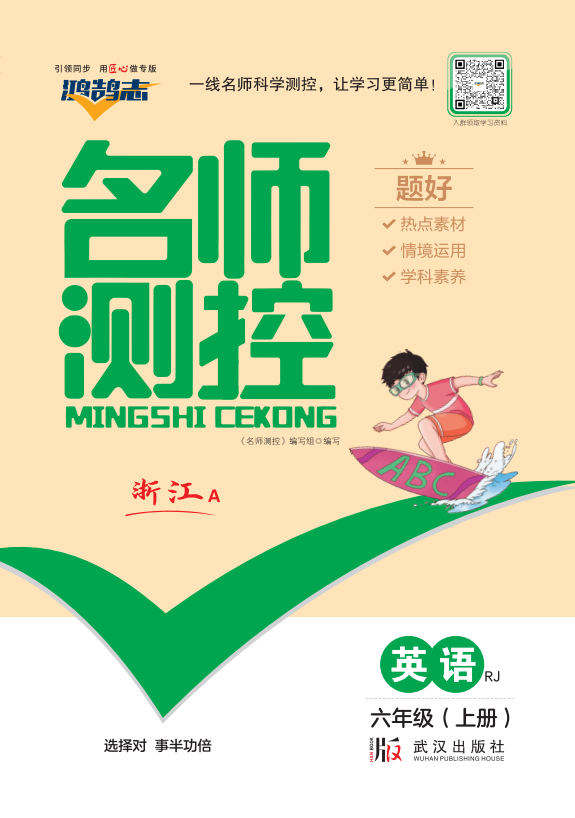
知识清单(pdf书稿)-【鸿鹄志·名师测控】2024-2025学年六年级上册英语(人教版 浙江专版)无答案及听力
2024-07-08
|
24页
|
429人阅读
|
18人下载
教辅

资源信息
| 学段 | 小学 |
|---|---|
| 学科 | 英语 |
| 教材版本 | 小学英语人教PEP版(2012)六年级上册 |
| 年级 | 六年级 |
| 章节 | - |
| 类型 | 学案-知识清单 |
| 知识点 | - |
| 使用场景 | 同步教学-新授课 |
| 学年 | 2024-2025 |
| 地区(省份) | 全国,浙江省 |
| 地区(市) | - |
| 地区(区县) | - |
| 文件格式 | |
| 文件大小 | 1.94 MB |
| 发布时间 | 2024-07-08 |
| 更新时间 | 2024-07-08 |
| 作者 | 湖北时代卓锦文化传媒有限公司 |
| 品牌系列 | - |
| 审核时间 | 2024-07-08 |
| 下载链接 | https://m.zxxk.com/soft/46213472.html |
| 价格 | 5.00储值(1储值=1元) |
| 来源 | 学科网 |
内容正文:
Unit 1 How can I get there?
Part A
【目》和识目标
一、词汇预览
四会词:science科学
museum博物馆
post office邮局
bookstore书店
cinema电影院
hospital医院
三会词:ask问
sir(对男子的礼貌称呼)先生
二、重点句型
1.-Where is the museum shop?-It's near the door.
2.I want to buy a postcard.
3.What a great museum!
【○》课文翻译
Let's talk(教材第4页)
Wu Binbin:Robin,where is the museum shop?:吴斌斌:罗宾,博物馆的商店在哪儿?
I want to buy a postcard.
我想买一张明信片。
Robin:It's near the door.
罗宾:在大门附近
Wu Binbin:Thanks..Where is the post office?吴斌斌:谢谢。邮局在哪儿?我想今
I want to send it today.
天把它寄出去。
Robin:Idon't know.I'lask.Excuse me,罗宾:我不知道。我去问问。打扰了
sir.
(请问),先生。
Man:Wow!A talking robot!What a great男士:哇!一个会说话的机器人!多
museum!
么棒的博物馆啊!
Robin:Where is the post office?
罗宾:邮局在哪儿?
Man:It's next to the museum.
男土:它紧挨着博物馆。
Robin:Thanks.
罗宾:谢谢。
Let's learn(教材第5页)
Wu Binbin:Where is the cinema?
吴斌斌:电影院在哪儿?
Robin:It's next to the bookstore.
罗宾:(它)紧挨着书店。
1名师控英语六年级上册RJ
【目和识点找
1.询问某场所的位置
询问某场所的位置时常用疑问词where进行提问,where意为“在哪里”。句
型结构为“Where is+(the)+地点类词汇?”。答语为“It's+方位介词+地点类
词汇”。例如:
一Where is the museum shop??博物馆的商店在哪里?
一It's next to the door.在大门旁边。
常用的方位介词:near在…附近next to与…紧邻behind在…后面
in front of在…前面
2.what引导的感叹句
感叹句是用来表达说话者惊讶、喜悦、愤怒等情感的句子。课文中“What a great
museum!”'是一个感叹句,意为“多么棒的博物馆啊!”,表达说话者对这个博物馆的
赞美。句中的great,museum均可以用相同词性的词汇来替代。例如:
What a nice picture!多么好看的图画啊!
What interesting stories!多么有趣的故事啊!
Part B
目》和识目标
一、词汇预览
四会词:crossing十字路口
turn转弯
left左
straight笔直地
right右
三会词:interesting有趣的
Italian意大利的
restaurant餐馆
pizza比萨饼
street大街:街道
get到达
BDS北斗卫星导航系统
gave(give的过去式)提供;交给
feature特点
follow跟着
far远的
tell告诉
二、重点句型
1.What an interesting film!
2.It's next to the park on Dongfang Street.
3.-How can we get there?
-Turn left at the bookstore.Then turn right at the hospital.
2名师测控英语六年级上册J
○课文翻译
Let's talk(教材第6页)
Mike:What an interesting film!
迈克:多么有趣的一场电影啊!
Wu Binbin:yes,butI'm hungry now..I know吴斌斌:是的,但是我现在饿了。我知
a great Italian restaurant.
道一家很棒的意大利餐馆。
Mike:Yum!I like pizza!Where is the迈克:好吃(好啊)!我喜欢比萨饼!
restaurant?
(这家)餐馆在哪儿?
Wu Binbin:It's next to the park on Dong-
吴斌斌:它紧挨着东方大街上的公园。
fang Street.
Mike:How can we get there?
迈克:我们怎么到那儿?
Robin:Turn left at the bookstore.Then turn
罗宾:到书店左转。然后到医院右转。
right at the hospital.
Mike:OK.Let's go!
迈克:好的。我们出发吧!
Let's learn(教材第7页)
Mike:Where is the Italian restaurant?:迈克:意大利餐馆在哪儿?(在)这里右
Turn right here?
转吗?
Robin:No,turn left.
罗宾:不,(在这里)左转。
(目》和识点拨
问路及指路
L.询问如何到达某地时常用疑问词how进行提问,句型结构为“How can+主语+get
(to)+地点类词汇?”。问句中get to意为“到达”,如果到达的地点类词汇是there,
here和home,则省略to。例如:
How can I get there?我怎么到那儿?
2.为别人指路时常用到下列句型:
(l)“Turn left,/right at the+地点类词汇.”在…左转/右转。
(2)“Go straight(along…).”(沿着…)直走。
(3)“地点类词汇+is on your left/.right.”…在你的左手边/右手边。
①在某个地,点转弯常用介词at。
②在某条大街上常用介词on。
3名师测测控英语六年级上册J
Unit 2 Ways to go to school
Part A
目和识目标
一、词汇预览
四会词:on foot步行
by(表示方式)乘
bus公共汽车
plane飞机
taxi出租汽车
ship(大)船
subway地铁
train火车
三会词:Mrs夫人
early早到的
二、重点句型
-How do you come to school?
-Usually,I come on foot.Sometimes I come by bus.
○》课文翻译
Let's talk(教材第14页)
Mike:Good morning.Mrs Smith!
迈克:早上好,史密斯老师!
Mrs Smith:Hi,children.you're early.How史密斯老师:你们好,孩子们。你们真
do you come to school?
早。你们怎么来学校的?
Amy:Usually,I come on foot.Sometimes埃米:通常我走路来。有时候我乘公
I come by bus.
共汽车来。
Mike:I often come by bike.
迈克:我经常骑自行车来
Amy:How do you come to school,,Mrs埃米:史密斯老师,您怎么来学校的?
Smith?By car?
开车吗?
史密斯老师:有时候会(开车),但我通
Mrs Smith:Sometimes,but I usually walk.
常走路(来)。
Mike:That's good exercise.
迈克:那是很好的锻炼。
Let's learn(教材第l5页)
Mrs Smith:Let's go to the nature park.
史密斯老师:我们去自然公园吧。
John:Hooray!
约翰:好极了」
Sarah:How do we get there?
萨拉:我们怎么到那儿?
4。名师狈控英语六年级上册RJ
Mrs Smith:By bus
史密斯老师:乘公共汽车。
目》知识点拨
1.询问某人的出行方式
询间某人的出行方式时常用疑问词how进行提问,句型结构为“How do./
does+主语+come/go/get(to)+地点类词汇?”。答语为“主语+come/go/get
(to)+地点类词汇+by+交通工具”,也可以直接用“By+交通工具”来回答。需
要注意的是交通工具前不加冠词。例如:
一How do you go to school?:你怎么去学校?
一I often go to school by subway.我经常乘地铁去学校。
2.频度副词
课文中出现的usuaIly,sometimes,often是频度副词,频度副词常用来描述动
作在某个时间段内发生的频率。常见的频度副词还有always,never等。
频度副词
always
usually
often
sometimes
never
词义
总是,一直
通常
时常
有时
从不,决不
频率百分比
100%
≈80%
≈60%
≈30%
0
Part B
自》和识目标
一、词汇预览
四会词:slow(使)放慢速度:慢的
down减少:降低slow down慢下来
stop停下
三会词:helmet头盔
sled雪橇
must必须
wear戴
attention注意
fast快
pay attention to注意
traffic交通
traffic lights交通信号灯
Papa Westray帕帕韦斯特雷岛
Wunich慕尼黑(德国城市)
Germany德国
ferry轮渡
Alaska阿拉斯加州(美国州名)
Scotland苏格兰
二、重点句型
1.-How can I get to the Fuxing Hospital?-Take the No.57 bus over there.
2.In the USA people on bikes must wear one.3.Don't go at the red light!
4.I must pay attention to the traffic lights!
5名师狈测控英语六年级上册RJ
○》课文翻译
Let's talk(教材第16页】
Wu Binbin:Mr Jones,how can I get to the吴斌斌:琼斯先生,我怎样能到复兴
Fuxing Hospital?
医院?
Mr Jones:Take the No.57 bus over there.琼斯先生:在那里坐57路公共汽车。
Wu Binbin:Thanks..Wow!So many pictures吴斌斌:谢谢。哇!这么多自行车的
of bikes!
图片啊!
Mr Jones::They're from my cousin in the USA.琼斯先生:它们来自我在美国的表弟。
Wu Binbin:What's this?
吴斌斌:这是什么?
Mr Jones::A helmet..In the USA people on琼斯先生:头盔。在美国骑自行车的
bikes must wear one.
人必须戴(头盔)。
Wu Binbin:Isee.Oh,the bus is coming!吴斌斌:我明白了。哦,公共汽车来
Bye,Mr Jones.
了!再见,琼斯先生。
Mr Jones:Hey,don't go at the red light!
琼斯先生:嘿,别闯红灯!
Wu Binbin:Oh,right!Thanks..I must pay吴斌斌:哦,是的!谢谢。我必须注
attention to the traffic lights!
意交通信号灯!
Let's learn(教材第17页)
Slow down and stop at a yellow light.
黄灯时,减速并停下来。
Stop and wait at a red light.
红灯时,停下来并等待。
Go at a green light.
绿灯行。
Mike:Look!The park is over there!Let'sgol迈克:看!公园就在那边!我们过去吧!
Mrs Smith:Please wait!It's red now.We史密斯老师:请等一下!现在是红灯。
must stop and wait.
我们必须停下来并等待。
〔目知识点拔
1.用must表示必须做某事
must是情态动词,意为“必须”,语气强烈。情态动词没有人称和数的变化,后
面接动词(短语)原形。例如:
I must pay attention to the traffic lights.我必须注意交通信号灯。
2.用“Don't.”劝诫某人不要做某事
课文中“Hey,don't go at the red light!(嘿,别闯红灯!)"是一个表示否定含
6名师测控英语六年级上册J
义的祈使句,don'十后接动词(短语)原形,用于劝诫某人不要做某事。例如:
Don't eat in class..不要在课堂上吃东西。
3.用句型“动词(短语)原形+其他”表示建议、命令别人做某事
课文中“Slow down and stop at a yellow light..(黄灯时,减速并停下来a)”是
一个表示肯定含义的祈使句。一般省略主语,以动词(短语)原形开头,用于表示建
议、命令某人做某事。例如:
Go at a green light..绿灯行。
Look left first when you cross the road.过马路时要先看左边。
Unit 3 My weekend plan
Part A
目》和识目标
一、词汇预览
四会词:visi计拜访
film电影
see a film看电影
trip旅行
take a trip去旅行
supermarket超市
evening晚上;傍晚
tonight在今晚
tomorrow明天
next week下周
三会词:lesson课
二、重点句型
1.-What are you going to do tomorrow?-I'm going to have an art lesson.
2.We're going to draw some pictures in Renmin Park.
○》课文翻译
Let's talk(教材第24页)
Mike:What are you going to do tomorrow?迈克:你明天打算做什么?
Sarah:I'm going to have an art lesson.
萨拉:我要上美术课。
Wike:What are you going to do in your lesson?迈克:你们打算在课上做什么?
Sarah:We're going to draw some pictures
萨拉:我们要到人民公园去画画。
in Renmin Park.
7名师预测侧控英语六年级上册RJ
Mike:Sounds great!I'm going to see a迈克:听起来很不错!我明天打算去
film tomorrow.
看电影。
Sarah:Have a good time!
萨拉:玩得开心!
Mike:You too.I have to do my homework迈克:你也一样。我现在得去做作业
now.Bye.
了。再见。
Sarah:OK.Bye.
萨拉:好的。再见。
Let's learn(教材第25页)
Sarah:What are you going to do today?
萨拉:你今天打算做什么?
Chen Jie:I'm going to see a film.
陈杰:我要去看电影。
目和识点拨
1.询问某人打算做什么
问句“What are you going to do tomorrow?”常用于询间对方明天计划、打算
做什么。tomorrow意为“明天”,表示将来的时间,可以用其他表示将来时间的词
汇代替,如tonight(在今晚),this morning/afternoon/evening(今天早上/下午/
晚上),next week(下周)等。例如:
一What are you going to do tonight?:你今晚打算做什么?
一I'm going to do my homework.我要做我的家庭作业。
2.描述某人打算做某事
描述某人打算做某事,句型结构为“主语+be动词+going to+动词(短语)原
形.”。be动词随主语人称和数的变化而变化。例如:
Mike is going to see a film tomorrow.迈克明天要去看电影。
主语与be动词的搭配口诀:我用am,你用are,is连着他她它。所有的复数都是are。
3.have to和must的用法区别
have to意为“不得不;必须”,后接动词(短语)原形,表示迫于某种客观条件不
得不做某事。ust意为“必须”,表示说话人主观上的看法,即说话人的主观需要。
例如:
I have to do my homework now.我现在得去做作业了。
I must pay attention to the traffic lights.我必须注意交通信号灯。
8名师测控英语六年级上册J
Part B
自和识目标
一、词汇预览
四会词:dictionary词典
comic滑稽的
comic book(儿童的)连环画册
word单词
word book单词书
postcard明信片
三会词:space太空
travel(尤指长途)旅行half一半
price价格
together一起
get together聚会
mooncake月饼
poem诗
moon月亮
Mid-Autumn Festival中秋节
二、重点句型
1.-Where are you going?
-We're going to the cinema.
2.-When are you going?
-Next Wednesday.
○》课文翻译
Let's talk(教材第26页)
John:My cousin Jack is going to visit me
约翰:我堂兄杰克下周要来看我。
next week.
Amy:That's nice.Where are you going?
埃米:那很好啊。你们打算去哪儿?
John:We're going to the cinema..We're约翰:我们打算去电影院。我们打算去
going to see a film about space travel!
看一部关于太空旅行的电影!
Amy:Cool!I have lots of comic books埃米:酷!我有很多关于太空的连环
about space.When are you going?
画册。你们打算什么时候去?
John:Next Wednesday.
约翰:下个星期三
Amy:Why not go on Tuesday??It's half埃米:为什么不(下个)星期二去呢?那
price then!
天半价!
John:Really?Thank you!
约翰:真的吗?谢谢你!
Let's learn(教材第27页)
Jack:Where are we going?
杰克:我们要去哪儿?
John:To the bookstore.I'm going to buy a约翰:去书店。我打算买一本新连环
new comic book.
画册。
9名师观测控英语六年级上册RJ
目和识点拨
1.询问某人打算去哪里
询问某人打算去哪里时常用疑问词where进行提问,句型结构为“Where+be
动词+主语+going(+表示将来时间的词汇)?”,答语为“主语+be动词+going
to+地点类词汇”。例如:
一Where are you going?你打算去哪里?
一I'm going to the cinema.我打算去电影院。
2.询问对方打算什么时候做某事/去某地
询问对方打算什么时候做某事/去某地时常用疑问词wen进行提问,句型结构
为“When+be动词+主语+going to+动词(短语)原形/地点类词汇?”,答语为“表
示将来时间的词汇”。例如:
一When are you going to the park??你打算什么时候去公园?一Tomorrow.明天。
3.用Why not句型提建议
课文中“Why not go on Tuesday??”,Why not意为“为什么不…呢?”,not后
接动词(短语)原形,常用于询问原因或用反问的语气提出建议。例如:
一Why not go to the cinema??为什么不去电影院呢?一Good idea!好主意!
Unit 4 I have a pen pal
Part A
目和识目标
一、词汇预览
三会词:pen pal笔友
hobby业余爱好
jasmine莱莉
idea想法;主意
二、重点句型
What are Peter's hobbies?
-He likes reading stories
了○》课文翻译
Let's talk(教材第38页)
Oliver:What are Peter's hobbies?
奥利弗:彼得有什么爱好?
Zhang Peng:He likes reading stories.He lives
张鹏:他喜欢读故事。他住在农场
on a farm,so sometimes he
上,所以有时候他读给奶牛听!
reads to the cows!
Oliver:That's interesting.
奥利弗:那可真有趣。
Zhang Peng:He likes doing kung fu and
张鹏:他喜欢练武术和游泳。
swimming.
10名师观测控英语六年级上册RJ
资源预览图

1

2

3

4
相关资源
示范课
由于学科网是一个信息分享及获取的平台,不确保部分用户上传资料的 来源及知识产权归属。如您发现相关资料侵犯您的合法权益,请联系学科网,我们核实后将及时进行处理。