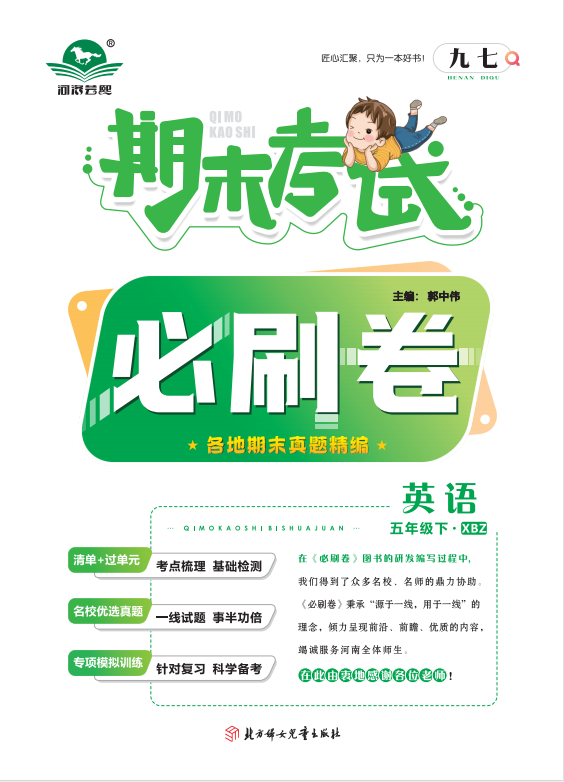
必备知识清单&过关训练-2023-2024学年五年级英语下册期末考试必刷卷(外研版) 洛阳九县七区专版
2024-06-21
|
2份
|
17页
|
162人阅读
|
0人下载

资源信息
| 学段 | 小学 |
|---|---|
| 学科 | 英语 |
| 教材版本 | 小学英语外研版(三起)(2012)五年级下册 |
| 年级 | 五年级 |
| 章节 | - |
| 类型 | 题集-综合训练 |
| 知识点 | - |
| 使用场景 | 同步教学-期末 |
| 学年 | 2024-2025 |
| 地区(省份) | 河南省 |
| 地区(市) | 洛阳市 |
| 地区(区县) | - |
| 文件格式 | ZIP |
| 文件大小 | 2.86 MB |
| 发布时间 | 2024-06-21 |
| 更新时间 | 2024-06-21 |
| 作者 | 洛阳芸熙文化传媒有限公司 |
| 品牌系列 | 期末考试必刷卷·小学期末 |
| 审核时间 | 2024-06-21 |
| 下载链接 | https://m.zxxk.com/soft/45886532.html |
| 价格 | 6.00储值(1储值=1元) |
| 来源 | 学科网 |
内容正文:
必备知识清单
和据艺熙
Module 1
☆重点词汇
I黑体词
night夜晚,夜间
wok工作;劳动;干活儿
or(用于否定句中)也不,也没
write写
川其他词
stil还,仍然
programme(电视或广播)节目
lady女士,夫人
life生活
different不同的
ag0以前
interviewer采访者
enough足够的
television电视机
grandchildren(grandchild的复数形式)(外)孙子;(外)孙女
change改变,变化
field田地
fire火,炉火
radio收音机
telephone电话
hope希望
couldn't=could not不能
☆重点句子
1.We lived in a small house.There weren't many buses.
我们住在一个小房子里。没有很多公共汽车。
2.She didn't have a television or a radio.她没有电视机,也没有收音机。
☆核心句型
L.“描述某人居住在某地”用句型“主语+ive(s)/lived in+地点.”来表达。
2.“描述以前没有某物”用句型“There wasn'/weren'L..”来表达。
3.“描述现在有某物”用句型“There is/are.”来表达。(注意:there be句型与have的区
别在于there be句型表示某个地方存在某人或某物,而have表示主语“拥有”某物。)
4.“描述某人以前没有某物”用句型“主语+didn't have..”来表达。
Module 2
☆重点词汇
儿黑体词
wrote(write的过去式)写
studied(study的过去式)学习
川其他词
learnt((leam的过去式)学习
taught(teach的过去式)教,讲授
language语言
dancer舞蹈演员
foreign外国的
hard努力地
外研版·五年级·英语·下册·第1页
☆重点句子
1.She was a dancer.She danced in lots of Chinese cities.
她(曾经)是一位舞蹈演员。她在中国的许多城市跳过舞。
2.一Did she learn any foreign languages??她学习过外语吗?
一Yes,she learnt English.是的,她学习过英语。
3.Twenty years ago,Mr Li was a teacher.He taught Chinese.
二十年前,李先生是一位老师。他教语文。
食核心句型
“描述某人做过某事”用句型“主语+动词过去式(+其他).”来表达。(注意:在一般过
去时的肯定句中,无论主语是第几人称、是单数还是复数,谓语动词都用过去式。)
Module 3
☆重点词汇
Ⅻ黑体词
English英国(式)的
breakfast早餐,早饭lunch午餐,午饭
gave(give的过去式)给
川其他词
hamburger汉堡包
sandwich三明治
fish and chips炸鱼加炸薯条
traditional传统的
dish食品;菜肴
tonight今夜,今晚
very much很,非常
☆重点句子
L.一What did she have for breakfast?她早餐吃了什么?
一She had eggs and sausages.她吃了鸡蛋和香肠。
2.Today Sam ate four hamburgers at school!今天萨姆在学校吃了四个汉堡包!
食核心句型
“询问某人三餐吃了什么”用句型“What did+主语+have for+三餐名称?”来表达,并能
用“主语+had+食物.”作出相应的回答。
Module 4
☆重点词汇
川黑体词
library图书馆
idea主意,想法
put放,安放
heavy重的,沉的
card卡片
ask邀请
wrong错误的
dear哎呀
外研版·五年级·英语·下册·第2页
ilm电影
way方法,方式
on关于
川其他词
student学生
sent(send的过去式)发送,寄
CD激光唱片,光盘
shelf架子
dictionary词典;字典
information信息
e-book电子书
project项目
guide介绍,指南,手册
topic话题
library card图书卡,借书证
as well又,还,也
食重点句子
l.Let's make a home library.让我们设立一个家庭图书馆。
2.These are all books about science.这些是关于科学的书。
3.We can find information from books and CDs.我们能从书和光盘中找到信息。
食核心句型
1.“提建议时”用句型“Let’s..”来表达。
2.“介绍某些物品的类别”用句型“These are+物品(复数)+about+类别.”来表达。
3.“描述某人能从某处找到信息”用句型“主语+can find information from+其他.”来表达。
Module 5
☆重点词汇
黑体词
light轻的
umbrella雨伞
easy容易的,不费力的
take选择要:选择购买
to0太,过于
ty试,尝试
川其他词
hard困难的,费力的
broken坏的,破的
department store百货商店
pocket口袋,兜
sales assistant售货员,营业员
wheel轮子
lovely美丽的,可爱的:令人偷快的
食重点句子
l.Look at this blue one.I's big and light.看这个蓝色的包。它又大又轻。
2.t'‖I be easy for you to carry.你将会很容易携带它。
食核心句型
1.“描述某物特征”用句型“’s.”来表达。
2.“描述某物对某人来说太怎么样”用句型“某物+be动词+too+形容词+for+某人.”
来表达。
外研版·五年级·英语·下册·第3页
Module 6
☆重点词汇
黑体词
et到达
parent母亲;父亲;家长
其他词
west西,西部,西方;向西方
stay停留
Jly七月
souh南,南部,南方;向南方
remember记得
June六月
east东,东部,东方;向东方
best最好的
noth北,北部,北方;向北方
have a rest休息一下
rest休息
rode(ride的过去式)骑
食重点句子
1.This is Xinjiang.It's in the west of China.I went there last year.
这是新疆。它在中国的西部。去年我去了那里。
2.Did you go with your parents?你是和你父母一起去的吗?
3.She visited the Tianchi Lake.她游览了天池。
食核心句型
1.“描述自己过去去过某地”用句型“I went(to)+某地+过去时间.”来表达。
2.“询问对方是否和某人一起去的”用句型“Did you go with.?”来表达,并能用“Yes,I
did./No,I didn't."作出相应的回答。
Module 7
☆重点词汇
黑体词
evening傍晚,晚上
late近日暮的;近深夜的:时间不早的
worker工人
early早的
taxi出租车,计程车
o(距整,点)差…
worTy焦虑,担心
其他词
factory制造厂;工厂
quarter一刻钟
食重点句子
1.My father goes to work at eight o'clock every morning.He's a policeman.
我爸爸每天早上八点钟去上班。他是一名警察。
2.t's a quarter to eight now.现在差一刻钟到八点了。
3.一What time will you be home?你将在什么时候到家?
一I'll be home at seven o'clock.我将在七点钟到家。
外研版·五年级·英语·下册·第4页
食核心句型
L.“描述某人去上班的时间”用句型“主语+go(es)to work at+时间点(+其他).”来表达。
2.“表达自己何时将会到家”用句型“I'Ⅱbe home at+时间点(+其他).”来表达。
Module 8
☆重点词汇
黑体词
Chinese中国人的
word词,字drew(draw的过去式)画put(put的过去式)放,安放
儿其他词
paper纸
s0如此,这样
cut(cut的过去式)剪,切,割
piece张,片,块
paint(用颜料)绘画,着色
stick小木棍,小木条
ied(tie的过去式)扎上,系上
string线,绳子
食重点句子
1.'m going to visit my cousin in New York.我将要拜访我在纽约的表哥。
2.What present can I take?我能带什么礼物?
3.What about a toy panda?一个玩具熊猫怎么样?
4.I'll make a kite!我将做一只风筝!
5.一Will you help me?你会帮助我吗?
一Of course I will..我当然会。
6.I made a kite for my sister.我为我妹妹做了一只风筝。
食核心句型
1.“表达自己将要做某事”用句型“I'1.”来表达。
2.“询问对方是否将要做某事”用句型“Wyou..?”来表达。
Module 9
☆重点词汇
Ⅻ黑体词
told(tell的过去式)口述,讲(故事等)
women(woman的复数形式)女性,妇女
wore(wear的过去式)穿
after在…后
read(read的过去式)读
im在(将来一段时间)之后
ask问,询问
bring带来,拿来
I其他词
laugh笑
letter信,书信
theatre剧院
actor演员
joke笑话
show(尤指剧院的)演出,表演
restaurant饭店,餐馆
外研版·五年级·英语·下册·第5页
ready准备好的
borrow借人,借来
another另一个
history历史
question问题
forget忘,忘记
s0on不久,很快
at all一点都
☆重点句子
1.The actors told lots of jokes.演员们讲了很多笑话。
2.We laughed a lot..我们开怀大笑。
3.Mum bought new T-shirts for you.妈妈为你买了新T恤衫。
4.Don't forget to bring some CDs of Chinese songs..不要忘记带一些中国歌曲的光盘。
食核心句型
1.“描述过去发生的事情”用句型“主语+动词过去式+其他.”。
2.“描述为某人买了某物”用句型“主语+bought+某物+for+某人.”来表达。
Module 10
☆重点词汇
川黑体词
when在什么时候
speak说,讲
川其他词
end结束,终止
nervous紧张的,情绪不安的
airport机场
ticket票
passport护照
safe安全的,平安的
pet宠物
building建筑物
American美国的:美国人的;美国人
more更多的(量),较多的(量)
all right没事,没问题
find out发现,弄清
☆重点句子
L.一Where are you going?你将要去哪里?
一I'm going to the airport.我将要去机场。
2.一What are you going to take?你将要带什么?
一Clothes,shoes,presents,the ticket and my passport.衣服,鞋、礼物、(机)票和我的护照。
3.一When are you going to the airport?你将要在什么时候去机场?
一At seven o'clock tomorrow morning.明天早上七点钟。
4.Who's going to the airport with you?谁将要和你一起去机场?
食核心句型
1.“询问对方将要去哪里”用句型“Where are you going(+其他)?”来表达。
2.“询问对方将要带什么”用句型“What are you going to take?”来表达。
3.“询问对方将要在什么时候去某地”用句型“When are you going(to).?”来表达o
4.“询问对方将要和谁一起去某地”用句型“Who is going(to)…with you?”来表达。
外研版·五年级·英语·下册·第6页
多Module1过关训练
一、选出每组单词中不同类的一项。
(
)1.A.different
B.enough
C.life
(
)2.A.field
B.fire
C.write
)3.A.radio
B.work
C.telephone
(
)4.A.interviewer
B.change
C.lady
(
)5.A.hope
B.programme
C.night
二、选择正确的答案,将其序号填入题前括号内。
(
)1.There
any apples on the table yesterday.
A.weren't
B.were
C.aren't
)2.We didn't have a car
a bike.
A.and
B.or
C./
)3.Thank you for
to us.
A.talk
B.talking
C.talked
三、给下列句子选择相符的图片。
)1.She didn't have a television many years ago.
)2.There is only one radio on the table
(
)3.I was in the supermarket yesterday afternoon.
)4.My little brother couldn't write.
四、看图,完成句子。(每空最多写三个单词)
1.There
many buses or cars
Now there
lots of
twenty years ago
now
2.We
in a small
ten years ago.
Now we
a big
ten years ago
now
外研版·五年级·英语·下册·第7页
多Module2过关训练
一、判断每组单词画线部分的读音是(T)否(F)相同。
(
)1.play
wait
)2.walk
ball
(
)3.autumn
warm
(
)4.party
quarter
(
)5.draw
saw
(
)6.class
pass
(
)7.hair
hard
(
)8.chair
rain
二、用所给单词的适当形式填空。
1.Last year Mr Li
(write)a novel(小说).
2.Jim liked
work)at school.
3.Did she learn any foreign
language)?
4.Amy was a
dance)three years ago.
5.My grandpa learnt
cook)yesterday.
三、判断下列句子或对话与图片是(T)否(F)相符。
25t65-
)1.She danced in lots of Chinese cities.
)2.-Did he watch TV yesterday?
-No,he didn't.
)3.My father is learning English now.
)4.Li Wei taught Maths ten years ago.
)5.-Did you go to the zoo last Sunday?
-Yes,I did.
四、选词填空,补全短文。
studied
was walked student
teaching
Ten years ago,Ms Zhang 1.
a girl.She 2.
at Shiyan
Primary School.She 3
to school every day.She was a good 4
Now she is an English teacher.She is 5.
in Shiyan Primary School.
外研版·五年级·英语·下册·第8页
多Module3过关训练
一、根据句意及汉语提示写单词,完成句子。
1.He has a
(三明治)and a cola this evening.
2.My grandparents like traditional
(英国的)food.
3.She ate rice and fish for
(午餐)yesterday.
4.Lisa
(Sam a big birthday cake last Sunday.
5.It's too late.I have no time for
(早餐)·
二、读一读,选择合适的单词补全句子。
1.Dumplings are traditional
Chinese/English)food.
2.Sam ate three
eggs/egg)yesterday.
3.I
give/gave)one banana to my little brother last Sunday.
4.Here is
(a/an)email for Dongdong.
5.My sister has got a letter
from/for)her best friend.
三、看图,仿照例子写句子。
例:
Jim,breakfast)
Lingling,lunch)
Mike,dinner)
例:Jim had eggs and sausages for breakfast.
1.
2.
四、将下列句子重新排序,组成一段完整、通顺的对话。
)He had dumplings.
()Yes,he does.He says it's delicious.
)Does he like Chinese food?
()Yesterday he had a Chinese lunch.
4 )What did he have?
)I have got an email from Steven.It's about Chinese food.
)What does it say?
外研版·五年级·英语·下册·第9页
多Module4过关训练
一、选出每组单词中画线部分读音不同的一项。
(
)1.A.teacher
B.head
C.bread
)2.A.bear
B.pear
C.near
)3.A.fire
B.light
C.tonight
)4.A.their
B.where
C.dear
)5.A.skirt
B.pie
C.girl
二、根据图片及首字母提示写单词,补全句子。
3
Happy birt山hday
1.The box is h
Can you help me?
2.We can read books in the school I
3.I want to make a birthday c
for my mum.
4.They saw a f
at the cinema yesterday.
5.Let's p
these books on this shelf.
三、用所给单词的适当形式填空。
1.There are lots of
dictionary)in the bookshop.
2.Daming
(send)a postcard to me yesterday.
3.We can ask our friends
play)together.
4.Where can she
(find)the book about animals?
5.People have many different
way)to find information.
四、给下列句子选择正确的答语。
()1.Let's make a home library.
A.It's about science.
)2.What are these big books?
B.You can find it in the library.
(
)3.Where are the books about sports?
C.That's a good idea.
)4.What's the book about?
D.They're dictionaries.
(
)5.Where can I find the information?
E.They're on Shelf C.
外研版·五年级·英语·下册·第10页芸熙文化·期末考试必刷卷
答案解析
四、【示例】1.I'm going to the airport
Module 1 过关训练
2. I'm going to take the passport.
一、1.C 2.C 3.B 4.B 5.A
3. I'm going to the park at eleven o'clock.
3.B
4. My father.
二、1.A
三、1.C
4.A
语音、词汇与句子专项归类复习卷
一、1.A
四.1. weren't: twenty vears ago: are:buses and car
【解析】画线部分在单词star和party中的
2. lived:house: live in: house
发音为/av/,在单词warm中的发音为/5:/。
Module 2
2.B 3.C
过关训练
4.C
一、1.T 2.T 3.T 4.F 5.T 6.T 7. F 8.F
【解析】画线部分在单词long和sing中的发
二、1. wrote 2. to work/working
3. languages
音为/n/,在单词English中的发音为/n9/
4. dancer 5. to cook
5.A
二、1.C
三、1.T 2.F 3.T 4.T 5.T
2.C3.A
4.B
【解析】July(七月)和June(六月)均表示月
四、1. was 2. studied 3. walked 4. student
5. teaching
份,Tuesday(星期二)表示星期,与它们不同类。
Module3 过关训练
5.A
2. English 3. lunch
4. gave
一、1. sandwich
三、1. taxi 2. library 3. drew 4. umbrella 5. film
5. breakfast
四、1.A 2.B 3.A 4.A 5.C
五1. to dance 2. ate 3. American 4. children's
三.1. Lingling had a hamburger and milk for lunch.
5. will have/ are going to have
六、1.D2.B
3 3.E 4.A
2. Mike had fish and chips for dinner.
5.C
七、1.C
2.E
3.A 4.B
四、5 76312
5.D
Module4 过关训练
补全对话专项归类复习卷
A.1.B
2.E
一、1.A 2.C 3.A 4.C 5.B
3.D 4.A 5.C
二1. heavy 2. library 3. card 4.film 5. put
B.1.E
2.A
3.C 4.B
5.D
C.1.E
2.C
4.D
3.A
三、1. dictionaries 2. sent 3. to play
4. find
5.B
2.A
D.1.C
3.D 4.E
5. ways
5.B
E.1.D
2.B.
四、1.C 2.D 3.E 4.A 5. B
3.E 4.A 5.C
Module5 过关训练
选词填空专项归类复习卷
5. too
一、1. light 2. umbrella 3. easy 4. Try
一.A. 1. for 2. cleaned 3. cook 4. likes 5. be
B. 1. made
二、1.C 2.B 3.C
2. painted 3. cut 4. put 5. fly
C. 1. early
2.C 3.D 4.A
二、1.B
2. breakfast 3. hamburgers
四、1. The hat is big for the boy.
4. had 5. read
2. The brown book is new.
二、A. 1. dinner 2. wore 3. gave 4. drew 5. wrote
The white book is old.
B. 1. by 2. interesting 3. animals 4. south
过关训练
Module 6
5. swimming
三、A. 1. went 2. parents 3. east 4. wore
一、1.B 2.A
3.C 4.C
5. jokes
6. for 7. about 8. worker 9. lovely
二、1.C
5.B
2.B
3.B
4.C
10.go
三、1.F 2.T 3.T 4.F 5.T
B. 1. five 2. parents 3. made 4. bought 5. works
5. stayed
四、1. July 2. parents 3. north 4. took
6. think 7. work 8. live 9. speaks 10. learning
Module 7 过关训练
阅读理解专项归类复习卷
一、1.T 2.T 3.F 4.F
一、A.1.T
二、1. early 2. worry
2.F
3. evening 4. late 5. worker
【解析】由短文中“The books about history
6. taxi
are inRoomA.”可知,有关历史的书在A房
三1.A 2.D 3.C 4. B
间,故本题表述错误
2.A.
3.E 4.C
5.D
四1B。
3.F 【解析】由短文中“The books about music
Module8 过关训练
are inRoomC.”可知,有关音乐的书可以在
一、1. will 2. think 3. English 4. sing
C房间找到,故本题表述错误。
5.words
4.T
三1.A 2.B 3.A
5.F 【解析】由短文中“You can take the books
四、C AF D E
hometoo.”可知,“我们”可以把书带回家,
Module 9
过关训练
故本题表述错误。
一、1. ask 2. After 3. wore 4. women 5. bring
B.1.F 【解析】由信的落款可知,这是Sam写的
二、1. n
2. read 3. put 4. about 5. to buy
信,且.信中“Last year I came to China...We
三、1.D 2.B 3.E 4.A 5.C
came fromNewYork.”表明,Sam来自纽约.
四、1. funny 2. wore 3. jokes 4. film
故本题描述错误
5. traditional
2.F 【解析】由信中“I met John inBeijing.”可
Module 10 过关训练
知,Sam在北京见到了John,故本题描述错误。
一、1.B 2.A 3.B 4.A 5. B
“.A
3.T 4.T 5.T
5. end
二、1.B
2.A
3.C
【解析】由表格内容可知,Xiaowei和妈妈都
5. arrived
在6:30吃早饭,故本题选C。
4
资源预览图

1

2

3

4
相关资源
由于学科网是一个信息分享及获取的平台,不确保部分用户上传资料的 来源及知识产权归属。如您发现相关资料侵犯您的合法权益,请联系学科网,我们核实后将及时进行处理。