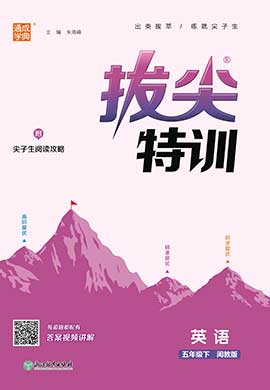
Unit 4 A Spring Outing重难点突破-【拔尖特训】2023-2024学年五年级下册英语(闽教版)
2024-04-24
|
2份
|
5页
|
246人阅读
|
5人下载
资源信息
| 学段 | 小学 |
|---|---|
| 学科 | 英语 |
| 教材版本 | 小学英语闽教版(2012)五年级下册 |
| 年级 | 五年级 |
| 章节 | Unit 4 A Spring Outing |
| 类型 | 作业-单元卷 |
| 知识点 | - |
| 使用场景 | 同步教学-单元练习 |
| 学年 | 2024-2025 |
| 地区(省份) | 全国 |
| 地区(市) | - |
| 地区(区县) | - |
| 文件格式 | ZIP |
| 文件大小 | 1.12 MB |
| 发布时间 | 2024-04-24 |
| 更新时间 | 2024-04-24 |
| 作者 | 江苏通典文化传媒集团有限公司 |
| 品牌系列 | 拔尖特训·尖子生学案 |
| 审核时间 | 2024-04-24 |
| 下载链接 | https://m.zxxk.com/soft/44683462.html |
| 价格 | 2.00储值(1储值=1元) |
| 来源 | 学科网 |
内容正文:
Unit
4
重难点突破
(1)
be
going
to句型
一、
be
going
to的概念
be
going
to是一般将来时的结构之一,表示将
要发生的动作或存在的状态及打算、计划或准备做
某事。句中一般有以下时间状语:
tomorrow、
next
day(week、
month、
year
...)、
soon、
tomorrow
morning等。
be
going
to后跟动词原形。如:
Im
going
to
visit
a
farm
tomorrow.
我明天打算参观农场。
二、
be
going
to的基本结构
be
going
to的肯定句结构为“主语+
be
going
to
+动词原形+其他.”,其中be动词随主语的变
化而变化。如:
Liu
Tao
is
going
to
wear
sports
shoes
tomorrow.
刘涛打算明天穿运动鞋。
We
are
going
to
pick
tomatoes
this
weekend.
我们这个周末打算摘西红柿。
三、
一般将来时的句型转换
1.
否定句:在be动词后加not即可。如:
I
am
going
to
take
some
tea
with
me
tomorrow.
→
I
am
not
going
to
take
any
tea
with
me
tomorrow.
Saly
is
going
to
see
animals
tomorrow.
→
Saly
isnt
going
to
see
animals
tomorrow.
2.
一般疑问句:将be动词提到句首并大写首字母,
some改为any,第一、第二人称互换,句点改为问
号即可。其肯定回答为“Yes,主语+
am/is/
are.”,否定回答为“No,主语+
am
not/isnt/
arent.”。如:
They
are
going
to
pick
some
oranges
next
week.
→
Are
they
going
to
pick
any
oranges
next
week? (改为一般疑问句)
Yes,
they
are./No,
they
arent.(肯定/否定
回答)
Im
going
to
visit
the
Summer
Palace
tomorrow.
→
Are
you
going
to
visit
the
Summer
Palace
tomorrow? (改为一般疑问句)
Yes,
I
am./No,
I
am
not.(肯定/否定回答)
3.
特殊疑问句:疑问词+一般疑问句? 如:
She
is
going
to
take
some
fruits
with
her.
→
What
is
she
going
to
take
with
her? (对some
fruits提问)
My
father
is
going
to
watch
a
footbal
match
with
me
this
afternoon.
→
What
is
your
father
going
to
do
with
you
this
afternoon? (对watch
a
footbal
match提问)
一、
用所给词的适当形式填空。
1.
We
(buy)
a
new
house
in
Fujian
next
year.
2.
Nancys
sister
(see)
her
grandfather
tomorrow.
3.
David
(fly)
kites
in
the
park
this
weekend.
4.
I
(make)
a
plan
for
资源预览图

1
相关资源
由于学科网是一个信息分享及获取的平台,不确保部分用户上传资料的 来源及知识产权归属。如您发现相关资料侵犯您的合法权益,请联系学科网,我们核实后将及时进行处理。