Module 3 Making plans-【导与练】2022-2023学年七年级下册初一英语同步练案(外研版)
2023-03-10
|
2份
|
10页
|
152人阅读
|
6人下载

资源信息
| 学段 | 初中 |
|---|---|
| 学科 | 英语 |
| 教材版本 | 初中英语外研版(2012)七年级下册 |
| 年级 | 七年级 |
| 章节 | Module 3 Making plans |
| 类型 | 作业-同步练 |
| 知识点 | 词汇 |
| 使用场景 | 同步教学 |
| 学年 | 2023-2024 |
| 地区(省份) | 全国 |
| 地区(市) | - |
| 地区(区县) | - |
| 文件格式 | ZIP |
| 文件大小 | 5.76 MB |
| 发布时间 | 2023-03-10 |
| 更新时间 | 2023-04-09 |
| 作者 | 山东瀚海文苑传媒有限公司 |
| 品牌系列 | 导与练·初中同步练案 |
| 审核时间 | 2023-03-10 |
| 下载链接 | https://m.zxxk.com/soft/37987340.html |
| 价格 | 4.00储值(1储值=1元) |
| 来源 | 学科网 |
内容正文:
Module 3
Making plans
Unit 1
What are you going to do at the weekend?
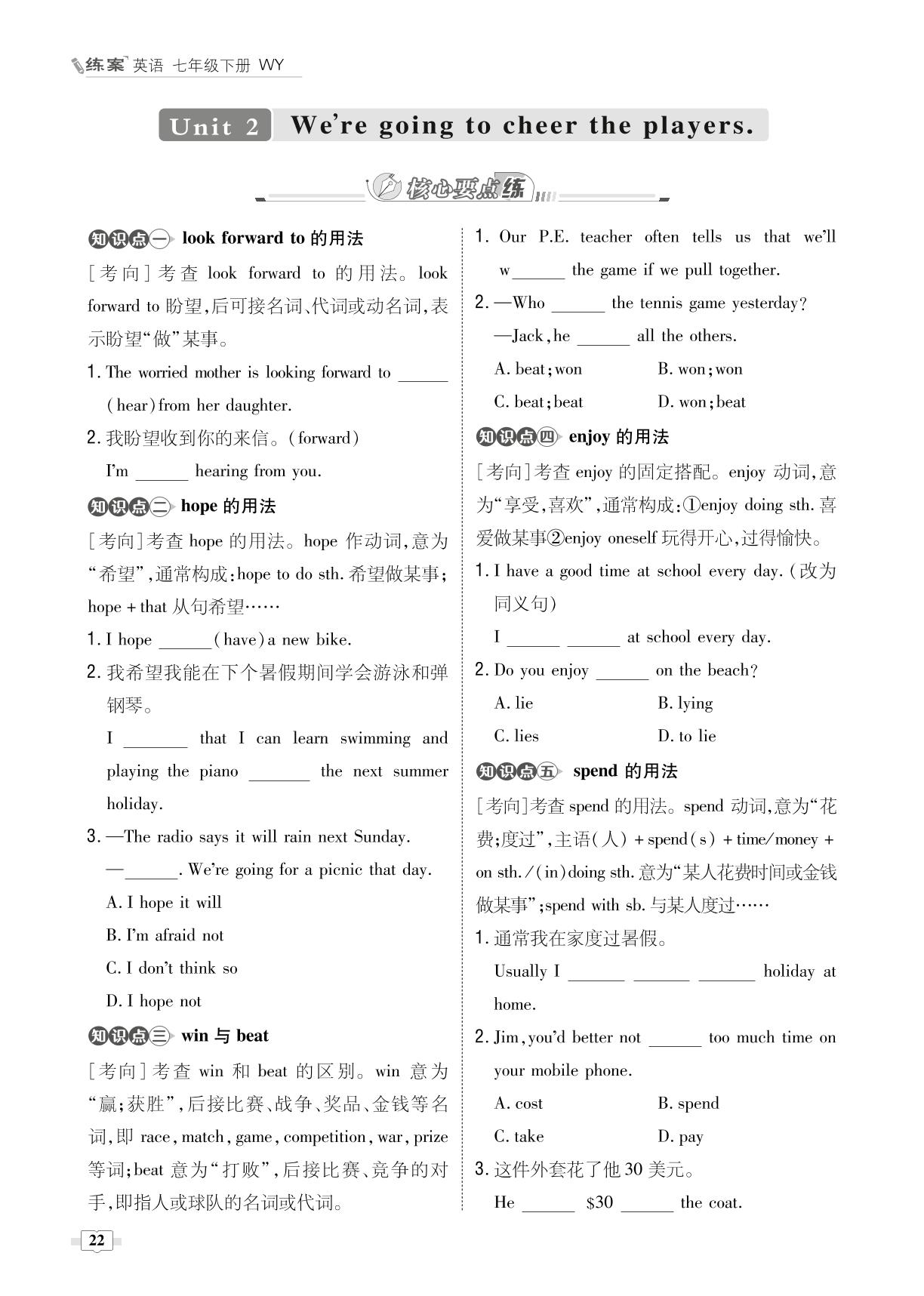
像心要点练
知识流○plan的用法
The children are
[考向]考查plan的两种词性和固定搭配:①plan
in the park.
to do sth.计划做某事②make a plan制订计划。
3.王先生经常晚饭后去散步。
1.你打算如何过周末?
Mr.Wang often
after
What's
for the weekend?
supper.
2.They plan
the old people next week.
知识点四else的用法
A.visit
B.visiting
[考向]考查else的用法。else作副词时,修饰
23-6335
C.to visit
D.visits
something,anyone等不定代词或what,who等疑
知识点已in/on表示“在…时候”的区别
问代词要放于被修饰词之后。
[考向]考查两者辨析。in泛指在上午、下午或
1.-What
do you want?
晚上,在某年、某月或某个季节;om用于具体某
-A new pen.
天(上午、下午、晚上)以及具体的日期、星期
A.other
B.else things
节日等的前面。
C.other thing
D.else
1.The Tianwen-1 Probe landed on Mars
2.Believe yourself.You're better than
May15th,2021.
You're the best.Wish you success.
A.at
B.in
C.to
D.on
A.anyone else
B.someone else
2.Karen and Lily went to Russia
July.
C.else anyone
D.else someone
A.on
B.in
C.at
D.of
知识点五alone与lonely
知识点自have/take+n.的用法
[考向]考查两词的区别。alone ad.单独地,孤
[考向]考查固定短语。have/Lake+a(n)+n.
单地;只能作表语:侧重于表示只有一个人的时
表示进行某种活动,如have a picnic野餐;talk
候,也不寂寞孤单;lonely ad.寂寞的,孤独的,偏
a walk散步。
远的;可用作定语,也可用作表语。侧重于表示
1.这个周六我们要去野餐。
由于没有别人或其他东西陪伴而感到寂寞孤
We are going to
this
单,通常用来指人;或指地方偏远、荒凉。
Saturday.
1.The old woman lives in the small village
2.孩子们在公园里正玩得高兴。
But she doesn't feel(感觉)
19
练案`英语七年级下册WY
A. alone;alone B. Alone;lonely _______!We'efriemds.
C.lonely;alone D. Lonely;lonely 2.—I want to fmish the work before five ocloek.
2.他一个人生活但他不感到孤独. ─_____You are too tired. And the work isn''
He lives— but he doesn't feelso important.
四D点六Don't be silly!别傻了! A.Come on! B.Dmtbe silly!
[考向]考查固定搭配用于交际用语. C.All right.D.God idea.
1.别傻了!我们是朋友.
I.根据汉语提示写单词 9.We'e going to have a football game. Would you
1.___(没有人)knowswhat happened in thelke to joinw)?
house. 10.My brother__(have) a test next month.
2.—What____(别的)dωyouwant to buy forⅢ.完成句子
your son? 11.今年你的暑假计划是什么?
一Some good books. ____are the__your summer
3.t''s fine today, Would you like to go for a holiday this year?
___(野餐)with Lucy and John? 12.杰克不想独自待在家里.
4.Helem is new
资源预览图

1

2

3
4
相关资源
由于学科网是一个信息分享及获取的平台,不确保部分用户上传资料的 来源及知识产权归属。如您发现相关资料侵犯您的合法权益,请联系学科网,我们核实后将及时进行处理。