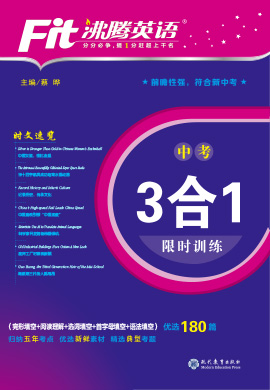
Group 12-【沸腾英语】2023年中考英语完形+阅读+短文(3合1)限时训练
2023-02-15
|
2份
|
10页
|
151人阅读
|
4人下载
内容正文:
能力提升
89
Group 12
完形填空与阅读理解第 节一
浏览文章:4′ 查读解答:5′ 反思感悟:1′ 实际用时: 限时:10 min
完形
填空 A
The word “plastic” comes from the Greek word “Platicos” and is used to describe something that
can be easily shaped.
The history of plastics is longer than you might 1 . In fact the first man-made plastic ever to
appear on the market was made over a hundred years ago. It was called “celluloid (赛璐珞)”. It was
discovered by 2 an Englishman and an American in the same year. 3 it was the Americans
who first produced it on a large scale (规模) during the year 1860. Everybody was 4 by this new
material which could be moulded (用模子做) into shapes and was so cheap to buy.
Poor young men working in cities with lots of smoke and dirt were 5 to buy white celluloid
collars (领子). The collars were hard and uncomfortable. But they did not have to be sent to wash.
The poor young men could rub them clean every evening with soap and water! Poor mothers, who had
not been able to afford playthings for their children, were now able to buy them playthings 6 of
celluloid.
But celluloid had one very serious fault. It caught fire very easily. In fact, it burned even more
quickly than wood or cloth. There were many terrible accidents, particularly 7 children. For years
scientists worked hard to find a better plastic material than celluloid. They had 8 success. Then in
1932 an American scientist called Baekeland produced a hard plastic material which did not burn. It
became known as bakelite (酚醛塑料). Other plastic materials like bakelite were also produced. They
were 9 to make electrical fittings (配件) and plates and cups. Poor people liked them because
they were both cheap and safe, but rich people disliked them because they were cheap, and they could
only be made 10 dark colours.
( ) 1. A. wish B. think C. want D. hope
( ) 2. A. both B. neither C. either D. between
( ) 3. A. So B. But C. And D. As
( ) 4. A. surprised B. excited C. told D. frightened
( )
资源预览图

1

2

3

4
相关资源
示范课
由于学科网是一个信息分享及获取的平台,不确保部分用户上传资料的 来源及知识产权归属。如您发现相关资料侵犯您的合法权益,请联系学科网,我们核实后将及时进行处理。