Unit 1 Art Reading and Thinking 课件-2022-2023学年高中英语人教版(2019)选择性必修第三册
2023-02-13
|
15页
|
3265人阅读
|
32人下载
普通
内容正文:
课前候背
1.two-dimensional/dɪ'menʃənəl/ works 二维作品
2.an important breakthrough一项重大突破
3.the invention of photography/fəˈtɒɡrəfi/照相术的发明
4.at sunrise /ˈsʌnraɪz/ 在日出时
5.the outer world 外部世界
6.convey the light and movement in the scene
传递场景中的光与运动
7.primitive/ˈprɪmətɪv/ man 原始人
8.emerge/iˈmɜːdʒ/ in France在法国出现
Unit1 ART
A SHORT HISTORY OF
WESTERN PAINTING
(西方绘画艺术简史)
Love of beauty is taste. The creation of beauty is art.
Lead-in
对美的喜爱是品味。对美的创造是艺术。
——沃尔多·爱默生
Q1.What is art?
Can you list some Chinese forms of art?
Ceramic 陶瓷
Paper cuts
Beijing Opera
Calligraphy
Fast reading
Read the title ,the first paragraph and the headings ,then answer the following questions.
Q1:What’s the passage mainly about?
Q2:Where can you find this passage?
Q3: What is western art?
Q4: What is the best way to understand it?
Q5:How did the Western painting develop?
The development of Western painting.
An art magzine.
It is hard to give a precise definition. There are many different styles of Western art.
Perhaps the best way to understand it is to look at the development of Western painting over the centuries.
Detail Reading:Read para. 2 and fill in the blanks.
The Middle Ages
(5th-15th C) Characteristics:
Representative artists:
Changes: religious themes; not realistic; primitive; 2-dimensional; larger;
13th C: more realistic; deep emotional impact
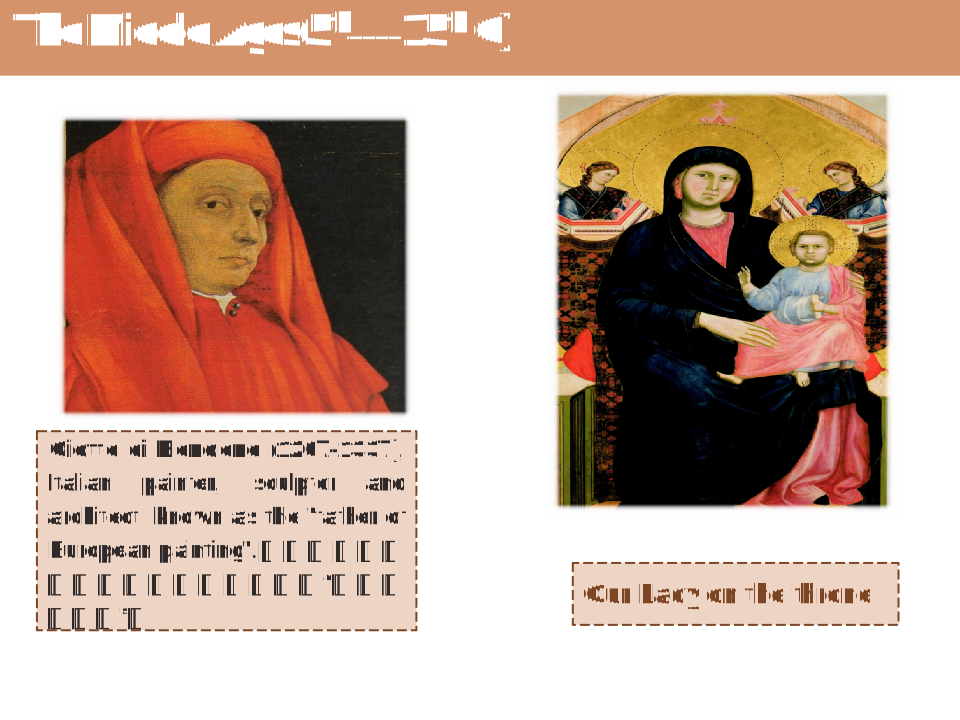
Giotto di Bondone乔托·迪·邦多纳
From religious themes to realistic human
[2]During the Middle Ages, the purpose of Western art was to teach people about Christianity基督教. Thus, artists were not interested in painting realistic scenes现实场景. Their works were often primitive原始的 and two-dimensional, and the main characters were often made much larger than everyone else to show their importance. This began to change in the 13th century with Giotto di Bondone (1267-1337). While his paintings still had religious宗教的 themes, they showed real people in a real environment. In part
资源预览图

1

2

3

4

5
6
相关资源
示范课
由于学科网是一个信息分享及获取的平台,不确保部分用户上传资料的 来源及知识产权归属。如您发现相关资料侵犯您的合法权益,请联系学科网,我们核实后将及时进行处理。